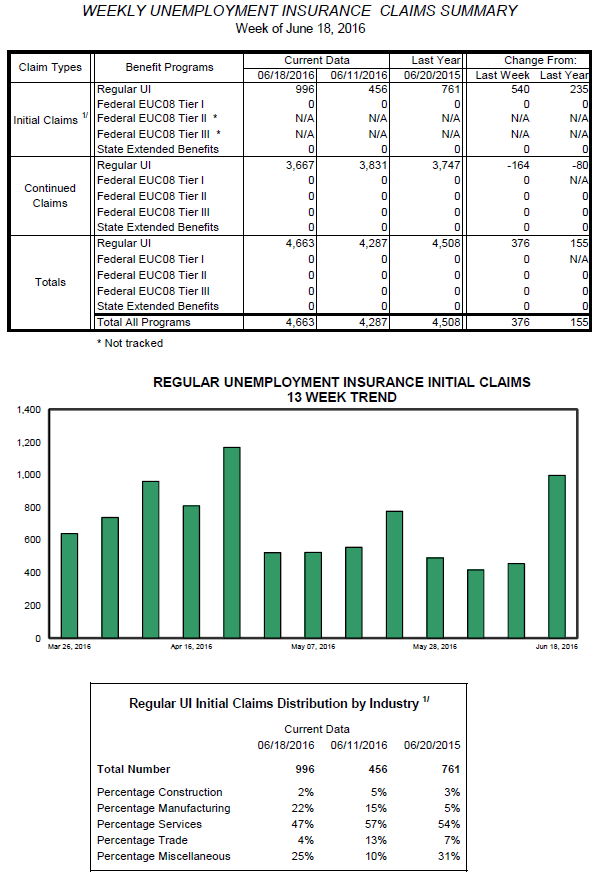
Vermont Business Magazine Weekly unemployment claims spiked last week, as they typically do in June after school ends and education employment falls. Following this spike there is usually a fall and then a leveling off at a relatively low level of under 500 claims for the duration of the summer. However, last week's increase is greater than usual. Spikes of this magnitude generally are seen after the Christmas layoffs and transitions between seasons. For the week of June 18, 2016, there were 996 claims, up 540 from the previous week's total and 235 more than they were a year ago. By industry, claims more than doubled in the Miscellaneous category.
 Altogether 4,663 new and continuing claims were filed, an increase of 376 from a week ago, and 155 more than a year ago.
The Department processed 0 First Tier claims for benefits under Emergency Unemployment Compensation, 2008 (EUC08).
The Unemployment Weekly Report can be found at: http://www.vtlmi.info/. Previously released Unemployment Weekly Reports and other UI reports can be found at: http://www.vtlmi.info/lmipub.htm#uc
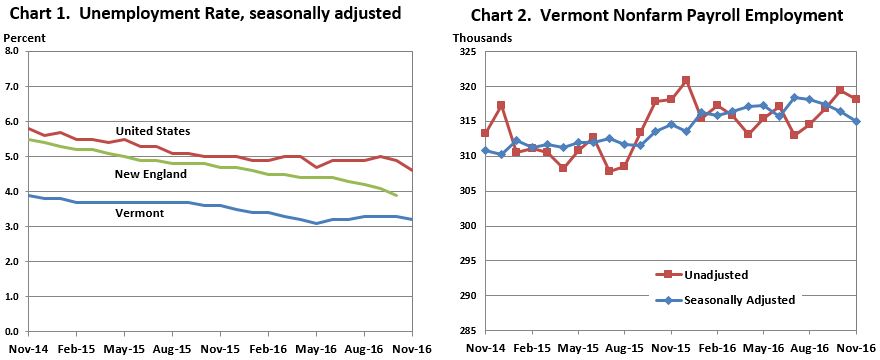
Vermont's unemployment rate fell one-tenth to 3.1 percent in May, as the labor force and total employment increased, along with a decrease in the number of unemployed. However, the overall jobs situation was not as strong as it was in April. SEE STORY.
NOTE: Employment (nonfarm payroll) - A count of all persons who worked full- or part-time or received pay from a nonagricultural employer for any part of the pay period which included the 12th of the month. Because this count comes from a survey of employers, persons who work for two different companies would be counted twice. Therefore, nonfarm payroll employment is really a count of the number of jobs, rather than the number of persons employed. Persons may receive pay from a job if they are temporarily absent due to illness, bad weather, vacation, or labor-management dispute. This count is based on where the jobs are located, regardless of where the workers reside, and is therefore sometimes referred to as employment "by place of work." Nonfarm payroll employment data are collected and compiled based on the Current Employment Statistics (CES) survey, conducted by the Vermont Department of Labor. This count was formerly referred to as nonagricultural wage and salary employment.