

Vermont Business Magazine Governor Peter Shumlin today signed into law the state budget. The Fiscal Year (FY) 2017 budget appropriates $5.8 billion in state and federal funds, representing an increase of $134 million, or 2.4 percent, over the FY2016 Budget Adjustment Act. In addition to being the first budget in nearly a decade that does not rely on the use of one-time funds for ongoing state expenses, the FY2017 budget fully funds pension payments, adds to Vermont’s reserves, meets debt service obligations, and honors statutory obligations to the Education Fund. It marks the sixth balanced budget of his tenure that does not raise income, sales, or rooms and meals tax rates on hard working Vermonters, delivering on a promise the governor made upon coming to office in 2011. It is also the first budget in nearly a decade that does not rely on the use of one-time funds for ongoing state expenses.
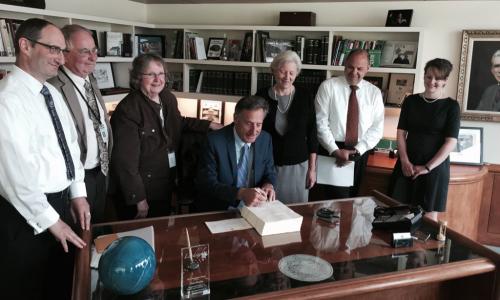 Governor Shumlin signs 2017 Budget at his office in Montpelier. Administration Secretary Justin Johnson, far left, and legislative leaders and others look on. Courtesy photo.
In a statement, the governor's office says this budget caps off a strong record of fiscal responsibility during the governor’s tenure. When Shumlin first took office, he inherited a state budget reeling from the blows of the Great Recession – Vermont’s General Fund revenues had fallen by nearly 15 percent and the state faced a $176 million budget gap. In light of this, since his first budget in FY2012, the compounded annual growth rate of Vermont's total budget has averaged 3.7 percent. This contrasts with the overall growth in Vermont’s economy, as defined by the Gross State Product, of 3.1 percent.
Over six years Shumlin has worked to balance state spending with overall growth in Vermont’s economy while also making investments to protect the most vulnerable Vermonters and grow jobs and economic opportunity. Investments in those priorities have helped create 18,000 jobs since January 2011, according to the Vermont Department of Labor; expand health care to 19,000 Vermonters, giving Vermont one of the lowest uninsured rates in America; and grow personal per capita income at or above the national rate for each of the last four years – something that has never happened before.
The statement says that over this time Vermont has faced significant budget pressures, including slow economic growth from the Great Recession, which led to lagging revenues and increased need for state support services; Tropical Storm Irene, which destroyed over 500 miles of roads, 200 bridges, and countless public and private properties; the opiate crisis, one of the largest crises to ever face Vermont families; and the expansion of health care coverage under the Affordable Care Act.
The FY2017 budget also funds the governor’s Step Up Program, which he highlighted in his State of the State Address. Modeled after a program at the Community College of Vermont in Morrisville called Man Up, the Step Up Program will help Vermonters who struggling in low-wage jobs get the resources and assistance they need to get back to school and on the road to a brighter future.
The FY2017 budget also includes expanded funding for working lands, a doubling of funding for suicide prevention, and funding for additional social workers and other resources for those on the front lines of Vermont’s opiate addiction crisis.
The budget also fully funds State Employee raises and other obligations and gives Designated Agencies a 2 percent increase and additional funding for non-DA community based providers.
RELATED STORY: Vermont tax revenues down across all major funds in May
Source: Governor's office 6.8.2016