

Vermont Business Magazine For the last couple of weeks, there have been rumblings that the governor might veto the hard-fought and much-compromised renewable energy siting bill. Today, Governor Peter Shumlin vetoed S230, An act relating to improving the siting of energy projects. The veto message is copied below. The goal of the bill was an attempt to give more authority to communities on where solar and wind energy developments can be located. Until now, there has been very little, if any, local regulation of small scale renewable energy generators. The fight in particular has been between farmers who see these resources as important to their economic viability and local officials and community members who want some say on where they can be located. The Public Service Board has had, and would continue under S230, to hold ultimate authority over siting. But S230 allowed some local decision making and added language concerning wind turbine noise levels, to which the governor objects. Legislators will be back at the State House on Thursday to consider the matter.
Shumlin issued the following statement: "In partnership with the Legislature, we have made incredible progress charting a cleaner energy future that is growing jobs, putting money in Vermonters' pockets, and helping to preserve a livable planet for future generations. Vermont has the highest number of per capita clean energy jobs of any US state. Currently, one in every 17 Vermonters work in the clean energy industry, which employs over 17,700 people in this state.
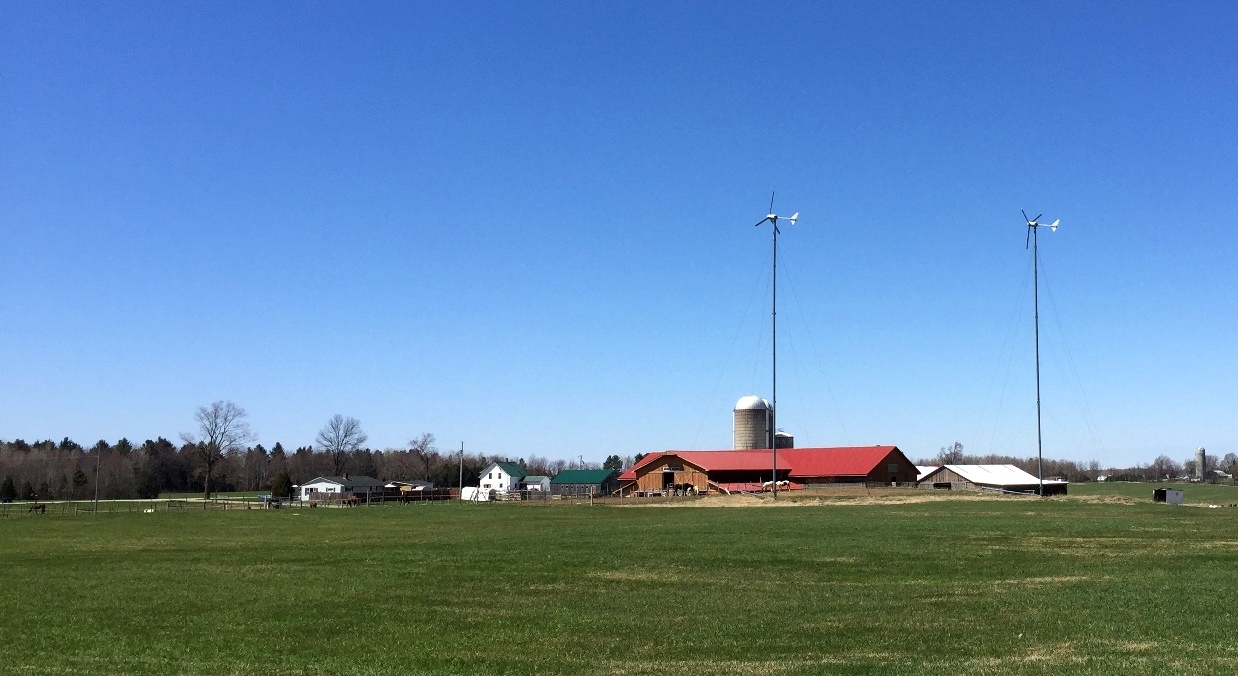
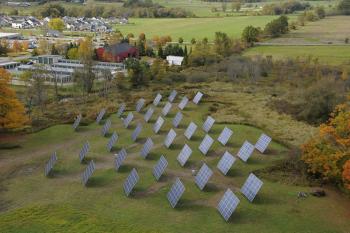 LEFT, Green Acres solar farm in Hinesburg. Courtesy photo. ABOVE, two wind turbines at a farm in Sheldon. VBM photo.
"Last-minute provisions added to S230 would have the effect of putting the brakes on this progress and costing Vermonters jobs, two things I will not do. I very much support giving communities more say as we plan for our renewable energy future together. That is the core of S230 that I would like to see become law. I stand ready to work with the Legislature on a modified bill in the coming days to make that happen."
The Legislature will re-convene on Thursday at 10 am. Senate President Pro Tem John Campbell said the session will be to override the veto, not renegotiate, which would take too much time and cost too much money. Each day the Legislature is in session costs about $60,000. He said the new Legislature could take up changes next year. Campbell, like his opposite number in the House, Speaker Shap Smith, and Shumlin are all stepping down. Smith, however, is running for lieutenant governor.
House Minority Leader Don Turner (R-Milton), issued a statement saying Republicans are unhappy with the governor's veto:
"Today, Governor Shumlin vetoed S230, an act relating to improving the siting of energy projects in Vermont. This is very disappointing news for Vermonters. S230 was a compromise bill approved by a 142-0 vote in the House and softened by the Senate and Governor during the legislative process. The changes the Governor requested were made and the final bill was a modest attempt to restore some regional and local control in renewable energy projects while setting noise standards for wind turbines. The Governor once again has shown that he will choose his donors in the renewable energy business over Vermonters. All four points that the Governor identified as reasons for his veto could have been addressed in the upcoming legislative session.”
"For the last six years the Democrats under single party rule have had total control of the process and failed to deliver a meaningful bill to protect our constituents and our communities from unwanted projects. This special session to bring legislators back to Montpelier on Thursday will cost taxpayers approximately $50,000 to discuss issues that can easily be addressed in the next session. Vermonters deserve better!"
Pro-renewable energy groups, who supported S230, were quick to respond, and were careful not to criticize the governor, who has been a staunch ally for renewable energy.
Olivia Campbell Andersen, Executive Director, Renewable Energy Vermont, said in a statement:
"S230 set forward a framework for collaborative and informed community planning, which is essential to reducing Vermont's climate pollution and making our state more energy independent. Vermont's renewable energy community supported legislators' efforts to create that framework - which is at the core of S230.
"We urge the legislature to quickly and collaboratively pass a simple fix of S230 to help communities move forward with the resources they need to achieve Vermont's clean energy and climate pollution reduction goals.
"With Vermonters already experiencing the devastating impacts of climate change, it is important that we utilize all available tools - including community solar, wind energy, and other clean energy technologies to combat this challenge."
Like VPRIG and the governor, the Vermont Natural Resources Council, a supporter of S230, is urging the Legislature to add language to restore $300,000 in community planning funds left out of the final bill and "correct" the wind noise issue in the bill as passed.
In a statement, VNRC said in part:
"VNRC believes that to be meaningful the planning portions of the bill must be properly funded. In addition, VNRC is concerned that progress towards combating climate change and meeting our renewable energy goals will be slowed if S.230 is interpreted to apply an overly restrictive sound standard that was not the intent of Legislature. Accordingly, VNRC urges the Legislature and Governor to come together and address these issues so that Vermont's progress on renewable energy development can continue, and community planning and input can be better integrated into the siting process. The Legislature has an opportunity, on June 9th, to correct the flaws in S.230 by adopting a corrected bill and sending that to the Governor for his signature."
Meanwhile, Energize Vermont, which supports local oversight of renewable energy, and has generally opposed wind development, issued a statement saying the Shumlin veto was an effort to restore the administration's original state control over siting, and in particular regulations on wind turbine noise. Its statement, issued by Executive Director Mark Whitworth, concludes:
"While Governor Shumlin was concocting the array of justifications for his veto, the wind lobby was hard at work directing its legislators in the development of “a fix” for S230 that will reduce municipal influence over energy siting, weaken turbine noise standards, and provide more goodies to the industry.
"The Legislature’s response to the governor’s veto will provide Vermonters with an instructive demonstration of character that will serve as a theme for the upcoming campaign season. How many legislators will have to explain why they voted against the bill after they voted for it?"
The veto message from the Governor:
I have carefully reviewed S230, which is a bill designed to give communities more say as we plan for our renewable energy future together. The core of this bill is something I strongly support and desire to see move forward. S. 230 was finalized very late in the legislative session, and unintended changes were made at the last minute. After consulting with legal experts at the Public Service Department and the Public Service Board, I have determined that in a few critical instances the language in the bill does not match what I understand to be the intent of the Legislature.
There are four issues with the bill that need to be fixed. First, in seeking temporary rules for new wind sound standards the bill unintentionally invokes a provision in 3 V.S.A. 844(a) that would make Vermont the first state in the country to declare a public health emergency around wind energy, without peer-reviewed science backing that assertion up. Second, in setting a ceiling for new temporary wind sound standards, the bill unintentionally relies on a standard used in a small 150 kilowatt project as the standard for all wind, large and small, going forward. That standard, a complex and variable formula that would require no sound higher than 10 decibels above ambient background, could have the clearly unintended effect of pushing wind projects closer to homes where the background noise is higher. In addition to these two problems, a third concern is a provision in the bill requiring notice of certificates of public good to be filed with land records, which could create problems for residential solar customers when they go to sell their home. Finally, $300,000 in planning funds for communities was unintentionally left out of the bill.
I believe that taken together, the emergency declaration and the restrictive sound standards will make it impossible to continue to sensibly site renewable wind power in Vermont. Through the policies passed by this Legislature, we have made great progress on building renewable energy. We have created 17,700 clean energy jobs which represents 6 percent of the Vermont workforce and makes us the highest per capita on clean energy jobs in the nation. Signing S. 230 as drafted would take us backwards and take an important renewable energy technology off the table. I cannot support that action, and therefore I am vetoing S. 230. I believe, however, the limited number of issues identified in the bill can and should be remedied by the Legislature during a veto session scheduled for June 9. My Administration will do whatever we can to assist the Legislature to make the fixes necessary to produce a bill that I can sign.