


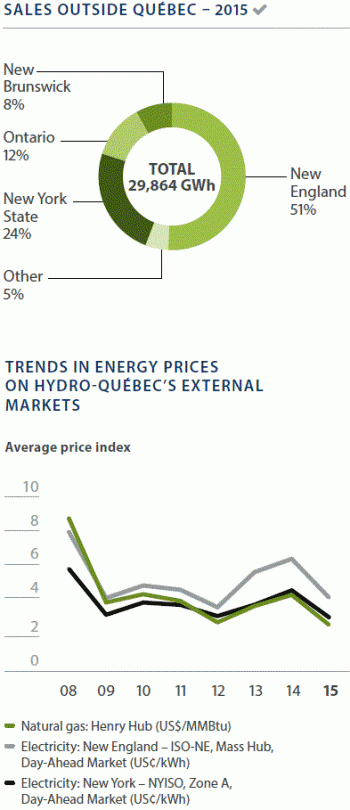
Vermont Business Magazine Hydro-Québec's power exports avoided the emission of 7.4 million metric tons of greenhouse gases in 2015, the equivalent of 25 percent of the total emissions of New England thermal generating stations in 2014. These figures are from Hydro-Québec's newly released Sustainability Report 2015. With 99.8 percent of its output generated from water, Hydro-Québec's net GHG emissions are "very positive" for North America. Vermont signed a roughly 20-year, 20-megawatt power purchase agreement with Hydro-Québec in 2011. Hydro-Québec has used export contracts, with their higher rates, to help pay for the development and expansion of the Hydro-Québec system. Over 50 percent of its exports are sent to New England, or nearly 15,000 gigawatt hours of electricity.
 "One of the things that puts us in an enviable position, as a global shift to renewable energy takes place to reduce greenhouse gas emissions, is the societal choice we made fifty years ago to focus on hydropower. Today, more than 99 percent of the electricity generated by Hydro‐Québec is clean, renewable energy, which contributes to the quality of life of Quebecers. The benefits extend to our export markets, as well, and we're very proud of that," said Éric Martel, Hydro-Québec's President and Chief Executive Officer.
The Vermont Public Service Board in April 2011 approved a contract for Vermont utilities to buy power from Hydro-Québec for 20 years. The new contract will supply about 20 percent of Vermont’s power needs, bringing 225 MW of power into Vermont. It replaced an expiring contract for 310 MW, which represented about a third of the state's electric needs. H-Q represents baseload power. Vermont's peak load is just under 1,000 MW. The starting price for the power is about $58.07 per MWh and will be adjusted annually based on regional electricity prices. Vermont regulators said the deal locks in a stable price that is lower than many other sources of electricity. They also cited the environmental benefits of non-carbon generation, which Vermont uses as part of its greenhouse gas reduction ratios, something most other states do not do.
Under the HQ PPA and associated transactions, 20 Vermont electric utilities would collectively purchase between 218 MW and 225 MW of energy from HQUS starting in 2012 and continuing through 2038.
In approving the deal, the Vermont Public Service Board wrote: "The proposed HQ PPA would provide a number of benefits to the Vermont utilities and their ratepayers. First, over the term of the contract the price of power is expected to be competitive with or favorable to market prices, and is less expensive than currently available sources of power with similar characteristics. Second, the price for this power is expected to be more stable than purely market-based purchases due to the formula for determining its future price. This formula is based not only on market prices for power but also on inflation, and includes a buffering feature that limits year-to-year price fluctuations. Third, the Vermont utilities will receive environmental attributes associated with the energy delivered by HQUS into the New England market in an amount matching the Vermont utilities' purchases under the HQ PPA and reflecting at least 90 percent hydroelectricity, which Vermont law recognizes as renewable."
In a statement to go along with its Sustainability Report, Hydro-Québec said it is a recognized leader in hydropower, which makes a positive contribution to Québec's carbon footprint. While playing a pivotal role in the Québec economy, it enables the province to boast among the lowest per-capita GHG emission rates in North America. Hydro-Québec reported total revenues of C$13.4 billion in 2015.
The utility's exports displace fossil fuel power generation. In this way, Hydro-Québec is extending the benefits of clean energy continent-wide. The company's 2015 exports have avoided 7.4 million metric tons of GHG emissions, the equivalent of the annual emissions of 1.85 million cars.
Hydro-Québec has been New England's energy partner for decades. As North America's biggest producer of renewable energy and New England's next-door neighbor, Hydro-Québec said it can do more to supply the region with power and help it achieve its objectives in the area of clean, renewable energy at an affordable cost.
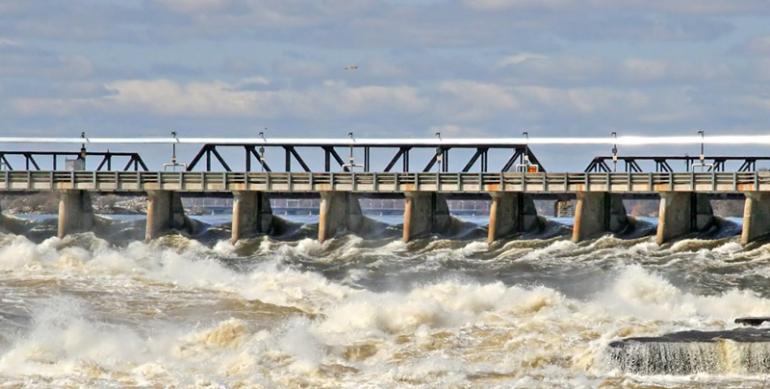 Hydro-Québec Gatineau generating station. Very top photo of Cote-Nord dam. Hydro-Québec photos.
SOURCE MONTRÉAL, May 11, 2016 /PRNewswire/ - Hydro-Québec. For more information, please read our Sustainability Report 2015 and visit our specialized sustainable development site.