

Vermont Business Magazine The City of Rutland, in the midst of a socio-economic turnaround that has boosted downtown, reduced crime and improved quality of life, is looking to make compassion the latest tool in its ongoing revitalization. Mayor Chris Louras, flanked by a host of community and business leaders, announced plans Tuesday to resettle up to 100 refugees – including families from war-torn Syria – in Rutland starting this fall.
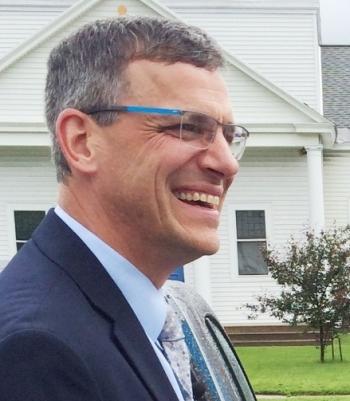 Rutland Mayor Chris Louras
“As a community whose forefathers, including my own grandfather, came here to escape poverty and persecution, we have a unique opportunity to repeat our storied history,” Mayor Louras said. “Just as our grandparents and great-grandparents were welcomed to Rutland in the late 1800s, early 1900s and during the World War II era, we will welcome new families facing peril.
“Their arrival will signal a new wave in the ongoing economic growth of the region,” Louras said. “As our forefathers’ arrival added to the rich cultural melting pot of Rutland County, our newest residents will enrich and expand the tapestry we cherish today.”
Louras announced that the city is working with the Vermont Refugee Resettlement Program, a field office of the U.S. Committee for Refugees and Immigrants, to serve as a new refugee resettlement site. The Committee is a refugee resettlement provider through an agreement with the U.S. Department of State.
With approval expected, children and their parents, forced from their homeland by civil war, terrorism and atrocities, could begin arriving as early as October, with all 100 refugees settled within 12 months. On average, it takes 18 to 24 months for the State Department to clear refugees through a rigorous security screening process for immigration to the U.S.
“These innocent people, including infants and toddlers, have been driven from their homes by the collapse of their nation,” said Louras, whose grandfather, Nicolaos Louras, immigrated to Rutland to escape persecution from the Ottoman Turks in 1906. “As Rutland welcomed my grandfather when he left the Greek island of Chios, we will welcome a new generation of Rutlanders facing the same kind of oppression and fear. These new residents seeking the American dream will bolster the economic growth taking place in Rutland and make us a stronger and better community.”
Governor Peter Shumlin issued the following statement after Mayor Louras made the announcement.
Following the terrorist attacks in Paris in November 2015, more than half of the nation’s governors said they would attempt to ban Syrian refugees from resettling in their states. At the time, Gov. Shumlin said such behavior was stomping on American values. He pledged that Vermont would be a welcoming state for those fleeing war and violence in Syria and elsewhere. Shortly after, the governor visited refugees in Burlington and helped fundraising efforts by three Vermont high school students collecting donations for those suffering in Syria.
"I could not be more proud of Vermont and the Rutland community. There is no denying that we are living in a time in America when fear mongering and bigotry are used by those in positions of power and influence to further their agendas. We saw it when more than 30 governors said they would ban refugees from their states. We saw it when North Carolina and Mississippi passed laws that discriminate against the LGBT community. And, unfortunately, we see it virtually every day on the Republican presidential campaign trail.
"As a state with a strong history of standing up for equality and common humanity, it is more important now than ever that we continue that proud tradition through our words and actions. Today, Rutland showed the rest of the country and the world that the values of respect for others, caring for those who need it most, and common decency are still alive and well in Vermont."
Vermont's congressional delegation also congratulated Mayor Louras:
“We are proud that the State of Vermont and the City of Rutland are welcoming civilian refugees who have fled the relentless violence in Syria, sometimes with just the clothes on their backs. We appreciate the leadership of Mayor Louras and Rutland’s business and community leaders who are not only doing the right thing by helping those in need but also making it clear that it is good for the region to welcome hardworking newcomers into the community. Struggling families, fleeing peril and motivated to start their lives anew, always have and always will enrich America and contribute immeasurably to our state,” Senators Leahy and Sanders and Congressman Welch said in a joint statement.
Rutland Board of Aldermen President William Notte echoed the mayor’s sentiments. “As someone whose family came to Rutland City as part of the great wave of Italian immigration, I look forward to warmly welcoming these new arrivals, who will serve to make Rutland more culturally rich while joining us as one strong and supportive community,” Notte said. “My family has benefited immensely generation to generation from the opportunity to set down roots in Rutland and I feel it is incredibly important to pay back that privilege by paving the way for others to share in the American dream.”
The refugee crisis resulted from civil war between dictator Bashar al-Assad, numerous pro- and anti-Bashar militias, Hezbollah, and terrorists including ISIS. About a dozen foreign countries have intervened, including the United States, Iran, Iraq and Russia. The war has included the use of barrel bombs in civilian areas, allegations of chemical weapon use, and widespread reports of torture, summary executions, and dozens of massacres.
Refugees are provided a small stipend through the U.S. resettlement program, and receive initial help finding housing, employment, registering children for school and other basic necessities. The program is known as a public/private partnership with a goal of early self-sufficiency for newcomers.
Community leaders and residents embraced the refugee plan, including the leaders of Project VISION, Rutland Young Professionals, school and college leaders, and neighborhood, non-profit and business people from all walks of life.
“We are thrilled to be working with city and business leaders and the citizens of Rutland to develop plans for refugee resettlement,” said Lavinia Limón, president and CEO of the U.S. Committee for Refugees and Immigrants. “I’m impressed with the depth of compassion and overall attention being paid to preparing an opportunity for the brave survivors who may come to Rutland. These are the type of assets we look for when considering new communities.”
“The addition of dozens of new families striving for a better life will provide fuel to Rutland’s rebirth,” said Sara Gilbert, a member of the Rutland Young Professionals board and assistant director of Rutland Economic Development Corp. “It demonstrates true compassion, and it makes sense as an economic development tool as well.”
Dave Wolk, president of Castleton University, whose grandparents immigrated to Rutland to escape religious pogroms in Russia in 1897, is among local leaders committed to supporting the program.
“We will offer Syrian refugees the warm embrace of a loving family, and will help them pursue education, and wherever possible, include them in our family of employees,” Wolk said. Rutland Regional Medical Center President Tom Huebner also offered his support.
"My father was born in Germany to a Catholic father and a Jewish mother,” Huebner said. “My paternal grandparents, my father and my uncle got out of Germany, barely, in May of 1939. They were welcomed and restarted their lives in the United States. My father and uncle both volunteered to be in the U.S. Army. My uncle lost his leg in the Battle of the Bulge. My father became an English and American history teacher and ultimately a high school principal. I am honored to support this program. I know what immigrants have brought to this country."
Steve Costello, whose roots include Irish immigrants and whose grandfather operated a store in downtown Rutland until his death in 1929, said he wholeheartedly supports the initiative. “Put simply, it’s the right thing to do,” Costello said. “My family and this community have instilled a sense of compassion and duty to our fellow man, and a sense of personal responsibility. I expect that like my grandfather, some refugees will open businesses, which will add to our economy and cultural fabric, and I look forward to supporting them.”
Carol Tashie, a community leader and farmer, said she welcomed the opportunity to expand what is already a diverse ethnic community, with large numbers of Irish, Italians, French, Polish and Greeks. The refugees will also help reverse a troubling downward population trend.
“As much as we will be helping these refugees, their presence will benefit the entire region by adding to the flavor and energy of our neighborhoods and stoking our economic engines,” Tashie said.
Amila Merdzanovic, director of the Vermont Refugee Resettlement Program, praised the community.
“We are thrilled to be working with city and business leaders and the citizens of Rutland to develop plans for refugee resettlement,” she said. “As a former refugee, who was embraced by an American family in Burlington 20 years ago, I’m so touched and inspired by the depth of compassion and overall support we have come across in Rutland. These are the types of assets we look for when considering new communities.”