

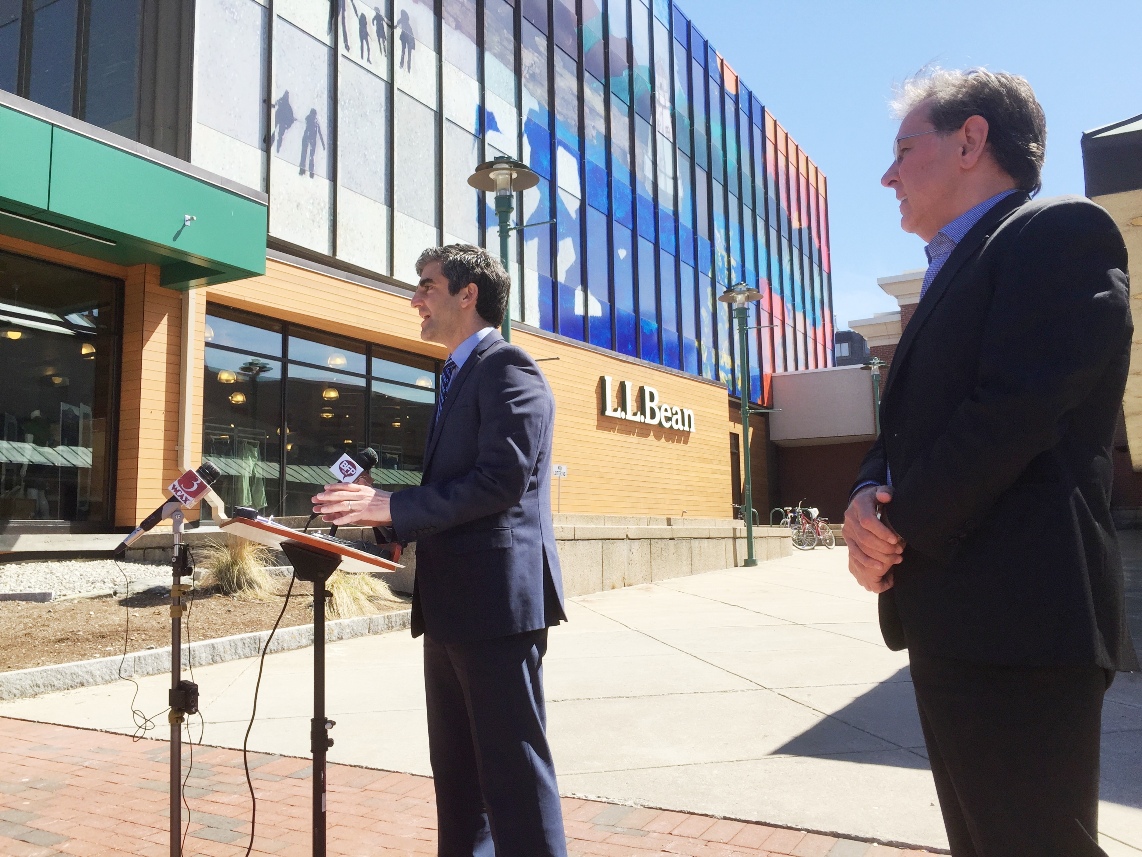
Mayor Weinberger, left, and developer Don Sinex. Redevelopment would create and preserve hundreds of downtown jobs and homes and completely rebuild and modernize mall’s downtown retail; Agreement commits owner to restoring public streets lost during Urban Renewal, paying construction workers livable wages, developing more than 50 permanently affordable homes; City will build up to $21.89 million of long-sought public infrastructure improvements using future property tax revenue generated by the project; Agreement carefully protects City from financial risks; Agreement is product of 18 months of public process and negotiation; City Council approval sought at May 2, 2016 meeting
Vermont Business Magazine A year and a half after it was first proposed, Burlington's downtown mall is ready for City Council action, as the next big step in its $220 million reformation. Mayor Miro Weinberger, with developer Don Sinex, on April 20 released the draft predevelopment agreement between the City of Burlington and Sinex’s BTC Mall Associates LLC, for the redevelopment of the Burlington Town Center mall. The proposed redevelopment will create and preserve hundreds of downtown jobs, help address the city’s housing challenge by creating at least 270 new homes, of which at least 54 units (20%) will be permanently affordable, and restore St Paul and Pine Streets, which are currently blocked by the mall. The restored north-south streets will reconnect the downtown district with Burlington’s Old North End neighborhood, achieving a long-held city goal and healing some of the disruption caused by Urban Renewal.
Weinberger said the City Council will be asked to sign off on the predevelopment agreement May 2 to get the process going. If successful, the project would require a final agreement, permits and voter approval for the TIF financing. Optimistically, Weinberger said, the approval process could be completed by the end of this year, ground broken in 2017 and the project completed in 2019, at least for Phase 1.
Sinex also is motivated to move the project forward as quickly as possible. Phase 1 involves "90 percent of the cost and 110 percent of the effort," which includes the West side of the complex, the vast majority of the building and road reconfiguration. In the meantime he will work to keep existing retailers happy on the Church Street side of the mall. He said he's talking with national retailers to bring smaller anchor stores to the mall. The mall has lost several stores recently and empty storefronts plague the mall, especially the farther one goes from the Church Street entrance.
Shortest-Tallest
Of another concern is the height of the new structure. At 160 feet, it would also be the tallest building in Vermont.
"That's a substantial building here in Burlington, Vermont," Weinberger said.
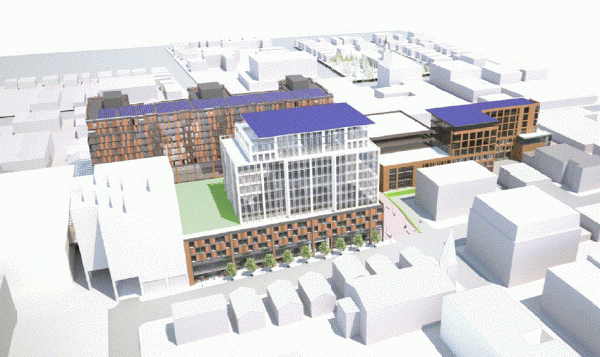 But Sinex pointed out that because of the nature of the building and the way it's stepped back, it would not pose a view risk for residential parts of the city. But in order to meet the economics of the project and create an urban space where people live, work and visit, it needed to be large enough and the only way to grow it is to scale it up.
Weinberger said that Vermont still would have the "shortest tallest building" of any state in the nation.
The agreement also commits the property owner to pay construction workers livable wages and to take steps to create construction and permanent job opportunities for local workers. The City will build up to $21.89 million of public infrastructure improvements using future property tax revenue generated by the estimated $200 million of new private investment in the project through tax increment financing (TIF). These new public infrastructure improvements on St Paul and Pine Streets include the creation of streets, sidewalks, subsurface utilities, and street lighting and will make the project more successful and responsive to the City’s needs.
“Over the past 18 months, at the urging of the public and the City, Mr. Sinex has dramatically improved his redevelopment plan. The proposed project now represents a historic opportunity to achieve many of the City’s long-standing planning, housing, and economic development goals,” said Mayor Weinberger. “This carefully negotiated agreement is a reflection both of our administration’s focus on protecting the City’s financial standing and our optimism about the City’s potential for creating new opportunities for Burlingtonians of all backgrounds on this important site.”
Sinex, who purchased the mall site in 2013 and embraced the City's vision for its redevelopment, thanked City government and residents for their engagement and support of this project to date.
"I know that the old-style suburban mall that sits here now is no longer working well for the City. Burlington needs housing; it needs its streets back; it needs places for more jobs, shops, and services that work for residents and visitors alike. Burlington deserves to have this central downtown location serve as a vibrant corridor of activity between Church Street and the waterfront where people can live, work, and play. That's what I want to deliver," said Sinex. "I appreciate the process we have participated in to get to this point. We have a substantially better project far more responsive to the City's needs because of it. I am looking forward to presenting this predevelopment agreement to the City Council and working with them further to make this project a success for Burlington."
The predevelopment agreement announced today is the product of 18 months of public process and diligent, careful project negotiation and reflects the property owner’s willingness to substantially alter the project design based on the public feedback received. The City and property owner are seeking City Council approval of the agreement at the City Council’s May 2, 2016 meeting, following several public presentations to the City Council and executive session discussions at both the City Council and Board of Finance that began in early February of this year. Some issues remain under discussion with the Council and may result in amendments to the current predevelopment agreement prior to the expected City Council vote on May 2, 2016.
Project will create vast opportunities in downtown Burlington
According to an economic impact study released by the property owner, this project will directly result in more than 500 construction jobs and more than 900 permanent jobs in a range of retail and office operations. Two weeks ago, the property owner and the University of Vermont Medical Center announced a letter of intent, committing 350-400 UVM Medical Center jobs to be housed in the rebuilt Burlington Town Center development. There is currently no other site in downtown Burlington that meets the Medical Center’s office needs.
The rebuilt Burlington Town Center mall will re-establish downtown streets that had been directly cut off during Urban Renewal, thus restoring connectivity and vibrancy between the Old North End and the downtown district. At the project’s conclusion, St Paul Street and Pine Street will once again pass north to south through the City, no longer truncated by the mall building.
Agreement ensures that opportunities will be open to Burlingtonians and Vermonters of all backgrounds
The Burlington Town Center project is poised to create a significant number of homes, across a spectrum of income levels. Of the at least 270 new housing units created, 20% (or 54 units) will be permanently affordable homes, which is the greatest number to date for a Burlington inclusionary zoning project. Consistent with the City’s Housing Action Plan – unanimously adopted by the City Council in October 2015 – the project also seeks to accommodate 110 units of student housing in order to provide options for students outside of the City’s historic neighborhoods, to address long-standing quality of life concerns, and to reduce price pressure on the rental housing market.
Further, the property owner also has committed to paying livable wages to all construction employees, creating local workforce opportunities in the Burlington community. The property owner will partner with the City’s Community & Economic Development Office and local groups to broaden job opportunities and availability to as many people as possible in the community.
Not the NEK
Weinberger and Sinex also sought to assure citizens that what recently transpired in the Northeast Kingdom and the complaints filed by federal and state regulators, announced last Thursday, against EB-5 developers up there, would not happen in Burlington.
"Terrible the situation up in the Northeast Kingdom," Weinberger said. He said that built into this agreement were guarantees that the city did not face any construction or development risks.
Sinex said that unlike the EB-5 immigrant investor developments in the NEK, the bank financing of this project requires stern oversight.
Agreement has been carefully negotiated after much public input
The Burlington Town Center mall project is a direct result of the community planning process planBTV – Downtown & Waterfront Master Plan, which involved the input of thousands of Burlingtonians and was unanimously adopted by the City Council in June 2013. The plan called for a redevelopment of the mall that would include taller buildings, reopening of St. Paul and Pine Streets, and improved street activation on Bank and Cherry Streets. Today’s agreement for the Burlington Town Center mall would implement the vision of planBTV.
The public process for the redevelopment of the mall was announced in November 2014, and the Burlington community has had the opportunity to refine this project’s vision, with input spanning over 18 months and numerous public meetings. The public has been engaged in eight major public events, including a kick-off in January 2015, a multi-day workshop to discuss individual components of the project, and two follow-up presentations to highlight the ways in which the proposed project responded to the community’s feedback. In January 2016 revised plans for the project were presented to more than 250 people during two separate events, and the City Council held two additional public forums in March and April to review “before and after” views of the project and shade studies.
Key elements of predevelopment agreement
· Inclusionary Zoning – The 54 units of affordable housing created under the City’s inclusionary zoning ordinance would be one of the largest increases to Burlington’s affordable housing supply in the City’s history.
· Amendment to the Zoning Ordinance – The proposed project would not be approved under the terms of the City’s current zoning ordinance due to applicable height limitations. The agreement commits the City to initiating the creation of a new overlay district, which will include prescriptive design standards and requirements regarding the uniformity of mass and skyline, façade articulation and design, and materials used in the project.
· Tax Increment Financing (TIF) investment – The Burlington Town Center mall property is located within the City’s Waterfront TIF District, within which the City is authorized to spend public funds to build infrastructure improvements that enable private investment. TIF makes an investment of this scale and economic impact possible, helping to revitalize two blocks of the City’s downtown and reconnect the Old North End with the downtown. The municipal debt incurred within this Waterfront TIF District is repaid using the incremental property tax increase created by the property’s enhancement. The City is currently permitted to incur debt in the Waterfront TIF District through December 31, 2019, to be fully paid by December 31, 2025. In order to facilitate the property owner’s construction of the public streetscape improvements and the City’s payment for and acquisition of those improvements, the City is requesting an extension of repayment until December 31, 2035 for the mall parcels from the Vermont State Legislature this session.
· Champlain College student housing – The property owner has entered into a preliminary letter of intent with Champlain College through a master lease of no more than 110 student housing units. These student residential units will be managed by Champlain College, the property owner, or a property management company with a proven track record of managing student housing. Besides the Champlain College housing agreement, all other forms of purpose built or student residential units would be subject to the review and approval of the City Council.
Agreement includes strong financial protections for City
As part of the predevelopment agreement, the City will make TIF investments in critical, long-sought, new, public infrastructure that the City will permanently control that restores the streets that were lost during Urban Renewal and dramatically improves Cherry Street and Bank Street. No TIF dollars will be spent on the project’s private improvements.
The agreement is structured to protect the City from construction and development risks through a number of critical provisions:
· The public improvements will be priced properly through an open-book, competitive bid process;
· The City will reimburse the property owner after the public improvements have been fully constructed to the City’s design and performance standards; and
· The City will reimburse the property owner and bond for TIF debt only once the property owner has created sufficient new property tax revenues for the City to service the TIF bonds exclusively using those revenues.
Next steps
While the approval of the predevelopment agreement will be a significant milestone for the project, there will be significant additional steps in the months ahead prior to full project approval. These additional steps include: approval of revised zoning for area that includes the mall property by the Planning Commission and City Council; City Council approval of a final development agreement; Development Review Board approval of a zoning permit; and voter approval of the proposed TIF investment.
To enable the proposed TIF investment, the City has sought an extension in the Waterfront TIF District from the Vermont State Legislature for the mall property specifically (not the full district). The public would vote to approve a TIF investment by the City in November 2016.
Regarding the zoning amendment, if the City Council approves the predevelopment agreement, the Planning Commission would review the proposed zoning amendment and return it to the City Council as a draft ordinance for final approval within 120 days. Project permitting would advance through preliminary stages and then to the Development Review Board.
Finally, a development agreement would be reviewed and approved by the City Council before construction begins.
Should these approvals occur, the mall project would move to begin construction. In an effort to mitigate construction time and disruption associated with this complex construction project, the project will consist of two construction phases: Phase 1 consists of the new housing, parking, and public improvements; and Phase 2 consists of the existing retail space renovation within Church, Cherry, Bank, and St. Paul Streets, the renovation of the property entrance from Church Street, and the construction of new office space. Phase 1 is estimated to generate at least $2.4 million a year in new property tax revenue for the City of Burlington.