

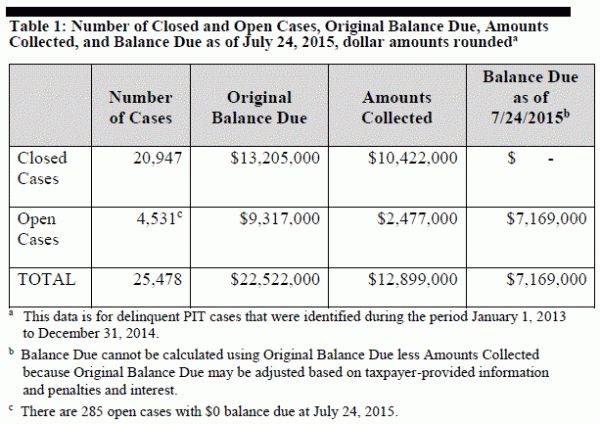
Vermont Business Magazine Vermont State Auditor Doug Hoffer today released a report on the success by the Vermont Department of Taxes on collecting unpaid personal income taxes. In 2013 and 2014, there was a total of $22.5 million in uncollected taxes (25,478 cases), of which VDT collected 57 percent, or $12.9 million. Delinquent personal income taxes comprised about 41 percent ($7.2 million) of delinquent taxes due to the State as of June 30, 2015. Hoffer said that based on his analysis that the state could increase the amount by starting the collection process sooner, especially for the smaller ("low dollar") collection amounts.
"Our analysis of closed cases showed the potential for increasing collections by shortening the period before active collection commences. That is, VDT allows low dollar cases (less than $500) 285 days to “self-cure” (eg, pay-off with no active collection efforts) prior to referring these cases to an OCA. Shortening the time to send a case to an OCA would start active collection sooner and could increase collections.
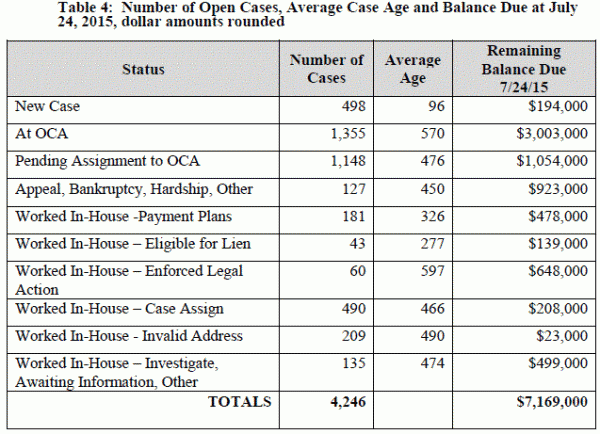
 "Additionally, when analyzing the status and age of PIT debt, we found about 1,400 open cases that were on average several hundred days old (between 476 and 490). According to VDT’s collection approach, many of these should already have been sent to an OCA."
An OCA is an outside collection agency. Hoffer wrote that assessing the cases and understanding why collections were not made was difficult for his office because of insufficient methodology in tracking the cases on the part of VDT.
"VDT indicated there are processing issues that result in some cases getting “stuck” in the Enterprise Tax Management Processing and Collection system (ETM) and not advancing to the next phase according to the rules established in the system," Hoffer wrote. "Furthermore, it’s likely that many of the cases that should be referred to an OCA are not being pursued by VDT compliance officers since each officer is assigned, on average, 1,500 cases."
"VDT has not assessed the effectiveness of its collection efforts because they 1) had not established performance measures to analyze the department’s collection results and 2) had limited reports about which collection methods were used and how much in payments was received as a result of each method. However, VDT has implemented a new system, VTax, for many of its tax types, and PIT is scheduled to be transitioned to this system in December 2016. This new system has better reporting capabilities than ETM and appears to be configured to collect information that will support analysis of collection methods and the payments associated with each method."
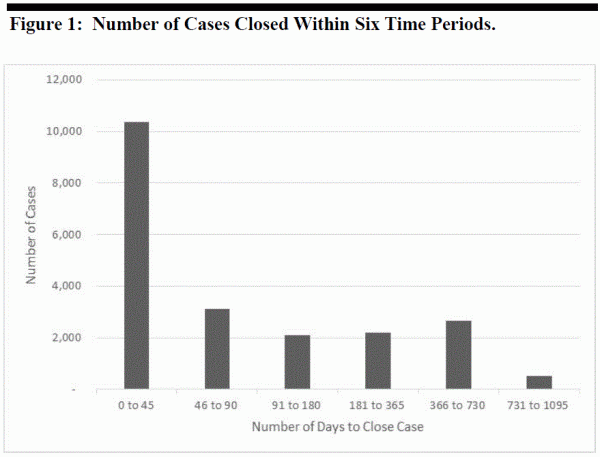 The report says that: according to VDT’s collections approach, 92 percent of the open delinquent PIT cases should be sent to an outside collection agency 105 to 285 days subsequent to the initial notice of assessment provided to the taxpayer. However, less than a third have been referred even though the average age for most of the cases in the treatment scenarios far exceed the time at which cases should have been sent to OCA. As a result, many of the open cases are in a collection status that does not appear consistent with VDT’s described collection approach.
VDT provided to the auditor a data extract that included 30,433 cases. Included were 4,955 cases with a total balance due of $12.4 million that had been identified by VDT as delinquent, but these cases closed without payment. According to VDT, cases close without payment for a variety of reasons:
- A taxpayer makes estimated payments during a tax period as a single taxpayer, but files a joint return because status changed during the tax period. A case is opened because a return was not filed for the taxpayer under their single status. Once this is brought to the attention of the collections section, the estimated payments for the single taxpayer are moved to the joint return. The single case is closed.
- A delinquent tax assessment is generated based on information from the IRS and the IRS data was incorrect.
- Taxpayer files an amended return.
- Taxpayer files an incorrect IN-113 form, used to determine the allocation of Vermont income for nonresident or part-year resident and to exempt income for Vermont residents, with the tax return.When corrected information is received by VDT, no money is due.
- Taxpayer fails to file an IN-113 form. When the missing form is received by VDT, no money is due.
The report (CLICK HERE FOR FULL REPORT) recommends:
1) decreasing the self-cure period for certain cases;
2) using case data to identify cases with ages that exceed the self-cure period and referring them to an OCA; and
3) ensuring that the incoming integrated tax system, VTax, is configured to track all collection methods utilized by VDT.
Tax Commissioner Mary Peterson responded in a letter saying that her office is well into restructuring its processes.
 "It's important to view this report," she wrote, "as a snapshot from the rear view mirror as VDT quickly moves ahead with modernization."
She went on to write that, "It must be noted that in the interim, even working within old systems with limited capabilities, VDT was able to improve collections by implementing a stand-alone data warehouse solution."
And while Peterson acknowledges that some cases should have gone to collection sooner, the department is short on staffing to work the cases manually through the process.
The audit report states: "SAO acknowledges VDT’s concern regarding resource constraints. However, it’s likely that many of the cases that should have been sent to an OCA are not being pursued by VDT compliance officers since each of the officers is assigned, on average, approximately 1,500. Approximately $1.1 million is owed for cases that were pending referral to an OCA at July 24, 2015. Delays in referring these cases to an OCA could result in lower amounts collected since the probability of collection decreases over time."