

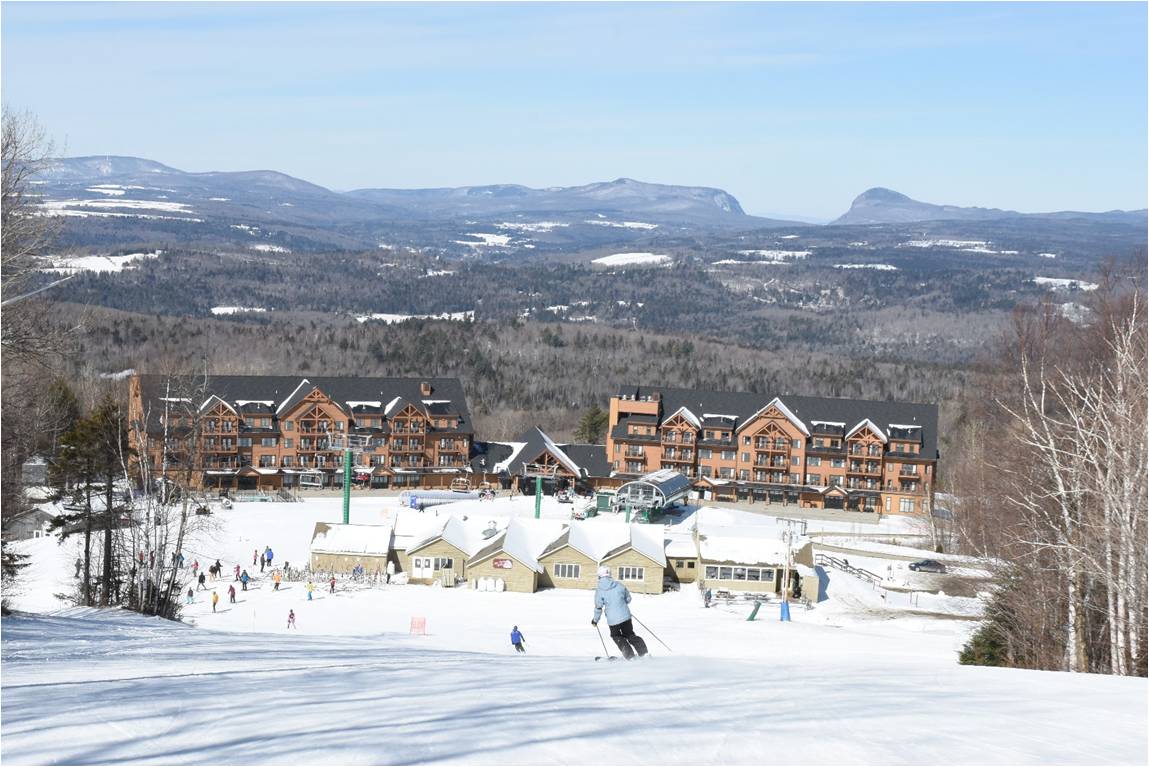
by Timothy McQuiston Vermont Business Magazine State government officials are holding a press conference today to explain why the locks had been changed, documents seized and the executive staff was displaced at Q Burke Resort Wednesday afternoon. Governor Peter Shumlin's spokesperson Scott Coriell told WCAX, which first reported the action, that: "We're aware of the situation in the Northeast Kingdom. This is a coordinated effort. We are unable to comment until relevant information is made public."
Coriell told the news media that a press conference would be held Thursday where further information would be disclosed.
But WCAX reported that Q Burke President Ary Quiros, son of co-developer of the resort Ariel Quiros, said that investigators from an unnamed agency changed the locks and took over the office.
VTDigger.org reported that, "A high-level source said no arrests would be made."
The other general partner, Bill Stenger, was unavailable for comment. Stenger has led EB-5 foreign investor projects at Jay Peak Resort, Q Burke and has started site work for a biomedical facility called AnC Bio in Newport. The total value of the developments is at least $400 million.
The Q Burke Hotel & Conference Center alone is a $50 million project that is nearly complete and was set to open last November. But beset with financial setbacks and increased scrutiny of its finances by state regulators, the hotel, while nearly complete, is still not open.
Contractor Jerry Davis of Peak CM filed a lien on the property March 25 in lieu of full payment from the developers.
Stenger told VBM earlier this week that full funding should be complete within a month and, while he was making no promises, hoped to open the hotel as soon as possible after that, which might be only another month after that, or by early summer.
All of that could be at jeopardy given the outcome of these latest developments.
Vermont DFR Commissioner Susan Donegan sent Stenger a terse letter in February essentially blaming him for the delays.
After questioning his fiduciary responsibility to the project and suggesting he use his own money to make up what was about $3 million at the time (the actual money was redacted from the letter) and saying he should not expect to receive the 15 percent construction management fee, Donegan writes: “Finally there is the issue of the propriety of using new investor funds to cover most of these expenses. As you are aware, we agreed to allow you to raise new funds to cover Q Burke construction, fixtures and furniture only. Legal fees, interest, equipment and other costs are not valid uses of new investor funds. This agreement was an accommodation, so you could complete the hotel while we performed an essential financial review of your project. Unfortunately, that financial review has been a long and difficult task for a whole host of reasons, including the absence of a proper general ledger and other standard financial controls. In short, your failure to engage in best business practices has further prevented us from considering the removal of the escrow conditions to date.”
Stenger, needless to say, disagreed with that assessment.
“It’s as transparent as it can get,” Stenger said.
To Donegan’s suggestion that he should just use his own money to complete the hotel, he said, “As if Bill Stenger has a diamond American Express card to just make up the difference. Three or four million. That’s not even remotely realistic.”
He very much bristled at the notion that the money available should not go to equipment.
“How in the world, why in the world, would you build a hotel without equipment? No washing machines, no dishes, no cooking equipment? You can’t open a hotel without equipment,” he said. “We never would have agreed to that.”
He said the state dragged its feet in getting the process going in its review by 75 days, which slowed the entire process down.
“It slowed down the payments,” he said. “That wasn’t our fault. That wasn’t the contractors fault. That’s the fact.”
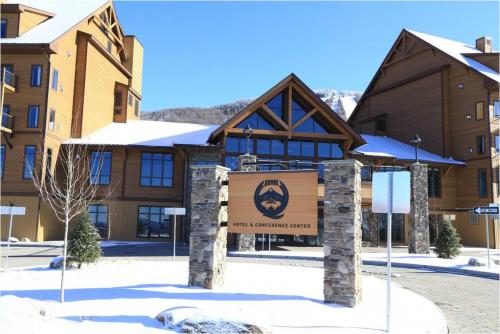 Q Burke Hotel & Conference Center. Photos courtesy of Q Burke.
At 196 investors (at $500,000 apiece) in Q Burke to date, Stenger would need another 50 to build the next $25 million phase, which includes an aquatic center and competitive tennis facility to emulate the success of the Burke Mountain Academy (which is not owned by Q Burke Resort).
By diversifying the resort he will be able to do what Jay Peak Resort has done and “weather-proof” it against a terrible winter, such as Vermont has just experienced.
Stenger said Jay Peak is only down 6 percent from last season’s record year because they build the aquatic center and ice rink and spa. He said no other resort in Vermont could boast such a season.
When the projects were first announced in September 2012, Stenger and his partners and Governor Shumlin and the congressional delegation and other dignitaries were all lined up for a photo op on the Newport waterfront.
Everyone was smiling.
Does Stenger feel abandoned by the state?
He answered with a rhetorical question of his own.
“Have we had a honeymoon with the Agency of Commerce and DFR over the last 18 months? No. But I believe we’re getting over it. And we need to get over it. We’re a small state,” he said.
And as for the hotel?
“It’s going to be a homerun,” Stenger said of the Q Burke hotel. “We’ve just got to get the damn thing open.”
Leahy on EB-5 Reform
Stenger has blamed an excruciatingly long regulatory process at both the state and federal level.
He’s particularly upset over the use of EB-5 investor money for skyscrapers in Manhattan, beachfront development in Miami and casinos in Las Vegas.
Just on Wednesday, Leahy urged his Senate colleagues to revamp the law, which sunsets on September 30, to ensure that EB-5 funds go to rural and poorer areas. He said gerrymandering poorer areas of Manhattan to include development sites was not the intent of the law.
“This program was designed to bring jobs to underserved areas, but in reality it has become an unintended boon for some of the wealthiest business districts in the country,” Leahy said.
“Newspapers across the country have exposed the abuse of TEAs (targeted employment areas) through gerrymandering. This abuse occurs when wealthy neighborhoods qualify for incentives intended for underserved areas. The Wall Street Journal reported just yesterday that one big-city developer referred to EB-5 financing as “legalized crack cocaine.” Developers draw TEA maps in any shape necessary to connect an affluent area with enough distressed areas to obtain discounted EB-5 financing. Through manipulation of the EB-5 program, Beverly Hills can be considered just as distressed as Detroit,” Leahy said.
Leahy concluded: “If this Regional Center program is to continue, it must be reformed. I will not support mere window dressing. Proposals that do not require transparency and accountability for every EB-5 project are just that. The program is need of a blood transfusion, not a Band-Aid. We know what is needed to repair this program. It is long past time that we fix it.”