

by Joyce Marcel. Vermont Business Magazine
When Joni Mitchell cheerfully sang “They paved paradise and put up a parking lot,” she didn’t know the half of it.
Now she can sing, “They paved paradise, but they reserved 10 percent of the view-shed on each side in perpetuity and the land may be a solar farm today but will revert to farmland in 25 years. Don’t it always seem to go that you don’t know what you’ve got till it’s gone? They paved paradise and put up a parking lot.”
Whether all the trees will be put in a tree museum remains to be seen.
We are living in an extraordinary era when capitalism and the profit motive appear to be at war with the survival of the planet as well as its human population.
Whether it’s lead-free, PFOA-free water, carbon monoxide-free air, plastic-free oceans, fish with two heads and two sexes on the same body, rising seas, miners dying underground while looking for minerals to run our cell phones, women sold into sexual slavery in the name of religion, polluted groundwater and sinkholes from fracking or a host of other horrors, this conflict is being played out all over the world.
Still, we need to earn a living, have a warm home, drink clean water and eat healthy food, maybe own a television set and, since we live in Vermont, drive a car that passes inspection once a year. To secure these things, especially in a small northern state with a tiny population and a shaky economy, can be big a problem.
Economic growth often requires expansion, which involves building on land that might be good farmland. In a state like ours, one which values farmland, agricultural products, stunning vistas and downtowns, this tension between growth and preservation can cause quite a ruckus.
Vermont, however, may be a thought leader in the way it balances the tension between economic growth and protecting the environment. At the center of this tension lies Act 250, Vermont’s fabled land use law.
Environmental attorney Peter D Van Oot has been close to the center of the struggle around Act 250 for 29 years.
Van Oot, 61, is a director of Downs Rachlin Martin PLLC, the state’s largest law firm. He works out of the company’s offices in Lebanon, NH. He has argued for many large Act 250 permits and at the same time been on — and chaired — Act 250 commissions. He’s been a member of two municipal planning commissions/zoning boards, served as counsel for developers of large-scale projects and is a board member of state-wide environmental and economic development organizations.
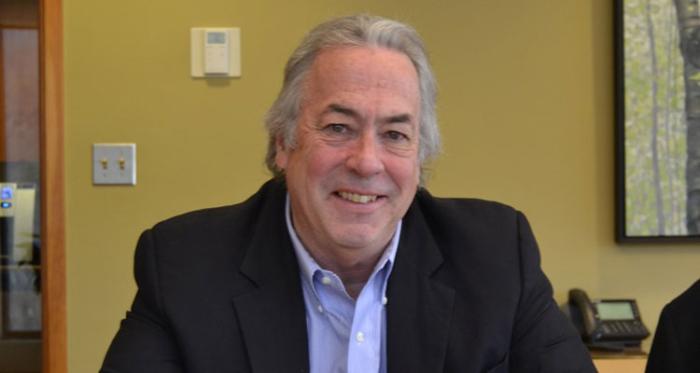
In person, Van Oot is tall, good-looking and imposing. Charming should be his middle name. He has long white hair that he combs straight back and a deep, sonorous voice that might lull any Environmental Board into acquiescing to his requests.
He and I talked for over an hour at DRM’s Brattleboro office, which has a spectacular view of the Connecticut River and all of Brattleboro town, and after a while I stopped trying to have a conversation with him and just enjoyed riding the waves of his deep voice.
I asked him about the tension between development and environmental protection, and he said he thought it was “overstated.”
“In Vermont, the proponent of any significant land use or energy development regulated under Act 250 has to demonstrate that their project will not have adverse impacts on the environment, or that they have taken appropriate measures to mitigate that impact,” Van Oot said. “I think Act 250 is the most important law that has been passed in Vermont in my lifetime. I don’t know of any other law that has had the impact it has had on or culture on our physical landscape. I believe — a lot — in Act 250.”
Act 250 makes Vermont a great place for businesses, Van Oot said.
“Vermont is generally a great place to do business if you understand how the laws work and you’re willing to invest in your project,” he said. “I always thought Act 250 provided tremendous financial advantage to developers because once they’ve got a permit, they’ve got a ticket to make a very successful business. I always thought Vermont has gotten a bad rap. If you understand the law and you’re willing to comply with the law and become part of the community, you can advance your business. What makes Vermont different is that you have such incredibly positive ability to work with your state government on your project.”
Any responsible developer should invest the time and money necessary to meet the burden of Act 250, Van Oot said.
“Generally, projects are appropriately approved,” he said. “I am not as familiar with the statistics of approved projects under Section 248, but the Natural Resources Board Annual Report for Calendar Year 2015, issued on February 16, 2016, states that of the 301 Act 250 applications that were processed in 2015, 252 or 84 percent were handled as minor amendments without contested hearings; only 5 or 1.6 percent of permit applications were denied; and only 6, or 1.9 percent of the District Commission decisions, were appealed to the Environmental Division.”
Highly contested proceedings fall into one of three areas, Van Oot said. Either the developer has not done everything reasonable to analyze and mitigate the project’s impact; or its opponents want to hold the developer to a higher standard than prescribed in the law; or the case presents a new issue under Act 250, Section 248 or a municipal ordinance that has not previously been addressed.
“Personally, I have adhered to American ecologist and author Garret Hardin's First Law of Human Ecology,” he said. "’You cannot do only one thing.’ I interpret that to mean that even a project well designed to serve a valued societal, economic or environmental need, such as a cheese or yogurt manufacturing facility or a solar farm; will necessarily have some adverse impacts. The critical issue is to ascertain and, to the extent reasonably feasible, thoughtfully mitigate those impacts within the parameters of the law.”
While there’s little argument that Vermont needs economical development, there is lots of argument about how it should be done.
Gubernatorial candidate and former Vermont Senator Peter Galbraith argues that Vermont is too small to have a strong effect on its future economy.
“Like it or not, Vermont is subject to the same macroeconomic forces as the rest of the country,” Galbraith said in a recent op-ed piece. “And the discretionary resources of our state government are simply too small to make a difference to our economy. But, where Vermont’s next governor can make a difference — indeed a big difference — is in the fight for economic justice.”
When Galbraith was asked to expand upon his comments, he told VBM, “The state of Vermont's financial resources are committed to essential state functions (schools, roads, health care, etc). There are no surplus funds available to promote economic growth, one needs money.”
The Federal government can do this because it can borrow — or print — money. Galbraith said.
“Think of the $1 trillion Obama stimulus,” Galbraith said. “Vermont cannot do that. The relatively small amount of money that we use to lure companies to Vermont cannot make an actual difference to their large investment decisions. No one can seriously believe the $5 million the Legislature appropriated to a $1.5 billion IBM/Global Foundries deal made any difference. In essence, we waste taxpayer money that would be better devoted to our essential services — again, education, etc. It is those services--plus our natural environment--that make Vermont attractive to businesses whose owners want to live here. This is our comparative advantage.”
Van Oot thinks the answer is to create jobs.
“When I first came back to Brattleboro about 20 years ago to open this office of DRM, I continued my involvement in various civic matters,” he said. “One of them was joining the United Way board. And I realized that being on that board was not going to be effective unless we did something about jobs in Windham County — specifically in Brattleboro. At the time, United Way had a lot of employee drives at manufacturing companies — this was 1995, and they also did a lot of work at banks and other large institutions. Well, Brattleboro lost its two state-wide banks. Manufacturing was starting to close, C&S downsized and there wasn’t any economic base to support great organizations like United Way or Youth Services.”
So Van Oot got involved with the Brattleboro Development Credit Corp.
“If we, as civic participants, didn’t support new jobs, or at least start to stem the loss of jobs, those good organizations would just not be able to do their jobs,” he said. “You can’t raise money in a community when you don’t have jobs. So my definition of economic development is anything that supports livable wages for a community and the people who work in the community.”
He cited the success BDCC had in attracting Commonwealth Dairy, in bringing Grafton Village Cheese down to Brattleboro, in helping Against the Grain when it was starting up its gluten-free bakery, and nurturing many other small but growing businesses.
“Those are examples when the state and the community work together,” Van Oot said. “But I think we could do more. On the environmental side, I think the Legislature needs to pay more attention to Act 250, particularly in environmental regulations. And I think the Natural Resources Board, which administers Act 250, needs much better leadership. I think we’ve taken steps backward on Act 250. I do not support the new criterion 9L, which has to do with scattered growth or sprawl development. It is bad legislation, ill-conceived and badly drafted, and the state is having a horrible time figuring out how to do it. It’s diminished the positive impact of Act 250.”
Vermont is not too small for economic development, Van Oot argued.
“I think we need to do better,” he said. “But Vermont is not too small. I think the local and regional efforts can and have been successful but somewhat inconsistent. Brattleboro's been lucky with BDCC. Chittenden County is thriving. Some places are not that successful. But over the years, there’s been a significant lack of leadership from the state. That has changed considerably since (Secretary) Pat Moulton (of the Agency of Commerce & Community Development) has been in charge, along with Joan Goldstein, who is the commissioner of the Department of Economic Development. In my considered opinion, Pat and Joan and their team have done a much better job of leading and supporting economic development in Vermont.”
Goldstein met Van Oot when she was working with the Green Mountain Economic Development Corp in White River Junction, where Van Oot now chairs the board.
“We had a big project contemplated in White River Junction,” Goldstein told me. “It had brownfields in the site. You need a really switched-on attorney who has expertise in how to clean up these properties, and that was Pete Van Oot. He came over and explained what we should do. I was impressed. Here’s this very high-power attorney reducing his rates for a nonprofit with no money. He took it on! He looked forward to it! He’s energized by the complexity of brownfields! I was amazed. The deal ended up not going through, but we learned so much.”
Goldstein says it is “good to have a healthy tension between people who want to develop and people who want to preserve.”
“There’s a balance and a risk,” Goldstein said. “I think we’re far from a situation where we have runaway growth. I think incremental growth is healthy. We can’t all of a sudden grow tomorrow. It takes care and seeding and the right fight. But you can still grow — with constraints. I think we just have to be very careful of not throwing the baby out with the bathwater. Because outside of Chittenden County, there is very scant growth. We have to be very mindful of that, because the more we limit development the harder it becomes. Part of it is sheer population numbers. More people are living in Chittenden County so more businesses come there and more people want to live there because there are more businesses. It becomes a cycle. And not everyone has a car. Where else besides Burlington are you going to live in the state if you don’t have a car?”
One thing that gives hope are “transplants,” Goldstein said.
“When you come from the big city, you don’t want to live in a place where you don’t have a backyard,” Goldstein said. “That’s where there’s an investment. They buy a second home and it becomes their first home. Lots of people move to Vermont and have the wherewithal to do it.”
Goldstein remembered when, in early 2011, Van Oot called her out of the blue.
“’Hey, I’m moving up to the Upper Valley and I want to be on your board’,” he told her.
“And here’s this high-powered land-use attorney who loves complex deals and wants to be on the board!” Goldstein said. “I was very happy about that. He’s really committed to economic development. He volunteers his time. He’s strategic and tactical. I can’t say enough good things.”
Even Van Oot’s natural enemies say good things about him.
“He is definitely one of the top environmental lawyers in Vermont,” said Christopher Kilian, who for 14 years has been director of the Vermont office of the Conservation Law Foundation.
“I’ve always found him to be aboveboard and thoughtful and open to dialogue,” Kilian said. “We’ve definitely been on the opposite side — both with Pete and other DRM attorneys —on many, many cases over the years. Some of them have been very hard-fought. One of the challenges of the legal profession is to be able to maintain quality, collegial, professional relationships while vehemently disagreeing at the same time. And I think that Pete has demonstrated that over time. Many of the biggest industry players across multiple sectors seek him out for his input and representation. The proposals where we’ve interacted with Pete are often issues and proposals that are causing us great concern. And throughout that process, while being a very strong advocate for his clients’ interests and views, he has been able to maintain, by and large, constructive relationships and an environment where there is a discussion about compromise and potential resolution.”
Van Oot returns the compliment.
“I actually say good things about Chris as well,” Van Oot said. “I think he is one of the best environmental attorneys in New England, much less Vermont. I always much prefer to work with good lawyers.”
When Peak Resorts, Inc bought Mount Snow, the resort came with several litigation problems. According to the company’s vice-president of business and real estate development, Richard K Deutsch, DRM was hired to deal with them. Deutsch met Van Oot through that litigation. Since then, they have become friends. Van Oot helped the company develop and permit a development Master Plan.
“We started in ‘08 or ‘09 to get this master plan approved, and Pete was instrumental -- along with other professionals -- in getting it approved in July of 2011,” Deutsch said. “When it comes to environmental issues and Act 250 issues, obviously Pete is very involved. He knows Vermont environmental law inside and out. He represents not only himself but his clients at the highest level possible. I’ve worked in many different states investing in recreational properties and Pete and DRM are some of the finest attorneys I’ve ever dealt with. I’ve been extremely happy with his ongoing representation with Mount Snow.”
Green Mountain Center
Van Oot has recently been at the center of one of the most contentious development projects in the state. He’s trying to permit the Green Mountain Center, a large mixed-use project that his client, landowner Jesse F “Sam” Sammis III, intends to develop in Randolph just off I-89. It is widely known as the Exit 4 Project.
The Conservation Law Foundation calls it “sprawl” and is only one of several groups that have party status to argue against the project.
The project calls for 1,150,000-square feet of development on 172 acres of prime agricultural land. It will include 43 buildings, including light manufacturing, a fitness and recreation center, shopping, a 180-room hotel and conference center, and visitor center (to replace the state rest stop up the highway).
In April of 2015, Van Oot asked the Act 250 commission for a partial review of the project on Criteria 9(B) (primary agricultural soils) and 10 (conformance with local and regional plans).
An opposing group called Exit Four Open Space organized to fight the project.
And Vermont’s civil war historian Howard Coffin wrote poetically, “Randolph is where the wondrous mountain beauty of Vermont is first dramatically presented to the northbound driver. It’s a place I treasure, and its value lies far beyond the aesthetic. It’s money in the bank for Vermont, an investment far beyond anything one patch of real estate can produce, for it instantly affirms to newcomers that Vermont really is a place to which they must return. My profound hope is that it stays the way it is.”
After five hearings and long private discussions with the Conservation Law Foundation and Vermont Natural Resources Board, Van Oot withdrew the request for partial review.
But the fight is just beginning.
“Rather than asking the commission to issue a decision, we felt comfortable that we had heard what we wanted to hear,” Van Oot said. “Then, through the partial finding process and in our conversations with VNRL and CLF, we will evaluate how we can best go forward with the project. It’s not dead at all. Mr Sammis is going to go forward. At the end of the day, what would be built, what it would look like, what it would cost, nobody knows. The full scope of the project may take 30 years. It may never be built. So my ability to say what the full impacts or the cost of the project would be pure speculation.”
Early Years
Van Oot is the third of five children. His father brought the family to Westminster when he took over the Northeastern Culvert Co in February of 1957.
Van Oot has a great affection for his childhood in Westminster. In testimony he gave before the Senate Natural Resource Committee, he once offered this colorful description:
“I grew up in Westminster, Vermont, which has a very historic town center. Westminster is the oldest existing town n Vermont, having been chartered in 1735. Westminster Center was the site of the Westminster massacre in March 1775 and where Vermonters first met to declare the independence of the Republic of Vermont. I defy anyone to find a more quintessential example of an existing community center in Vermont.”
Van Oot’s last name is unusual, and I wondered about his family’s origin.
“As with many in the pre-PBS ‘Finding Your Roots with Henry Gates’ generation, I knew little of my background and cultural heritage growing up,” Van Oot said. “And most all I thought knew turned out to be wrong. I had been told that our family’s ancestral name was Van Oot, that we were Dutch on my father’s side of the family and Scottish/Irish on my mother’s side —maiden name Dawson, and that both my father’s and mother’s ancestors had migrated to upstate New York.
“In my twenties I discovered that my father’s family was from Alsace-Lorraine, not the Netherlands; and that the ancestral family name was Uth, not Van Oot. I have no real clue as to the derivation of the Van preposition/prefix. As soon as I learned the more accurate history, I switched my import beer allegiance from Heineken to Kronenbourg and started exploring the wonders of Alsatian food and wines.”
Van Oot’s father had a degree in metallurgic engineering from Cornell University and worked for Dow Chemical before coming to Westminster
Why did he choose Vermont?
“He took advantage, like a lot of us, to live and work and ski and enjoy being in Vermont,” Van Oot said. “He died young, in 1976, but he had a very successful company and I grew up with my four siblings and my mom. She’s still alive and well and living outside of Hartford in a retirement community.”
Van Oot said his father taught him “everything” about business.
“He was a wonderful man, really admired, very involved in his community,” Van Oot said. “What he taught me was that it was really important to provide those jobs. He used to say that after his family, the most important thing he did in his life was provide jobs for the folks that lived and worked in Westminster.”
For his second year of high school, Van Oot went to the private and elite Deerfield Academy.
“My father had saved money to support one of my older siblings in college and she wasn’t going to college at the time,” he said. “And the fact that Westminster didn’t have a union high school allowed me to go to Deerfield.”
He did well in school. He graduated cum laude from Deerfield in 1973, cum laude from Williams College in 1978, and then paid his own way through Georgetown University Law Center.
“I worked on Pat Leahy’s 1980 campaign and was fortunate enough to be asked to go to DC as a legislative assistant,” Van Oot said. “I went to Georgetown at night. My day job allowed me to pay my rent and buy a few books.”
After he got his degree, Van Oot worked at a mid-sized law firm in Boston; he wasn’t happy there.
“I did not like the bar,” he said. “I did not enjoy the people for whom I worked. I was doing commercial real estate and corporate work, not unlike what I do now. But I’d grown up in Vermont and learned to trust people until they gave you a reason not to. In Boston, in the legal community back in the day, it was exactly the opposite. You didn’t trust people unless they gave you very good reasons.”
Coming Home
Van Oot came back to Vermont in 1987 and joined Downs Rachlin Martin.
“I’d love to say they recruited me, but it somehow worked out and I was delighted to have the opportunity to come back to Vermont and to work as a lawyer here, where the bar is a very good bar and where people are decent and for the most part well-meaning,” he said. “And those who are not, you know who they are and you stay away from them.”
DRM is Vermont’s largest law firm, with approximately 70 lawyers in five offices. Van Oot began his Vermont career in the St Johnsbury office, and also began his community involvement by being the chair of Act 250’s District 7 in the Northeast Kingdom. (Act 250 has nine districts.)
How does it work when an environmental lawyer trying to permit a project under Act 250 is also the chair of an Act 250 district? Isn’t there — at least — an appearance of conflict of interest? No, said Van Oot.
“There have been a number of DRM lawyers and other lawyers who serve on the commissions,” Van Oot said. “In District 2 right now, at least two of the commission members are lawyers. If you’re serving on a commission, number one, you recuse yourself in any proceeding where your partners are involved. And you don’t appear before the board, clearly. So for those years in St Johnsbury, I didn’t appear before that commission. But I appeared before other commissions.”
Commonwealth Dairy
After a few years in St Johnsbury, Van Oot was asked to open an office in Brattleboro, which he did. That’s when he became involved with the Brattleboro Development Credit Corp and served on their board.
One of Van Oot’s “extraordinary success stories” comes from that time.
Back in 2010, Commonwealth Dairy, a company that makes Greek-style yogurt, was looking for a home. It’s founders, Thomas Moffitt and Ben Johnson, looked all over New England and upstate New York.
“The folks at Commonwealth Dairy were encouraged by Massachusetts to come here,” Van Oot said. “Massachusetts said, ‘You’re not really big enough for us to care about.’ But in Vermont, with our help, the state really did care about that type of project.”
According to Moffitt, Van Oot had a lot to do with the company’s location — and success.
“While we were vetting Vermont as a potential location, we were put in touch with Pete Van Oot,” Moffitt told me. “We were given some early advice that if we wanted to successfully navigate the permitting environment, there was nobody better than Peter Van Oot.”
Van Oot was well-versed in the legal and permitting and the political landscaping in Vermont, Moffitt said.
“One of the biggest values we gained was an immediate high-level understanding of what considerations we had,” Moffitt said. “As we started working our way through the process of identifying the exact location and evaluating the various permitting ordinances, Pete was incredibly effective. He made sure we were talking to the right people about the right projects at the right time. So for us, whether it was permitting or wastewater or navigating the Act 250 process, Pete knows the right people -- for us he was an inimitable part of our project.”
The dairy was built in 2011 and just finished its second expansion, going from 38,000 square feet to 68,000 square feet. It employs 125 people and has over $125 million in sales. A few years ago it opened a second, state-of-the-art yogurt manufacturing facility in Arizona.
Exit 4
Commonwealth Dairy was welcomed in Brattleboro with open arms. Other projects have been more contentious.
The main issue with the Green Mountain Center in Randolph is that Sammis, who owns 172 acres at the northwest and southwest quadrants of Exit 4 at Interstate 1-89, wants to cover 1,150,000-square-feet of the land — 47 acres of it prime agricultural soil — with buildings.
In April of 2015, Van Oot presented the commission with a complete proposal and requested a review of just two criteria — 9B, which looks at agricultural land, and 10, which examines compliance with city and county planning. Sammis was asking for an Act 250 permit for the whole project. He just wanted to hear what the objections might be under those two criteria,
“Criteria 9B, the agricultural lands criteria, was what we wanted the commission’s input on,” Van Oot said. “It basically requires the developer to make all reasonable efforts to mitigate the impact of their project on prime ag soils, either by preserving those soils on site, or, there is an allowance under appropriate circumstances, to mitigate off-site.”
How do you preserve agricultural land when you’re paving it over? What does “mitigate” really mean?
“Depending on the type of soils, it’s either a two- or three-to-one mitigation,” Van Oot said. “You can, in effect, write a check to the Vermont Housing Conservation board and they will take that money and preserve prime ag soils elsewhere in the state.”
CLF and the Vermont Natural Resources Board jumped in to oppose the project, as did the citizen’s group, Exit 4 Open Space.
What followed, according to contemporary newspaper reports, were five contentious hearings held over five months.
The agricultural land was not the only concern. The breathtaking view of the rolling mountains that people enjoy at Exit 4 would be gone forever (currently there is a McDonald’s restaurant and a gas station/convenience store at the site).
According to Van Oot, the hearings were “long, very principled and constructive conversations with the district commissions as well as the parties, including CLF and Vermont Natural Resources Council and Two Rivers Regional Planning Commission about how this project could would or should proceed under 9B.”
In the middle of the hearings, Van Oot and Sammis asked for a time out to hold confidential talks with the other parties.
“We engaged in those conversations,” Van Oot said. “They were very positive and very constructive. We learned a lot and they learned a lot, I think. Then we decided to withdraw only our request for partial findings under criteria 9B and 10. Rather than asking the commission to issue a decision, we felt comfortable that we had heard what we wanted to hear. Now we can evaluate how we can best go forward with the project. It’s not dead at all.”
The private talks were so confidential that CLF would not reveal their contents. However, Kilian was happy to talk about its main concern: sprawl.
“Our view, in context of Exit 4, is that the kind of development proposed there — and in similar developments around the state — ultimately harm our economy by degrading our scenic quality and harming our farms,” Kilian said. “We need good soils for farming, and paving over those soils is a concern in Exit 4 and other places. But even more fundamentally, sprawl development along our interstates and outside of downtowns harms our communities and undermines growth and development in our town centers.”
The type of commercial development proposed at Exit 4 would draw large buildings and big box stores, something that CLF feels can be destructive to Vermont’s thriving downtowns.
“Our concern extends not just to where development is occurring, but also the type of development that goes on,” Kilian said. “Our view is that Walmarts and Home Depots and Targets undermine the stores that are locally operated and pay wages in our downtowns. Sprawl development costs our communities a lot of money by putting excessive demands on infrastructure — on roads, water and power — plus damaging the environment with runoff, increased reliance on cars which pollute the air and contribute to global warming and paving over wetlands and other habitat for animals. Our view is that sprawl harms our economy, and protecting the environment and long-term sustainable economy in Vermont go hand and hand. That’s our view of the world.”
For Van Oot, the experience was a positive one.
“It’s what Act 250 is supposed to do,” Van Oot said. “Have a full discussion of the impacts of a project and engage in sophisticated and full discussion of the impacts before you decide whether to build it or not. That’s what we’re doing and what we’re going to continue to do.”
Net Importer
Electric power is an essential and controversial growth issue in Vermont, and it is deeply embedded in economic development. When I asked Van Oot about it — specifically whether the state could ever site another wind project — he turned me over to DRM attorney Kimberly K Hayden, who has been a power expert for over 20 years. She believes that 80 percent of her work is involved in energy projects, and she has permitted several large wind installations including Georgia Mountain Community Wind.
I asked her about Vermont’s energy future.
“We’ve been relatively energy-growth dormant in Vermont,” Hayden said. “We import most of our power from outside the state and that’s been the case for, frankly, decades. Now we’re 50th out of 51 states (includes DC) for net energy development. We are a net importer.”
Vermont has some excellent reasons for this, Hayden said.
“We’ve had a good relationship with our Canadian friends and in upstate New York, where we’ve been able to procure relatively low carbon resources,” she said. “That’s hydro primarily, but others as well. With the clean energy regulations starting in 2006, the Legislature started enacting climate change legislation and creating much more significant goals and targets. This past year we got Act 56 — which has a renewable portfolio standard. We were really the last state to actually get mandated standards in place. That will generate more activity, but we don’t know what that will look like.”
Programs such as net metering — principally solar projects — have been promoting renewable energy in the state since 2008, Hayden said.
“Over the past four or five years I have permitted 20 megawatts of solar,” Hayden said, “And our clients do a lot of net metering.”
According to a study by ISO New England — the entity that runs the New England grid — Connecticut and Massachusetts have been very aggressive with renewable energy projects.
“They are far, far ahead of us in terms of amount of solar,” Hayden said.
Even though these states are larger than Vermont, they still have limits in terms of their geographic space, Hayden said. So does Vermont.
“So of course, you can always do rooftop,” Hayden said. “A 2 megawatt project is probably a 12-acre facility for solar. For scale, the Deerfield Wind project is a 30 megawatt project that required about 80 acres of land to build. A lot of that has to do with getting access to the mountain top. A solar facility of that capacity project of that size would be well over 100 acres.”
The New England states have set very ambitious renewable energy and greenhouse gas reduction targets,
“Vermont and other New England states do allow a certain amount of that renewable generation to come from outside their respective borders,” Hayden said. “Having said that, the targets will require that we build more generation infrastructure in-state, and that will very likely require us in New England to have more transmission paths leading into the load center in central New England, primarily Massachusetts.”
Last fall, an RFP was issued for New England energy projects. In January, Connecticut, Massachusetts and Rhode Island began inspecting proposals. Vermont opted out.
“It’s pretty interesting to look at the different types of energy bids that came in,” Hayden said. “Many are generation with transmission. There’s a significant component for off-shore wind. A significant component for upstate New York-Massachusetts wind coupled with transmission. Several are for large scale solar facilities. Based on what I see in Vermont, we will continue to need to buy power from outside of the state. And I think New England regionally will need to do imports from Canada and probably some off-shore wind that is technically in US waters. And this will happen at the same time we continue to build instate renewable energy. So going to the question of will we have more wind in Vermont? I think we will.”
But it will be “community wind,” she said. Smaller installations in towns and counties that request it.
“My sense of it, just from the difficulty the developers have had in siting these ridge-top wind facilities in Vermont, is we may see more of what I would call the community scale,” she said.
Transmission is going to be a big issue. No one wants a pipeline in their back yard. Even if you build a huge wind installation up north, it still has to connect to a reliable grid. And that can be a problem. For example, if you build a natural gas plant in Vernon — one was eagerly approved by Vernon voters at the last town meeting — it still has to have a source of gas, and everywhere you drive in northern Massachusetts, you see signs opposing a new pipeline. The same thing happened in Vermont.
“Vermont is a unique state in the sense that I don’t know if there will be an appetite to build gas generation,” Hayden said. “It will be interesting to see where that goes. If not here, it will very likely be built somewhere else in New England. Hopefully we continue to focus on renewables in-state. But these are what the developers have to grapple with, besides, ‘Do we have a community that wants our project? Will we get the support?’ “Those are really important considerations in Vermont.”
At Georgia Mountain, the aesthetics component went all the way to the Supreme Court.
“The board generally, and this is my experience from the Georgia Mountain case, the board requires the developer to do an aesthetic assessment for a 10 mile radius around the site,” Hayden said, “And this is for projects going forward. But for wind, the Public Service Board has rules that now require developers to do aesthetic assessment and historic properties assessment for a full 10 miles, and landowners within that radius have the potential to intervene.”
Due to tax credits, there has been a significant build-out of solar in the state over the past few years.
“Some communities are feeling a little inundated,” Hayden said. “At least that’s the narrative to some degree at the Legislature this year. On the other hand, we represent Ranger Solar, LLC, which is proposing to build some of the larger scale solar facilities in the state, and the town of Ludlow has voted unanimously to support what is an existing proposal for a 20 megawatt, 85-acre solar project. So there are portions of the state where the local community wants that type of infrastructure. They like that idea of renewable energy. They want the tax base.”
Renewable energy only provides a small percentage of Vermont’s energy needs. That is why the state imports most of its power.
“I think we could do more and should do more,” Hayden said. “The interesting debate going forward is will Vermont just import more power from outside the state or will we get behind projects within the state?”
If developers build more solar installations, for example — like Solar City in Milton, a 5 megawatt project where no one intervened — the question will be mitigation. Here again, legislation has stepped in.
“Legislation simply requires the PSB to treat primary agricultural soils as they do in the Act 250 process,” Hayden said, “In Vermont, any solar project greater than a megawatt is required to have a decommissioning plan. It has to be decommissioned at the end of its useful life. Virtually every project I work on, including the smaller projects, has a soil reclamation and restoration plan. That means we restore all the prime agricultural soils at the end. Solar projects have a relatively small footprint. In some place soils need to be scraped up and stockpiled until the end of the project. Then they’re fluffed up, tested for pH, and reapplied.”
Hayden believes that solar preserves prime agricultural land.
“The farmers that provide the land for these projects are generally selling the land, or most often entering into long term lease payments — very good lease payments,” she said. “Ranger Solar LLC has a project in Sheldon that it will be filing soon. It will require about 100 acres on a farm. The farmer owns over 1,000 acres, and the land for the solar is the relatively lower-productivity portion of his land. He looks at it as helping him continue to farm.”
Keeping the land out of production for 25 years — the general life span of a solar facility — can be a “bridge” as Vermont grapples with its energy future.
“Over the next 25 years, Vermont has a lot of good rural areas that could host sites for solar,” Hayden said. “After 25 years, the soil reverts back to agricultural land. You can’t decommission a wind project and put back the stones on top of the mountain. I think we will have more solar in Vermont. We may see more smaller wind projects. And then there are those very large offshore — way offshore — turbine projects. European companies that bid into that RFP are proposing to build eight-megawatt turbines. The scale? The size? It’s enormous. And these are way offshore, not like Cape Wind down in Nantucket. They will use underground cables. The wind resource is so much better out there. They can produce much more energy.”
Now that the US has signed the global climate accord, and Vermont passed a renewable energy portfolio requirement, and other New England states are doing the same, there is strong political will to clean up greenhouse gasses.
But will power come from within the state?
Hayden said. “No, I think not for Vermont. But our total statewide load is about 1,000 megawatts. We have the opportunity to meet a good chunk of that from in-state renewable energy and then we should be responsible for purchasing out-of-state resources on an economic basis. That’s the balancing that occurs. Technology is changing. Policy is changing. It’s happening so quickly. Vermont has a strong renewable energy industry. I think we’re thought leaders. But there’s so much more to do.”
Van Oot Looks to the Future
When Van Oot recently moved up to DRM’s New Hampshire office in the Upper Valley, he immediately — no surprise — threw himself into both professional and volunteer development work. Besides his permitting work, he serves as counsel to many of Vermont’s largest nonprofits — including the Brattleboro Retreat, which is Brattleboro’s largest employer. He serves on the Upper Valley Corporate Council with a group of top executives from companies on both side of the river who are studying future ways to create economic development. He’s the chair of the board of the Green Mountain Development Credit Corporation.
“I always try to get a mix of local, regional and statewide board engagements,” Van Oot said. “My twin focus has been environmental and economic development. Which I don’t feel is incompatible at all.”
Although he works in Lebanon, NH, he hasn’t really left Vermont. He lives in Norwich, across the river.
So far, Van Oot is very happy with the way his career turned out.
“It’s been a wonderful career to work with such an outstanding law firm,” he said. “We have really good people and we are given the opportunity to practice a pretty high level of law. And we live in such a beautiful state and in wonderful communities.”
I asked him what the future looked like for him. Retirement? Politics?
“I can’t really say, as I honestly don’t know,” Van Oot said. “I enjoy the law, but more the counseling and client interaction than technical law or litigation — which I avoid at all costs. I expect that going forward I will be more involved in mission-based nonprofit work and will work less, if at all, as a private environmental lawyer. My four kids are all well-educated, happy and kind young adults, so I should be able to change my work profile somewhat. I just don’t know what that profile will look like quite yet.”
Retirement is not in the picture, he said.
“I am not ready to retire, and expect that I will continue to work in some meaningful capacity for a while yet,” he said. “I plan to remain interested and involved in politics, but likely not as a career. I enjoyed growing up in southeastern Vermont and living in the Kingdom. Now I am happy to live in Norwich in the Upper Valley and spend as much time as I can at my cottage in the Kingdom with my family. You won’t ever see me move to Florida.”
Joyce Marcel is a journalist who lives in southern Vermont. She is currently writing a memoir covering six generations of her family caught in the sweep of history across the 20th Century. She is writing another book about Vermont businesses. More of her work appears at her Web site, joycemarcel.com.