


by Timothy McQuiston Vermont Business Magazine The regional electric grid operator has released its annual report and identified the many challenges obvious to many observers: too much reliance on natural gas, on the one hand, while on the other great strides have been made in energy efficiency. ISO New England's 2016 Regional Electricity Outlook, an annual report on the state of New England’s power system, reviews the innovative solutions ISO and regional stakeholders are pursuing to ensure reliable electricity for the region’s homes and businesses—today and into the future. In particular, the report highlights that natural gas pipeline development is out of step with demand.
 Click on cover for full report
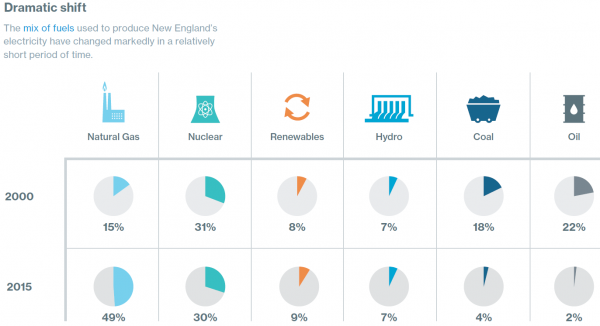
The region, the report says, hasn’t added natural gas pipeline capacity, despite the tremendous growth in natural-gas-fired generating capacity, coupled with growing demand from the heating sector. Thus, the system could be particularly vulnerable in the winter. The result is that existing pipelines are now running at or near maximum capacity at times, particularly in winter when nuclear in particular would pick up the slack. But nuclear is in steep decline with seveal plant closings. During times of high demand, gas-fired resources may have to pay high prices for fuel—if fuel is available at all.
One result of all this is that more coal, oil or oil-conversion (dual fuel with natural gas) plants might have to be employed. This could reverse the steep decline in pollutants seen over the last several years (NOX, SO2, and CO2).
It also turns out that the best day for solar generation in 2015 was May 23 (long sunny day and not too hot; solar PV-photovoltaics work best under cooler conditions).
The report explores the unprecedented changes currently underway in New England’s electricity industry:
 · In the next decade or so, New England’s power grid is on course to becoming a hybrid grid where up to 20% of the power system’s resources are made up of smaller power resources connected directly to retail customers or to local distribution utilities—and not the transmission sytem: http://www.iso-ne.com/about/regional-electricity-outlook/grid-in-transition-opportunities-and-challenges
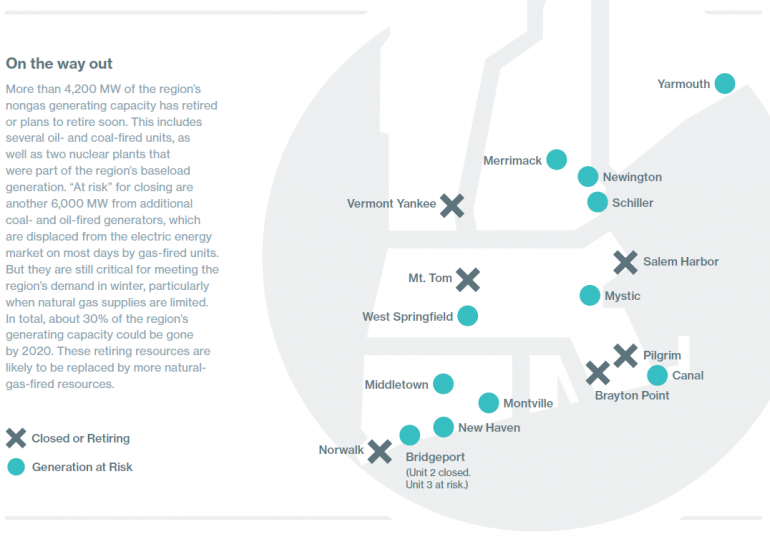
· More than 4,200 MW of the region’s nuclear, coal- and oil-fired generating capacity has retired recently or plans to retire soon: http://www.iso-ne.com/about/regional-electricity-outlook/grid-in-transition-opportunities-and-challenges/power-plant-retirements
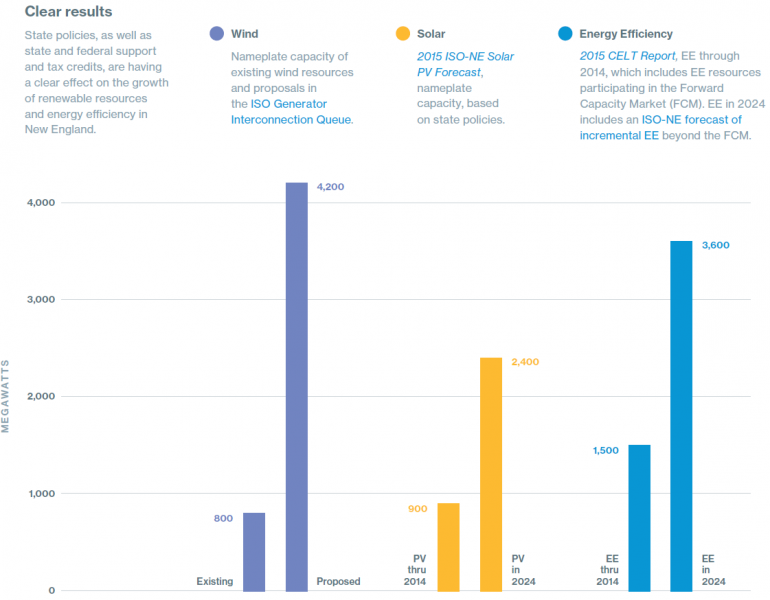
· A third of the approximately 13,000 megawatts (MW) of proposed generation projects are wind resources. But delivering that wind power from remote locations to consumers in load centers will require major transmission system upgrades and additions: http://www.iso-ne.com/about/regional-electricity-outlook/grid-in-transition-opportunities-and-challenges/integration-of-new-technologies
· Despite expected continued growth in demand for natural gas for both heating and power generation, New England has relatively few pipelines that can bring natural gas into the region and few delivery points for liquefied natural gas. : http://www.iso-ne.com/about/regional-electricity-outlook/grid-in-transition-opportunities-and-challenges/natural-gas-infrastructure-constraints
 Opportunities
- Natural gas resources and renewables are displacing less economic and higher-emitting resources in New England.
- The ability of many natural-gas-fired plants to change output quickly helps to balance an increasing amount of generation from intermittent power resources that rely on the wind and sun.
- Overall regional air emissions are down significantly. Between 1999 and 2014, nitrogen oxides fell by 66%, sulfur dioxide by 94%, and carbon dioxide by 26%.
- Wholesale electricity prices are being driven down—except when natural gas prices spike.
- Distributed generation may be able to help lessen the impact of local power outages.
- Smart grid technology and retail rate design changes will empower consumers to use electricity more efficiently and reduce their energy bills.
 Challenges
- Inadequate natural gas pipeline infrastructure is at times limiting the availability of gas-fired resources or causing them to switch to oil, which is creating reliability concerns and price volatility, and contributing to air emission increases in winter.
- Substantial nongas generating capacity is retiring, limiting the options for reliable grid operation when natural gas infrastructure is constrained.
- The weather-dependent output from wind and solar resources and the increase in DG adds complexity to how the ISO must operate the power system to maintain reliability.
- Expensive transmission infrastructure upgrades are needed to connect more wind and hydro resources.
- Efforts to meet state policy goals to inject more clean energy into the system through long-term contracts may undermine confidence in the markets and inhibit future investment in competitive power resources.
The 2016 REO is available on our website in two formats:
· A PDF of the entire report: http://www.iso-ne.com/static-assets/documents/2016/03/2016_reo.pdf ; or email [email protected] for a hard copy
· New webpages highlight and expand on information and statistics in the new report: http://www.iso-ne.com/about/regional-electricity-outlook/reo-report
Also available online is the New England Power Grid 2015–2016 Profile: http://www.iso-ne.com/static-assets/documents/2016/02/NE_Power_Grid_2015-2016_Regional_Profile.pdf. This two-page overview summarizes key facts on the region’s demand growth, resource mix, transmission development, and wholesale electricity prices.

Holyoke, MA—March 24, 2016—ISO New England