

by Howard Shaffer, PE In a recent press release, Vermont Speaker of the House Shap Smith made statements about Vermont Yankee groundwater management. His claims merit an informed response. First: The plant is shut down and not circulating any steam, or the water to make it. Groundwater is leaking into the basement of the turbine building. Do any houses in Vermont also have leaky basements? In a nuclear power plant, any water is “guilty until proven innocent” so must be sampled.
Second: The water activity is “slightly above the drinking water standard.” What does that mean for your health? It means that if you drink the standard amount, two liters a day, every day for a year there will be NO detectable effect on your body or health. This was developed by finding the NUMBER for the amount of tritium in water that WILL cause a detectable effect if you drink two liters of water every day for a year, THEN dividing that number by TEN. Remember that we evolved and live in a naturally radioactive environment, and there is tritium naturally in water. None of the tritiated water is drinking water.
Third: Through the majority of its operating life, the plant has NOT been discharging water to the river from radioactive systems, it has been recycling the water. The plant did this on their own from the beginning, to be good environmental citizens. The Nuclear Regulatory Commission issued a license to Vermont Yankee that allowed them to discharge to the river. Years later the plant committed to the state to not discharge to the river. Unless the license has been modified otherwise, the plant might be able to easily get rid of this water from the turbine building basement by discharging to the river. This would be a very inexpensive way to get rid of the water as trucking it off site is very costly.
Mr. Smith said Entergy is “raiding the decommissioning fund to pay its bills.” In fact, Vermont Yankee is $5 million under budget to date and has self-financed $145 million for the transfer of spent nuclear fuel from the spent fuel pool to dry cask storage. The solution for the basement water he criticizes is quick, low-tech, affordable, safe and effective. It is the kind of procedure one would expect from a safe, prompt, affordable decommissioning, maintaining the commitment to the state.
Mr. Smith further asserts that “Entergy had to take emergency action to store 90,000 gallons of radioactive water in swimming pools designed for family use.” Migrating groundwater has not been an “emergency” situation, but an expected part of the decommissioning process. As noted above, this water contains a low level of tritium. About a quarter of the 90,000 gallons were stored in the swimming pools, the rest isin industrial water storage containers.
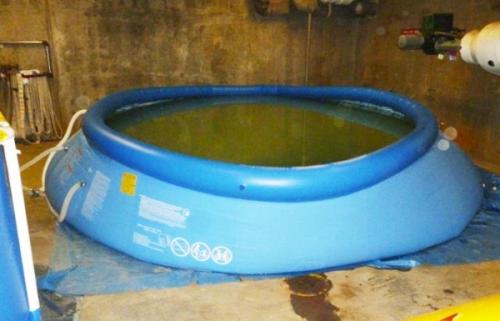 Water stored in pool. Vermont Yankee photo.
In late February Vermont Yankee sent its first truckload of water to a process and disposal facility in Tennessee. VY announced Thursday, February 25 to the Nuclear Decommissioning Citizen’s Advisory Panelthat 2-4 tankers of water are planned to be transported weekly. At that rate, the 90,000 gallons onsite now should be gone before the end of March.
The tanker trucks will be needed until the tritiated water source has been mitigated, and all the water removed. No tritiated water has reached the Connecticut River. Seepage is entirely inside the turbine building and poses no risk to public health and safety.
And finally, Mr Smith claims that “Entergy is not prioritizing use of decommissioning trust fund dollars for the cleanup of the Vermont Yankee nuclear site.” This is simply not so. Vermont Yankee’s solution to the water storage problem exemplifies prudent, safe, innovative use of precious decommissioning dollars. A true failure to prioritize would have been to 1) spend nothing by doing nothing or 2) over-react by spending unnecessary money and response time erecting non-portable onsite water tanks. Instead, VY employed a prompt, safe, cost-effective solution, showing itself a good steward of the environment and the trust fund.
Howard Shaffer, PE, of Enfield, NH, is a retired nuclear engineer who worked on the start-up at Vermont Yankee, and again later through Yankee Atomic Electric Co, Nuclear Services Division. He is a member of the American Nuclear Society and was their 2001 Congressional Fellow. He , attends most of the Nuclear Decommissioning Citizens’ Advisory Panel meetings and occasionally writes, speaks and testifies about Vermont Yankee decommissioning and other nuclear power issues.