

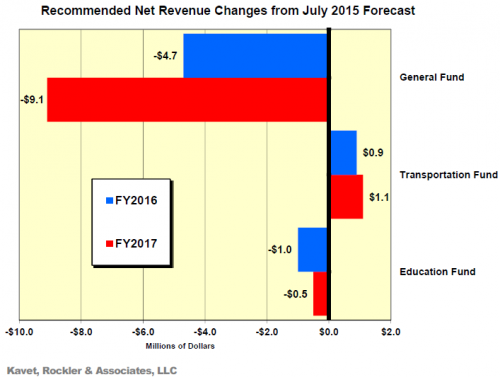
by Timothy McQuiston Vermont Business MagazineVermont state tax revenues are running about where economists expected them at this point in the fiscal year, now more than half over, but they announced today that they are downgrading projections for the year as a whole based on both a slight softening of the national economy and on continued uncertainty here in Vermont. They expect revenues to be lower by $4.7 million in fiscal year 2016 and $9.1 million in FY2017, than previously estimated.
Governor Shumlin said, “While this news makes our job a bit more difficult, it is manageable. I look forward to presenting a balanced budget to the Legislature and Vermonters on Thursday.”
That uncertainty has mostly to do with tax changes in the last couple of years, as well as the poor start to the ski season and how both personal and corporate incomes will come in in the fourth quarter of FY 2016.
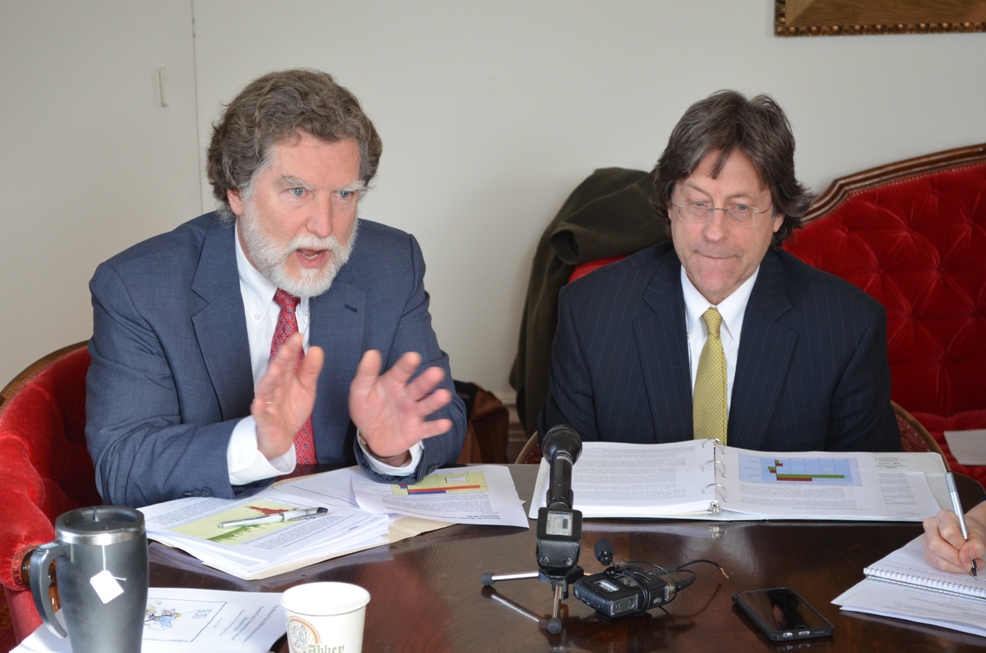
Economists Tom Kavet (on behalf of the Legislature) and Jeff Carr (for the Administration) presented their joint January 2016 Economic Review and Revenue Forecast Update to the Emergency Board Tuesday morning. The E-Board is comprised of the chairs of the Legislature’s four money committees and Governor Shumlin.
The economists report at least twice a year to the E-Board on current economic conditions and on their projections for tax revenues. The governor and legislators then use the information to construction the state budget and to tweak spending or taxes as needed, if revenues are not meeting expectations in the current fiscal year.
As Carr pointed out to the committee in regards to tax changes, “There’s always a greater degree of uncertainty.”
 For instance, the economists suggested last year at this time(but did not put into their forecast)that there would be an “April surprise” of windfall tax revenues because many taxpayers would be dealing with more bonuses and dividends on their tax returns. Sure enough, April turned out to be the biggest revenue month in the state’s history and created a small surplus at the end of the fiscal year (June 30).
A different kind of surprise will also impact revenues, but Carr is not certain when. Keurig Green Mountain is being acquired for $13.9 billion, or $92 per share from European holding company JAB. Keurig shareholders will vote next month on whether to accept the offer, which has full Keurig board support.
Already, shareholders are selling their stock at slightly below $92 to ensure they get at least a guaranteed premium on the shares, which had been trading around $50 before the December sale was announced. However, as Carr noted, the timing of when the sales close (now or at the time of acquisition sometime this quarter, if all goes well) will determine when people and companies who own shares will have to report the capital gains. It is likely that most of the tax revenues from the sale will happen during FY17. If so, they will not help legislators balance the budget this year, nor do they know what that windfall will look like next year, or whenever it might be, until after it happens.
Uncertainty can have a downside, as well,Carr noted. Refunds from last year carried over into the current fiscal year, pushing down overall Personal Income Tax revenues. He also said, in just adding to the uncertainty, that the Personal and Corporate Income taxes are assuming more and more of the total General Fund revenues; they are also relatively volatile revenue sources (compared to, say, the Sales Tax).
Kavet called the start to the ski season “terrible” and one that creates more uncertainty. For instance, the Sales and Rooms and Meals taxes from December have not been fully accounted for, so they don’t know exactly what the impact has been, though presumably it is bad. Also uncertain is how the rest of the season will go. Sugarbush, for one, reported a very good Martin Luther King Jr holiday weekend. The strength of the US dollar has, anecdotally, kept at least some Quebec visitors away.
Kavet wrote in his report: "Total State revenues have tracked exceptionally close to targets through the first half of FY16, but continued macroeconomic headwinds and technical revenue issues will result in very slight negative adjustments to General and Education Fund revenues, and comparably minor increases in Transportation Fund revenues, in FY16 and beyond. Although current revenues across all three funds through December were 0.18% above prior July projections, total forecast adjustments recommended herein are slightly negative, due to a poor start to the winter tourism season, continued global economic sluggishness, slightly lower than expected yields from new taxes and assorted technical issues associated with individual revenue categories.
"Across the three funds, the total revenue forecast recommendation is a mere 0.25% below prior July forecasts for FY16 and 0.44% below FY17. Minor Transportation Fund increases over the forecast period reflect slightly higher gasoline and diesel consumption as a result of lower prices and higher revenue from newer car purchases and associated registration revenues."
Carr explained that gasoline tax revenues may see a bit of a bump because gasoline prices are down, people may be induced to buy less fuel efficient vehicles and/or feel better about driving more. Gasoline revenues are derived from both a sales tax and a gallonage tax, so even if gasoline prices stay low and do not generate more on the sales side, if people are driving more they will be buying more gallons of gasoline.
Carr said one of the economists suggestions last year when gasoline prices started diving (gas was going for $1.95 per gallon in Montpelier on Tuesday) was that consumers would use that extra money to spend more and thus there would be an increase in things like the Sales and Rooms and Meals taxes because of it. But, he explained, it appears that consumers aren't consuming, but using that extra bit of cash for savings or to pay down debt. He said that people just aren't believing, yet, that prices at the pump will remain low.
National projections, however, suggest that the world oil glut, along with the strength of the dollar internationally, will continue to at least keep gasoline prices where they are. With sanctions lifting on Iran, which is the world's fourth largest producer of crude oil, prices could go even lower (though it is uncertain if Iran's lower quality of crude will have much of an impact immediately).
As of Tuesday, gasoline prices in Vermont averaged $2.03 per gallon (down from $3.75 in April 2014) and in the US averaged $1.87 ($3.70 April 2014).
National Trends
"Slow and steady, US economic growth in this recovery is beginning to make up in duration what it has lacked in both vigor and speed," Kavet wrote. "Now in its 78th month, the current expansion is among the longer expansionary periods in business cycle history (see chart on next page). As job growth has mounted with gains over the last 63 consecutive months, more than 13 million jobs have been created, the US unemployment rate has been pushed to 5%, and broader wage and income gains are finally in sight."
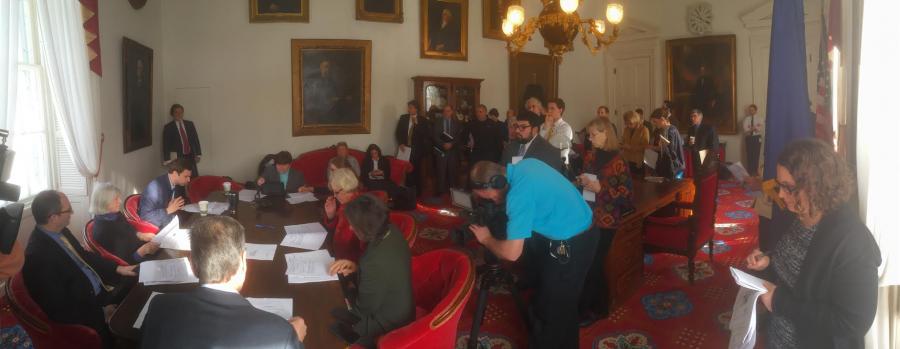 ABOVE: Treasurer Beth Pearce explains Vermont's allocation to the E-Board, whose meeting was held at the Governor's Ceremonial Office in the State House Tuesday morning. VERY TOP PICTURE: Tom Kavet, left, and Jeff Carr explain their joint revenueforecast to the E-Board. VBM photos.