

by Timothy McQuiston Vermont Business Magazine The Vermont Public Service Board gave a significant victory today to Vermont Gas Systems in its effort to build a pipeline to Middlebury, and in turn issued a significant blow to the many individuals and organizations seeking to stop it. The PSB, in a decision dated January 8, decided not to revisit its original approval of the project. The PSB had considered reopening the case after construction costs increased twice in 2014. If it had reopened the docket, it could have reapproved it as is, approved it with new conditions, or canceled the $153.6 million project.
Vermont Gas has already built about a third of the line in Chittenden County. It has incurred the cost of that, as well as the cost of a lawsuit involving a former contractor on the project, and other legal costs regarding challenges and protests.
Opponents of the project include AARP, which was advocating on behalf of existing ratepayers, landowners in the path of the pipeline, environmentalists and opponents of fracked gas, as some of the source of the natural gas will be from hydraulic fracturing.
One of the biggest boosters of the project is Governor Peter Shumlin, who sees it as both an economic windfall for Addison County homeowners and businesses and also as an environmental benefit over what he calls “dirtier” and more expensive fossil fuel alternatives.
Just Friday he asked a business group how many of the 200 in attendance would trade some fracked gas for other fossil fuels. No one raised a hand at the Vermont Chamber of Commerce’s economic summit in South Burlington, where the governor was speaking.
Meanwhile, reaction against the decision came swiftly.
Paul Burns, Executive Director, VPIRG, said in a statement: “While the world is turning away from fossil fuels, it appears that fracked gas continues to enjoy the warm embrace of the Public Service Board. This really is a terrible decision.
“VPIRG believes the evidence was clear that safer, cleaner and cheaper alternatives to fracked gas are available today. That means that the $154 million pipeline cannot possibly be in the public’s interest.
“It is also clear that as long as we allow the fossil fuel industry to sell its dirty product without paying a dime for the true cost of its pollution, we may continue to get flawed decisions like this one. It’s time to put a price on carbon pollution and return the revenues to Vermonters in the form of tax cuts and incentives for energy efficiency and renewable energy.”
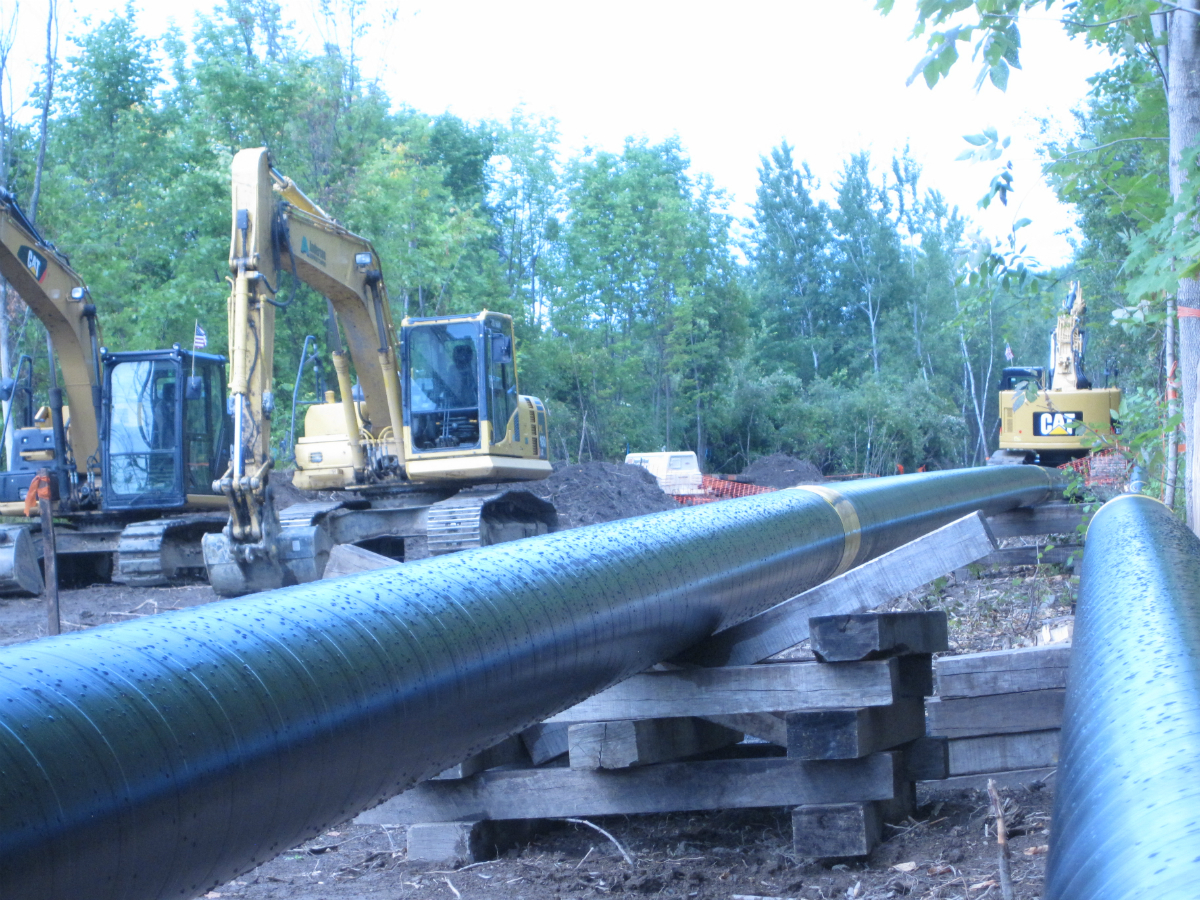
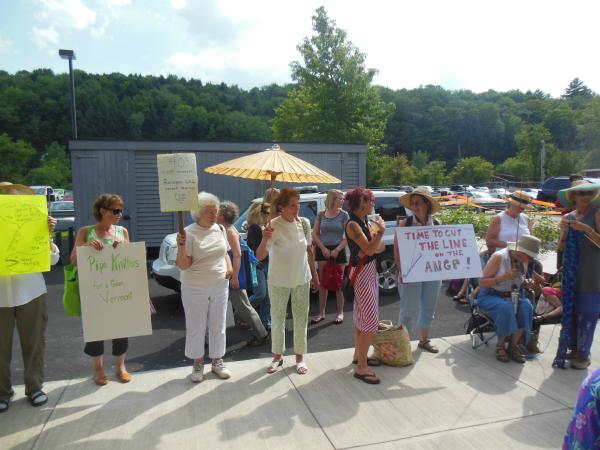 Above, construction under way in Williston and, left, protests at Vermont Gas headquarters in South Burlington in 2014. Vermont Business Magazine photos
Shaina Kasper of Toxics Action Center and Rebecca Foster of Just Power issued a joint statement saying: “Today's decision sheds light on the broken regulatory process. The ruling relies on vague statements from VGS about how itmightmitigateexorbitant rateincreases necessary to pay for the project and notes that those options will be addressed in a future rate case. However, VGScould have filed a rate request already. Instead, the company, with ardent support from DPS, extended its Alternative Regulation Plan anddeferred the costs of the first 11 miles of pipeline until next year. In other words, the latest cost increase could have been reviewed onthe basis of facts. Instead, customers are left with continued uncertainty about cost increases that will affect themdecades into the future.WhenDPS protects the utility rather than the publicthe regulatory processas a whole is broken.
“In 2011, VGS received special dispensation from the State topre-chargecustomers for what VGS said would be adistribution line serving businesses down Route 7 at a total cost of $60-70 million. Today, with a price tag of $154 million,rate increases that couldexceed15%, almost no price difference between fracked gas and oil,alternative home heatingoptions dropping in price, available compressed natural gas for commercial customers,and a dangerously high-pressuretransmission line thatcutsthrough prime agricultural land and sensitive wetlands, the projectand the conditions around itaresimply unrecognizable.
“With so much at stake for Vermonters’ safety, health, andeconomy, we today call on the Board to reverse its decision andappoint independent counsel to represent the public immediately. Vermonters deserve a fair and thorough review of thislarge-scale utility project. Under these circumstances, the only way the public good can be served isthrough effectiverepresentationby independent counsel – whetherbefore the Board or before the Supreme Court on appeal.”
As a final appeal, the Vermont Supreme Court could be asked by opponents to review the PSB ruling.
Meanwhile, Lieutenant Governor Phil Scott issued the following statement:
“I applaud the Public Service Board's decision allowing the Addison natural gas project to continue to move forward. Vermont Gas has done a good job getting this important infrastructure project back on track so more Vermonters, Vermont businesses like Cabot and Vermont institutions like Porter Hospital can benefit from cleaner natural gas and save money.
“I am particularly pleased that theiragreement with the Public Service Department caps the costs that can be charged in rates and that their efforts to renew discussions with landowners have resulted in agreementswith 161 of 164 landowners.
“Infrastructureprojects like this are an important part of making Vermont more affordable and growing our economy. I look forward to the completion of this project and remain hopeful Vermont Gas will apply the lessons they've learned to extend the choice of natural gas to more communities.”
Scott is running for governor this year.
On December 23, 2013, the PSB issued a final Order in which it granted a Certificate of Public Good (CPG) to Vermont Gas Systems, Inc to construct a natural gas transmission line into Addison County. Although a number of circumstances have changed since the original decision, the most significant of which was the much higher estimated cost of the Project. Vermont Gas also canceled an extension of the line to run under Lake Champlain to the International Paper plant in Ticonderoga, NY.
In its decision, regulators wrote in part, “The new evidence does not alter our conclusion that construction of the pipeline promotes the general good and is in the best interest of the state. In reaching this decision, we place substantial reliance upon the Memorandum of Understanding between VGS and the Department of Public Service and on VGS’s testimony to the Board, under which the potential rate impacts of the Project have been limited through VGS’s commitment to not seek rate recovery for costs in excess of $134 million (subject to limited exceptions, called the “Cost Recovery Cap”), even if actual Project costs exceed that figure.
“Originally, the Project was estimated to cost approximately $86 million. At that cost level, we found that the Project was needed to meet demand for service and had significant economic benefits for the state. Moreover, it would not impose large costs upon existing VGS ratepayers in the form of higher rates. Now, the estimate has risen approximately 78% to $153.6 million.1 Other changes in the energy marketplace have also occurred since our original Order: (1) declining oil prices that reduce the competitive price advantage of natural gas; (2) the availability of compressed natural gas (CNG) as an alternative to pipeline-supplied gas; and (3) the availability of cold climate heat pumps (CCHPs, which run on electricity), which may be more cost-effective for some customers than natural gas.
“Collectively, these changes raise significant concerns. The need for the Project has been affected by higher estimated Project costs and changes in the market, the anticipated economic benefits have been reduced, and there is a potential that existing ratepayers will be called upon to absorb rate increases in the 15% range (as compared to the 5% rate increase we found acceptable in the 2013 Final Order or the 10.1% increase we considered in the First Remand Order).
“We note that this proceeding is not an examination of VGS’s rates; before any increase in rates occurs, the Board will carefully scrutinize VGS’s request and evaluate the reasonableness of all Project costs, notwithstanding the Cost Recovery Cap (rates must be approved by the PSB). In addition, the Company has an incentive to control costs to keep the rate increase as low as possible, thereby optimizing the competitive price advantage of natural gas relative to other fossil fuels. The testimony nonetheless indicates that if the full $153.6 million cost of the Project were permitted to be recovered in rates, a 15% rate increase could occur, which would raise fairness questions.2
“The commitments contained in the MOU, however, materially alter the impact of the higher estimated cost of the Project. VGS has committed to a $134 million cap on the amount of the Project costs that it may seek to recover from ratepayers, reducing the potential rate impact from 15.1% to 12.2%. This figure is close to the 10.1% potential rate impact we found acceptable when we examined an earlier VGS estimate showing that the cost of the Project was expected to increase from $86.6 million to $121.6 million. By reducing the potential rate impacts of the Project, the Cost Recovery Cap also has the effect of improving the economic benefits of the Project relative to the benefits that were projected assuming that the full $153.6 million in estimated costs were flowed through to ratepayers. A lower rate impact also helps preserve the price advantage of natural gas relative to fuel oil and propane, which is part of the source of demand for the Project. Critically, in answers to our questions, VGS testified unambiguously that its commitment to cap its future recovery of Project costs was not only to the Department but was to the Board and other parties as well. The Board relies upon VGS’s commitment to us in evaluating the impact of the MOU on future rate recovery. After weighing the impact of the MOU and the evidence presented by the parties, we find that reopening our original approval is not warranted. The evidence shows that, with the Cost Recovery Cap, it is unlikely that, if we reopened, we would reach a different conclusion applying the standards of Section 248 of Title 30 than we did in either the 2013 Final Order or in the First Remand.”
PSB FOOT NOTES:
1. On December 19, 2014, VGS disclosed that the estimated Project cost had risen to $153.6 million (the “Second Update”). Earlier, in July 2014, VGS had notified the Board that the estimated Project costs had increased to $121.6 million (the “First Update”). In response, the Board obtained a remand from the Vermont Supreme Court and held further proceedings pursuant to Rule 60(b), V.R.C.P. to determine whether to reopen the 2013 Final Order (“First Remand”). After hearings, the Board issued an Order on October 10, 2014, in which we declined to reopen the 2013 Final Order (the “First Remand Order”). In the instant proceeding, we are considering the Second Update. To do this, the Board requested and obtained from the Supreme Court a second remand of the pending appeal of the 2013 Final Order. In this Order, we refer to the current phase of the proceeding as the “Second Remand.”
2. Throughout this Order, we discuss the potential rate impacts of the Project. These potential impacts do not necessarily reflect the actual rates that will occur. They are based upon the assumption that VGS’s costs would be recoverable in rates, that VGS would seek to increase rates to recover these costs and earn its allowed rate of return, and that the existing rate designs are employed. At this time, we are not determining that any of these factors are actually true. For example, VGS has suggested that it might not seek to recover all costs or that it might vary the rate designs. Nonetheless, in assessing the merits of the Project, it is necessary to evaluate the potential rate impacts in light of the information that is available. The findings reflect VGS’s testimony concerning potential rate impacts, which was not contested by any party.