

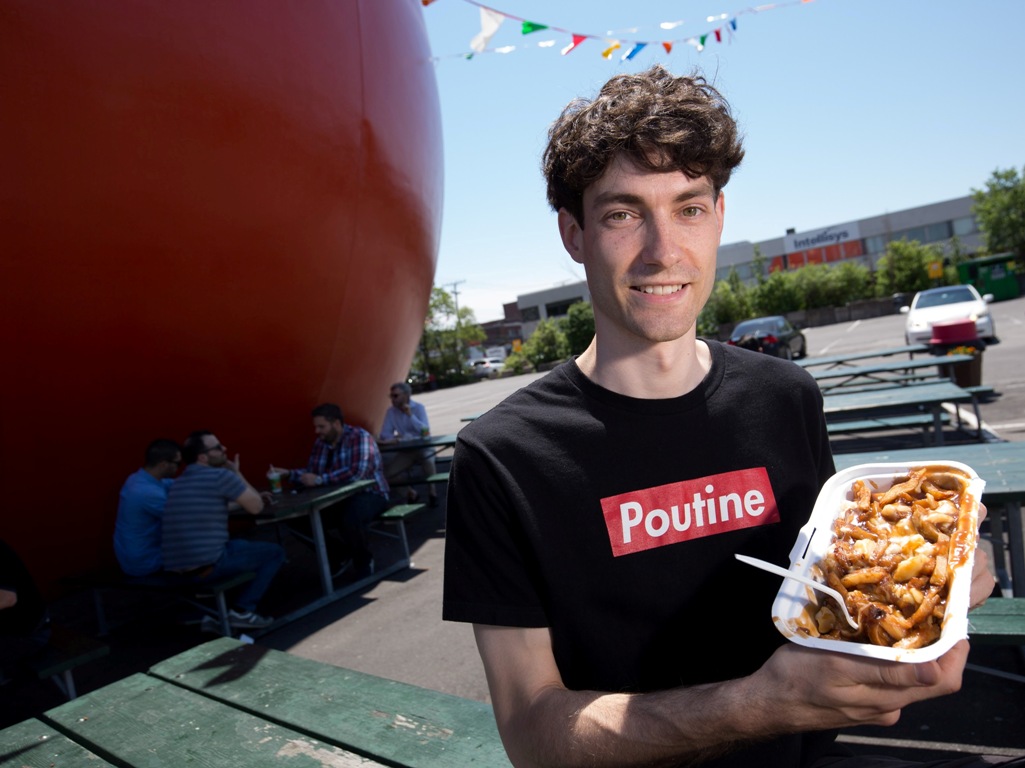
Nicolas Fabien-Ouellet, a student in the University of Vermont's Food Systems Master's program, with an order of poutine from Orange Jules in Montreal. A scholarly paper by Fabien-Ouellet arguing that the Quebeçois dish has been culturally appropriated by the larger Canadian society received wide attention in Canadian and US media. (Photo: Owen Egan)
Vermont Business Magazine NicolasFabien-Ouellet, a Master’s degree student in UVM’s Food Systems Graduate Program, has been all over the news recently, both in his native Canada and in the US. The cause of the media’s feeding frenzy? A savory Quebeçois concoction made of french fries, gravy and cheese curds called poutine, which Fabien-Ouelette says has been the victim of cultural appropriation.
Once mocked by Canadians as declassé junk food favored by the lower strata of Quebec’s French-speaking community, poutine is now routinely celebrated as Canada’s national dish. That transformation absorbs, dilutes and ultimately weakens the culture of the Quebeçois minority that created the dish, Fabien-Ouelette contends.
Poutine's elevation in status and its cultural implications had been of interest to Fabien-Ouelette, a Montreal resident with an undergraduate degree in bio-resource engineering from McGill University, for some time.
But it was an event in Washington, DC, several months after he started at UVM that really piqued his scholarly curiosity.
Poutine was on the menu – presented as an emblematic Canadian dish – when Justin Trudeau, Canada’s new prime minister, visited with then President Barack Obama in March 2016.
“I was very curious about how poutine got to the White House” during an official Canadian state visit, Fabien-Ouelette says.
He began tracking poutine references in Canadian and U.S. print and online media, on TV shows and radio talk shows.
“Everywhere I could find people talking about poutine, they were presenting it as Canadian.”
In search of a substantive topic for his first major paper in the program, this one seemed perfect. His advisors agreed. They liked the final product so much, they encouraged him to submit the paper to a journal for publication.
In December,Poutine Dynamicsappeared in the peer-reviewed, open-access journalCuiZine:The Journal of Canadian Food Cultures,and Fabien-Ouelettewas invited to present the paper at the Congress of the Humanities and Social Sciences at Ryerson University in Toronto.
Then all heck broke loose.
A leading Canadian newspaper,The National Post,interviewed Fabien-Ouelette andpublished the first story.Radio Canadawasn’t far behind.VICE, the online culture magazine, and theHuffington Postcame shortly after, then a host of live TV and radio shows, thenSeven DaysandVermont Public Radioin Vermont.
“I knew that the concept of cultural appropriation would be of interest, but I could not have predicted that I would have to wake up every morning to a live interview show or go to live TV or do interviews over the phone for a week nonstop,” he says
All told, more than 30 stories on his paper have appeared to date.
Far from being bothered, Fabien-Ouelette is grateful for the attention. “I’m just happy that the findings of the research are getting to the general public and don’t just stay in scholarly circles,” he says.
One important question is left unaddressed in his paper, however. What's the best poutine in the Burlington area?
“The Mule Bar is good,” he says of the popular Winooski watering hole, adding that he hasn’t tried all of the Queen City’s offerings.
“But always, the best poutine is the one you share with your friends.”
And ascribe to its true cultural origins.
Source: UVM 6.9.2017