

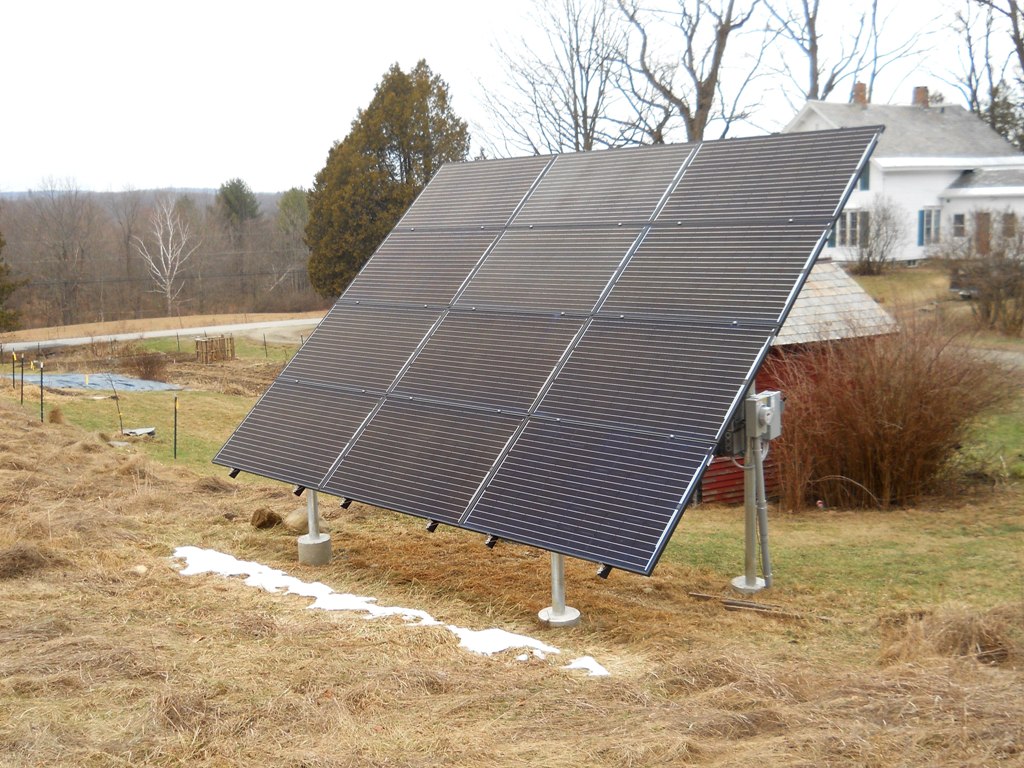
A home-based solar installation in Poultney. VBM photo.
by CB Hall Vermont Business Magazine Representatives of Vermont's solar industry are for the most part looking to the future with cautious optimism, hoping that the established nature of the no-longer-novel industry will serve as a bulwark against policies that the administration of President Donald Trump, with its skeptical view of renewable energy, might impose.
“The solar industry nationwide has garnered broad bipartisan support because of the job creation and the low-cost energy we are producing – making it very difficult to see a Republican-led rollback against our industry,” Andrew Savage, chief strategy officer at Williston's AllEarth Renewables and a member of the national Solar Energy Industry Association's board, told VBM.
 A large, 2.2 MW utility-sized AllEarth solar farm in South Burlinigton. VBM photo.
AllEarth manufactures a dual-axial tracker that allows solar panels to follow the path of the sun at the angle most conducive to energy production.
Among the federal policy issues that loom uncertainly on the horizon is the so-called investment tax credit available for the installation of solar systems.
Under legislation enacted in December, that tax credit will remain at 30 percent for solar systems installed before 2020; it will then decline incrementally, and, in 2023, disappear completely.
The extension of the credit program, established in 2005, will help keep solar installers busy, but pronouncements by President Trump suggest at least the possibility that the tax break could be rescinded.
Solar industry representatives minimize that possibility, however.
“It's not changing our goals,” said Emily McManamy, spokeswoman for Waterbury's SunCommon, the state's largest residential-solar installer. “If anything it creates a greater sense of urgency for people to go solar now, when these incentives do exist.”
“We're used to changes in the solar industry, so we continue to innovate.”
 SunCommon solar canopy at Hunger Mountain Co-op with Governor Scott. SunCommon photo.
After five years in business, McManamy said, SunCommon employs 70. Looking to the future, she saw promise in Governor Phil Scott's continued commitment to ambitious renewable-energy goals. On January 9, Scott joined SunCommon for the roll-out of the company's latest innovation, a sun canopy installed at Montpelier's Hunger Mountain Co-op.
Suitable for a carport, for example (SEE STORY), the canopy consists of a timber frame structure supporting a roof fitted with bifacial solar panels, which absorb light from both front and back. When snow covers the canopy, the underside of the panels still produces power from the sunlight reflected off the surrounding snow.
At the roll-out event, the new governor stated his support for maintaining the goal, first articulated under the Shumlin administration, for using renewable sources to provide 90 percent of the state's energy by 2050.
“He recognizes that solar plays a large role in strengthening our economy and growing our workforce,” McManamy said.
Crucial to an understanding of the solar energy market is its division into four more or less distinct categories: development by utilities, independent solar farms that sell to utilities, residential installations on rooftops and in backyards, and so-called community solar, meaning installations with 15 to 150 kilowatt-hours of capacity. Community solar typically serves households and small businesses that may not have the space or other prerequisites for placing solar panels on their property.
Also crucial to that understanding is the concept of ownership of the renewable attributes of a given type of energy.
While the electrons pulsing through the nation's electric grid are fungible goods, the producer of each source of those electrons may claim title to their renewable characteristics, if the power generation in question is solar or wind, for example.
That power can then be bought and sold with those attributes, which generally translate into a premium over the price of power coming from coal, for instance.
Under the practice through 2016, solar power producers, including both solar farms and backyard and rooftop solar arrays, could send their electrons to utilities for a premium price 5 to 6 cents per kilowatt hour above what utilities charge their customers for the power that the companies sell – roughly, 20 cents as opposed to 15 cents.
The extra pennies represented the extra value solar provided to all ratepayers – meaning, notably, a reduction in costs at times of peak usage, when the utility might otherwise have to buy power off the open market at a very high, opportunistic price.
For new power sources coming on line this year and thereafter, that arithmetic will however change under a Public Service Board (PSB) interim order that is awaiting finalization as a permanent rule.
The utilities will only pay producers 3 extra cents per kilowatt hour for net-metered solar, so as to acquire so-called renewable energy credits (RECs) – a commodity created by state law – which can be used to meet goals for increasing the share of renewables in the utility's overall power mix.
In lieu of getting the 3 cents, producers can retain ownership of the electricity's renewable attributes, but they will then lose an additional 3 cents – meaning the sacrifice of 6 cents in income, all told.
The RECs, of which there are many categories under the laws of multiple states, are a very marketable commodity.
In an email interview, James Gibbons, director of policy and planning at the Burlington Electric Department, stated that “the price differential between RECs from various types and ages of generating units ... allows for arbitrage in the regional REC market. In 2015, for example, the Burlington Electric Department sold all of the RECs from its wind-generated sources at a premium price – then bought cheaper RECs that are still, however, classed as renewable (in this case from older, small hydro units). That allowed BED to meet its goal of 100% renewable sourcing.”
The Burlington utility, he added, “does not expect this type of opportunity to exist forever, but it has allowed for BED to secure long-term contracts for renewable resources, while limiting the initial rate impact.”
In time, as the percentage of renewables in the energy supplied to customers increases apace with stiffer state requirements, “BED anticipates relying less and less on this form of arbitrage,” he stated.
Net-metering got its start some 10 years ago with Green Mountain Power, the state's largest electric company – and the only one which is investor-owned.
GMP found that a 5- to 6-cent “solar adder” tacked on to the price of power sold to Vermont's households was commensurate with the solar attributes' value to the utility. The state subsequently mandated that premium for all the state's utilities.
Savage credited GMP for its “early leadership role” in Vermont's solar industry.
“Their diligence in showing how solar could shave the utility's peak and thus save all ratepayers money was easily the single most important factor in igniting our state's solar industry,” he said.
GMP spokeswoman Kristin Carlson explained her company's modus operandi thus: “Is [a solar project] cost-effective for our customers, and how will this help us reach state renewable energy goals?”
GMP has been able to reduce its rates three years out of the last four, she said, and while net-metering means buying above the market price for energy, in other cases solar projects help reduce prices. Amplifying that point, she mentioned the recently completed solar installation at Essex Junction's GlobalFoundries plant, where electricity is being generated at about 10 cents per kilowatt-hour, or half of what the utility pays for net-metered solar.
“GlobalFoundries uses some of the power, while the remainder goes into the grid,” she said. (STORY)
The rate-reducing impact should continue in the future, as more and more solar comes on line and adds to the power supply.
 GMP's Stafford Hill solar and storage facility in Rutland. GMP photo.
Solar power's cost has already come down “dramatically,” Carlson said, now costing about a third of what it cost to produce in 2009.
Among the innovations GMP has brought to market is the pairing of solar generation with battery storage. The utility pioneered that technology nationally, Carlson said, when it launched the Stafford Hill Solar project at a decommissioned landfill in Rutland in 2015.
Energy at that facility is stored in batteries and then discharged to the grid during peak-usage spikes, when energy prices soar. On the hottest day of 2016, Stafford Hill saved $200,000 in costs of purchased power in a single hour – costs that otherwise would have been passed on to power consumers.
“That's the exciting promise,” Carlson said of the Stafford Hill project.
GMP is intent on pushing back the limits of what the term electric utility has traditionally meant.
In a December press release, the company announced the launch of a program – the first of its kind nationally, Carlson said – to sell consumers an “off-grid package.”
In return for a flat monthly fee, the package covers the installation and maintenance of off-grid systems. This reduces maintenance costs of often outdated infrastructure, to say nothing of reducing demand for expensive grid power when hot weather sends droves of Vermonters to their air conditioners.
The solar industry frontier encompasses not only new technological solutions, but also new business models – such as the one SunCommon embraced in January in launching what it termed a partnership with Sustainable Energy Development of Ontario, NY.
In a press release, SunCommon co-founder James Moore described the collaboration as “combining the expertise of the newly-branded New York team in the commercial and utility space with the Vermont team's expertise in the residential and Community Solar markets.“
“With SunCommon’s expanded reach, 800 New York households and businesses will shift to clean energy by going solar with SunCommon’s Rochester-area arrays this year,” the release stated.
“As Vermont closed the door to the program, New York opened theirs – so here we come,” SunCommon co-founder Duane Peterson explained the deal's business logic, alluding to the substantial crimp that the siting restrictions in the PSB's new net-metering order have placed on community solar development.
For AllEarth Renewables, too, places beyond Vermont's borders beckon. Since its founding in 2008, the company has both installed solar systems in Vermont and manufactured its solar tracker for the nationwide market – and sold some 4,500 of them.
As the industry has continued to grow across the country, Savage said, his company has in the last two years “focused on expansion into new markets and growing our dealer network nationally."
As the solar sector evolves, the expansion of this once very localized industry into the national sphere appears inevitable.
California's SolarCity, which employs more than 10,000 people, opened a Burlington base in 2015, and already employs 80 in Vermont, according to a SolarCity spokesman.
Asked about the challenge from SolarCity, which focuses on residential installations, McManamy said, “We're not concerned about that,” stressing what she perceived as the greater diversity of products and services that SunCommon offers.
But it's not just major players like SunCommon, GMP or SolarCity that are working on the next big thing in solar.
Norwich-based Solaflect has developed an innovative solar tracker supported by cables rather than a heavier steel-truss structure. Solaflect president Bill Bender described the product as “much more material-efficient” than competing trackers.
“It gets rid of a lot of steel,” he said.
 Norwich-based Solaflect community solar project. Solaflect photo.
He noted that the tracker forms part of about half of all solar installations in Norwich, where, he said, 17 percent of all households now utilize some sort of solar power source.
Solaflect is marketing the device in New Hampshire and Massachusetts as well as Vermont. Bender declined to share sales figures.
Unlike others interviewed for this article, he expressed some skepticism about his industry's immediate future in Vermont, citing several worries for solar developers.
“The federal policy is very much up in the air. There's a very strong presence of fossil fuel interests in this [Trump] administration.”
“From a state perspective, there's been a modest reduction in the incentives for residential solar,” he said, referring to the new PSB order and its 3-cent provision.
Like SunCommon's Peterson, he also decried changes to the rules on siting solar projects as a substantial hindrance.
“The state policy makes it much more expensive and challenging to build” community solar, he said.
Most industry representatives interviewed for this article struck a confident tone, however, that underscored the status of the solar industry:
Whatever the twists and turns of government policy, no one any longer views solar as a trivial enterprise that the whims of those in high places will be able to sweep away, much as President Ronald Reagan, in 1986, ordered the removal of the solar panels that his predecessor, President Jimmy Carter, had installed on the White House roof.
And Vermont has seen a disproportionately large part of the sector's growth, with more than one solar industry job for every 500 Vermonters, a rate about three times the national ratio, according to 2015 statistics from the Solar Foundation, a Washington-based nonprofit advocacy organization.
Nationwide, according to the federal Energy Information Agency, solar added more new electric generating capacity in 2016 than did any other single source, such as hydroelectric or natural-gas plants.
“The solar industry is not a boutique industry any more, but a major player in the production of new energy and creating local jobs,” said Savage.
As McManamy put it, “The sun continues to shine.”