

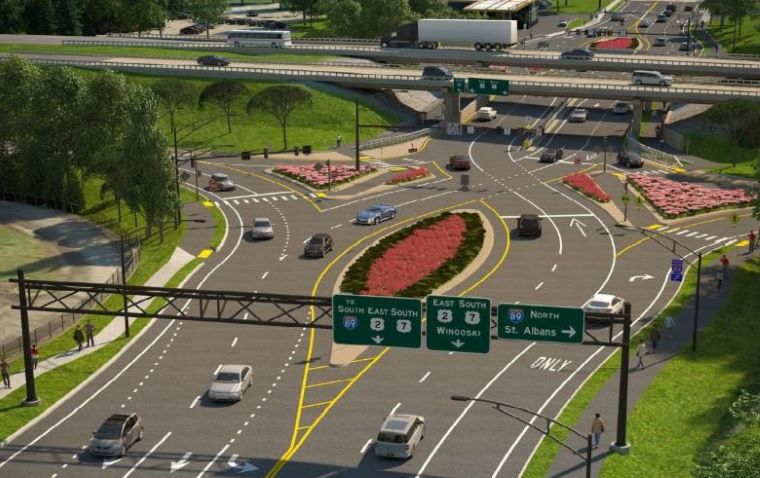
Renderings courtesy VTrans.
by C.B. Hall, Vermont Business Magazine
Two major roadway improvement projects in the Burlington area — the Exit 16 Diverging Diamond Interchange (DDI) in Colchester and the Champlain Parkway Project in Burlington — will continue apace this spring, despite pending litigation seeking to either halt or alter the plans.
The $19 million DDI project, which aims to reduce traffic congestion along the US 2/7 corridor near I-89 Exit 16, is currently in the preliminary stage. For the next several months, workers from SD Ireland Brothers will move utility lines and install retaining walls under the interstate bridges “to provide room for nonvehicular users to stay clear of the roadwork coming in Phase 2,” according to Mike LaCroix, project manager at the Vermont Agency of Transportation. Motorists should expect significant impacts on traffic during daytime hours, he added.
The core of the Phase 2 work will involve reconfiguring the existing tight diamond interchange to a diverging diamond interchange. When the project is complete, traffic on US 2/7 will cross over to the left side of the roadway so as to facilitate left-hand turns onto the interstate’s ramps without left-turn lanes, dedicated left-turn signals or the necessity for motorists heading in the opposite direction to wait while spewing carbon-rich fumes until the left-turn phase of the traffic signals ends.
As of now, being stuck at a light (and often having to sit through more than one) is a matter familiar, for example, to anyone leaving the nearby Costco and heading onto I-89 southbound. At each traffic light in the redesigned interchange, all vehicles will instead proceed straight ahead, simplifying and speeding the traffic flow and reducing the incidence of accidents. LaCroix said the intersection currently sees 24,000 vehicles pass through every day and ranks eighth in Vermont in number of crashes.
To facilitate the necessary work, the state “amicably” acquired portions of adjoining private properties, except in the case of the Hampton Inn and the Maplefields and Champlain Farms convenience store/gas stations, LaCroix said. Owners have appealed the condemnations of their property to the Vermont Supreme Court, which is expected to issue a decision soon, he added.
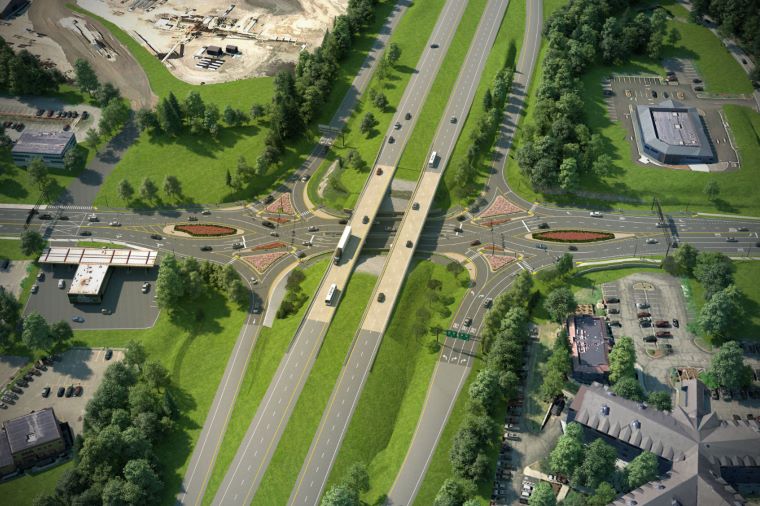
Rendering looking north on I-89, Exit 16, in Colchester.
That litigation follows extensive legal wrangling over environmental aspects of the project, whose original plans are now 11 years old. LaCroix said current work on the first phase of the two-phase project can continue unabated while the litigation is pending.
That work “would be required to occur prior to any other interchange work anyway,” LaCroix said, alluding to possible Plan B remedies to the interchange’s problems. “With the cost of construction soaring, putting (the first phase) out to bid separately now ... will save time and money later on.”
Further, the current work is occurring within the state-owned right-of-way, while the private property will only enter the picture in subsequent work. Assuming the implementation of the current DDI design, LaCroix expected the project to be completed sometime in 2026.
Champlain Parkway, Burlington

Photo: The green line shows the Champlain Parkway proposed route starting at the I-89/Route 7 intersection and following the partially built connector from the 1990s to eventually link up with Pine Street to the north at Lakeside Avenue. City of Burlington image.
The Interchange 16 project cost and longevity pale beside those of a public works undertaking not too far away: the Champlain Parkway in the South End of the state’s largest city, Burlington.
In 1965, the Vermont Department of Highways, now known as the Vermont Agency of Transportation, recommended building the Burlington Belt Line, a four-lane freeway running the length of the Queen City. Over the years, the plans underwent a reduction in lanes to two, a major route change to bypass a Superfund site, two name changes and at least seven environmental studies — and no shortage of community opposition, sometimes in the form of litigation.
Opponents have argued that the 2.8-mile roadway has been planned without sufficient or current information, would attract more traffic to southwestern Burlington and would disproportionately affect low-income residents and racial minorities.
One lawsuit still awaits a decision from the Vermont Supreme Court. Originally filed in 2018 by the Pine Street Coalition, a group of Burlington and some South Burlington residents, that suit seeks to keep the project out of the low-income, racially diverse neighborhood at the north end of the parkway, as currently proposed.
“We believe that the project should go north on Pine Street only to Kilburn Street and then veer to the west on the REP (Railyard Enterprise Project), or there should not be a project at all, because of environmental justice issues," said the coalition’s Steve Goodkind, a retired city engineer who once managed the Champlain Parkway project under Mayor Peter Clavelle.
The REP, still in the planning stages, would, after the parkway was completed, divert much of that new traffic to an alignment alongside the state-owned Burlington Railyard. Last June, the Vermont Racial Justice Alliance and several other organizations filed an amicus brief in US District Court for the District of Vermont in support of the Pine Street Coalition suit.
The court subsequently issued but then lifted a temporary restraining order delaying commencement of the parkway work in response to the suit, thus allowing crews to begin removing trees to carve a path for a southern segment of the parkway, between Home Avenue and Sears Lane.
 Photo: Champlain Parkway rendering looking north from Home Avenue. City of Burlington image.
Chapin Spencer, director of the Burlington public works department, said the city has prevailed on all six appeals to date and is confident it will successfully beat back future challenges. A court decision on the merits of the suit will likely be rendered by early summer, he added.
“This project is not perfect,” Spencer conceded, but added, “What started out as a four-lane high-speed highway has become a two-lane, 25 mph city street. … “A lot of people in the city have collectively worked ... to achieve the downsized design.”
Burlington Mayor Miro Weinberger said in a statement last December that he found it “pretty remarkable” that the project, now in its sixth decade, is still facing legal challenges.
“We are going to have to find a better way,” Weinberger said, “to make infrastructure decisions in the years ahead to build key infrastructure projects like all the new wind turbines, solar installations and distribution lines that are going to be necessary to restructure society and end the climate emergency.”
Animations on the project’s website show what travel on the existing streets will look like after their transformation into the northern part of the 2.8-mile thoroughfare. The animations also depict travel on the roadway to be built from scratch in the southern portion of the route — a broad, tree-lined right-of-way that resembles a parkway. The entire route will have a 25-mph speed limit.
The project’s vicissitudes have matched changes in American culture, moving from the 1960s’ unquestioning love of automobiles to today’s complete-streets concept, whereby transportation facilities must balance the needs of all concerned parties, be they bicyclists, pedestrians, motorists or local residents.
When more construction-friendly weather returns in April, Spencer said, crews will continue work on the roadway between Home and Sears.
This summer, that work will continue north to Lakeside Avenue. Rehabbing of the existing roadway will also take place this summer on the route’s eastward jog along Lakeside to Pine, and on Pine as far north as Kilburn Street.
The initial work does not include the northern part of Pine — in the neighborhood affected by the litigation — or the portion south of Home Avenue that will eventually hook up with the I-189/US 7 intersection, the route’s southern terminus.
Spencer said that the city had spent about $15 million on the parkway project since taking it over from the state in 1998. The current phase of construction, from Kilburn to Home, carries a price tag of $45 million, including a 10% contingency, he added.
Spencer estimated that the construction remaining thereafter would cost $18 million to $20 million, with the entire project winding up in 2027.
“I’d say we are on schedule,” he said.

Photo: Remnants of the old connector remain, seen here near the Route 7 end of what would be the new Champlain Parkway. VermontBiz file photo.
C.B. Hall is a freelance writer from Southern Vermont.
