


Vermont State Auditor Douglas R Hoffer. Photo: Baldwin Photography
by Joyce Marcel, Vermont Business Magazine If you’re in state government and your agency or program is running well, State Auditor Douglas R Hoffer’s work is an affirmation that you’re doing a good job. If your agency or program isn’t running well, he’s the last person you want to see.
And if you’re a taxpayer — and aren’t we all? — you can thank your lucky stars for Hoffer and his staff because all of us want our hard-earned tax dollars to be spent wisely and well.
The mission of the auditor’s office “is to hold state government accountable by evaluating whether taxpayer funds are being used effectively and identifying strategies to eliminate waste, fraud and abuse.”
“Basically, we have no authority to compel anyone to do anything except provide documentation,” Hoffer told VermontBiz. “But we end up with findings, conclusions and recommendations. And you can hope that we’ve made the case and that administrators and policymakers will accept and implement our recommendations.”
His mission sometimes makes him unpopular, but that is of no concern to Hoffer.
“I’ve always been a pain in the neck,” Hoffer said. “I didn’t take the job to make friends. As someone who believes that government has an important role to play, I want to believe that government is doing a good job. And I want to remind people that contrary to what they may think, government is not the problem. We’re not riddled with corruption and incompetence. That’s not who we are.”
The state has only five elected positions mandated by Article 48 of the Vermont Constitution: a governor, lieutenant governor, treasurer, secretary of state and auditor of accounts. This gives Hoffer, 71, the stability of an elective office; he first ran in 2010 and lost. He came back two years later, ran again and won — and has been serving ever since.
The state auditor’s job has three important functions: The first two — preparing the state’s financial statement audit and the compliance audit — are time-consuming, technical and, in Hoffer’s words, “kind of boring.”
“But they need to be done, so we farm them out, and that’s what we’ve done for about 25 years,” he said.
The third responsibility area — conducting performance audits — holds much more interest for Hoffer. They are a means for looking deeply at how a chosen part of state government is operating.
“We look at how policies are implemented and whether they’re effective and cost-effective,” Hoffer said. “After that, I can’t compel anyone to do anything, which is probably a good thing. We are the only part of government that tries to hold government accountable.”
With a budget of slightly under $4 million and a staff of 16 — including Hoffman’s deputy, Tim Ashe, former president pro tem of the Vermont Senate — the auditor’s office has its work cut out for it.
But the results have been impressive. Last year alone, according to Hoffer’s annual report, the office:
Uncovered $7 million in ineligible payments in the Agency of Human Service’s COVID health care provider grant program; in one example, a provider overstated its need by $1.5 million by submitting duplicate expenses.
Found, during an audit of the Criminal Justice Council’s law enforcement officer training oversight, that “some law enforcement agencies could not prove their officers were receiving the amount and type of training required by state law.”
Discovered $16.3 million in potential savings to the state employees’ health care plan without any benefit reductions. “Though neither the Legislature nor the administration made any effort to pursue the matter in 2022, we hope the anticipated 11.45% premium increases will prompt action in 2023,” the report said.
Found, during an audit of the Department of Environmental Conservation’s Dam Safety Program, that many dams in the state aren’t receiving their required inspections, “even when they are in bad shape and their failure could lead to loss of life or major property damage.” When the department was presented with the results of the audit, it added $2.3 million to the budget for dam inspections.
Concluded the Department of Corrections’ inmate grievance process was not effective, “which jeopardizes the life, health and safety of staff and incarcerated individuals.”
Quantified for the first time the total effort that state government has made in recent years (FY17 to FY22) to combat homelessness. “We conclude that Vermont has spent more than $455 million in the last six years,” the report said.
Found numerous weaknesses at the Department of Labor after a vast hack of its computer systems exposed Vermonters’ personal information such as social security numbers, biographical details and work history.
Issued an analysis of the way the state measures its performance, “highlighting the main improvements needed to make it useful to citizens to hold their government accountable.”
Testified in numerous legislative committees, “resulting in actions that reduced the risk of improperly spending tons of millions of federal funding.”
Then there are the TIFs (tax increment financing), a creative way of financing large infrastructure projects that allows municipalities to borrow by redirecting future property taxes toward a project and then paying back the debt once a project is completed.
Just last month, the auditor’s office issued a report announcing that the city of Burlington has made “numerous errors” in the infrastructure financing of its Waterfront TIF District. As a result, the city owes the TIF district $1.2 million and the state education fund $197,510.
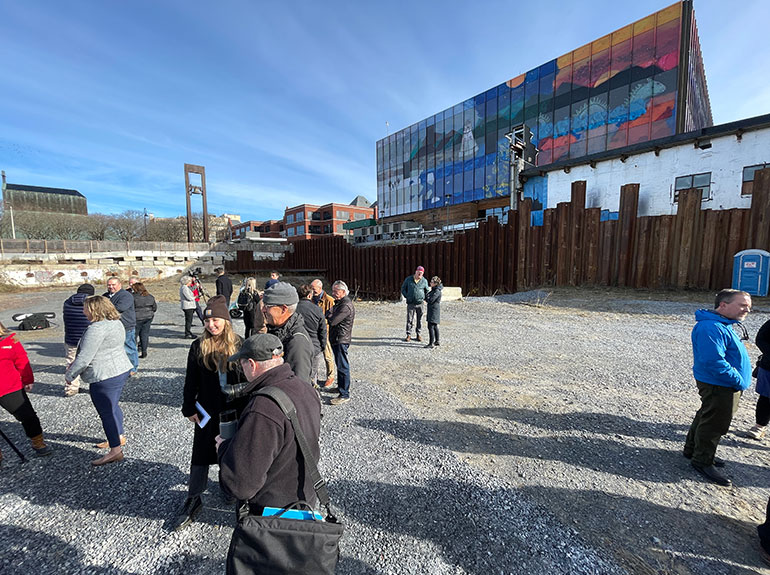 Photo: CityPlace Burlington broke ground last fall after several arduous years in which the former downtown mall was demolished and laid bare. The development is part of the city's Waterfront TIF district. VermontBiz photo.
In a statement released shortly after the report was released, Burlington Mayor Miro Weinberger acknowledged “significant errors” and pledged to take “prompt action” to address them. However, he disputed the state education fund debt.
Although the press attention after his office released the report made Hoffer uncomfortable, another of his office’s reports last month — one that included a sheriff in Caledonia County awarding staff bonuses totaling $400,000 before leaving office and another about a sheriff’s violence toward a suspect — exploded in the Vermont media and, along with a few other irregularities, has caused the Legislature to study the possibility of adding oversight to the sheriff department structure.
Hoffer’s main interest in doing this work is to open conversations.
“As is the case with all the work we do, I’m naive enough to think, ‘Hey, this is interesting information,’” Hoffer said. “It should encourage people to act, to scratch their heads and say, ‘We should have a conversation about this.’”
Hoffer is frequently viewed as something of a gadfly, said Roberta Harold, a management consultant and a former state director for USDA Rural Development. She first worked with Hoffer when he was an independent policy analyst.
“I think at times, various departments of state government — various executive offices of government, both Democrat and Republican, kind of wish he would go away,” Harold said. “And he’s not going to go away because he thinks performance auditing, which is where you look to see whether the money has done any good, is a critical part of effective government. It’s a philosophy that he’s taken into the auditor’s job, and I think we’re very lucky to have him in that job.
“He may have a somewhat prickly exterior at times, but his heart is absolutely in the right place,” she added. “And he is trying to do what he can for working people and poor people — people without privilege. It’s really good that we have him in that spot for that purpose. And I hope the Legislature and executive departments pay attention to his findings because he’s trying to help them do a better job.”
Hoffer may indeed appear “prickly” — others have used the words “forbidding” and “threatening” to describe him — but in person he’s anything but. He’s led a colorful life that has left him accessible, warm, diffident, irreverent, sardonic and very, very funny.
Hoffer is custom-made for the job of auditor, said attorney John Franco, his long-time friend and golfing partner.
“Doug is not the kind of guy that expresses his gratitude very often,” Franco said. “But he’s very grateful to the people of the state of Vermont for giving him this opportunity. He still says he pinches himself to believe that he’s now the auditor of the state of Vermont. He’s been the auditor for 10 years now. He really will ask tough questions, and he doesn’t care what the partisan implications of them are. That makes a good auditor.”
Another friend, Frederick Weston, principal with the Montpelier-based Regulatory Assistance Project and a former economist and hearing officer at the Vermont Public Utility Commission, says he enjoys engaging in “enlightening, fascinating and educational conversations” with Hoffer.
“We might not always agree, but we can talk about almost any subject I can think of,” Weston said. “He cares deeply about the truth. Throughout his career, he spent a great deal of time making sure he has the facts. What really characterizes Doug is just an overwhelming desire to get reliable evidence and understand the truth. And he cares deeply about the public good.
“One reason why Doug and I are friends,” Weston added, “is because we both share that notion that working for the public good is deeply rewarding. It’s very difficult, even painful at times. But knowing what you’re trying to do is make the lives of your fellow citizens better is a powerful motivator.”
Hoffer was a high school dropout who became a kind of wandering adventurer for most of a decade. He straightened up at the advanced age of 30 to earn a bachelor’s degree at Williams College and then went on to receive a law degree, magna cum laude, from the University of Buffalo Law School.
One of Hoffer’s inspirations is US Senator Bernie Sanders (I-VT), who was still mayor of Burlington when Hoffer first arrived in the state, fresh out of law school, to work with the city of Burlington’s Community and Economic Development Office. Sanders left office soon after Hoffer arrived, and he served most of his time working under Mayor Peter Clavelle. But Sanders’ work is what led Hoffer to the state.
Sanders’ greatest accomplishment as mayor, Hoffer said, was not developing the waterfront or creating affordable housing, it was “expanding the discourse.
“He made it possible to talk about things that people couldn’t talk about before, that were off limits for towns and cities in Vermont. He didn’t win all those battles, but at least we got to try and have those conversations. And that’s worth a lot.”
After leaving CEDO in 1993, Hoffer set himself up as a freelance policy analyst. In 1994, he was appointed by the mayor and City Council to the Burlington Electric Commission, which oversees the municipal electric utility. He served for six years, including five years as chair.
In 1996, as a private policy analyst, Hoffer, along with Ellen Kahler, then executive director of the Peace and Justice Center and now executive director of the Vermont Sustainable Jobs Fund, wrote the seminal “Vermont Job Gap Study,” published by the Peace & Justice Center. The report revealed just how many Vermonters did not earn a livable wage and relied on some form of public assistance, even though they were working full time.
“It has helped the overall public dialogue about wages and benefits in the state,” Kahler said. “Before we introduced the concept, it was not part of our lexicon. But people gravitated towards it because it made sense to them. We were saying, ‘If you’re working full time, you’re playing by the rules, you’re doing everything society says you should do, and you’re still not able to pay your bills, then there’s something wrong with the wage system, not something wrong with you, the worker.’”
An updated “Job Gap Study” is now produced every two years.
Hoffer is “amazing at working with data,” Kahler said.
“I think state auditor was the perfect job for him, ultimately, because he loves data,” Kahler said. “It just makes his heart sing. Truly, there are just some people that are like that. There are people that are really good at policy. There are people that are really good at vision. Doug is really good at data. He understands it. He’s very careful with it. He reads all of the fine print. He knows what the assumptions are that go into whatever data set he’s looking at. He understands its limitations.”
Hoffer also understands the power of information, Kahler said.
“And he understands that sharing that information is a way to help policymakers make better policy,” Kahler said. “He helps them to be smarter and more strategic. Oftentimes, you can get into a situation where policies are made by anecdote. A number of legislators receive some input from their constituents saying there’s a problem out there, and often out of a desire to want to be helpful, they’ll try to move forward on passing some kind of a policy without fully understanding all of the potential consequences — the unintended consequences. Doug has been instrumental in helping to raise the bar about how data is used to inform decision-making in the state.”
Over the years, Kahler and Hoffer have become good friends.
“Something that most people don’t know about him is that he’s actually a softie,” she said. “He’s very loyal and has a very soft heart. He can come off as aggressive or arrogant sometimes, but underneath all that he’s actually a sweet, kind, loving person. And he’s kind of a Renaissance man, literally, in that he really appreciates good music and good film. He just has this Renaissance quality about him that I think most people in the public sphere don’t see.”
Wayne Fawbush, who hired Hoffer to do data collection and interpretation at both the Vermont Sustainable Jobs Fund and the Ford Foundation, said Hoffer’s insights were always “ahead of the curve.
“It was amazing, the insight the guy had,” Fawbush recalled. “When you asked him for a piece of information, he had the data to back it up. I think the world of him. Doug is a guy who always has a perception of what is happening in the world. That’s a very, very valuable asset, especially for the state of Vermont.”
Finding His Footing
Hoffer was born in New Rochelle, NY, a suburb of New York City, but the family soon moved to Norwalk, CT, which is where he grew up.
Hoffer’s father, who recently celebrated his 99th birthday, was a jazz drummer who went into market research when he had a family to support. His mother was mostly a homemaker. They had two children; Hoffer is the youngest; sadly, his older brother recently died. (After this interview
concluded, his father pasted away on February 15.)
“My mother worked much of the time when I was a kid, but not full time,” he said. “She raised us, and that’s certainly a job.”
Hoffer learned about and gained an appreciation of music from his father.
“The beauty is that there was always music in the house,” he said. “My father turned me on to Louis Armstrong and Benny Goodman. I grew up listening to them and even to Dave Brubeck. I was the beneficiary of his love for music.”
His mother took him to his first demonstration.
“In the civil rights era in South Norwalk, there were a lot of concerns for a very compassionate, caring person,” he said. “The concerns were about desegregation, housing, integration and so forth.”
His father was a more analytical type.
“He got me reading the New York Times when I was 7 or 8,” Hoffer said. “He later turned me on to architecture, just as an alien interest, not as a profession. He was political. My mother was a little less so, but they shared an interest in politics. My father was a member of Americans for Democratic Action in the ‘50s, which was considered a communist front at the time, which is ludicrous. He would occasionally go to their meetings, but not that often. He certainly had what we would now consider liberal politics.”
His parents eventually moved the family to central Florida because Hoffer’s father was tired of commuting to New York. He took a job with the Florida Citrus Commission. Once there, he encountered Anita Bryant, a pop singer and spokesperson for the Florida citrus industry. During the 1970s, Bryant became an outspoken anti-gay activist as well.
“The Florida Citrus Commission represented the citrus industry,” Hoffer explained. “Anita Bryant went crazy and started mouthing off about her right-wing politics. It became evident, even to people who didn’t mind her right-wing politics, that it wasn’t helping to sell orange juice. So, my father brought that to their attention and said, ‘You know, you can keep her if you like, but it’s not working.’ And they took his advice. He’s the man who fired Anita Bryant.”
Hoffer fully enjoyed his childhood.
“My father is a man of integrity,” he said. “I think the world of him. I have no complaints about my parentage, my upbringing, any of it. I was a kid who grew up in the post-war era. We were given a great deal, in terms of opportunity and education. My parents loved and respected education. I know I disappointed them when I quit high school.”
Dropping out had a lot to do with the freedom-loving times, but also with the state of the schools in Florida, Hoffer explained.
“I was about to enter the 10th grade when I got to Florida, having grown up in Connecticut, where they had great schools,” he said. “At that time in Connecticut, they were spending about $1,100 (a year) per pupil. Florida was about $400. That’s not to say the teachers weren’t nice, caring, well-intentioned folks. But the system wasn’t nearly like Connecticut.
“There were other things to do for a teenager besides going to a boring high school in central Florida. My parents were separating and divorcing at the time, so it created a little space for me. And I took advantage of it and hit the road. You know how people take a gap year between high school and college? Well, I took a gap decade.”
The Gap Decade
During his wandering years, Hoffer touched the Zeitgeist many times.
“I had a lot of very interesting experiences,” Hoffer said. “I could easily have gone back to school, gone to some fancy college and played it the way all my friends in Connecticut did. Who knows where I’d be today? But I’m not dissatisfied with the way it all turned out.”
For example, he was living in Baltimore during the trial of the Catonsville Nine — a group of Catholic activists, including brothers Phillip and Daniel Berrigan — who burned draft files to protest the Vietnam War. They were found guilty at trial.
“I’m a big fan of the Berrigan brothers and William Kunstler,” Hoffer said. “Kunstler was one of their attorneys; he spoke at my law school graduation 20 years later.”
Hoffer was living in Los Angeles during another interesting trial.
“In LA, my boss used to take me downtown past the courthouse where Charlie Manson was on trial,” Hoffer said. “Girls were out front with swastikas on their foreheads.”
Hoffer estimates he had 40 to 50 jobs during his decade off. He produced a Benny Goodman concert in Florida. He went to New York City for America’s bicentennial celebration. And he traveled to the Berkshires to visit his mother, who was living there.
“I just fell in love with the Berkshires,” he said. “Toward the end of the summer, I was working as a waiter at a cafe in Stockbridge, and a couple of guys who worked for Alice and Alice’s Restaurant — this was her third place — asked me to work at Alice’s. So, I did, and within weeks I became the maître d’ because the maître d’ punched somebody, and they had to find a replacement. That was a great experience. I stayed for a number of years and met, seated and served many famous artists.”
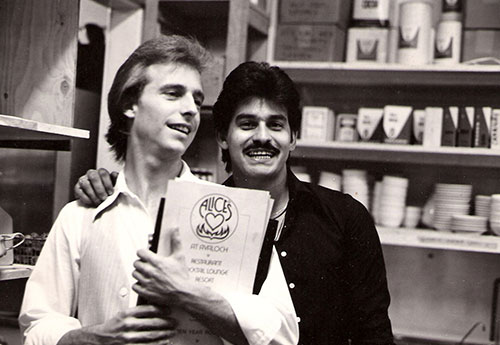 Photo: Doug Hoffer working at Alice's Restaurant. Courtesy photo.
Among them were Leonard Bernstein, Seiji Ozawa, Jackson Browne, Emmylou Harris, Fred Friendly (Edward R Murrow’s producer), Gilda Radner, Pete Seeger, John Hammond Jr, Arthur Penn (who directed the 1969 comedy film “Alice’s Restaurant”), Cecily Tyson, Julian Bond, James Taylor and Wynton Marsalis. Hoffer has good stories to tell about those years, some of them scandalous.
After a time, Hoffer started thinking of going back to school; he decided to take the SATs.
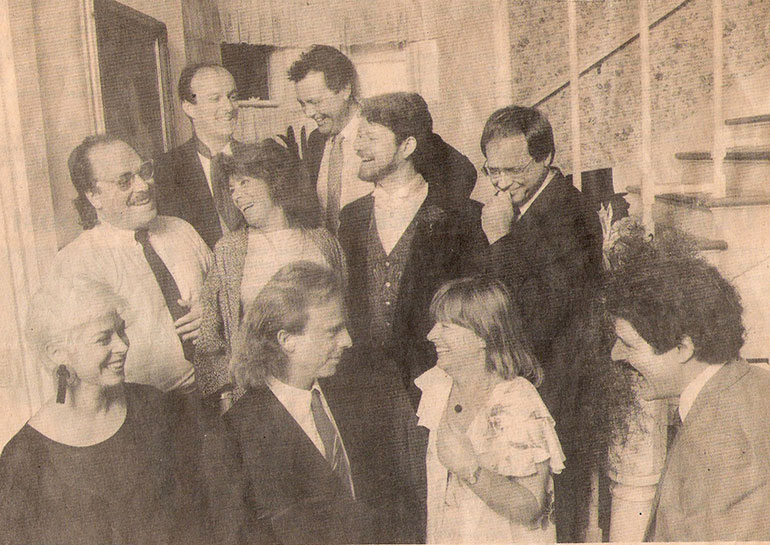 Photo: Alice Brock, third from the left in the second row surrounded by former employees. Courtesy photo.
“I thought, ‘OK, I can do this,’” he said. “I went down to the high school at 7:30 in the morning with all the 16-year-olds. They passed out the test booklets, and we completed the first section. I thought, ‘That looks pretty good. I’m happy with that.’ And I put my head down. I was out. I had been up till about 3:30 the night before — remember, I was in the restaurant business. If it hadn’t been for the girl sitting across from me who tugged on my shirt when the proctor said, ‘You may now turn to the next section,’ that would have been all of the SATs I did. But I got lucky. I did pretty well and was accepted to Williams College on a full scholarship, thankfully, because I could never have afforded it otherwise.”
Hoffer enjoyed his time at Williams.
“I had a great experience,” he said. “I was 30 years old. I took the work very seriously. I rented a house out in the woods, on 20 acres of land at a dead-end dirt road. I loved the faculty. I had some good friends. I hung out with the teachers and the kids.”
The school often gave Hoffer odd jobs “to kind of justify the money they were giving me.”
“I would be a driver,” he said. “And if somebody were coming to speak at the school, or it was a faculty candidate, or so forth, I would drive them to and from either Albany or Hartford.”
One day he found himself driving the radical feminist legal scholar, activist and author Catharine MacKinnon.
“I had an hour and a half with her, and I told her I’m looking into law school and it’s boring,” Hoffer said. “And she said, ‘Forget Michigan and Yale and those places. You’ve got to go to Buffalo.’ She said that was where all the commies were. She didn’t put it quite that way, but that’s where all the critical legal studies people were. I looked into it, and it was exactly as she described.”
Hoffer took MacKinnon’s suggestion and went to the University at Buffalo Law School, where he graduated magna cum laude.
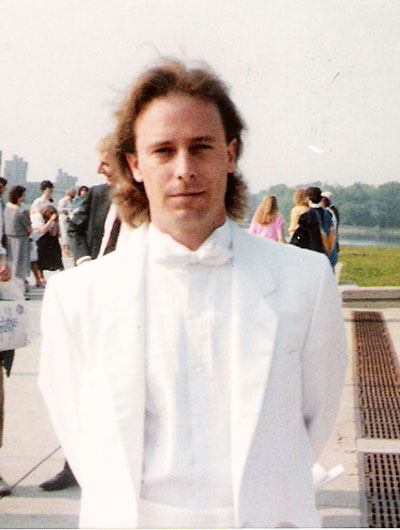 Photo: Doug Hoffer at Buffalo Law School graduation ceremony. Courtesy photo.
“I had a fabulous experience there,” he said. “I was so grateful for her. I just got lucky. I’m a lucky guy.”
Hoffer was not interested in practicing law, however.
“I knew I wasn’t going to practice,” he said. “That wasn’t my intent. I wanted to do public policy work. And I thought law school would be a much better preparation than a master’s program in political science or public administration. In my third year of law school, the only job I applied for — literally, the one job — was to work in City Hall in Burlington for Bernie Sanders.”
He got the job, finished his degree and moved to Burlington.
Policy Analyst
Hoffer arrived near the end of Sanders’ tenure as mayor of Burlington.
“I was aware of what had been going on in Burlington during Bernie’s tenure, not so much by him but by the people who had been attracted to him,” Hoffer said. “Working at City Hall was wonderful. I stayed for about five years. I had a great time there as well and met a whole bunch of people who are my dear friends to this day. But when Peter Clavelle lost in ’93 — he subsequently was reelected in ’95 — but when he lost in ‘93, I was ready to go after five years. I went out on my own and managed somehow to pay the bills for 19 years as a sole proprietor, self-employed doing policy work.”
In any area of public policy — environmental, health care, economic development, etc. — a policy analyst looks at programs or strategies and analyzes the opportunities to do something different, something new or, at the very least, something more cost-effective. They also review the performance of existing programs.
“The end goal is to try to persuade policymakers and administrators that either what they’re doing is stupid and wasteful, or that what I’m proposing makes more sense,” Hoffer said. “It’s a bit about numbers, it’s a bit about writing, it’s a bit about thinking. It’s fun, and it’s all I ever wanted to do after I stopped taking 10 years off and having 40 or 50 jobs.”
One of his first jobs in policy was working for then-State Auditor Ed Flanagan, who served from 1993 to 2001. It gave Hoffer a taste for what was happening in that world.
“Flanagan understood that the whole state audit world was moving away from its stodgy, narrow view of what it had always done, which is to audit the state’s financial statements,” Hoffer said. “And in the last 20 or 30 years prior, to also do the so-called single audit, the audit of the federal money. Both of those audits are important, but they’re boring.”
Forward-thinking state auditors were deciding that apart from the necessary tracking of the money and making certain the rules were followed, there could be more value to the job.
“The financial audits are the beginning of the conversation, not the end,” Hoffer said. “We should be talking about whether the money is being spent wisely and effectively. That’s performance auditing. And that interested me.”
A partial list of Hoffer’s clients from that era includes the Vermont Sustainable Jobs Fund’s Farm to Plate initiative, the Vermont State Employees Association, the Vermont State Treasurer for Economically Targeted Investments, the city of Burlington, performance reports for Burlington Electric Department, Public Assets Institute, Yellow Wood Associates, Good Jobs First, Ben & Jerry’s and City Market.
As an independent policy analyst, however, Hoffer is most renowned for his work on the first “Vermont Job Gap Study.” The study arose out of mid-1990s cuts to federal welfare programs, new work requirements and the decline of union strength.
States already had a minimum wage, but the livable wage was a new way of looking at how working people were paid. In the fall of 1995, Kahler became aware of work being done in Minnesota on the concept of a basic needs budget.
“I thought that would be a good thing to do in Vermont,” Kahler said. “We should try to look at how much it actually costs to live in Vermont, and therefore what wages and incomes would need to be in order to pay bills if working full time. I approached Doug to see if he would be interested in developing that methodology in Vermont, with Vermont data sources, and producing a report that would identify the basic needs budget for different family sizes, and then calculate the livable wage for those family sizes. Then I raised the funding to support that and hire him. And we published the first edition in 1996.”
The calculations revealed just how many Vermonters did not earn a livable wage and had to rely on some form of public assistance, even though they were working full time.
Back then, Vermont was known for the paucity of its wages; that’s where the old joke “Moonlight in Vermont — or Starve” comes from, as a play on words with the popular 1940s song. Today, Vermont is 17th in the country in annual median wage.
If Vermonters are not being paid a livable wage, they must rely on state and federal funding for support.
“We acknowledge Vermont is a small-business state,” Kahler told the Legislature this year when asking for a methodology revision for the 2025 report. “It can be hard to pay a living wage even if employers want to. But many in business will say that if you are not paying at least a livable wage, then you shouldn’t be in business, as taxpayers are subsidizing your existence. So many of us have been focusing on how to help businesses improve their ability to pay living wages.”
Vermont was an early adopter of the livable wage concept, which eventually became a national movement.
State Auditor
Hoffer was deep into his career as a policy analyst when he decided to run for state auditor.
“I was already working in the public interest, obviously,” Hoffer said. “I was working for people who were elected officials. And I was reasonably happy doing that. I became aware that the state auditor was moving the office towards performance auditing. He hired one or two people from outside to help bring the staff up to current standards and so forth. All that was good, but I didn’t care for the way he was running the office. I thought he was damaging the integrity of the office. I thought the auditor’s office was a place that could do good work. And I thought that the way the current occupant was running it was not optimal.”
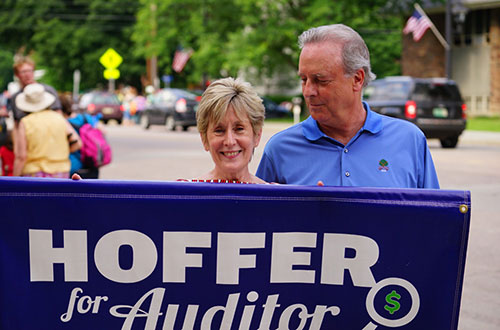 Photo: Doug Hoffer in a parade campaigning in 2014. Courtesy photo.
In 2010, Hoffer challenged the incumbent, Thomas M Salmon, son of former Governor Thomas P Salmon. Hoffer performed well but ultimately fell short.
“I got almost 47 percent of the vote, which is amazing, because statewide office depends, as you know, largely on name recognition,” Hoffer said. “While a lot of people knew my work, it was a pretty small circle. On the other hand, I was running as a Democrat/Progressive in a very blue state against a guy who hadn’t impressed people with his performance. So, when I lost, I thought, ‘I could do this.’”
The next election cycle was a presidential election year that saw Barack Obama seeking a second term. With Salmon declining to run for reelection, Hoffer won. Since then, he has not been seriously challenged. (In the 2020 general election, Hoffer received 266,445 votes, more than any candidate for elected office in Vermont history. By comparison, Governor Phil Scott got 248,412 votes that same year.)
Auditing Performance
How does the auditor’s office decide on what to audit? There are several considerations, Hoffer said.
“We have to be careful when we select a project,” he said. “We have to define the objectives. We don’t want it to be too big, or it’ll take two years. But we don’t want it to be too narrow; then it doesn’t mean anything. That’s an important part of the process.”
As a rule, Hoffer defined two types of performance audits.
“One is nuts-and-bolts about how state government operates as a business,” Hoffer said. “That covers a lot of ground, because it’s a big business with 8,000 employees, and it does a lot of things. The other is programmatic. When the Legislature appropriates $50 million to a certain type of program, which is part of a bigger strategy, the question that people have is, ‘Is it working?’ Is it achieving the goals established by the Legislature for this program? Is it solving the problem? Does it have value, and not just for the program administrators? Politicians are the ones that said, ‘Let’s spend the money on that.’ They need to get some feedback. Unfortunately, legislators don’t have the time or resources to do a lot of this. So, we do the best we can with limited resources.”
That being said, the reasons to choose a program to examine vary. Sometimes Hoffer follows the money.
“During the pandemic, for example, the state received a river of money from the federal government,” Hoffer said. “And I had to look at a couple of big programs. We did one that went to the Agency of Commerce, and one that went through human services for hospitals. Each one of those was over $100 million, and we found problems in both of them. That’s just an example of why you can’t ignore the big programs.”
Sometimes money isn’t an issue.
“We’ve done an audit of the Child Protection Registry, for example,” Hoffer said. “It’s about whether those things are helping to protect children. And that’s worth my time, for sure.”
His department is currently completing a study of long-term care facilities.
“This is a job that is really important to me personally, because of my father and his situation at 99, and because of all the other people like him in long-term care,” Hoffer said. “The Department of Disabilities, Aging and Independent Living has the responsibility for overseeing nursing homes, assisted living facilities and residential care homes. That’s a lot of Vermonters. And I think Vermonters, as people do in every other state, have a right to expect that the state’s going to make damn sure that those facilities are protecting the health and well-being of the people who live there, as they’re required to do.”
Ideas for audits can come from a number of sources, including members of the auditor’s staff, elected officials or Deputy Auditor Ashe, whose vast experience in the Legislature gives his suggestions considerable weight.
“Tim, who spent 10 years in the Legislature, was a participant in the creation of some programs,” Hoffer said. “In fact, we just did one on the Vermont Criminal Justice Council by Tim, who had participated in some legislation that changed that entity and its process a little bit a couple of years ago. He said, ‘It’s been long enough, so if you’re interested, we could do the job.’ And we did, and we found some things that they can improve, for sure.”
Sheriffs, who derive their power from the state Constitution, have a lot of authority but not a lot of accountability, making them ripe for audits, Hoffman said.
“It’s a messy system,” he said. “The Legislature now requires an audit of the sheriff’s departments every two years. It’s become a hot issue this year. But it’s required by statute because years ago the Legislature understood that sheriffs need somebody looking over their work. Those routine audits were the source of several news stories. I don’t like getting coverage in the press for stuff like that, to be very honest. But that’s what’s happening.”
The Burlington TIF audit also made headlines.
“I think very few people know about TIFs,” Hoffer said. “They are intended to help towns develop or redevelop infrastructure that is intended to promote more development, so that the grand list will grow more buildings, more houses, more businesses, meaning more property taxes. But the way they do it today is different than it was done previously. Back in the day, if the mayor wanted to do a project in your town, he or she and their associates would go to the people in the town and say, ‘Here’s what we want to do. We want to upgrade our wastewater treatment facility. It’s going to cost $3 million. But we think it makes sense because we can have more houses or whatever.’ And the voters would say yes or no. And that would allow the town to borrow money with a bond or something.”
When the state introduced the Education Fund, supported with statewide property taxes, it became more complicated. Now a town could create a development block called a TIF district and borrow money from the education fund to pay for it.
“They basically turn the Education Fund into a bank, which bothers me,” Hoffman said. “Their view of it is, ‘Well, it’s OK, because all this investment is going to create more value in the town. More tax revenues. So, after we pay the debt, there’ll be more money to go to the Ed Fund.’ Well, we’ll see about that.”
The Legislature mandates that each TIF program be audited three times in its lifecycle.
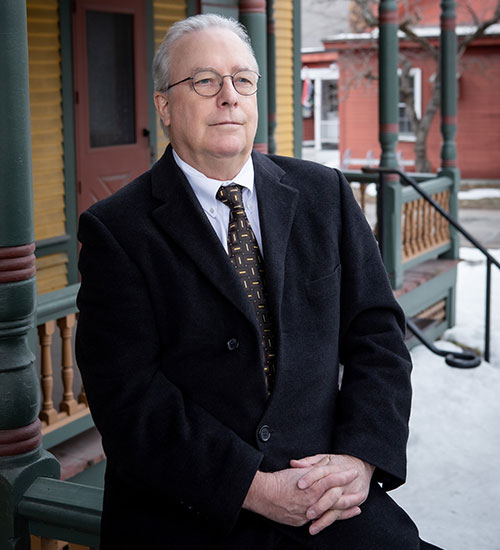 Photo: Vermont State Auditor Douglas R Hoffer. Photo: Baldwin Photography
“That’s my first unfunded mandate,” Hoffer said. “The Legislature didn’t give me any more staff. I eventually went back and got them to give me another auditor, but that’s not enough. It’s very time consuming for the towns. It’s tedious. It’s important, but I’d just as soon they scrap the program and find another way to do it. Everybody agrees on the goal, but the means are screwed up. So, that’s a requirement from the Legislature. I keep my ear to the ground to see if they’re going to give me any more requirements, as much fun as that is.”
The city of Burlington has the biggest TIF in the state, involving the most money and the largest number of projects.
“They just did not have the wherewithal, 15 years ago, to track capital projects the way they needed to,” Hoffer said. “They didn’t have the systems in place. It was clear that they didn’t have the mechanisms internally to do it. And then they had some turnover in key positions. So new people coming in didn’t have a framework or guidelines for this. All this money was moving around that just compounded things.
“By the time we got there, it was pretty clear they had sent money to the wrong places. They had used money that wasn’t supposed to be used. It was a mess. It took an enormous amount of work by my staff to get this done, only to come down to the end to say, ‘OK, you’re going to have to pay this much money to the TIF fund and this much money to the Education Fund.’ They weren’t cheating anybody, but they didn’t get it right.”
TIFs are expensive to operate, Hoffer said.
“All of these TIFs around the state will cost $100 million in interest,” he said. “It’s expensive to borrow money, even for municipalities. I happen to think there are better ways to accomplish the same goal. To that extent, I don’t like them. They’re complicated. Too complicated. And I think for many, they’re not cheap. I mean, Burlington is the biggest, most sophisticated municipality in Vermont, and look at the trouble it’s in.”
The issue of homelessness has also demanded a lot the auditor office’s attention.
“We did a job on homelessness and the state’s response to it,” Hoffer said. “And the fact is, the state has spent an enormous sum of money on homelessness in the last four or five years. Meanwhile, the rate of homelessness doubled. The state doesn’t really have a clear system of measuring success. We weren’t being critical of individuals or programs, or the governor or anybody else. We’re just saying, ‘This is what we found. This is where the money has been spent. And this is where we are today. We’re not making a lot of progress, so let’s have a conversation.’”
Then there is the dairy industry, which presents its own set of issues for the auditor’s office.
“Dairy is kind of a third rail in Vermont,” Hoffer said. “We did a couple of jobs, one of which was about the best-management practices program with the Agency of Agriculture, where they spend taxpayer money from the capital budget for dairy farmers to make changes on their farms to reduce the amount of phosphorous that goes into the water. And you could say, ‘Well, that makes sense.’ On the other hand, what other polluters do we pay to reduce their pollution? Just tell them to stop polluting!
“We did another job where we quantified how much the state had spent in subsidizing dairy farmers. Over the last 10 years it was $285 million, which includes monies to clean up the mess. So why are we subsidizing a commodity in the 21st century that is polluting? I know why. Because farmers have some political power. They work their tails off. Nobody’s ever going to argue with that. And they have helped protect the image of Vermont as a green place. People like the cows.”
Today, much of the green rolling hills and farmland in Vermont has been protected, thanks to the Vermont Housing Trust and the Housing and Conservation Trust.
“I think that’s Madeline Kunin’s biggest takeaway,” Hoffer said. “I mentioned the dairy only because it’s not dissimilar to the homeless thing. How much are we spending? What are we getting for it? Isn’t it time to have a conversation? Should we continue to subsidize an industry that can’t seem to survive without deep subsidies? Those questions are why we do some of the things we do.”
‘I’m Here to Do This Job’
Other state auditors have tried to make the job a stepping stone to higher office, but none so far have succeeded. Hoffer is clearly in the job he wants to retire from, although he doesn’t have any idea when that will be.
“When I got elected. I said very honestly, this is the only job I’m looking at,” he said. “I have no ambition for more. I wanted people to know that. It wasn’t a stepping stone for me like my predecessors. I’m here to do this job.”
Retirement will probably contain a lot of golf. But Hoffer is emphatic he’s not going anywhere just yet.
“We’ve hired some people in the last two or three years. We have a very good crew right now, and we always did,” Hoffer said. “I really like the folks we hired recently. I like my deputy; I like my senior people. And I’m still enjoying the work. I think in fairness to other people, if I decide not to run again, I should say so within a year or so. Right now, it’s an open question.”
Even after he retires, Hoffer insists he will still have a lot to say.
“I would like to continue working on issues that are important to me,” he said. “And I can weigh in on occasion with commentary — what we used to call op-eds. But I’m not sure how much of that stuff is effective anymore. That kind of stuff is drowned out by lobbyists. I know a lot of people in the Legislature. I would hope that they have respect for the work I’ve done and the work I still do. If I can get there on occasion, that would be fine. But I know full well there’s only so much you can do. There are only so many hours. When I’m gone, either somebody will do what I’m doing, or they won’t. But there’ll be nothing I can do about it.”
In retrospect, Hoffer said again, he’s just “a lucky guy.”
“I went to Williams College when I was 30 years old,” he said. “How lucky can you get? And then I went to law school. I was in college and law school during the entire Reagan administration. Then I came to Burlington, VT. I don’t have a lot of regrets in my life.”
Joyce Marcel is a journalist in southern Vermont. In 2017, she was named the best business magazine profile writer in the country by the Alliance of Area Business Publishers. She is married to Randy Holhut, the news editor/acting operations manager of The Commons, a weekly newspaper in Brattleboro.