

Vermont Business Magazine The Legislative Joint Fiscal Office on Wednesday published their updated ‘Fiscal Note’ on S5, The Affordable Heat Act. Below is their analysis.
March 1, 2023
by Joyce Manchester, Senior Economist
S.5 – The Affordable Heat Act
An act relating to affordably meeting the mandated greenhouse gas reductions for the thermal sector through electrification, decarbonization, efficiency, and weatherization measures
As amended by the Senate Committee on Appropriations1
Bill Summary
The bill would establish the Clean Heat Standard to reduce Vermont’s greenhouse gas emissions from the thermal (heating) sector. The Public Utility Commission would administer the Clean Heat Standard with assistance from two advisory groups: the Technical Advisory Group and the Equity Advisory Group. The Department of Public Service would be a partner in providing assistance and in verifying and evaluating clean heat credit claims.
Fiscal Impact
JFO estimates the bill would have a $1.725 million fiscal impact on the General Fund for fiscal year 2024. The fiscal impact of the bill would likely be greater in future years because of increased investments over time. The bill contains two appropriations from the General Fund for fiscal year 2024:
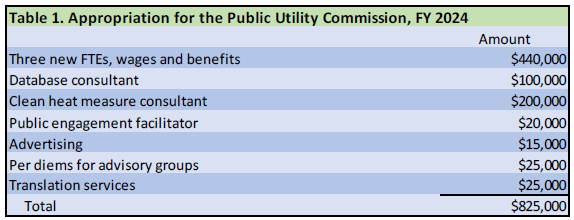
- • $825,000 for the Public Utility Commission to pay for three new full-time employees (FTEs), consultants, per diems for members of the two advisory groups, marketing and public outreach, and translation services; and
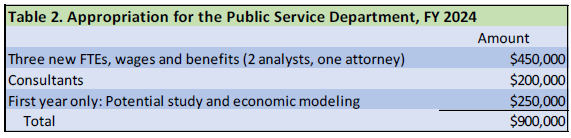
- • $900,000 for the Department of Public Service to pay for three new FTEs, consultants, and funding to complete the potential study and economic modeling. This appropriation reflects a recent request from the Department of Public Service.
Background and Details
Under the Clean Heat Standard, each year obligated parties2 must retire clean heat credits – a tradeable, non-tangible commodity that represents the amount of greenhouse gas emissions reductions caused by a clean heat measure. Clean heat credits may be retired by delivering fuel and technologies that reduce greenhouse gas emissions (clean heat measures) or by contracting out or purchasing clean heat credits. The Commission would establish the number of clean heat credits obligated parties must retire each year to set a pace for Vermont’s thermal sector to achieve the greenhouse gas emission reductions required by 10 V.S.A. § 578(a)(2) and (3), as amended by the Vermont Global Warming Solutions Act of 2020.
The following sections of the bill would have a fiscal impact.
Section 3
Section 3 establishes the Clean Heat Standard and the clean heat credits system. Credits are based on lifecycle greenhouse gas emission reductions that result from the delivery of eligible clean heat measures to end-use customers in Vermont. The Public Utility Commission will adopt rules to implement and enforce the Clean Heat Standard program, including establishing the number of credits that each obligated party is required to retire each calendar year. Making annual requirements understandable to the public will include using translation services. Each obligated party will retire at least 16 percent of their assigned credits from customers with low income and 16 percent from customers with moderate income; at least 50 percent of these credits must be from capital investments that will last at least ten years and lower energy bills. The Department of Public Service will be responsible for the verification and evaluation of clean heat credit claims. The Commission may hire a consultant to evaluate, develop, or support a means for tracking clean heat credits and compliance.
Section 3 also establishes two advisory groups to assist the Commission with the ongoing management of the Clean Heat Standard: the Technical Advisory Group and the Equity Advisory Group. The Technical Advisory Group will establish and revise the methodology used to determine each obligated party’s annual requirement and establish credit values for each year of an installed clean heat measure’s expected life. The Group will provide feedback on the work of a consultant hired by the Commission to develop assumptions and methods relevant to clean heat measures and lifecycle emissions analyses. Per diems and expenses are available to group members whose employers do not reimburse time spent at group meetings.
The Equity Advisory Group will assist the Commission in ensuring that an equitable share of clean heat measures is delivered to Vermonters with low and moderate income and that Vermonters who are not early participants in clean heat measures are not negatively impacted in their ability to afford heating fuel. Again, per diems and expenses are available to those not otherwise compensated for meetings.
Section 6
Section 6 explains how the Commission will implement the Clean Heat Standard. The Commission will hire a facilitator to help with the public engagement process, advertise at least six public hearings or workshops, and provide at least three opportunities for the submission of written comments. Section 6 also requires that the Commission deliver several reports to the General Assembly or committees of jurisdiction.
Section 7
Section 7 establishes three new positions in the Public Utility Commission and two new positions in the Department of Public Service. It also appropriates $1.725 million from the General Fund in fiscal year 2024 as described below.
Details of Appropriations
The $825,000 appropriation to the Public Utility Commission in fiscal year 2024 would cover the three new positions, any consultants required, and marketing and public outreach (see Table 1).
The $900,000 appropriation to the Department of Public Service in fiscal year 2024 is intended to cover three new positions, consultants to support verification and evaluation, and funding for the potential study and economic modeling.3
3Testimony by June Tierney, Commissioner, Department of Public Service before the Senate Committee on Appropriations, February 23, 2023.
4 Energy Futures Group and Cadmus, “Vermont Pathways Analysis Report 2.0,” February 11, 2022.
Source of Funding
The appropriations would come from the General Fund.
Impact on Vermont’s Economy
The Vermont Pathways Analysis Report 2.04 estimated that reducing greenhouse gas emissions in Vermont as outlined by the Vermont Climate Council, in line with the Global Warming Solutions Act requirements, would offer $6.4 billion in net benefits by 2050 compared to “business as usual.” The Clean Heat Standard plays a prominent role in that analysis by reducing greenhouse gas emissions in the thermal sector. Although additional costs and investments will be required to reduce emissions as required in the Global Warming Solutions Act, the avoided costs for fossil fuels together with the avoided economic, health, and environmental damages are expected to yield significant net benefits by 2050.
In the near term, it will be important to monitor how the Clean Heat Standard is implemented and administered and how the State can ameliorate possible negative effects on households and businesses, with special attention to households with low and moderate incomes. Many participants will have critical roles to play in achieving the required reductions in greenhouse gas emissions, including the Public Utility Commission and Department of Public Service, the wholesale fuel dealers and natural gas utilities, and the households and businesses that choose to make structural and heating system changes. The General Assembly will have an important oversight role in monitoring implementation and reviewing and responding to the frequent reports and recommendations from the Commission.
