


10th Anniversary. Courtesy photos.
by C.B. Hall, Vermont Business Magazine Most Vermont food cooperatives that have survived since the counterculture boom of the 1970s have done so by developing a niche market in the natural-and-organic sector of the grocery industry. But exceptions exist – such as the Onion River Co-op, City Market, which also sells conventional products, in accordance with its original 2002 lease with the city of Burlington, which then owned the store property on South Winooski Avenue.
Then there's the South Royalton Market, which places the same story in the setting of a small village not unlike many another rural American community that has withered in this age of all things big.
The establishment opened its doors in 2001 as a "village sized, full service grocery store," in the words of its website; today it moves almost $5 million worth of food and other merchandise yearly, maintains a payroll of 18 full-time equivalents, and serves 1200 members, as well as non-members, in a store fashioned by combining two former storefronts directly across the street from the Windsor County town's green.
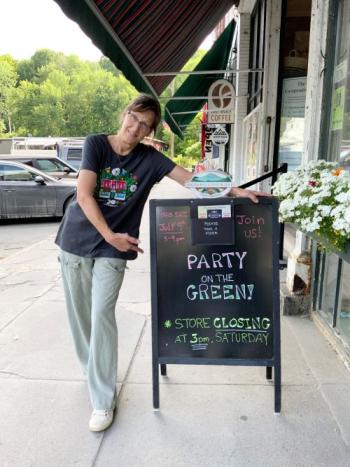 Right from its start, the co-op has sold conventional products alongside the natural and organic offerings, and, in the words of general manager Adam Smith, "We've stayed true to that mission statement every since... We did want to be inclusive."
Gross sales increased by 17% between 2019 and 2020, and by 23% between 2020 and 2021, according to the co-op's annual report. In an early December interview, Smith anticipated that 2022's gross sales would rise "a little bit over 10%."
About 60% of the store's patrons come in for natural and organic products, he estimated; the remainder prefer the conventional.
And in a community the size of Royalton – population 2750 spread over 40.9 square miles - that 40% may represent the difference between a successful business and the fate of many a niche enterprise – an empty storefront waiting for somebody with a better idea.
Within the confines of about 4000 square feet, SoRo Market, to use its nickname, also strives to attract customers who are not simply shopping for groceries to take home. The store stocks gifts and housewares and maintains a small cafe space, with a view, through the floor-to-ceiling front windows, of the prototypical New England green. A grab-and-go deli lasted until sacrificed to create more space for produce backstock.
"We're looking at getting back to that when we can get more space," Smith said. "We're kind of pinched where we are."
The offerings extend to the cultural, too, in the form of a miniature art gallery in the cafe. Often the hangings are the work of just one artist, which are usually for sale, but, the co-op's website notes, "Sometimes we exhibit the collective works of local school art classes, child care centers, library book clubs and the like."
"It's just exploded"
 The relative isolation of South Royalton could be called both a blessing and a hassle. The nearest supermarkets are 16 miles away in Randolph, and 18 miles away in White River Junction.
But that distance also created the need for the market. The village's sole grocery had closed in 1996, leaving "a humongous gap," in the words of the co-op's outreach and marketing coordinator, Heather Jenkins.
A year later, two local women, Jenn Hayslett and Katie Fellows, set out to replace the missing community amenity with a co-op.
"It took us four years to get the funding and get organized," Hayslett said. "There was a lot of pieces. We went looking for steering people who represented a cross-section of the community. Our goal was to make it accessible and welcoming to everyone – not just the hippie types."
The enterprise opened on August 29, 2001, with over 100 paid-up members, $11,111 in cash, and loans totaling about $90,000, according to a balance sheet Hayslett found and shared with VermontBiz.
"I never imagined it would get like this," she said, alluding to the current space crunch. "It's just exploded."
While the co-op is registered as a nonprofit corporation, its financial performance normally suffices for charitable contributions to the local senior center, food pantries, and other organizations. In fact, the support is part of the enterprise's budget, getting an earmark every month.
Finances have also sufficed for holiday bonuses for the staff, and upgrades to the physical plant, including a recent addition that squeezed 200 new square feet into the back of the building, for packaging bulk items and cheese.
So, while other rural communities across the state and nation have seen their grocery options reduced to Dollar Generals, Amazon, and long pilgrimages to the nearest full-service store, SoRo Market is thriving – a solution at once small and comprehensive, and consistent with the traditions of a Vermont village.
