

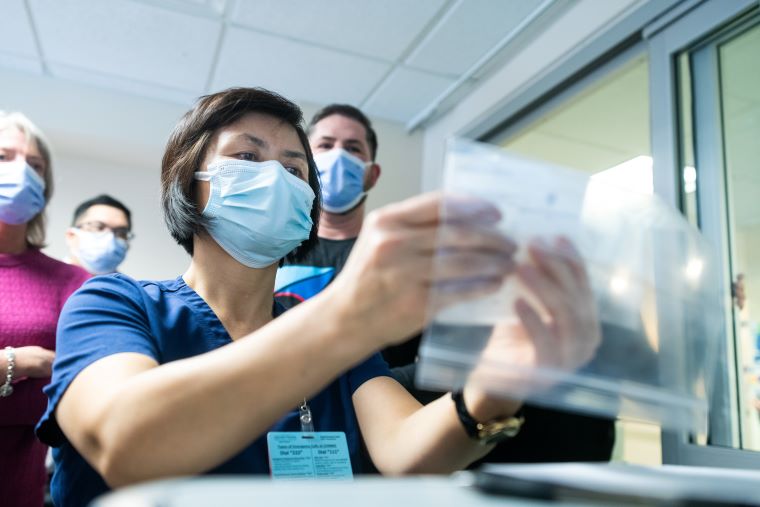
The nursing team at the UVM Cancer Center prepares for the launch of the CAR T program at the UVM Medical Center. CAR T-Cell Therapy will be Available in February to UVM Medical Center Patients (Photo credit: Andy Duback)
Vermont Business Magazine The University of Vermont Cancer Center will offer a novel, highly effective form of cancer treatment called CAR T-cell therapy beginning in February, when final accreditation and approval to begin treating patients is expected.
The Cancer Center will be the only healthcare institution in Vermont and northern New York to provide the treatment.
CAR T, as it is known, uses the body’s immune system to fight cancer. Unlike other immunotherapies, CAR T uses genetically modified T cells from the patient to attack cancer cells. (SEE ANIMATION BELOW)
Approved by the FDA in 2017 for a variety of blood cancers, CAR T-cell therapy induces a “complete response” — where no remaining cancer is detectable — in 50 to 80 percent of patients treated with it, depending on the cancer type — including in 70 percent of patients with mantle cell lymphoma and 80 percent with follicular lymphoma. Up to 90 percent of patients with these two cancers see a “partial response,” where the cancer has been significantly diminished. The therapy is typically used after other forms of treatment have been unsuccessful.
Blood cancers account for 10 percent of all cancer diagnosed in the United States every year, according to the Leukemia and Lymphoma Society.
Though long-term data for CAR T-cell therapy is not yet available, the treatment has the potential to cure cancer. Of the first patients treated over 10 years ago with CAR T-cell therapy in clinical trials, few of those who achieved a complete response have seen their cancer return.
UVM Clinic Led by One of First Clinicians to Administer CAR T
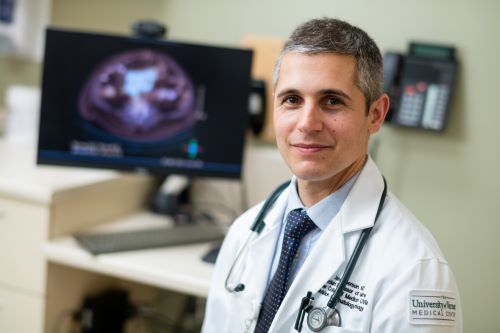 James Gerson, MD, assistant professor in the Larner College of Medicine’s School of Medicine, and the physician lead of the CAR T program. Dr. Gerson joined the University of Vermont from the University of Pennsylvania, where CAR T-cell therapy was discovered and developed. Dr. Gerson worked with the creators of the treatment and is one of the first physicians in the country to use CAR T in a clinical setting. (Photo credit: Andy Duback)
The Cancer Center’s new CAR T program will be led by James Gerson, M.D., assistant professor in the Larner College of Medicine’s Department of Medicine, who came to UVM from the University of Pennsylvania, where CAR T-cell therapy was discovered and developed.
Gerson worked directly with the team of researchers who created the therapy, led by Carl H. June, M.D., and was among the first clinicians to use it in a commercial setting.
“We are thrilled to have someone of Dr. Gerson’s caliber directing our CAR T clinic and offering this life-saving therapy to patients in our region,” said Randall Holcombe, M.D., M.B.A., director of the UVM Cancer Center and Associate Dean for Cancer Programs at the Larner College of Medicine .
The new CAR T program highlights the benefits that an academic medical center like the UVM Medical Center — which combines cutting edge clinical care and innovative research — can bring to a community.
“The Larner College of Medicine was honored to work with our partners at UVM Medical Center to recruit Dr. Gerson to our academic medical center,” said Richard L. Page, M.D., dean of the UVM Larner College of Medicine. “The CAR T program is yet another example of the profound value that the UVM Cancer Center brings to our region,” he said.
Avoiding Upheaval in Patients’ Lives
Currently, patients in the UVM Medical Center’s catchment area who want CAR T therapy need to travel, usually to Boston, New York, Dartmouth or Rochester, to access it.
The remote treatment can cause significant upheaval in their lives, Gerson said, since it requires multiple episodes of care over the course of three to six months. Many patients live in the area where they’re being treated for four weeks.
“Our goal is for you to be able to access this therapy without uprooting your life,” he said.
CAR T works by training T cells — a type of white blood cell used by the immune system to kill viruses and other foreign bodies — to recognize and attack cancer cells.
The treatment has several steps. First, T cells are removed from the patient’s blood. Then, in the lab, they’re modified by adding a receptor gene — a “chimeric antigen receptor” or CAR — that can recognize a protein on the cancer cell, latch onto it and kill the cell. Finally, cells are multiplied and given back to the patient.
CAR T is currently approved only for blood cancers: lymphoma, some leukemias, and multiple myeloma. Research is ongoing to apply the method to other cancers.
“We look forward to bringing this innovative new treatment to the patients who need it in our region. I’ve seen first-hand its potential to save lives,” Gerson said.
Patients interested in the therapy should contact their oncologist.

A Car T-cell attacks and destroys a cancer cell. UVMMC animation.
Also: Live-action b-roll footage of Dr. Gerson and employees at the UVM Cancer Center preparing for the launch of the CAR T program. Please note that this b-roll has no associated audio component. Access the footage here: https://uvmhealth.imagerelay.
About the University of Vermont Cancer Center
The University of Vermont Cancer Center is Vermont’s only not-for-profit comprehensive clinical and research cancer center. Founded in 1974, the organization is located within the University of Vermont Larner College of Medicine and enjoys a clinical partnership with the University of Vermont Medical Center. Drawing on the expertise of more than 165 research and clinical members, the center works to reduce the burden of cancer in Vermont, northeastern New York and across northern New England, through research, outstanding clinical care, community outreach and education.
About the University of Vermont Medical Center
The University of Vermont Medical Center is a 499-bed tertiary care regional referral center providing advanced care to approximately 1 million residents in Vermont and northern New York. Together with our partners at the Larner College of Medicine at the University of Vermont and the College of Nursing and Health Sciences, we are Vermont’s academic medical center. The University of Vermont Medical Center also serves as a community hospital for approximately 150,000 residents in Chittenden and Grand Isle counties.
The University of Vermont Medical Center is a member of The University of Vermont Health Network, an integrated system established to deliver high-quality academic medicine to every community we serve.
For more information visit www.UVMHealth.org/MedCenter or visit our Facebook, Twitter, YouTube, and blog sites at www.UVMHealth.org/MedCenterSocialMedia.
