


On June 7, 2022, Governor Phil Scott signed historic housing legislation into law. S.226 and S.210 dedicate more than $45 million to address Vermont’s housing shortage. The state has committed over $250 million to housing over the last two years. Courtesy photo.
by James Dwinell, Vermont Business Magazine The week before Christmas, VermontBiz conducted a remote interview with Governor Phil Scott. Correspondent James Dwinell led the discussion and was joined by VB Editor Timothy McQuiston. The interview looked forward to the new year (see his inaugural speech here, which contained many of the themes found below), the upcoming legislative session and Scott’s fourth — and perhaps final — term. Scott did not, however, offer any hint of his future political plans.
VB: What is the size of the budget (to be released January 20)?
Scott: That depends on how you count the federal monies that are still flowing through. Last year, we were up over $8 billion. Incredible.
How much of that are federal funds? Folks, including you, say this is a unique moment for Vermont and that we need to invest those monies wisely and try to avoid starting new programs that we can’t sustain when we lose those funds.
Right.
How much COVID money is still around?
There are so many different pots of money flowing in from Washington, so it is hard to individually count their sources. Put them all together, it could be $3 billion. All one-time money, but not one year. We received over $1.25 billion of flexible money. We utilized that for broadband, housing, water, sewer, stormwater infrastructure, weatherization and economic development. We are using some of the other bits of money for more broadband, but the majority of that is for transportation infrastructure projects.
 Photo: On March 16, 2020, Health Commissioner Mark Levine and Governor Scott, with Public Safety Commissioner Mike Schirling, discussed COVID mitigation measures. Scott declared a State of Emergency three days before. VermontBiz photo.
Do all of these expenditures have to be approved by the Legislature or is some money available at your discretion?
We have been working with the Legislature with all expenditures. We could make the argument that they need not be involved in some of the spending decisions, but I made the decision early on that I thought that it would be conducive to our relationship to work together on this.
Do you regret that?
There are days that I do, but for the most part, I think that it is the right approach.
The incoming Legislature is significantly veto proof. Do you agree or do you have any reliable Democratic “friends” in the Legislature?
This is not the first time we must deal with a veto-proof Legislature, but not by this margin. This is not great territory for me, but we have been able to get things done. I never consider the veto the first option, but only as the last resort. We will do whatever we can to avoid that. We will be honest and transparent when I cannot go beyond something, so I let the leaders know and hopefully we can change course a bit or, if not, the veto is proposed. In the majority of those issues, I have given them a path forward in the veto letter accompanying the veto. Some folks in the media are focusing on the past vetoes, but if you look at those moments, we came up with legislation to go beyond the veto.
Has Vermont’s tax base grown as much as the budget?
When you think of inflation, the more things go up, the tax base increases along with it. So, there are substantial increases creating surpluses because so much money was being injected into the system. It is not just inflation but the federal dollars as well. (Editor’s note: Through November, two of three major tax revenue funds – General and Education – are ahead of projections for the 2023 fiscal year, with Transportation slightly behind, mainly because of fuel receipts. The funds are 6.5%, or $76.4 million, above the combined consensus targets. The personal income tax, which is the most important single source, is $59.3 million ahead of targets YTD).
What is the rate for legal marijuana sales tax?
I don’t know, I have not bought any! On the campaign trail back when I was running for lieutenant governor, someone I knew from the construction trades came up to me and anecdotally said, “I know everyone is considering legalizing and taxing pot, but I just want you to know that I will keep buying from my same source to avoid the significant sales tax.” I think that the black market will disappoint those making tax income projections.
Because of the US Supreme Court’s decision on Maine’s religious schools receiving state aid, do we now effectively have school choice?
I would not describe it as now having school choice. We have more to figure out. I would like to see more school choice. I think now, for example, if you want to send your child to Rice High School in Burlington, a Catholic school, the state money will follow your child.
Are the Public Service Board and the Green Mountain Care Board too independent?
They are supposed to be. We need to revisit the Green Mountain Care Board, as it was set up to oversee single payer, but single payer failed. I wonder if it is still needed. Previously, we oversaw medical care at the Department of Financial Regulation (then known as the Department of Banking, Insurance, Securities and Health Care Administration). The oversight could be handled in a different way at a lower cost. I do not promote this idea, nor will it be part of our budget.
At the general contractors meeting last week, everyone seemed to be talking about child care. What is your plan?
The Legislature has some significant agenda items, including paid parental leave and child care. Both are big-ticket items. I have consistently talked about our need for child care. I don’t think that previous administrations did as much as we are trying to do. I believe that we need to look more at a cradle-to-career approach. Child care is a piece of that. We agree with the goal, but how do we pay for it, and for all the other big-ticket items that the Democrats have promised or contemplated?
Child care should not be paid with a payroll tax. I am very concerned about opening up that door. It’s easy — you derive a lot of money quickly. With inflation, the cost of living, we face the challenge of allowing our workers to keep more of what they earn. With the collection of online sales tax a few years back, I said, “Let’s dedicate this money to child care.” The Legislature turned me down.
Maybe the $7 million to 8 million anticipated back then was not enough, but today we are collecting about $50 million, and we would be well on our way if we had used that tax for child care. We need to use our existing and perhaps other sources of money and not use the payroll tax. There is enough money in the system, and we need to focus on that. If we are creative and we continue to grow the economy we’ll bring more money in.
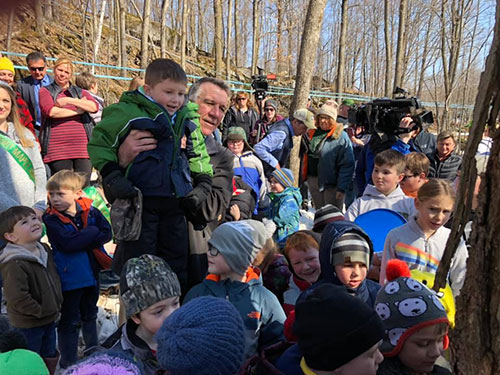 Photo: Sometimes governors get photo ops, like the ceremonial tapping of a maple tree in early March. Courtesy photo.
Are you open to using the Education Fund and the public school system to develop this child care system?
Yes. There is enough money in that area to find some symmetry, so I am open to talking about that as well.
Can we do both paid family leave and child care, or can we only do one or the other?
I agree with both initiatives, but how do we pay for it? I have heard from many employers that support paid family leave. We put forward a voluntary plan that was very rigorous. The Legislature is interested as well because, as implemented, we would build the structure that every Vermonter could access. Could the employer and employee support this funding as they do Social Security? One size does not fit all; small business is different than big business.
Instead of trying to do everything at once, our plan is a good first step. Let’s pass it and develop the necessary systems moving forward. Trying to do it all ourselves makes less sense than partnering with The Hartford (insurance company), for example. This is happening. State employees are going to have paid family leave, and the Hartford will help. Let’s build from there.
Have you heard more from GlobalFoundries about its future plans relating to employment?
No. I was disappointed to hear about the layoffs, particularly after the electric power plant project we agreed to, which was very beneficial to them. (Editor’s note: GlobalFoundries announced December 20 that it would lay off 148 employees in Vermont as part of a global reduction of 800.)
But layoffs are the way of the world. Their market is volatile. We can’t put all our eggs in one basket. That is why we keep diversifying our economy and are working so hard to bring businesses from Canada. We do have more jobs available than we have workers. So the timing of the layoffs, though hurting individuals, at least comes during a labor shortage and they may be able to find other promising jobs. We are working hard to help these employees find even better jobs.
Are you looking to do more private partnerships like The Hartford?
Partnering with The Hartford will be helpful. But I do not believe that government has all the answers for everything; we need to work together to be successful. Government’s biggest mistake is that we build infrastructure, then we ignore it as we don’t do enough maintenance.
Do you expect a hangover when all that “free” money is gone?
I think so. It will take a while for the market to adjust. We have supercharged the economy with lots of government money, putting lots of cash into the system. Instead of trying to do everything, it is important to make sure that each dollar received be well spent. We can’t create new programs here and there, we need to invest this one-time money in our future, transformative investments to move us to where we need to be.
Who controls the National Guard?
I am the commander in chief as governor. We have limited flexibility, but at the end of the day the federal government rules.
Prisoner deaths are up. Is there is no plan for compassionate leave as death approaches?
No. There is no flexibility in not completing a sentence.
Could you commute or pardon a prisoner’s sentence?
I could pardon. There is a process for that, but it takes a while.
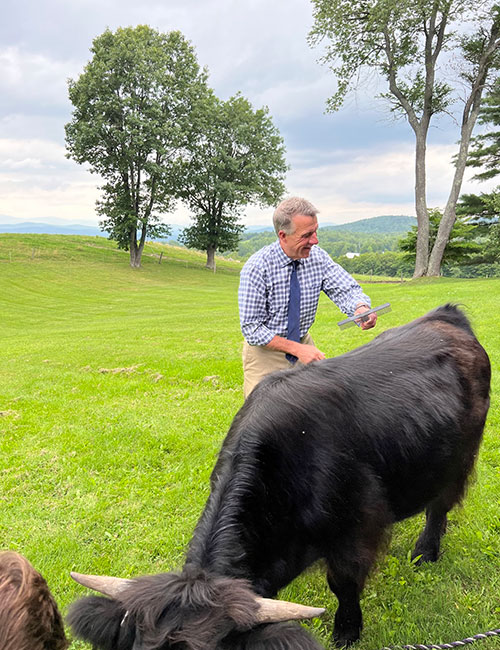 Photo: Sometimes governors get photo ops, like combing cattle last August as part of an agriculture promotion. Courtesy photo.
You have said that we need to separate the treatment of criminals we are mad at from those whom we are afraid of. Please explain.
The pandemic caused us to alter things because we could not overcrowd; therefore, we needed to reduce the population. We are seeing more crime both from Vermonters and others coming to take advantage of us. A lot of it is about drugs. The criminals are using all means to take advantage of our compassion. There must be consequences. Much of the crime and most of the deaths are around fentanyl. And now there is a new drug. Many treatments are not effective. Some major drug dealers are using young Vermonters as mules to traffic the drugs here.
(Editor’s note: The new drug is called Xylazine, and as it is not opioid related it does not respond to the overdose treatment Narcan.)
Will a carbon tax move forward?
It will only hurt those folks who can’t afford a car or anything else that would rise in cost because of a carbon tax. The day before each election, I go to every county — 14 counties in 14 hours for 14 minutes. In talking with voters, the disparity in wealth and poverty is very apparent throughout the state. In the more rural parts of the state, your commute is much longer on more difficult roads in older vehicles. How can we impose another carbon tax on those people when it’s all they can do to heat their homes and make it to work or shop? I am very excited about more electric vehicle options and nuclear fusion, and nuclear power should not be off the table. When I was in the Senate, I voted with four others against closing the Vernon plant (Vermont Yankee) a dozen years ago. Technology keeps surprising us.
Economic data is suggesting harder times. The unemployment rate has ticked up to a still low 2.5% (fifth lowest in the nation), but the growth in the labor force and employment has softened.
There are many parts of our economy interrupted by weather, like home building and road building, for example, as construction winds down. So (the unemployment rate) upticks in the winter. But anyone who wants to work should be able to find a job.
Will you run for governor again?
I will not make that decision until at least I am sworn in!
How’s Thunder Road? You seem to enjoy driving your race car more than running the state!
Yeah, yeah. I continue to enjoy trying to race, though it is giving me a dose of reality every now and then.
Have you raced an electric car yet?
I have not, but it is coming. I saw that at an event in Iowa they had an electric car event. It will happen here after I retire. They now have electric car races; they’ve even developed a sound device to mimic the engine noise to make it as exciting.
How is the torque different?
Incredible torque, much more with electric. It’s about how the motor has significantlyfewer parts. That’s why in business electric motors replaced gas engines. There is less weight, despite the batteries. The maintenance on the existing cars — all the crank shaft parts, pistons and all the rest — all have to move at the same time. No oil change, no radiators and all the rest. Carrying the gasoline can be dangerous, but the batteries can create trouble as well.
What is the question we did not ask?
There is always a big shiny object that distracts our attention. What will be done is a lasting question. We haven’t finished many things that we have started. There is so much left undone, especially during election time, so many flashy promises are made. Instead of flashy, let’s finish what we started.
We constantly do this in politics, thinking about the next day when we have not completed what we said that we were going to do. Let’s try to make sure that we follow through on the appropriations that we have made, make the investments we need to make. We need to finish up before we expand more.
We still need housing, to do things tied to workforce, making our lives here easier, making us a more comfortable, more attractive Vermont to those looking to come to Vermont. This is the answer. Everything we do is aimed at workforce improvements. Let’s finish that. It’s going to be adding one, two, three, four, five folks at a time. It is not going to be lots of folks just like that.
