

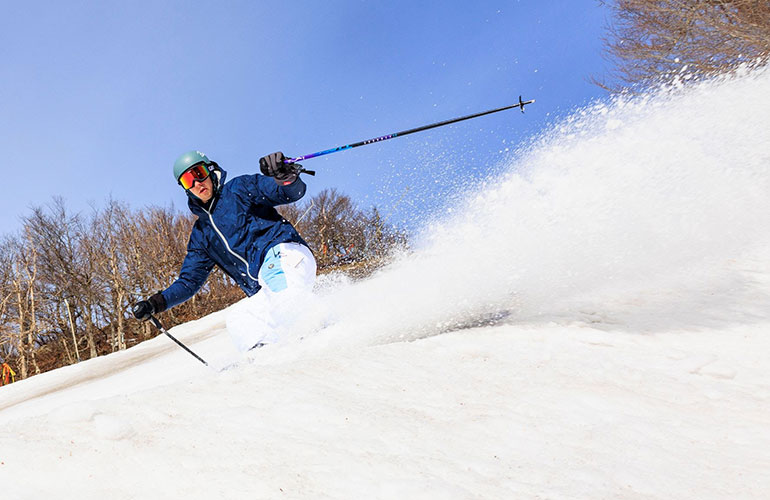
Photo: Skiing at Bromley Mountain Ski Resort. Courtesy photo.
VermontBiz The history of alpine skiing in Vermont has been nothing short of breathtaking for skiers and journalists. Vermont was home to the first commercially available ski lift. Celebs came to ski at “Mascara Mountain,” the so-called “in” ski resort at Sugarbush frequented by New York fashionistas, led by Oleg Cassini.
Mount Snow, Stratton and Bromley were able to make fashion statements of their own. Ski resorts were playlands in the 1950s and ’60s. They featured gondolas and heated pools and ice rinks suitable for folks who preferred a leisurely weekend away from what was otherwise a leisurely life.
Skiing is still that way, to some extent, of course. They don’t call it après ski because you’re doing algebra homework.
Still, even the 1954 classic “White Christmas” showed how even an earnest fellow could fail in the ski industry in Vermont. It takes more than just skiing.
But at almost the same time Vermont Business Magazine was founded in 1972, skiing became an industry in which businesspeople had to make money at it or fail.
Not just in Vermont, but across North America, the ski industry became a hard business full of sharks and phenomenal story lines.
It also feels like we’ve reached a point of stasis.
Vail and its smaller rival Aspen/Alterra have carved up most of the big resorts, and there’s not much left. Their Epic and Ikon ski passes have paved the way for crowded access roads at a time when technology has solved the problem of crowded lift lines.
In Vermont, Vail owns Okemo, Mount Snow and Stowe, and Alterra owns Stratton and Sugarbush.
With Jay Peak finally sold, the industry appears to be as settled as a mountain glade on a perfect winter afternoon.
But how we got here is the fun part.
Much of that comes from Preston Leete Smith, the developer of Killington.
He had grand plans. The Euro-vision of gondolas and heated pools were expensive to maintain and had to earn their keep. Lift lines were long. The idea was to get skiers up the mountain without it costing an arm and a broken leg.
Real estate was seen as a huge windfall for the developers. You’d make money by selling property, and then the owners would feel compelled to keep coming back.
Act 250 threw a wrench into that in the late 1960s, but the concept was sound enough to keep housing an important part of the economics.
But smaller ski areas couldn’t keep up with insurance costs or the excitement. Meanwhile, Colorado, California and Utah kept drawing off those mascara clients as air travel became more common and more affordable.
But in the ski industry, business models, of which there were many, were as sure a thing as the weather. As the business expanded, technological improvements became vital, especially with the magic of the detachable chairlift.
From rope toes to J-bars and T-bars, getting up a mountain full of snow was an adventure. Ernest Hemmingway contended that skiing was ruined when the lift was invented. A total of two runs was considered a full day.
The chair lift was easier and got skiers higher up the mountain faster for a more rewarding experience.
The old lifts had to go slow enough to allow the skiers to jump on and off the chair, like a hockey player changing lines.
The detachable chairlifts go much faster up and down the mountain, and then slow down to let the skiers on. It is a miracle of engineering as the mechanism itself never pauses.
Such quads and sixes, some with space-age windshields, make the journey faster and more comfortable.
And then there is snowmaking: You don’t have to wait for Mother Nature to bless the Green Mountains. It just has to be cold. This, too, is a miracle. How does the water not freeze in the pipes like in an old farmhouse? The machines also have become more efficient and cheaper to run over time.
But even with innovations, snowmaking and real estate, the whole thing wasn’t quite working as a sustainable business until, well, now.
Preston Smith bought Sunday River in Maine, and then sold it to local manager Les Otten. Smith bought Mount Snow, too, and massive Sugarloaf in Maine, and his corporation S-K-I went public. It still didn’t fully work.
Otten himself had big plans and swooped in and at one point bought out S-K-I and added Sugarbush and more, forming what he called the American Skiing Company.
This is what the modern Vail is talking about.
Otten then bought a stake in the new Boston Red Sox ownership group in 2002 and became co-chairman with John Henry. He was with them through 2007 and multiple World Series.
But the whole thing still wasn’t working. Otten was bought out of Fenway and investors forced him out of the ski operations too. He wasn’t alone.
In the last 50 years, well-known resorts Burke Mountain, Bolton Valley and Haystack all ceased to operate at times. Fortunately, they’re all back. But nearly all the mom-and-pops are gone.
After the swashbuckling Smith and Otten left the stage, calmer voices appeared. In 2007, ASC sold Killington and Pico to POWDR.
Tim and Diane Mueller had been quietly running Okemo since 1982 and turned it from a ski hill into a resort.
Win Smith bought Sugarbush in 2001. He and the Muellers ran their resorts like a family business, which meant if they didn’t do well, they didn’t eat that week. Metaphorically.
But underlying this seeming quiet was the high drama yet to come.
Jay Peak was a sleepy ski area with good snow by the Canadian border. It was run by Bill Stenger and owned by a Canadian company. The Canadians wanted out and found a Floridian who really wasn’t that interested, until he was.
In 2008 Mont Saint-Sauveur International had already begun the immigrant investor program known as EB-5 in order to further develop the resort. They then sold it to Ariel Quiros. Quiros then used the money already gathered from the EB-5 program to fund buying the resort, which was a no-no and the first of the funny business.
Ultimately, it led to Quiros and Stenger using EB-5 funds to expand the ski operations, add hotels and lodging, build a hockey rink and golf course, and install the famous water park.
All was going swimmingly until their offices at Jay Peak and Burk Mountain were raided in April 2016. They and a third conspirator were sentenced to prison in what was described as a $200 million “Ponzi-like scheme.”
After many sleepless nights, the receiver sold Jay Peak for a stunning $76 million to Pacific Group Resorts last month. Everyone seems very happy with that result.
But the hijinks in the Northeast Kingdom was not the only thing going on in the ski world the last five years.
Vail and Aspen/Alterra were not only scooping up resorts across the country and into Vermont, but they also had what appears to be a master plan and master stroke: You need only one pass to ski at any of their member resorts. Ski in Vermont, then Colorado, then Canada, then Utah, then California, and on and on.
The business of skiing finally appears to be a business run like a business. Real estate, which was slow to develop as a viable part of the business plan, has taken off during the pandemic.
Unlike the rich and famous and the young ski barons who once dreamed of a financial avalanche in Vermont, these corporations don’t need to mortgage their future. They just make money, and snow, and put on a show.