

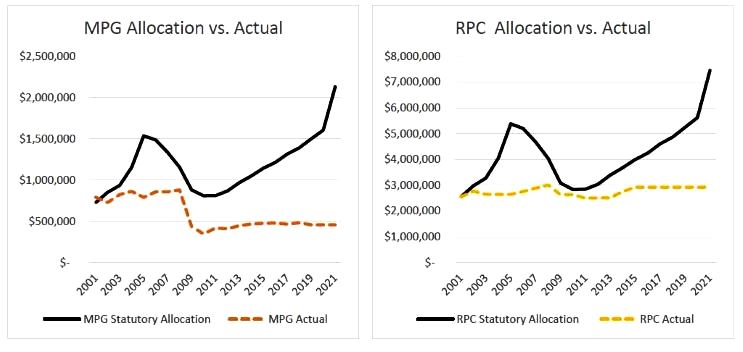
by Chris Campany, Executive Director, Windham Regional Commission Vermont’s regional planning commissions have been close to level funded since 2001. This makes it difficult to keep up with the needs of the towns we serve and the work we want to do in service to the Region as a whole. It also diminishes the role and responsibilities of our Commissioners, and our ability as a Commission to work with towns to establish regional priorities. Funding for Municipal Planning Grants has also been stagnant, and have actually decreased during the same 20-year period. This reduces access to planning funds for towns during a period when planning demands have only increased in number and complexity.
The Municipal and Regional Planning Fund (MRPF) is a key state funding source for planning. The MRPF provides substantial funding to the regional planning commissions, limited funding to municipalities through the Municipal Planning Grant program, as well as funding for the Vermont Center for Geographic Information (VCGI). For regional planning commissions, it supports all of our statutory responsibilities (see 24 V.S.A. § 4345 and 4345(a)). Pursuant to 24 V.S.A. § 4306(2), the MRPF “shall be composed of 17 percent of the revenue from the property transfer tax under 32 V.S.A. chapter 231 and any monies from time to time appropriated to the Fund by the General Assembly or received from any other source, private or public.” For twenty years, the MRPF has been seriously underfunded.
Because regional planning commissions have been close to level funded for 20 years, it causes us to make requests of legislative committees for funding typically related to bills they are moving that have some role for RPCs. To be sure, we appreciate the funding we get to do what the state asks of us, which is typically to assist towns with the implementation of a new state policy or priority. This is without question an important task. The downside of this arrangement is that our work is increasingly limited to what very narrow performance-based grant agreements allow us to do. Our work is now very much driven by scopes of work negotiated with state agencies rather than priorities identified by our Commissioners and the region’s towns. This arrangement also creates unpredictability. We are constantly ramping up to perform new contractual obligations with a very limited (short) lifespan. From a managerial perspective, the level funding coupled with short-term appropriations makes it difficult for us to both retain and compete for employees. We need predictable, sustained funding that supports our core mission and operations.
Town assessments are a small (typically 5-7 percent of our budget) but incredibly important part of our budget. You can see our work program and budget here. We work hard to limit annual increases in town assessments to the change in the annual Consumer Price Index, but this is increasingly unsustainable under the current circumstances. But as you can see from the change in the property transfer tax relative to what we have been appropriated over the last two decades, we shouldn’t be in a situation where we have to consider asking towns for greater financial support.
We want to do more for the towns we serve and the region as a whole based upon local and regional needs in a more robust, predictable, and sustainable manner. Planning demands are only going to increase in number and complexity in the areas of climate change – both greenhouse gas reduction and adaptation and resilience, energy generation and conservation, housing, infrastructure, community and economic development, natural resources and green infrastructure, and conservation. Funding Vermont’s regional planning commissions as Vermont statute says we should be funded will help us do the work in service to the Windham Region that is needed.