


Photo: Trapp Family Lodge in Stowe. Courtesy photo.
In Lamoille County’s booms and challenges, the tourism economy is strong but the county needs more housing
by Olga Peters, Vermont Business Magazine Lamoille County’s economy is performing better than expected.
Early in 2020, the state’s “stay home, stay safe” pandemic emergency measures closed the hotels and restaurants at the core of the county’s tourism economy. Information from the state Department of Labor shows the county has a higher concentration of food and hospitality businesses than the rest of the state. It is also home to the four-season resorts of Stowe Mountain Resort and Smugglers’ Notch Resort.
Yet, a combination of federal stimulus funds, an increase in midweek lodging bookings, and an influx of visitors purchasing real estate has buoyed the county’s economy.
“When the pandemic hit, at first it was a ghost town,” recalls Stowe Town Manager Charles Safford. “But all of a sudden, once the lockdown started to recede, and people saw Stowe as a safe option, things just supercharged.”
“And then everyone got a chance to get boosted, and people could start being more mobile, and then Stowe became hyper-charged,” he continued.
The boom, however, comes with its share of pressures. More people means more demand on Stowe’s municipal services, said Safford. See Stowe is seeing epic traffic jams page 23.
While more people moving to the area has contributed to a busy real estate market, the county still lacks affordable housing and workers.
David Silverman said, “We’re hearing is that there's a real lack of housing inventory, particularly in affordable housing.”
The president and chief executive officer of the Union Bank of Morrisville added, “We are personally concerned about the increase in prices and how that's impacting local people from being able to participate in the real estate market. It’s still a part of the American dream, and I think it's becoming more and more difficult to attain.”
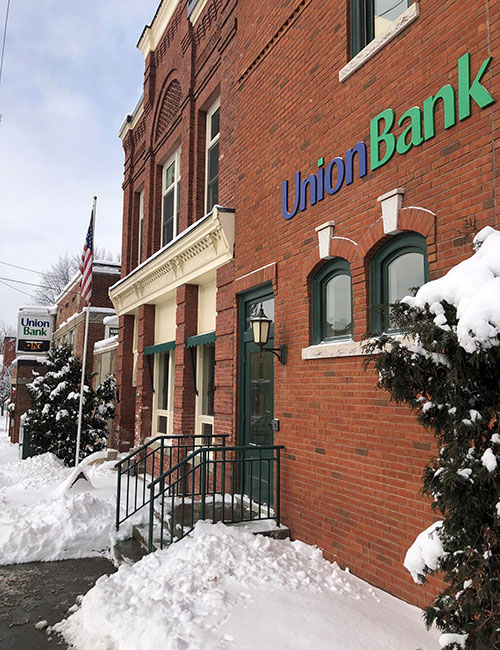 Photo: Union Bank on Main Street in Morrisville. Courtesy photo.
Jim Lovinsky, executive director of Lamoille Housing Partnership, pointed to the ripple effects of a lack of housing on the workforce.
“I think that a lot of businesses have started to recognize this is happening because it's affecting them,” Lovinsky said. “They're losing good employees because they can't find places to live. And they're having trouble attracting new employees because they can't find places to live either.”
Patrick Ripley, executive director of the Lamoille Economic Development Corporation, said so far, customers are patient when a business reduces its hours because of staffing.
“The good news is that the demand is still there; it hasn't gone away,” Ripley said. “We just need to solve these issues with the staffing and housing workers so that these businesses can get back to pre-pandemic operating levels, which they are not at now by any stretch. I want just to make sure that's clear.”
Planning For Growth And Increasing Resiliency
Before the arrival of COVID-19, Lamoille County was one of the few counties in Vermont experiencing population growth, said Tasha Wallis, executive director with the Lamoille County Planning Commission (LCPC).
Towns and villages’ ability to expand depends on more than simply growing the population. It also involves ensuring communities are environmentally and economically resilient.
Wallis said many of Lamoille County’s towns nestle next to rivers at the bottom of steep mountains. This configuration can make them more vulnerable to flooding.
“We’re all committed to this statewide goal of developing within existing downtowns and villages,” she said. “But some of our villages are right next to the river.”
A few years ago, the LCPC facilitated a bridge replacement in the village of Jeffersonville, creating an area to collect excess floodwater and adding a new culvert.
Meanwhile, the smaller communities that lack municipal water and sewer systems see this as a barrier to growth.
Vermont needs to increase its water and sewer infrastructure, she said. As the larger communities reach capacity, more people will move into the small towns.
With increased development pressures, Wallis expects traffic issues to increase.
“What our county doesn't have is an interstate,” she said. “The Route 100 corridor is a two-lane road.”
She said that more affordable housing and broadband are significant needs in the county.
“We see individuals whose rent is equal to what people are paying in mortgages," she said. "These people are unable to move on to homeownership because it's hard to save when rents are so high."
The LCPC is supporting Lamoille FiberNet Communications Union District as the district prepares to access the federal and state stimulus funds to improve broadband access.
Several LCPC projects relate to outdoor recreation, such as parking improvements at Smugglers’ Notch [see sidebar]. Another is helping to complete the Lamoille Valley Rail Trail.
The 93-mile trail follows the former Lamoille Valley Railroad rail line across five counties from St. Johnsbury to Swanton.
Pieces of the four-season recreational trail were completed over several years. Last year, the state Agency of Transportation took over finishing the remaining miles by 2023. To follow AOT’s work, visit the agency’s local project page https://vtrans.vermont.gov/highway/local-projects/lvrt.
“It'll be like a giant smile going across the upper part of Vermont,” Wallis said.
Supporting Businesses New And Established
In Ripley's opinion, the county's tourism economy is free of any long-term pandemic effects. Well, except for the need to find more workers, he said.
Ripley joined the organization last April. He has worked within the economic development community for approximately 10 years. Before taking the helm of the LEDC, Ripley worked with the Vermont Small Business Development Center for about nine and a half years.
“But there's still a lot to learn, and I'm learning as I go,” he said. “So definitely doing a lot of listening.”
Ripley said that the data he has seen shows that “things have really bounced back in terms of folks coming to Lamoille County and spending their money at local businesses.”
LEDC follows travel-related data such as the amount of rooms and meals taxes generated in the county. He said that the numbers have returned to pre-pandemic levels in many cases.
Ripley is pleased to see visitors returning to the county.
“It appears to have already remedied itself, and people are eager to get back,” he said. “So that's really encouraging for us here in Lamoille County that we don't need to have concerns moving into the future about our travel and tourism numbers.”
Ripley stressed that even if tax revenue looks promising, this does not mean every business is thriving. Many companies lack the workers to meet customer demand. Every customer that goes unserved represents money lost.
“I don't want to give the impression that it was all roses for these business owners because it's not,” Ripley added. “The challenge is going to be serving [customers] and being able to keep those revenue streams at or near pre-pandemic levels, which they're not right now.”
In his 2022 State of the State address, Governor Phil Scott outlined housing and workforce development as statewide priorities, Ripley noted.
“We’re all for anything that can assist the businesses with workforce and staffing and housing,” he said.
Ripley explained that the struggle to find workers is often a case of not enough workers or workers without the skills employers need. The LEDC is helping connect existing educational training programs with employers.
“Nursing is an area where we're seeing specific struggles, and we're trying to connect those educational programs with the employers,” he said.
Hospitality is another industry in Lamoille County that lacks workers.
It’s too early to understand why people aren’t taking hospitality jobs. He said it could be because of barriers like a lack of affordable child care. Or people took jobs in different industries. Or the county may lack the overall population to fill open positions.
“So we haven't really solved that puzzle, but we're looking at various ways to do it,” he said. “It may mean some advertising out of state, identifying some areas where there's a glut of these types of workers in the country, and doing marketing efforts to reach out to those folks in those specific areas and encourage them to come here to Vermont and work here.”
LEDC is the local contact hub for ThinkVermont.com. The state website provides information for people looking to relocate to Vermont.
Lamoille County is in step with other areas of the state regarding a lack of housing and how it appears to constrain the local workforce.
“Housing is arguably equally a factor as much as the actual workers,” Ripley said.
Although plans are still in the early stages, Ripley said the LEDC is exploring new housing options such as campus housing and cultivating partnerships with other organizations.
As part of its efforts to support businesses, LEDC has helped prepare applications to the state Agency of Commerce and Community Development’s Vermont Capital Investment Grant Program. The $10.5 million program funds infrastructure needs such as housing, broadband, wastewater, climate change prevention, and economic development projects using federal ARPA monies. More information at https://accd.vermont.gov/economic-development/funding-incentives/capital...
“So we've been doing a lot of work to get the appropriate businesses connected to that program,” he said. “We've had some good candidates in Lamoille County, and we're hopeful that they will get at least some funding out of that effort.”
The LEDC operates a revolving loan fund for small business owners. Priority is given to business owners considered high risk, but the application is open to everyone, he added.
Businesses can also contact the LEDC also about their grant to help build or redesign companies’ websites.
To check out the organization’s other resources, visit lamoilleeconomy.org.
Expecting More Of The Same
“It’s hard to figure out what will happen in 2022, but I sort of expect that there will be a little bit more of the same,” said Silverman. “Where we stand today in January of 2022, I mean, we're in a far better spot than I thought we might be, and a lot of that is attributable to state and federal stimulus.”
Union Bank of Morrisville has seen unprecedented growth, said Silverman. In 2019, the bank closed its books at a little over $900 million. The bank’s balance sheet grew more in 2020 and 2021, primarily due to the federal stimulus funds.
In a January 19 press release on its website, the publicly traded bank announced that the institution’s total assets increased to $1.2 billion as of December 31, 2021, up from $1.1 billion for the same date in 2020.
“So we possibly had five years' worth of growth in two,” he said.
“I think the 2022 story is going to be the labor market. It's just very, very challenging,” Silverman said.
He said the bank’s mortgage lending and refinancing have slowed compared to January 2021. The purchase of businesses is still pretty strong.
In Silverman’s perspective, the local business climate seems healthy with a caveat: staffing. Many of the local restaurants have reduced their hours, he said.
According to the Vermont Department of Labor’s latest unemployment numbers, in November 2021, the state’s unemployment rate was 2.6 percent. The rate for Lamoille County was 2.4 percent.
Staffing issues haven’t spared Union Bank either, he said. In some ways, the current COVID variants are contributing to an increase in absenteeism than when the pandemic first arrived in Vermont.
In 2020, he continued, the bank shut branches in response to the state’s emergency protocols, so illness didn’t impact the bank’s day-to-day.
“We didn't lay anybody off. We tend to be pretty protective of our teammates,” he stressed.
However, as the pandemic enters its second year, the staffing picture has changed.
“I actually just got a report this morning, and we've got gaps that are a result of absences due to omicron [variant] and other things — because, you know, we're in flu season — and so from the standpoint of operating the bank, and staffing the bank, we're probably in a more challenging spot today than we have been during the entire pandemic,” Silverman explained.
In his opinion, the economy appears to have recovered from the pandemic’s initial upheaval. Here, Silverman pauses to add, “I don't want to understate the fact that there have been people that have been absolutely slammed in this whole thing.”
“The folks on the less fortunate end of our spectrum tend to be the ones that were hurt the most through this whole process, and I don't think the upheaval is over by any means,” he said.
The county has yet to reach any post-pandemic new normal, he said. What has occurred is that people and businesses have adjusted.
“It's not the same pace of rapid-fire decision making that we had to make in the early days,” he said.
Silverman continued to add that he, his teammates, and community members are all tired.
“We all have COVID fatigue,” he said.
Workcations and Staycations
Tourism in Stowe is flourishing but with a slight twist.
Carrie Simmons said bookings have increased, but more are happening during the week than during the weekends.
“To take advantage of this trend, we are promoting workcations—working remotely and exploring the area before, during, and after the workday—and staycations, or longer stays,” wrote the executive director of the Stowe Area Association (SAA) in an email.
Simmons shared the midweek and weekend occupancy statistics for summer 2021 - winter 2022 and compared them with the previous year.
- Summer (May - Aug): up 20 percent midweek, up 6 percent weekend
- Fall (Sep - Oct): up 20 percent midweek, down 1 percent weekend
- Winter (Nov - April, as of 1/13/22): up 32 percent midweek, down 17 percent weekend
Simmons attributes the increase in travel and tourism to the pent-up demand associated with staying home during the pandemic.
“Many lodging properties are reporting record-breaking earnings; however, the growth has been much more notable for midweek travel over weekends,” she wrote.
Simmons attributes this shift to mid-week travel to two factors. First, guests are looking to avoid crowds. Second, historically, winter weekends already had high bookings, so there was little room for growth.
The occupancy trends align with what Simmons sees in the SAA marketing efforts.
“In 2021, new website users on GoStowe.com were up 27 percent from 2019, and people are spending more time on the website as well. We're also seeing more interest from media and influencers in highlighting the destination in their publications and on their feeds,” she wrote in an email.
Like the rest of the state, a shortage of affordable housing and staff hinders businesses’ ability to take full advantage of tourism demand.
“The shortage of housekeeping staff at many properties has played a notable role in the limitation of how much weekend and holiday occupancy can grow,” Simmons wrote. “While demand is extremely high, some properties are forced to leave rooms vacant during holiday periods and busy weekends simply because they do not have the staff to clean them.”
Last year, the SAA launched a new marketing campaign, Only In Stowe. The effort highlights Stowe’s restaurants, shops, ski areas, outdoor recreation, and local charm.
“Stowe is a bucket-list destination for every type of traveler—from relaxing getaways to non-stop adventures,” she wrote.
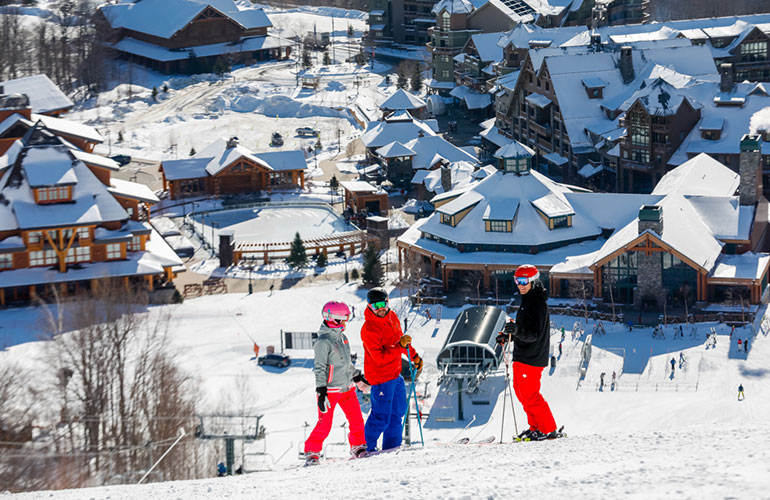 Photo: Skiers at Stowe Resort. Photo: Jesse Schloff Photography.
Last May, SAA participated in the National Travel & Tourism Week (NTTW) for the first time. Organized by the U.S. Travel Association, NTTW highlights the economic, business, and personal value of traveling.
Simmons said the SAA is focused on working in partnership with the town of Stowe, similar neighboring organizations, and with the state. These partnerships are critical to tourism's success in Stowe, she said.
“We were also awarded the Restart Vermont grant, which promoted the ‘Best of Route 100 Holiday Experience’ emphasizing holiday shopping, dining, and lodging in Stowe, Waterbury, and the Mad River Valley,” she wrote.
To learn more about the Best of Route 100, a collaborative effort by the SAA, Mad River Valley Chamber of Commerce, and Revitalizing Waterbury, visit www.bestof
vtroute100.com.
Last February, Stowe received a bump in coverage when Bravo filmed its reality television series, "Winter House,", in the area.
“Stowe, Vermont is a dynamic place, and promoting it is exciting and rewarding,” Simmons added. “We are often reminded of how critical Stowe's tourism industry is to our economy and quality of life."
Continuing To Care While Adjusting To The Pandemic
COVID has upset the proverbial apple cart while also pushing communities to innovate.
Joe Woodin said that Copley Health Systems’ response to the pandemic has evolved with the pandemic.
Copley Health Systems is the umbrella organization for Copley Hospital; the Health Center Building; a 40-unit independent living retirement community, Copley Woodlands, located in Stowe; and the 38-unit low-income independent living community, Copley Terrace, in Morrisville.
“Early on, it was easier to say we can't do this,” said Woodin. “It's easier to say, this is not possible. Or, it was easier to say we can't do this.
“And then later, we learned no, we could figure this out. We have to. There's nowhere to pass this problem along - this is our problem,” he said.
The Morrisville-based hospital is about to celebrate its 90th birthday. The 25-bed facility is one of eight Critical Access Hospitals in the state. According to Woodin, Copley has a reputation as a skilled orthopedics facility that draws patients from across the region. Most of Copley’s services are outpatient.
Delivering care in a small rural community is a personal experience, he said. It’s a beautiful and exhausting obligation to care for neighbors.
Staffing issues have made operating Copley harder. For a hospital to fully serve its community, it needs all its staff from housekeeping, food services, community volunteers, LNAs, RA’s, and doctors, Woodin explained.
“The labor piece has been pretty dire for the healthcare field,” he said. “We just don't have enough people in the pipeline. We don't have enough students or people interested.”
Unlike businesses like restaurants that can reduce shifts or hotels that can close rooms, hospitals must remain open for emergencies.
“We haven't had much relief. There is no relief,” he said.
Community support and new partnerships with fellow health care organizations have helped Copley through the pandemic.
Woodin said one company to come through for Copley was the rowing machine and exercise equipment business in Morrisville, Concept2, Inc.
“They said that they had a lead to be able to get 500,000 masks through China when America wasn't making anything,” Woodin said.
Woodin responded to the offer with a degree of skepticism. Nobody in the health care field could source personal protective equipment.
“And you know what happened? They did it. They delivered, they actually received hundreds of thousands of masks,” he said. “I sort of cried about that because it was such benevolence and caring and generosity on behalf of a company.”
Copley joined other Lamoille organizations to form the Coronavirus Response Team. The organizations include health care organizations from across the county. Throughout the pandemic, members of the group met to share ideas, resources, and discuss the latest federal or state guidance.
“I think there's the science and the science that we know is… it's actually temporary,” he said. “So that, to the best of our knowledge, our science looks like x today, and only today.”
In Woodin’s opinion, the pandemic is about more than science. It also carried consequences for the community’s social and mental health.
“We're not good at measuring those things. I think that's been sort of expensive, and it's been a stressor,” he said.
The health care system has a lot to learn about mental health, and the pandemic is teaching practitioners, even more, he said.
Woodin expects health care will become more expensive. Labor will probably comprise the most significant additional expense. Adapting to COVID and preparing for other infectious diseases with equipment and negative pressure rooms will also increase costs.
“My prediction is, we're all going to have to be graced and be aware that there's going to be a significant increase in the cost of health care in America,” he said.
Woodin continued, “And it's nobody's fault. It's the private marketplace because we're private hospitals and private organizations just doing the best we can to respond to the needs and the mandates of taking care of folks.”
One of the outcomes of the pandemic for Copley is an in-depth review of their policies, procedures, staffing, facilities, and following innovative methods of returning patients to their regular lives quicker and with less expense.
“The good news is we've learned to be extremely flexible,” he said. “So we are really working very hard to be more creative, more efficient, continue to offer better quality, manage operations, and figure out how to make this work.”
Two Sides Of The Hot Real Estate Market: More Local Investment But Less Affordability
“Basically, 2021 was a continuation of 2020, but with fewer options and higher prices,” said McKee Macdonald.
The broker and co-owner of Coldwell Banker Carlson Real Estate with offices in Morrisville and Stowe added, “And 2022 is starting with a with a real shortage of inventory to the point where it's actually going to slow sales down.”
In Macdonald’s experience, the Lamoille County housing market remains hot, especially the second home market, which is a good thing. It means more people, a more substantial tax base, and more local investment.
Macdonald serves on the board of the Stowe Area Association with several hospitality business.
“A new breed of hoteliers are coming into our area” and revitalizing old properties, he said. “From a restaurant standpoint, we’ve got renewed interest from Burlington-based restauranteurs that are looking at Stowe as a real viable option, and all that [economic activity] spreads out.”
The flip side of the county’s busy housing market is that housing prices have increased as housing inventory has diminished. People are moving farther away from the economic hubs to find affordable housing.
As people look for housing in other areas of the county, prices increase in those communities.
“So it is impacting those communities,” he said. “It's not quite as pronounced, but it's certainly a factor.”
Affordability is an issue for both homeowners and renters, he said.
“So you're seeing your base of rental prices go up and up, which is putting a squeeze on people, and then that's pushing them, you know, to move further out and longer commutes,” he continued. “So, Hardwick is now a commuter town for Morrisville and Stowe.”
In Macdonald’s opinion, more people moving to communities to find affordable housing may have a silver lining. The new residents are elevating property values, sending their children to the local schools, and participating in community revitalization.
In January, Carlson Real Estate released its 2021 year-end market report, which compared Q4 2021 to Q4 of 2020. According to the report, buyers continued to look for larger homes with home offices, access to high-speed internet, and near amenities such as outdoor recreation.
The median price for a property in Stowe was $890,000 in 2021 compared to $805,000 the previous year.
Stowe’s luxury home market is approximately 40 percent of the whole market. Sales of properties above $1 million also increased to 43 in 2021 compared to 38 in 2020. The data did not include a $33 million deal which the report writers considered an outlier.
Fewer properties in Stowe sold last year. This is likely a reflection of low inventory more than the market’s strength. Q4 of 2021 saw a 50 percent reduction in new listings. The average number of days on the market dropped in 2021 to 47 from 100 days in 2020.
Data for Lamoille North (the county minus Stowe) also showed increased growth.
“What was most significant about this growth was the expansion of sales within the luxury arena,” stated the report. “There were 14 sales above $900,000 in 2021 compared to 3 the prior year. This is a direct reflection of the lack of inventory in the Stowe market.”
According to the report, buyers in the luxury market were mainly looking for vacation homes.
The median price for properties in Lamoille North rose from $260,000 in 2020 to $347,000 last year. Primary homebuyers purchased the majority of the homes in this price range. Days on the market dropped to 66 from 106.
Macdonald said that most of the properties he has sold became second homes. The new owners he’s spoken with divide their time between Vermont and a home base. Few have made the complete transition to Vermont. Households with children tend to divide their time between Vermont and home depending on when the kids are remote or in-person schooling.
Broadband remains a challenge even in the more populated municipalities like Stowe, he said.
He described the internet in his neighborhood as living in 1999. This slow internet was a struggle during the depths of the pandemic in Macdonald's household, where he, his wife, and their children were all trying to work and study remotely. Eventually, Macdonald and his neighbors paid to install better internet in their neighborhood, but it wasn’t cheap.
Macdonald feels optimistic about the county’s economy. He believes the county is well-positioned for a prolonged economic run of growth.
“You know, from a real estate standpoint, it's been fantastic,” he said. “Vermont, on the whole, has had a renaissance through this period that I'm not sure anybody really saw coming.”
The County Needs More Housing
“I’ve got a brand new 24-unit going up in downtown Morrisville that we’ve been working on for two years,” said Jim Lovinsky. “So it is just so exciting to have it actually taking shape before my eyes.”
Lovinsky is the executive director of the Lamoille Housing Partnership, a non-profit affordable housing developer.
Built on a vacant lot in downtown Morrisville, Village Center Apartments will open this summer. The new construction is unusual for LHP, which usually rehabilitates existing buildings, Lovinsky said.
Lamoille County’s housing shortage existed before the pandemic, he continued.
“I think it's important to understand that it's not just a shortage of affordable housing,” he said. “It's a shortage of housing, across the spectrum, whether it's new homes, new single-family homes, market-rate apartments, nice townhouses, or affordable housing. There's not enough of it.”
LHP conducted a housing needs assessment in 2018, according to Lovinsky. At that time, the study team determined that the county would need more than 1,000 new rental units in the next 10 years to meet demand, he said. And that was before the real estate boom of 2020.
“We have almost 300 units in our portfolio, and at any given time between three and 400 applications that we're working with, and maybe half a dozen apartments that turnover,” he said. “Okay, so it's really tight.”
The conversion of long-term rentals into short-term vacation rentals puts pressure on the rental market, too, he said. Anecdotally, Lovinsky has heard from business owners who lost employees after their long-term rentals were converted to short-term.
“I hear from town officials all the time about how are we going to control the short-term rentals because it's causing such problems, and Zoning Boards, Planning Commissions they're all trying to figure it out,” he said.
According to the website HousingData.org, in 2019, 15 percent of households in the county spent more than half their income on housing. For the people in that category, 25 percent were renters compared to 11 percent of homeowners. These rates were higher than the state average.
“There's a big wage to housing gap in Vermont,” Lovinsky added.
Lovinsky feels that people have finally recognized the need for more housing.
“Yeah, the good news is we've got a bunch of money, and I think we have the infrastructure in place, at least in the affordable housing arena, to deploy those resources,” he said.
For example, the LHP partnered with the town of Morrisville to develop accessible parking spaces for residents.
“We collaborated with the town to upgrade the municipal parking lot across the street and make it so that we can have overnight winter parking and it's because they're recognizing the need for affordable housing,” he said.
Lovinsky said he feels grateful towards the private developers in the county building market-rate housing.
“They’re filling those units as fast as they can build them, just like we are,” he said.
As of January, LHP was collaborating with a private developer to purchase a building in Stowe. Once the deal is completed, the LHP will have 14 new affordable housing units.
“Probably the most rewarding part of my job is when you see people moving into a unit, and they are so excited and so grateful to have a nice place to live. It is absolutely the best part of the job when that happens,” he said.
Olga Peters is a freelance writer from Windham County.
