by Timothy McQuiston, Vermont Business Magazine The tight labor market continues, just as it was before the pandemic. Businesses have urged the governor to suspend the federal unemployment insurance stipend they maintain has kept otherwise able-bodied workers at home. They believe the $300 extra a week results in some potential employees making more not working than working.
Governor Scott in May reinstated the work-search requirement for UI filers and at the end of June told VBM that he would end the federal stipend in September whether or not Congress extended it.
"I think we should see this through," Scott said June 29. "But I would say this: If Congress decides to extend the $300 stipend, I would probably not accept it. I think it's gone on long enough and we would let it lapse as of September 6." (see his full comments below)
However, the governor also knows that the stipend has and will continue to push millions of dollars a week into the Vermont economy. At about 18,000 UI claims now, that would equate to about $5.4 million injected into the local economy every week. Meanwhile, the data is still out on whether those states that have suspended the federal stipend to encourage people to get back into the workforce have actually seen an increase in job seekers.
In Vermont, regular initial unemployment claims remain at levels more typical of a pre-pandemic summer. Numbers fell dramatically earlier this year when the Vermont Department of Labor was able to eliminate the vast bulk of fraudulent claims. VDOL now requires new claimants to call the department directly.
As the VDOL discovered, and other states have realized, criminal operations were barraging online systems with false claims. In addition, initial technical issues with the work search requirement for unemployment insurance filers have been resolved. The work search requirement was suspended by the governor during the pandemic and was reinstated on May 9.
Also, the Legislature has removed 2020 from the unemployment calculation for businesses. If they hadn't, rates to employers would have escalated and the UI Trust Fund would have unnecessarily ballooned. Commissioner Michael Harrington had urged the Legislature to change the law regarding how employers are charged to meet the UI Trust Fund obligations, which they did.
The state’s UI contribution rate will index up to Tax Schedule III and the maximum Weekly Benefit Amount (WBA) will increase to $583 per week. Both changes took effect July 1.
Vermont’s unemployment rate falls again to 2.6 percent in May
The Vermont UI Trust Fund was well-stocked with over $500 million before the pandemic and is still flush with over $200 million. Despite the Stay Home order from a year ago and layoffs at their highest levels since the Great Depression because of the pandemic, current law would have required a steep increase in employer charges because of those pandemic-related layoffs. If the law had not been changed, more than $1 billion would be raised.
Harrington said this would have put a burden on employers who are just emerging from the recession and is simply not needed.
It also would have punished employers who were not at fault for the pandemic or for the layoffs related to it.
As for the fraud, criminal enterprises in the US and internationally were taking advantage of the new benefit year (in which claimants were required to re-file) to file false claims in Vermont and across the nation.
In many cases the criminal enterprises were using personal information they had gained from data breaches at other private companies or credit agencies upwards of 15 years ago and were biding their time for the best opportunity to take advantage. The pandemic has provided that opportunity, Harrington said.
He said Vermont has likely lost millions of dollars because of this, but knowing exactly how much has been difficult to assess.
Department of Labor temporarily suspends online UI application for new fliers in order to combat fraud
While the Labor Department was catching most of the fraudulent claims, even those that managed to get through for even a few weeks were able to steal substantial amounts of money because of the sheer volume of attempts (see Figure 2 graph below).
Harrington said that upwards of 90 percent of claims online were fraudulent. Given the data available now, it appears to be over 95 percent.
Labor Dept to reinstitute work search requirement for UI benefits beginning May 9
Governor Scott has said he hopes to use a surplus of federal funds to update the 30-year-old Labor Department mainframe and other IT systems to reduce the opportunity for fraud should another large-size calamity arise.
He added that there always has been fraud related to UI claims. He said such fraud should be a felony, but in the case of the pandemic, the criminals are not only outside Vermont but outside the nation.
We will have to see if the June summit between President Biden and Russian President Putin will yield a positive result regarding cybercrime. Much of the blame for many levels of cybercrime in the US and across the Western economies has been laid on Russian culprits. Biden emphasized to Putin that he must rein in this activity or the US would have to retaliate with its own substantial cyber capabilities. Putin has denied the claims. But Biden plainly warned Putin that if Russia did not address the problem that the US would react in kind with greater resources at its disposal.
For Vermont, suspending the online registration appears to have solved the problem for now.
Harrington pointed out that much of the money lost is federal and likely related to the federal PEUC and PUA programs, as the US government extended benefits because of the pandemic.
Current UI Claims
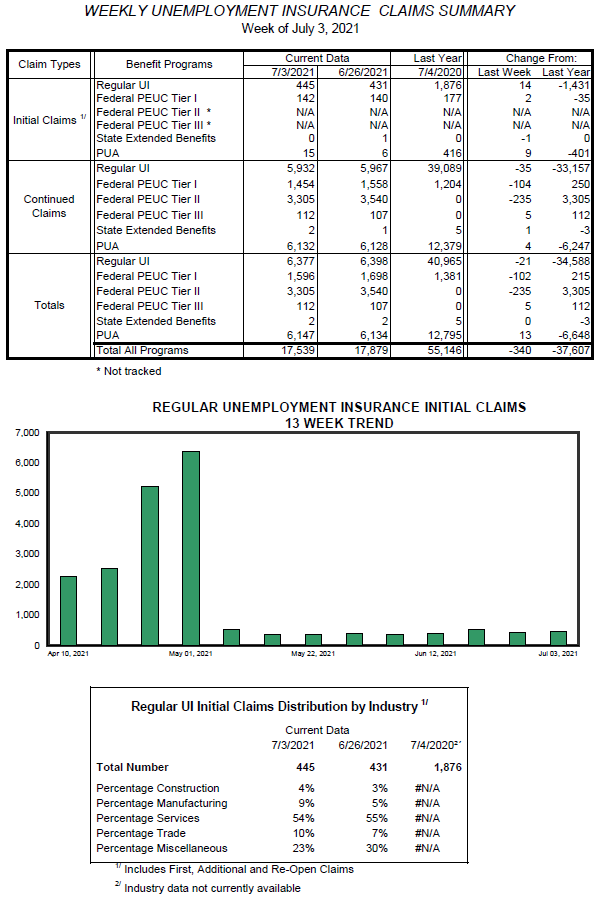
Meanwhile, on July 3, 2021, the Labor Department reported 445 new weekly filings (they were 6,372 on May 1, 2021).
This week's claims are 14 more than the week before. But they are 1,431 fewer than the same time last year.
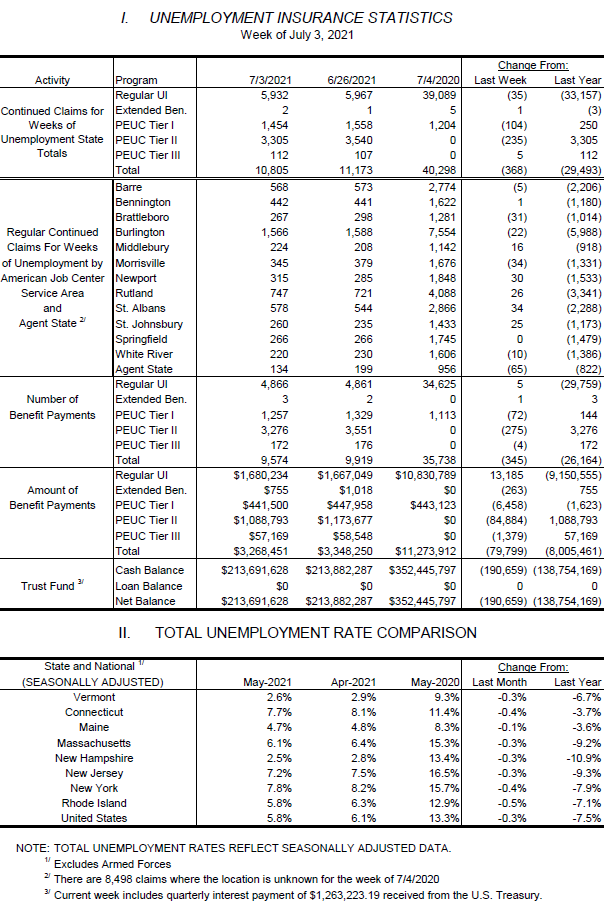
As for ongoing jobless claims, for the week ending July 3, the Labor Department processed 6,377 regular UI claims, down 21 from the previous week and 34,588 fewer than the same time last year.
As for further comparison, initial Vermont claims last year for the week of March 21, 2020 (the first full week of the pandemic in Vermont), were 3,784, up 3,125 from the week of March 14, 2020.
For the legitimate claims this week, there were 6,377 on regular UI; 5,013 on PEUC; 6,147 on PUA; and 2 on extended benefits as of June 12, 2021.
Nationally, claims increased to 373,000 for the week ended July 3, compared with the 350,000 economists' estimate. While these are well lower than during most of the pandemic, they remain at historically high levels.
Productivity also exceeded expectations in the first quarter.
The US unemployment rate declined by 0.3 percentage point to 5.8 percent for May 2021.
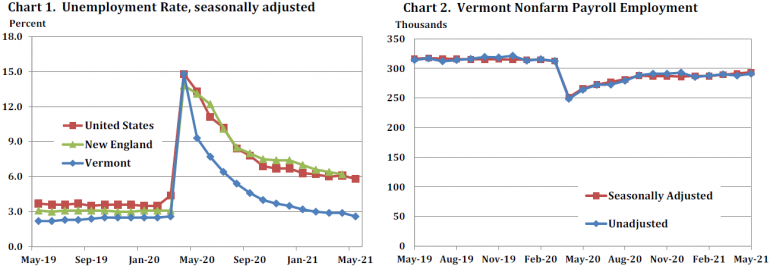
The Vermont unemployment rate in May 2021 of 2.6 percent is just one tick higher than its very low level just before the pandemic in February 2020 (2.5 percent, before spiking to 14.8 percent in April 2020, which was the high-water mark).
Governor Scott on $300 Federal Stipend
Vermont Business Magazine posed this question to the governor in late June: Complaints have been coming in from employers about people not coming back to work. This is especially acute, of course, in the tourism industry. I’m wondering what your reaction is to that and whether you believe people are just slumming on the sidelines and taking the federal payout?
Governor Scott, June 29, 2021: Obviously, we're moving in the right direction in some respects. We went from over 90 000 being on the unemployment insurance program and we're now down below 20,000. I think the last I saw we were around 18,000 and that was all in traditional UI, PUA and so forth.
So we're moving in the right direction. I think that's the good news. There are some good aspects and then there are some concerning aspects of the $300 stipend.
I think there are a certain segment of the population that do the math and feel as though they can stay home and collect unemployment and get the $300 stipend and be in better financial shape than they were if they were working.
There's also a segment of the population that can't go back to work at this point and need that $300 stipend. This lasts until September 6 and I know this is painful for many, especially in the hospitality sector in particular.
But every single sector in Vermont is challenged by workforce needs. But again this is no surprise. Just remember before the pandemic, we had the lowest unemployment rate in the country (the May 2021 rate fell to 2.6 percent, second lowest in US behind NH). We also had more jobs than we had people to fill them.
That hasn't changed. In fact it's gotten worse.
Go back four or five years when I first ran, I talked about 6-3-1. We're losing six workers out of the workforce every single day. Six workers. So think about that. I mean that's a couple thousand every single year. Now it's been four or five years. That's 10 to 12 thousand people since then.
We're also losing kids out of the school system. That was the three fewer kids in in the school system every single day. That's another thousand a year. (The one in the 6-3-1 equation refers to on average one baby born to an opiate-addicted mother every day.)
So, again, this shouldn't come as any surprise. We're still challenged and that's why I talk about the refugee program, more immigration, trying to attract more people into the state, making Vermont more affordable, so people will either stay here or come here.
We have all the attributes. Being the safest, healthiest state in the country is an attribute we earned over the last 16 months and we should take full advantage of that.
As well we should use the beauty of our state, all that we have to offer, selling that.
I’ve taken a lot of criticism at times from the Legislature – not from taxpayers but from the Legislature – on some of the vetoes I’ve imposed over the last four years. Most of them were financial and most of them were budgetary issues.
We didn't need to raise taxes during this time because we need to make Vermont more affordable and we proved that we could do it without raising taxes. And that's why we have to continue to march forward and make sure that we're not making Vermont a more expensive place to live but actually more affordable
And other things, like this the military pension. For the life of me I don't understand why we don't move forward with that. I hear from military retirees every single day. We're one of six states that still taxes their military pensions. If we didn't do that they might consider staying or coming to Vermont.
So, there's a lot of opportunity out there. We need to continue to focus on the needs of the state, but having more people here, having more people in the workforce is something that we were challenged with pre-pandemic and we're certainly challenged today.
But getting back to the original question.
The stipend of $300 will end the 6th of September. We have to give a 30-day notice whatever we do.
I think we should see this through. But I would say this: If Congress decides to extend the $300 stipend, I would probably not accept it. I think it's gone on long enough and we would let it lapse as of September 6.
VBM: Do you have any thoughts on whether we're seeing a sea change in how people view the workforce, and perhaps will not come back to these hospitality jobs even after the stipend ends?
Governor Scott: There's some discussion about that right now, that maybe we've seen a change in the overall economy. I suppose that could be. But everything has a way of leveling itself out. I know that those business owners in those sectors are doing their part. They're offering more money for people to come in, higher wages far exceeding the $15 dollar minimum wage that many advocates had proposed. And I think that, again, it's about supply and demand.
Employers know they have to offer more benefits, higher wages in order to keep and to attract more people and they're doing that so we'll see how this all levels out. I think it's a little too soon at this point to determine what the future is going to bring. I think we're just going to need a little bit more time.
Maybe with some of the students coming back to the colleges and universities, seeking part-time jobs, that will help as well. They might not have been able to do that previous 16 months (some colleges went fully remote and others used a hybrid model). But when they come back in the fall, and maybe sooner, I think we'll see that there'll be more that may enter the workforce.
Labor Department Report to Legislators
(The Legislature adjourned May 21; this represents the most recent report from the VDOL, filed June 29, 2021.)
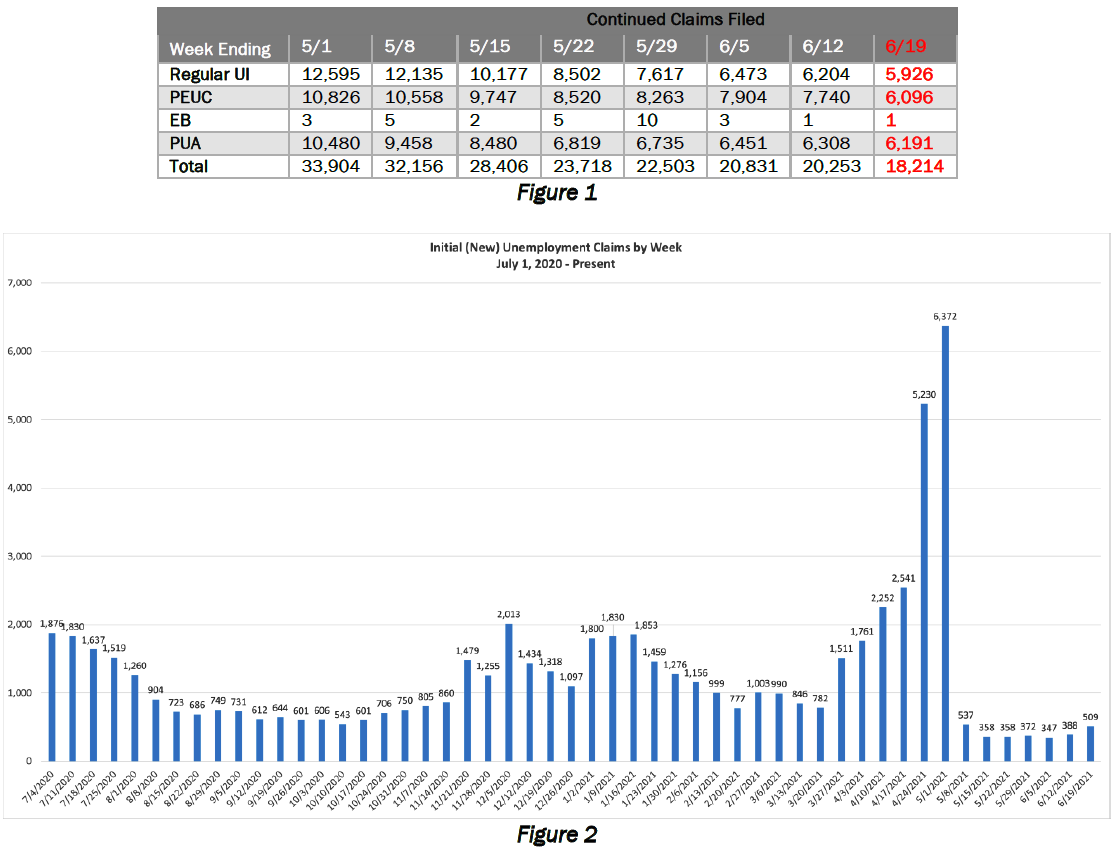
Figure 2 shows the spike in suspected fraudulent claims.
VDOL tables as prepared for the Legislature. Click HERE to see full report.
During the benefit week ending June 19th there 18,214 weekly claims filed. This is a decrease of 2,039 continued claims filed over the previous benefit week. During the week ending June 19th, $7,718,667 in benefits were paid out to claimants.
The Department of Labor offices will be closed on July 5th in observance of Independence Day. This includes the UI Claimant Assistance Center. Claimants will still be able to file their weekly claims on Sunday and Monday but will see a one-day delay in claim processing.
Workforce Development has reopened Job Centers across the state to allow for both walk-in and by appointment services to support Vermonters through a variety of services to reengage with the workforce. Job Centers in Barre, Bennington, Brattleboro, Burlington, Rutland, St. Albans, and St. Johnsbury are open now and Middlebury will be opening on July 6. The remaining Job Centers will be opening in the coming weeks.
Initial UI Claims Fraud
According to a VDOL spokesperson, in April of 2021, initial unemployment claims increased to roughly 1,500 claims a day, with some days reaching well over 2,000 submissions. These numbers immediately raised questions about the validity of the claims being submitted.
The Department’s analysis resulted in well over 50 percent of claims submitted being flagged as fraudulent and needing to be manually reviewed by the UI Fraud Unit.
This created concern for the Department’s capacity to review claims in a timely manner as well as the monetary liability being given to fraudulent claims before a review could be conducted.
In response, the Department removed the online application from its website on April 28, directing claimants to the Claimant Assistance Center to file an initial claim or establish a new benefit year.
At the time the initial claims application was taken offline, more than 80 percent of claims were being marked as fraud.
Due to the evolving nature of this situation, and the commitment to processing timely benefits for eligible claimants, the Department does not currently have data to share on the number or amount of fraudulent payments. This is specifically due to the fact that the systems the Department uses do not aggregate claims that are marked as fraud that resulted in payments. States across the country, have had to quickly adapt to an unpredictable operational environment and increasing security threats that have emerged due to the pandemic.
To that end, VDOL is currently reconstructing historical data to remove fraudulent claims to better reflect the actual population of unemployed Vermonters.
Based on available data, there is strong evidence that throughout the spring, fraudulent activity contributed to an artificially high number of initial claims being reported based on the sharp decline once the application was removed.
However, the Department continues to manage a claims load that is roughly 10 times higher than pre-pandemic levels.
Weekly UI Report
Regular weekly UI claims in Vermont had been edging down since late January, but starting in late March headed steeply back up. Governor Scott declared a State of Emergency on March 13, 2020, and closed restaurants and bars after lunch on March 17, 2020. (The State of Emergency ended June 14, 2021).
On March 24, 2020, Governor Scott issued a “Stay Home, Stay Safe” order and directed the closure of in-person operations for all non-essential businesses (effective March 25-May 15, 2020). These measures swelled the ranks of the unemployed and led to about 90,000 Vermonters filing for unemployment benefits.
As part of unwinding the emergency measures taken to combat the novel coronavirus a year ago and to jumpstart the economy now, on Tuesday April 6, 2021, Governor Scott unveiled two major actions.
First he announced his Vermont Forward Plan to get the state "back to normal by the Fourth of July" or nearly so. This is based on the rollout of vaccines. It would provide universal instead of sector-specific mitigation measures.
It would also lift economic and gathering restrictions, perhaps as early as mid-June but by the July 4th in any case.
Scott also revealed a $1 billion economic recovery and revitalization plan. This features major infrastructure upgrades, including $250 million for broadband.
American Rescue Plan
• The American Rescue Plan (ARP) signed into law by the President on March 11 and includes provisions to extend various Unemployment Insurance programs:
o Pandemic Unemployment Assistance (PUA) was created in March 2020 as a program for individuals not typically eligible for regular unemployment insurance to file for and receive benefits (e.g. self-employed, independent contractors, etc.). This program has been extended until September 6, 2021. The benefit week ending September 4, 2021 will be the final week claimants are able to file in the PUA program.
o Pandemic Emergency Unemployment Compensation (PEUC) was also created in March 2020 as an extension program for claimants who exhausted their regular unemployment insurance benefits but remained unemployed. The ARP extends the number of weeks an individual may receive in the PEUC program from 24 to 53 weeks if they exhaust their regular UI benefits.
o Federal Pandemic Unemployment Compensation (FPUC) has also been extended through the benefit week ending September 4, 2021. Claimants will receive an additional $300 benefit which will be added directly to their state weekly benefit payment.
o Reimbursable Employers: The ARP increases the federal reimbursement rate for non-profit and municipal governments from 50% to 75% for the amounts of compensation paid for weeks of unemployment beginning after March 31, 2021, and ending on or before September 6, 2021.
o Unemployment Insurance Tax Exemption: The first $10,200 in 2020 unemployment benefits are exempt from federal income tax for households with incomes below $150,000 per year. This tax exemption is under the jurisdiction of the IRS. Claimants may find more information about the exemption on the IRS website here: https://www.irs.gov/faqs/irs-procedures/forms-publications/new-exclusion...
1099 Processing Incident
• Once a claimant has received and reviewed all of their 1099 documents, if they still feel that the information provided on the forms is incorrect, they can submit a 1099 correction request form. If a claimant needs a new 1099 or never received a 1099, they can also request to have the Department reissue their 1099. Individuals who receive a 1099 from the Department but never filed for unemployment benefits should file a fraudulent 1099 report with the Department immediate. All in formation regarding 1099 requests can be found at https://labor.vermont.gov/request-1099-correction.
Recapture Update
• As of March 7th, the Department had recaptured 61% (approximately 57,600 returned out of 94,800) of all original 1099s that were delivered to the post office.
Identity Protection Update
• The State has contracted with Identity Theft Guard Solutions, Inc (IDX) to provide identity protection service to claimants. This protection will cover claimants for a minimum of 12-months. Notices were mailed to all 2020 claimants on Thursday, February 18. Claimants have until May 18, 2021 to register with IDX for credit monitoring services, which are retroactive to the date of the incident (January 29, 2021).
• As of March 22, 2021, 11,573 individuals (11.7% of population) had enrolled in ID protection. Claimants have until May 19, 2021 to enroll. The industry average for enrollment is 10% of the affected population.
First quarter 2021 US GDP (second estimate) grew at a significant 6.4 percent, which was unchanged from the first estimate. Economists had expected it to be even higher at 6.6 percent.
US GDP had its worst quarter on record in the second quarter last year as it fell 31.4 percent in that April-June period; the next worst was in 1921, which led to the Great Depression.
Meanwhile, the state unemployment rate, which was the lowest in the nation before the pandemic, then spiked during the pandemic, has retreated and is now the fifth lowest in the nation and back to its pre-pandemic level, which is not really that good of a thing.
The VDOL points out that the US Census modeling has not caught up with the reality of the pandemic and Vermont's 2.9 percent unemployment rate in April portrays a rosier economic picture than what actually exists.
Harrington has previously said that the real unemployment rate is more in the 5 percent range, and if it included the PUA, the rate is likely more in the 6-8 percent range.
Harrington and Scott said that while the data the US Census collects is not erroneous, they disagree with the methodology the federal government is using given the altered behavior of people during the pandemic.
They said people have left the workforce for reasons related to the pandemic, like for personal safety or childcare, which then lowers the total Labor force, which works as the denominator in the calculations, thus lowering the unemployment rate.
PUA claims are not included in the unemployment rate calculation.
The PUA benefits in some cases are more advantageous. PUA claimants also can get partial payments even if they have some income.
Governor Scott has also extended his Emergency Order until June 15. He has said that he will continue to extend the Order as long as necessary.
However, the governor said on Tuesday, May 25, that he would end most of the pandemic mandates when the state hit the 80 percent vaccination level. This could happen as soon as the week of Memorial Day. The governor had targeted July 4th for the state "getting back to normal," but Vermont vaccination rates accelerated and the state leads the nation.
Unemployment claims hit their peak in early April 2020.
At that point, Governor Scott's "Stay Home" order resulted in the closing of schools, restaurants, construction and more, while many other industries cut back operations.
The official Vermont March 2020 unemployment rate was 3.1 percent, but the April 2020 rate was 15.6 percent, which is the highest on record. The Vermont unemployment rate in May 2020 fell to 12.7 percent.
The US April 2020 rate was 14.7 percent, the highest rate since its was first calculated in 1948 and the highest unofficially since the Great Depression of about 25 percent.
Early on in the pandemic, US jobless claims reached 5.2 million and then 6.6 million claims. Just prior to the steep job loss, there were 282,000 claims on March 14, 2020.
The Pandemic Unemployment Assistance (PUA) has added to the ranks of those receiving benefits, but is not counted in the official unemployment rate. The PUA serves the self-employed who previously did not qualify to receive UI benefits and might still be working to some extent.
As for regular UI claims in Vermont, during the Great Recession for the entire year in 2009, claims spiked at 38,081 claims.
The claims back in 2009 pushed the state's Unemployment Insurance Trust Fund into deficit and required the state to borrow money from the federal government to cover claims.
UI Trust Fund
Right now (see data below), Vermont has $213.7 million in its Trust Fund and saw the fund decrease by a net of $190,659 last week. Payments lag claims typically by a week. The balance as of March 1, 2020, was $506.2 million.
Vermont at the beginning of the pandemic had more than double the UI Trust Fund it did when the economy started to slide in 2007, as the Great Recession descended.
The fund eventually went into deficit and the state had to borrow money from the federal government to pay claims. Some states like California are already in UI deficit because of the COVID crisis.
Scott has said the UI fund is not expected to run out under current projections. At the this rate, Vermont has enough in the Trust Fund for nearly 200 weeks.
"We are in a much healthier position than many other states," Labor Commissioner Harrington has said.
Given the Trust Fund's strong performance and the burden of unemployment taxes on employers, Governor Scott reduced the UI tax on businesses. He also announced that starting the first week of July, the maximum unemployment benefit to workers will increase about $20 a week.
Related Stories:
Vermont’s unemployment rate falls again to 2.6 percent in May
Labor announces UI Contribution Rate and Maximum Weekly Benefit Amount increase
Labor Dept to reinstitute work search requirement for UI benefits beginning May 9
Tax revenues still ahead of projections after revision, but less so: VBM Feb 17, 2021
Tax revenues soar with one-time money
Unemployment benefits extended with authorization of federal relief bill
Unemployment rate falls to pre-pandemic level of 3.1 percent
Over $100 million in recovery grants awarded, still more available
Businesses to see double-digit rate decrease in workers’ comp insurance in 2020
Tax revenues finish year nearly $60 million above targets
UI tax rates for employers fell again on July 1, 2018, as claims continue to be lower than previous projections. Individual employers' reduced taxable wage rates will vary according to their experience rating; however, the rate reduction will lower the highest UI tax rate from 7.7 percent to 6.5 percent. The lowest UI tax rate will see a reduction from 1.1 percent to 0.8 percent.
Also effective July 1, 2018, the maximum weekly unemployment benefit will be indexed upwards to 57% of the average weekly wage. The current maximum weekly benefit amount is $466, which will increase to $498. Both changes are directly tied to the change in the Tax Rate Schedule.
The Vermont Department of Labor announced Thursday, October 1, 2020 an increase to the State’s minimum wage. Beginning January 1, 2021, the State’s minimum wage will increase $0.79, from $10.96 to $11.75 per hour. The calculation for this increase is in accordance with Act 86 of the 2019 Vermont General Assembly. It tracks inflation.
This adjustment also impacts the minimum wage of “tipped employees.” The Basic Tipped Wage Rate for service or tipped employees equals 50% of the full minimum wage or $5.88 per hour starting January 1, 2021.
The Vermont Department of Labor has announced that the state is set to trigger off of the High Extended Benefits program, as of October 10, 2020. This determination by the US Department of Labor follows the recent announcement of Vermont’s unemployment rate decreasing from 8.3% in July to 4.8% in August.
The Unemployment Weekly Report can be found at: http://www.vtlmi.info/. Previously released Unemployment Weekly Reports and other UI reports can be found at: http://www.vtlmi.info/lmipub.htm#uc
NOTE: Employment (nonfarm payroll) - A count of all persons who worked full- or part-time or received pay from a nonagricultural employer for any part of the pay period which included the 12th of the month. Because this count comes from a survey of employers, persons who work for two different companies would be counted twice. Therefore, nonfarm payroll employment is really a count of the number of jobs, rather than the number of persons employed. Persons may receive pay from a job if they are temporarily absent due to illness, bad weather, vacation, or labor-management dispute. This count is based on where the jobs are located, regardless of where the workers reside, and is therefore sometimes referred to as employment "by place of work." Nonfarm payroll employment data are collected and compiled based on the Current Employment Statistics (CES) survey, conducted by the Vermont Department of Labor. This count was formerly referred to as nonagricultural wage and salary employment.
UI claims by industry last week in Vermont are similar in percentage to those from a year ago.