

Vermont Business Magazine The state is opening up vaccinations this week to two more groups. The first change is that parents or primary caregivers who are caring for children with certain high-risk conditions will be eligible for vaccination starting tomorrow (Wednesday, March 31). The second change is for Vermonters who are Black, Indigenous and people of color. Beginning Thursday (April 1), ALL members of the Vermont BIPOC community 16 years of age and older – as well as their family members – will now be eligible for vaccination.
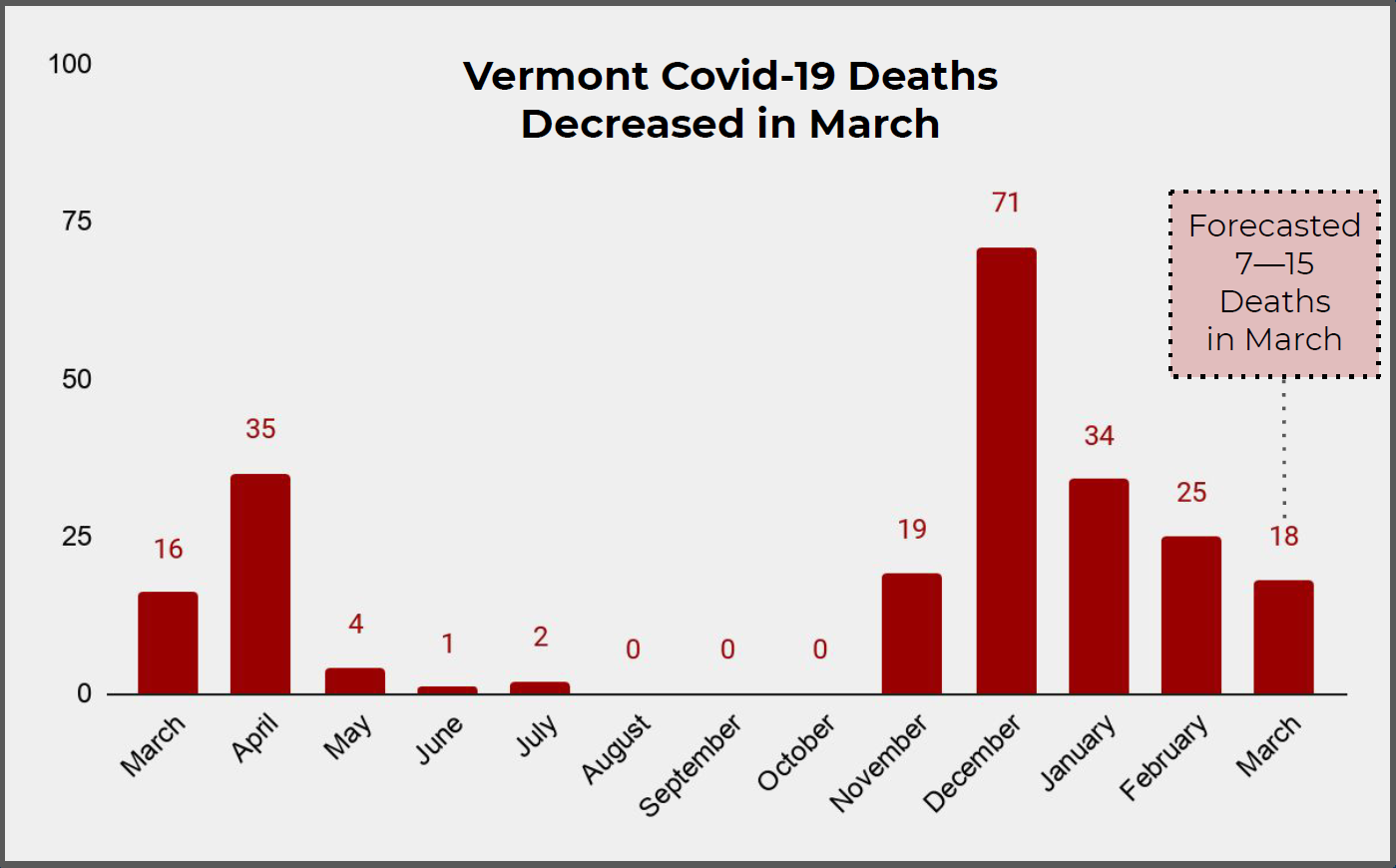
Meanwhile, the VDH today is reporting 73 new COVID-19 cases. Deaths are holding at 225. However. DFR Commissioner Michael Pieciak presented his weekly COVID modeling which showed cases continue to increase in Vermont and across the Northeast. Vermont had its second highest weekly total last week. The highest was in February. While deaths have stabilized in Vermont, younger people are catching the virus. This appears to be from a combination of a general increase in community transmission, perhaps related to new, more transmissible variants and perhaps a letting down of our guard now that vaccines have reached nearly 40 percent of the adult population. He urged continued vigilance and the following of health protocols.
COVID-19 Daily Update
March 30, 2021
New or updated information is in red and bold
This update is available online at healthvermont.gov/covid19
Click the “See the Daily Update” button
Vaccine Eligibility Adjusted for BIPOC, Caregivers of Children with High-Risk Conditions
Health Commissioner Mark Levine, MD announced changes to vaccine eligibility for two groups at Tuesday’s press conference.
The first change is that parents or primary caregivers who are caring for children with certain high-risk conditions will be eligible for vaccination starting tomorrow (Wed., March 31).
“These children would be on our high-risk disease list due to their immunocompromised medically complex condition, and prioritized, if they were only old enough to qualify for a vaccine,” Dr. Levine said. “We need to ensure these parents and caregivers remain healthy enough to care for their child, and that they not risk bringing the virus into the home.”
Parents and primary caregivers of children with certain high-risk health conditions can make a vaccination appointment starting tomorrow by visiting healthvermont.gov/MyVaccine, or by calling 855-722-7878.
The second change is for Vermonters who are Black, Indigenous and people of color. Beginning Thursday (April 1), ALL members of the Vermont BIPOC community 16 years of age and older – as well as their family members – will now be eligible for vaccination.
They can make an appointment online at healthvermont.gov/MyVaccine or through our call center. Registrants would state they identify as BIPOC. These Vermonters can also register through one of the community clinics developed with our partners around the state.
Dr. Levine said there is an almost two-fold increase in risk for hospitalization among the BIPOC population. He also spoke to how the pace of vaccination for BIPOC continues to lag significantly behind, with a rate of 20.2% of the population having received at least one dose of vaccine, as compared with a rate of 33.4% among non-Hispanic whites.
“This is in spite of our ongoing efforts to offer vaccination of multigenerational households within the current age banding strategy and to engage our community partners in setting up community-based clinics,” he said. “Nonetheless, it is unacceptable that this disparity remains for this population placed at higher risk.”
New on healthvermont.gov
Household members of a person with COVID-19 are most likely to be identified as a close contact. They are also the type of contact most likely to become a case. Get more data about people who have been identified as close contacts in Vermont in the latest Weekly Data Summary Spotlight.
If you have any symptoms, stay home and get tested for COVID-19
Interviews with people who have COVID-19 indicate that some assumed they had a cold or a sinus infection, instead of first thinking they might have COVID-19. The COVID-19 virus is still circulating in our communities, and the only way to know if you have it is to get tested.
Remember that symptoms can sometimes be mild, such as a headache, cough, fatigue or a runny nose. So, if you have even just one of these symptoms, it’s best to get tested. It’s also important to avoid going to work, school or other places until you receive a negative result. COVID-19 is a highly transmissible virus, and this is how we can each protect our loved ones and our communities.
Testing is important – In fact, the only way to know if you have COVID-19 is to be tested.
If you have symptoms, talk to your health care provider. They can refer you for testing. Even if you don’t have symptoms, you can still have COVID-19 and not feel sick. If you don’t have symptoms and want to get tested, there are many test sites now available around the state. It’s free and easy! Watch a video about what to expect.
COVID-19 Activity in Vermont
As of 12 p.m. on March 30, 2021
Data is updated daily.
|
Description |
Number |
||
|
New cases* |
73 (19,109 total) |
||
|
Currently hospitalized |
25 |
||
|
Hospitalized in ICU |
2 |
||
|
Hospitalized under investigation |
1 |
||
|
Percent Positive (7-day average) |
2% |
||
|
People tested |
354,301 |
||
|
Total tests |
1,319,118 |
||
|
Total people recovered |
15,754 |
||
|
Deaths+ |
225 |
Find more data on COVID-19 Activity at: healthvermont.gov/currentactivity.
COVID-19 Vaccine Data
As of 12 p.m. on March 30, 2021
Data is updated Tuesdays through Saturdays.
|
Description |
Number |
||
|
Total people who have received least one dose of vaccine |
202,317 |
||
|
Total people who have received two doses of vaccine (completed) |
116,275 |
Find more vaccine data on the COVID-19 Vaccine Dashboard: healthvermont.gov/covid19-vaccine-data.
Additional Resources About Vaccination and More
- Find answers to your questions about the COVID-19 vaccine from the CDC: www.cdc.gov/coronavirus/2019-ncov/vaccines/faq.html.
- Get Vermont-specific information in our Frequently Asked Questions.
- Sign up for the COVID-19 Weekly Email Update.
- Find information sheets, posters and toolkits, as well as translated materials on our Resources web page.