

The best industries in the US for startups, and the states where they’re most likely to succeed
Vermont Business Magazine If the thought of launching your new business during the pandemic has stopped you in your tracks, new data has revealed that success could be around the corner should you pursue your startup. And while Vermont has the second lowest rate in the nation for startups, it also has the overall lowest failure rate.
Rovva crunched the numbers from the Business Dynamics Statistics Tables, analyzing business statistics, in order to provide an insight on what industry and state have been the most successful for startups.
429,914 businesses are created across the United States every year; to break that down, 8,245 a week - 1,178 new businesses every day. Proving that the entrepreneurial spirit is alive and well across the USA.
Successful Startups by State
Of the over 8,000 startups created every week in the US, 1,125 of them are in California, the highest number for any individual state. However, Nevada is the state with the highest annual percentage increase of new businesses at 11%, followed closely by Florida and Utah at 10.1%.
All three states have seen a leap in businesses being created each year, this is great news if you are located in the area as it could be an early indication for a new startup hub for budding entrepreneurs.
Vermont and Alaska have the lowest startup rates (6% and 7.1%), with an average number of 16.8 new businesses created per week in Vermont and 18.9 in Alaska.
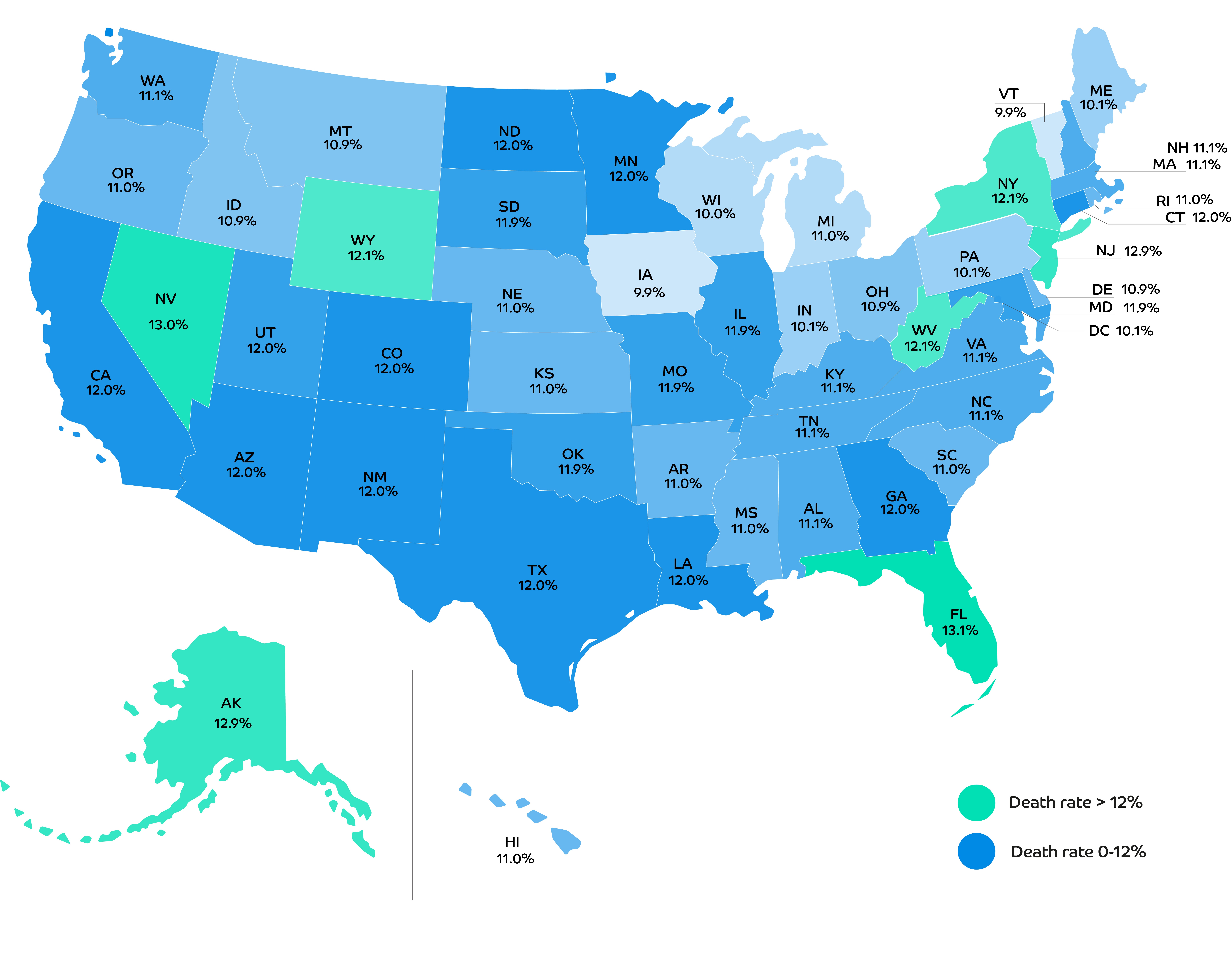
However, Vermont, alongside Iowa, is where a business has the highest chance of surviving its first five years. In both states, the five-year death rate - the number of businesses that die after five years - is just 9.9%.
So, while Vermont might have the lowest rate of new startups, it’s also where a new business is most likely to succeed. The sectors that saw the lowest death rates in Vermont included Manufacturing (5.8%), Professional, Scientific and Technical Services (9.3%), as well as Real Estate and Rental and Leasing (8.5%) and Retail Trade (9.5%).
Overall, the data showed that the industry with the biggest success rate is Health Care and Social Assistance, as it had the lowest death rate across 25 states, including Alabama, Florida, New Jersey, Virginia and Washington.
Educational Services followed closely behind, with the industry having the lowest death rate in nine states, including Iowa, New York and Wisconsin.
Businesses categorized under “Other services (except Public Administration)”, matched this success, with lowest death rates in eight states (including Georgia, North Carolina and Tennessee) plus Washington DC.
Jon Abrams from Rovva said: “It is inspiring to see so many people chasing their dreams, especially in these difficult times. We’re glad to see so many industries thriving.
“Seeing sectors such as Healthcare and Education thriving during a turbulent landscape, providing crucial services to their communities.
“This data highlights exactly how resilience can prove a success when launching a startup, we hope to see continuous growth throughout 2021”
The full research can be found here.
About Rovva
Rovva is the world’s largest business support platform. It puts everything business owners need for their company in one place – every topic, every service, in every country.
Whether it’s a professional business address, or a network of drop-in business lounges, Rovva’s got everything covered. It’s fast, simple and totally free to use. Business owners can research, book and buy all in one place, globally.
Website: https://www.rovva.com/en-us/
Methodology
Data taken from 2014-2018 Business Dynamics Statistics Tables
Startup firm birth rates were calculated by comparing firms less than a year old with all firms with age data given.
Startup firm death rates were calculated by comparing firm exit/death figures from firms under 5 years old with the extant number of firms in that bracket. Survival rates are the inverse of this, i.e. if a state has a death rate of 10%, the survival rate is considered to be 90%.
When ranking data segmented by state and industry, any state/industry combination with less than 100 firms under 5 years old (on average) was excluded.
Source: Rovva 3.9.2021