

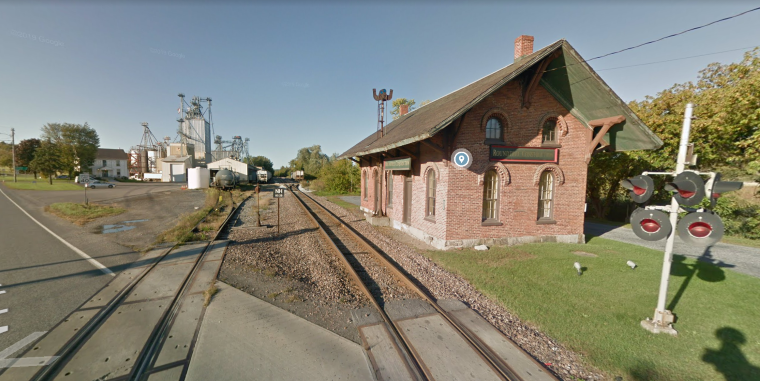
Google Maps view of New Haven rail depot on Route 7 just north of Middlebury, which currently houses the offices of Roundtree Construction. The extended Ethan Allen Express Amtrak would run past the depot. To the left is the Phoenix Feeds.
by C.B. Hall, Vermont Business Magazine Prospects for Amtrak service to Burlington, which passenger trains have not served in almost 70 years, have taken a strange twist. The state has notified the occupants of a 19th-century depot that sits only a few feet from the state-owned tracks at the Route 7 crossing in New Haven that their building will have to be moved before the Amtrak train, the Ethan Allen Express, comes through on its new route. And moving the little brick building does not look like a simple matter.
The Vermont Agency of Transportation, subsidizes Amtrak service in Vermont, owns the land under the depot, The Agency of Commerce and Community Development's (ACCD) Division of Historic Preservation owns the building itself, which it has leased to Roundtree Construction.
In a January 6 letter, Michele Boomhower, director of AOT's Division of Policy, Planning and Intermodal Development, told DHP director Laura Trieschmann that "it will be necessary to relocate the station to meet the safety standards required for the operation of the Amtrak service at full speeds."
Boomhower's letter also noted that the train was scheduled to begin serving the Queen City, 68 miles from the train's current northern terminus in Rutland, "in the late fall of 2021." But that timeline looks dicey, given the thicket of questions surrounding the depot's relocation - or, conceivably, demolition, which Roundtree's Ric Santa Maria described as "the worst-case scenario."
"What we were told ... is that one way or the other the building's going to go. In the worst-case scenario they would demolish the building," referring to AOT and DHP.
The conundrum originates with Amtrak operational standards that mandate a good line of sight for engineers as their trains approach grade crossings. Standing only about eight feet from the tracks, the building blocks the southbound engineer's view of the busy crossing. No problem exists northbound, since nothing interferes with the engineer's view.
Discussions of what to do with the station have progressed slowly.
AOT gave DHP official notice of the Ethan Allen extension plans and their impact on the depot in 2017, according to Trieschmann.
In 2019, Dale Azaria, then general counsel at ACCD's Department of Housing and Community Development, informed Roundtree that the building "will have to be moved due to the safety concerns with the present location, and especially given the plans for higher speed travel on the rail corridor."
Amtrak has told AOT that correcting the safety risk posed by the station represents an "immediate need," Trini Brassard, assistant director in Boomhower's division, told a well-attended New Haven selectboard meeting on January 19. The only way to address that need, she said, "is to move the building."
Amtrak made its position clear to AOT after a survey trip on the Rutland-Burlington line. When that took place is unclear: Amtrak would not answer any questions posed by VBM, referring all inquiries to AOT, which did not know when the trip occurred.
Under federal standards, the condition of the line allows for passenger trains to travel at up to 59 mph.
Boomhower's January 6 letter stated that the obvious alternative of a lower speed limit in the area of the crossing "will not be possible on a long-term basis for passenger service to be successful."
The location has seen at least two derailments, in 1981 and 1982, but sources did not know of any other mishaps. In the 1982 incident, one derailed car hit the depot, causing extensive damage; details of the earlier incident were not readily available.
When, Where, And At What Cost?
Trieschmann told VBM that in 2019 she received an estimate of about $400,000 to move the structure. That sum did not however include the cost of land to move the depot onto, or the cost of a new foundation or any rehabilitation of the structure at its new home.
In a recent WCAX interview, transportation secretary Joe Flynn estimated that moving the structure would cost $500,000, including land-purchase and infrastructure expenses.
So Who Foots The Bill?
Since it is the motive force behind the relocation, "the state should find the funds to cover the costs" should that solution be chosen, according to Carl Fowler, a veteran passenger rail advocate based in Williston.
In 2019, in another email to Roundtree, Azaria stated that "the State has no intention nor funding for purchasing land and moving the Depot," but AOT now appears to have backpedaled on that. At the January 19 meeting, Brassard offered to help the town find a new location for the depot, and figure out a way to pay for it.
There is also another cost to be considered - time.
AOT's goal is to have the problem resolved by year's end. Referring to DHP, Santa Maria told VBM that, in the wake of Boomhower's January 6 letter, "They said we have to vacate by June and the building had to be removed by the fall."
Asked at the selectboard meeting if there was any wiggle room in the eviction deadline, Brassard suggested Roundtree could stay an extra month or so, but added, "What I don't want to do is give a false sense of security that no, they've got a year... We do have a date by which we've got to address this safety issue."
"What we've been looking for is some flexibility," Roundtree's Dan Morris told VBM. "Our interest is less about our occupancy than about historic preservation."
At this point, of course, no one can say where the depot's bricks and mortar might wind up, or how they might get there, far less on what timetable.
A delay in the long-anticipated Burlington service launch thus looms as a possibility - again. In 2015, the state's rail plan foresaw la launch by 2019 at the latest.
The terms of a federal grant used to upgrade the Rutland-Burlington line for the new service require completion of that work by the end of June 2022.
"While we are hopeful that everything else comes together by then, I am not making the statement that the Ethan Allen will be up and running by June 30, 2022," Dan Delabruere, director of AOT's Rail and Aviation Bureau, wrote in an email. "We do not have an exact date for when the service will extend to Burlington."
The Alternatives
Countering AOT's view that the building needs to be moved off-site, Santa Maria said the building could be relocated within the AOT-owned rail right-of-way and still be out of the determinative sight line.
He cited an AOT guideline whereby "as a general practice [AOT] will not grant a request to build a structure of any kind that is within 25 feet of the centerline of the tracks."
He shared a drawing proposing a location almost next to the structure's current siting to meet that standard - but that location lies in a designated wetland, and chances for putting it there thus look dim, considering environmental regulations.
He points out, however, that the entire area, including the Route 7 crossing, has been covered with fill for decades and to all appearances has been stable and usable.
At the January 19 meeting, selectboard chair Steve Dupoise raised another alternative: moving the depot to a site across the rail line, although still within the state-owned right-of-way. In a satellite view, that area appears to have ample room for the depot, which takes up about 1500 square feet.
In an interview for this article, he noted however that the Vermont Railway, which runs freight traffic on the line under a lease from the state, had expressed a need to conduct operations in that area.
"I think putting the depot over there would be an outside chance," he said, but added that discussions were continuing.
"The AOT and VT Rail have commercial aspirations for this intersection," Santa Maria told VBM, noting plans for increased shipments of grain to area dairy farms.
Morris told the selectboard that in his 35 years at Roundtree, he had often seen the area in question used for staging railroad ties for track repairs, but never for any freight handling.
In an email interview, Selden Houghton, president of Vermont Rail System, the Vermont Railway's parent company, declined to comment on the merits of the site.
There remains the option of lowering the speed limit for the train as it passes through the busy crossing - the alternative Boomhower dismissed in her January 6 letter.
"I strongly disagree" with Boomhower's position, rail advocate Fowler said. "Even at 30 mph the time penalty would be negligible. Even if they had to slow down to 10 mph, it would not bring catastrophic changes to the schedule."
As an additional safety measure, he also recommended installation of so-called four-quadrant gates, which are impossible for drivers to go around, on Route 7.
A January 19 email from Amtrak to AOT, addressing questions raised by the latter, stated that restricting speed through the immediate area to 10 mph would lengthen the schedule by about three minutes.
The federal standards allow freight trains to traverse the New Haven crossing at up to 40 mph. Vermont Railway's trains go through the crossing at that speed, Houghton confirmed.
Be such things as they may, AOT hasn't budged on the speed question. In her presentation to the selectboard meeting - just after the Amtrak email arrived - Brassard said that "the Amtrak train coming through here is going to be going 59 miles an hour."
Asked if AOT had given consideration to lowering the 59 mph limit with a so-called slow order, Delabruere wrote, in a February 18 email, "Passenger rail needs to be competitive... Every slow order adds to the length of time a trip takes and results in less passengers using the service."
Mike Schafer, long-time editor of Illinois-based Passenger Rail Journal, told VBM there are hundreds of reduced speed limits on Amtrak's 21,000-mile network, virtually all of which he's traveled on personally. For any number of reasons, some places call for going slowly - just as with highway travel.
Nor are buildings close to the tracks anything new for Amtrak.
The abandoned Fair Haven train depot, which the same Ethan Allen Express - absent COVID - would be passing daily, sits about the same meager distance from the nearest rail as the New Haven depot does, and appears to block the view for engineers in much the same way, as the train approaches the unsignaled, albeit far less busy, street crossing adjacent to the building.
Whatever the standards for new construction, the New Haven depot could - to all appearances - be treated the same way.
Amid the controversy, the old station stands as impassively as it has since it was built in the early 1850s. Italianate in style, the edifice faces Route 7 with curved-arch windows that bespeak the artisanship of a long-forgotten builder. A manual semaphore control tower, likewise a memento of another age, rises through the long eaves. The depot is a prim monument to the past of railroading - a monument with a very uncertain future.

Google Maps view of the abandoned Fair Haven rail depot. This stop is on the current Ethan Allen Amtrak route just west of Rutland.
C.B. Hall is a freelance writer from Southern Vermont.