

Information serves as an early warning system for Burlington community and an alert to exercise extra caution; Results indicate very limited prevalence of mutations associated with variant to date
Vermont Business Magazine Late yesterday afternoon, the City of Burlington received test results from its COVID-19 Wastewater Monitoring Program that detected evidence of two COVID-19 mutations that are associated with the B.1.1.7 variant, which was first detected in the United Kingdom. Though this finding will not be definitive until it is confirmed through genomic sequencing, it indicates that the B.1.1.7 variant is likely now present in Burlington at a low level. The B.1.1.7 variant has been found in 34 U.S. states according to the C.D.C., and has not previously been identified in Vermont.
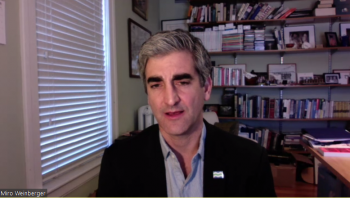 Burlington Mayor Weinberger held a late-afternoon virtual press conference to discuss the likely finding of a COVID-19 variant in Burlington. ZOOM screen shot.
“As we have anticipated would happen, we now have strong indication that the more transmissible variant of COVID-19 that originated in the UK is circulating here in Burlington,” said Mayor Miro Weinberger. “By identifying this early, while there appear to be very low levels of the new variant, we have an opportunity to heighten our vigilance and slow the spread of this more contagious form of the virus in the weeks ahead – which will be critical weeks when many of our most vulnerable community members will receive the vaccine. It is now more important than ever that Burlingtonians practice the public health strategies that have served us so well over the last year.”
At a late afternoon, the mayor said "There's no cause for alarm," but he did urge people to continue to follow the health guidelines, including wearing a mask, avoiding crowds, not gathering and staying home when sick.
The mutations associated with the variant were located in a sample from the City’s Main Wastewater Treatment Plant, which serves the City’s downtown, Old North End, South End, and parts of the Hill Section. These mutations have not yet been identified in samples from the City’s two other treatment plants, indicating limited spread in the community to date.
Wastewater sampling is a pooled sample of many different community members, and only looks for the presence of two specific mutations, so this should not be considered definitive finding of that variant, but it does indicate the variant is most likely present in Vermont. The Health Department will work to confirm the presence of the variant through genetic sequencing of individual samples from COVID-19 positive individuals.
Viruses constantly change through mutation, and new variants of a virus are expected to occur over time. Many emerge and disappear, but others can persist and even become the predominant strain. Some experts anticipate the more easily transmissible B.1.1.7 variant will become widespread throughout the country. According to the CDC, studies so far show the current vaccines are largely effective against this variant. Nonetheless, health experts warn the faster spreading variants can lead to more cases of COVID-19, as well as increased hospitalizations and deaths.
Whole genome sequencing is a laboratory method already in use by the Department of Health to definitively detect all known COVID-19 variant strains. The department has been sending samples of select positive COVID-19 test specimens to the Centers for Disease Control and Prevention and to the Massachusetts Public Health Laboratory, Molecular Diagnostics and Virology program for genetic sequencing. The sequencing can detect all of the mutations present in the COVID-19 genome isolated from a single patient sample.
“This is a new stage of the pandemic here in Vermont,” said Health Commissioner Mark Levine, MD. “It is not, however, surprising. We expected that variants could be circulating in Vermont, and now that looks to be the case.”
As of Monday, the B.1.1.7 variant has been reported in 34 states, including Connecticut, Massachusetts and in upstate New York.
Burlington’s wastewater testing program is an important surveillance tool that provides timely public health information by broadly monitoring for the presence of these specific mutations occurring in SARS-CoV-2, the coronavirus that causes COVID-19. The City’s testing is performed by GT Molecular of Fort Collins, Colorado.
As a result of the City’s findings, the Health Department has added sampling in a wastewater catchment area where mutations have reliably been detected to its criteria for which specimens to submit for whole genome sequencing.
Health Commissioner Mark Levine, MD said medical experts are still learning more about the variant, but that we do know it is more highly transmissible. “This virus already moves quickly from person to person,” said Dr. Levine. “It is extremely important for everyone to take every step to help prevent getting and spreading the virus, even as our vaccination efforts continue – wear your mask, keep a distance of 6 feet from each other, and absolutely avoid crowded places.”
Dr. Levine also encouraged people to get tested.
“Not everyone shows symptoms of the virus, and the only way to know if you have it is to be tested.”
Wastewater monitoring data is best used to indicate the detection or non-detection of the virus and to indicate trends over time, and cannot be used to determine how many people may be sick with Covid-19. However, the volume of the mutations associated with the variant identified at this point is so low as to be close to the level of detection, which also suggests that if the variant is present in the Burlington community it is not yet widespread. Further, the City’s Wastewater Monitoring Program is currently showing a low overall concentration of Covid-19 RNA on a generally stable or downward trend across different parts of the City.
What this detection means for Burlington residents
It is estimated that the B.1.1.7 variant spreads 30 to 40 percent more quickly than the strain of Covid-19 that is currently prevalent in the community. If the variant is now present in Burlington, this means that it will be even more important for Burlington residents to be vigilant in implementing all of the tactics that we have learned over the past 11 months. These include:
· Sharing this news with friends and neighbors so that everyone is aware that this is a period of higher risk, and can make decisions accordingly.
· Continuing to avoid gathering with other households and following State guidance.
· Wearing high-quality face coverings that are well-fitted to reduce gaps around the face and have two or more layers.
· Getting a test for Covid-19 if you have any symptoms, have traveled, or have attended a social gathering.
· Getting a vaccine for Covid-19 if you are eligible, and reaching out to family and neighbors to make sure that those who are eligible have the information and assistance that they need to register.
About the City’s Wastewater Monitoring Program
In August 2020, the City launched its Wastewater Monitoring Program to look for Covid-19 RNA in the wastewater at the City’s three Wastewater Treatment Plants. In mid-January, the City added testing for the B.1.1.7 variant of Covid-19 to this program.
Wastewater-based epidemiology, or wastewater monitoring of Covid-19, is based on the fact that many people shed the Covid-19 virus in their stool, and that this can be detected five to seven days before clinical testing. Through the program, the City samples the wastewater (or sewage) that is entering its three treatment plants. The City’s project partner and lab partner (GoAigua and GT Molecular, respectively) then analyze this sample to determine the number of gene copies of the virus that are present.
This program is a collaboration between the City of Burlington, the Vermont Department of Health, GoAigua Inc., and GT Molecular LLC, and it has included participating research partners at Dartmouth Hitchcock Medical Center and the University of Vermont. It is important to note that this program has no impact on the City’s tap water – these readings come from the wastewater that comes into the plant before it is treated, and all sewage is then treated and disinfected to remove bacteria and viruses (including Covid-19).
For additional information, please see:
· Information about the City’s Wastewater Monitoring Program
· Information about new variants of COVID-19
· COVID-19 in Vermont and getting tested
Source: Burlington 2.11.2021. burlingtonvt.gov/Mayor Vermont Department of Health