


A Weekly State House Recap By Maggie Lenz and Gwynn Zakov (on behalf of Atlas Government Affairs and Garnet Government Relations
Bumpy Ride
Last week, we told you about the tie vote in the Senate Education Committee that temporarily stalled H.955, the major education transformation bill moving through the Legislature this session. Senate Education is the only Senate committee with an even number of members and an even partisan split. The committee took a straw poll to test support for H.955, and the result was 3–3, split along party lines, with all Republican members voting against the bill. That left the bill without a favorable vote from the committee that had spent weeks working through the House version.
The House-passed version of H.955 creates Cooperative Education Service Agencies, or CESAs, as a new statewide education service structure. It also requires districts to participate in study groups to consider whether forming larger unified districts is advisable. The bill does not automatically merge districts. It requires a study process and leaves local voters involved before any recommended merger could move forward. Senate Education appeared to stay within that general framework, rather than throwing out the House bill and starting over.
Last Tuesday, the Senate voted to relieve Senate Education of the bill and recommit H.955 to the Senate Finance Committee. Senate Finance moved quickly, voting the bill out 5–2 within two days. Sen. Randy Brock, R-Franklin, was the only Republican to support it, though he described his vote as “reluctant.” His vote may have been more procedural than a full endorsement of the policy. Conference committees typically include three members from each body, often with one member from the minority party, and members need to have voted for the bill in order to serve on the conference committee.
The day before that vote, Senate Minority Leader Scott Beck, R-Caledonia, introduced an amendment that would have replaced H.955 entirely. His proposal would create 12 large area districts statewide based on career technical education, or CTE, catchment areas, move districts into those new regional governance structures by July 1, 2029, and repeal the foundation formula. Read: forced mergers. The proposal is similar to the map and consolidation approach Beck supported during the redistricting task force process over the summer. Beck served on that task force, and the approach was ultimately voted down by the task force. Some members of Senate Finance appeared frustrated that the same idea was being brought forward again at the end of the committee process.
The amendment was ultimately rejected by the Senate committees of jurisdiction as well, but it still drew attention because Beck is the Senate Minority Leader. It raised the question of whether the proposal was, in some sense, being floated by the Scott Administration through Beck. Sen. Thomas Chittenden, D-Chittenden Southeast, asked Beck fairly directly whether the Administration supported the approach. Beck was careful to say that he would not speak for the Administration and did not know.
Meanwhile, the Governor is saying loudly and clearly that the current approach advancing in the Legislature does not meet his requirements for forced consolidation, and that he will veto it. He is not just threatening to veto the education bill. He is also threatening to use the must-pass state budget as leverage. He has indicated that he is willing to keep the Legislature in Montpelier for as long as it takes to get a bill he is willing to sign. That turns H.955 from a difficult policy debate into a high-stakes game of chicken between Democratic leadership in the Legislature and the Scott Administration
What is most notable about the Beck proposal is that it repeals the foundation formula that was passed in Act 73. While the Governor has been more outspoken publicly about forced mergers, he and Secretary of Education Zoie Saunders have also described the foundation formula as a critical step in the education reform effort. So even if the Beck amendment is not the bill on the table right now, it raises a real question: would the Governor support a plan that gives him mandatory consolidation but repeals the foundation formula his Administration has been touting?
Under Act 73, the foundation formula has already been passed, but implementation is tied to new district lines being implemented. The House and Senate versions of H.955 change that relationship. They decouple the governance changes from the finance trigger. They adopt the foundation formula as state policy, but push implementation out to 2030 and add conditions before it can take effect. The Beck plan goes in the opposite direction. It uses the mandatory governance change and removes the foundation formula altogether.
For now though, the Beck amendment is not what is moving. The Senate Finance version of H.955, which uses the CESA structure and mandatory merger studies, is headed to the Senate floor for a vote, likely this week. If it passes, it will almost certainly go to a conference committee with the House, where three members from each chamber would negotiate a final compromise before sending it back for up-or-down votes.
The House is moving to twice-a-day floor sessions to move bills along and is saying publicly that it plans to adjourn at the end of this week, though several major issues remain unresolved. Hallway wisdom suggests there may be a little more time left than that. Still, things do feel like they are ramping up in the way they do before they finally wind down. It is an election year, and lawmakers seeking reelection are eager to get out and campaign.
It is not yet clear when the session will actually end, or how the final days will unfold, but it will not be a clean or quiet ending. Going out with a bang feels like the only near-certain outcome right now.
Curiosities: a weekly peek at the odd and intriguing happenings under the Golden Dome
End Game
The Legislature is now in Week 19 of the 2026 session, not counting the week legislators headed home for Town Meeting break. Lawmakers gaveled in on January 6, and by long custom this is right around when they would normally be heading home. Vermont has no fixed end date for its annual session, no hard deadline written into law, only a part-time legislature that has traditionally aimed to adjourn around the middle of May, around Week 18. And yet here we all are. The State House is still plodding along, slowly and not so surely, with no end date anyone will put in writing.
It is totally normal for State House employees, lobbyists, advocates, and legislators to start guessing when adjournment will be. There is even a long-running adjournment pool that people bet on every year. But this year feels especially wonky, disjointed, and a bit rudderless. With so many issues left open, it begs the question: is this a real trend or just a difficult year? The answer is, it is some of both.
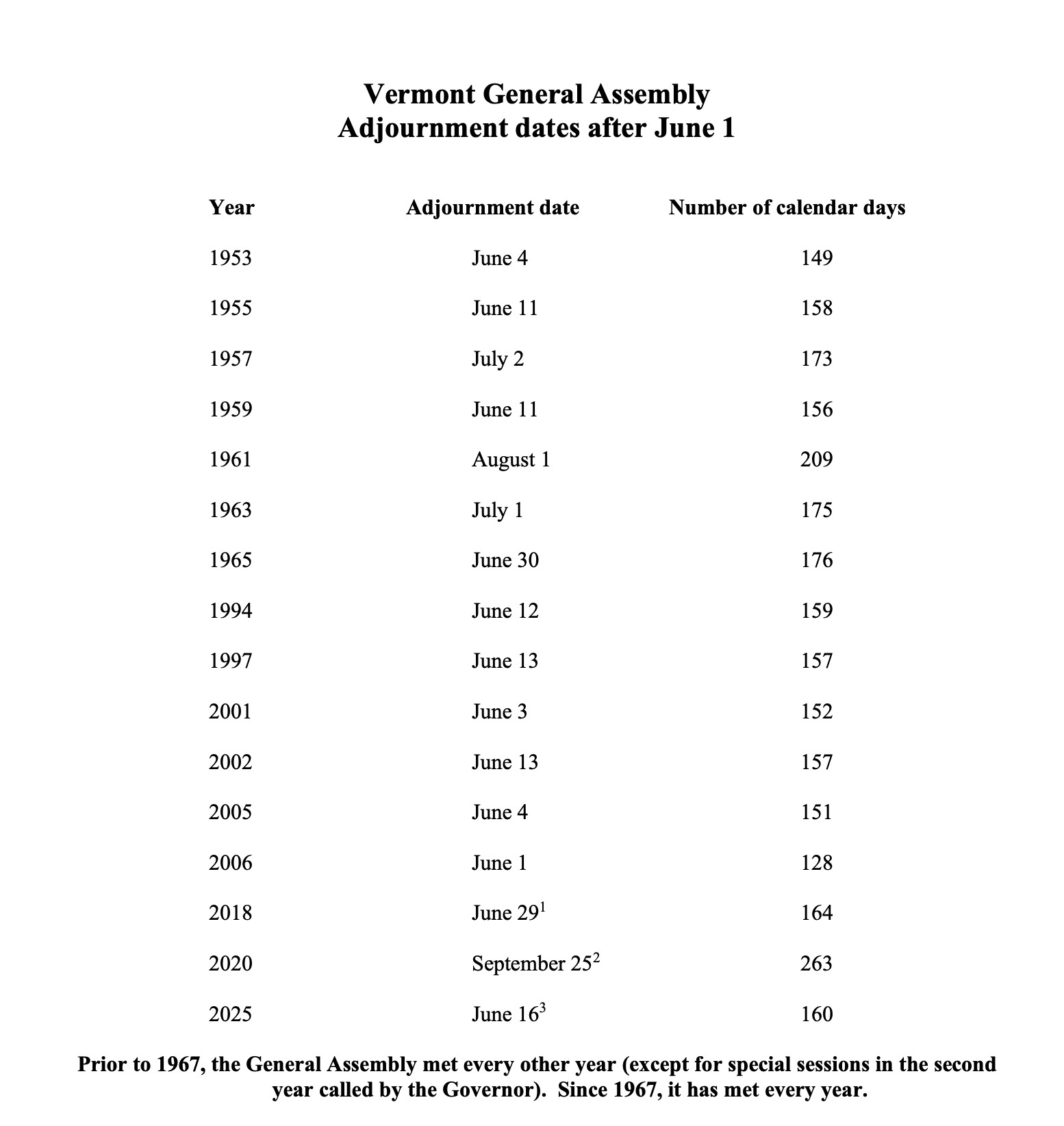
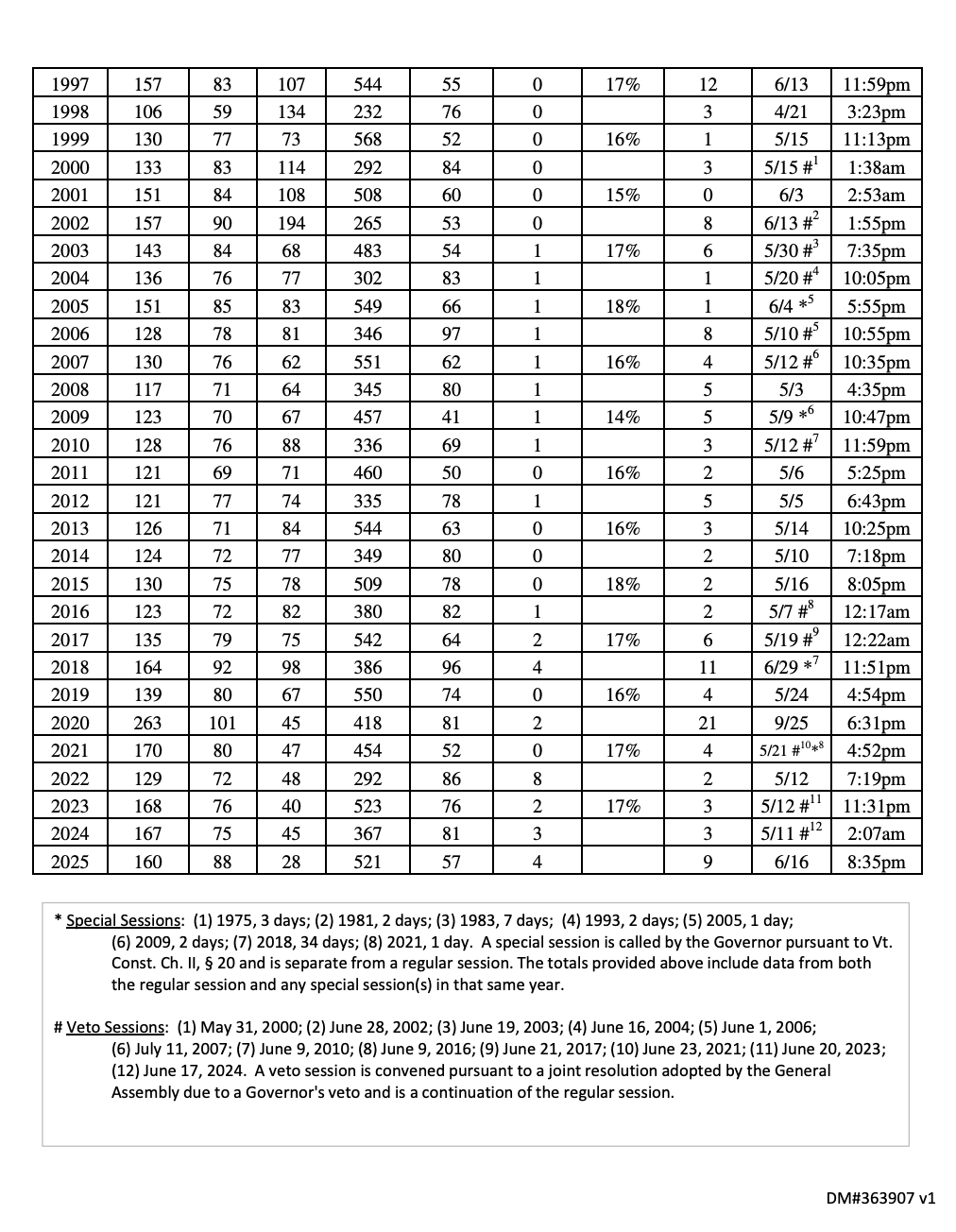
In 2020 the House adjourned on September 25, due to COVID-related scheduling changes. In 2021, the first fully remote session in state history, they adjourned on May 21, with lawmakers steering nearly $600 million in federal American Rescue Plan funds into the budget. A remote session awash in one-time federal money was always going to run long. The years that followed are the cleaner comparison. In 2022 lawmakers wrapped up on May 12, in 2023 on May 12 again, and in 2024 on May 10. Three tidy mid-May finishes in a row, with veto sessions in mid-June. Then came last year, when they did not officially finish until June 16, more than a month later. And 2026 is still an open question.
Until 1969, the General Assembly met only every two years, so those marathon sessions of the mid-twentieth century that ran into July or August were doing two years of work in one sitting. The honest baseline starts in 1969, when Vermont moved to annual sessions. Through the 1990s and 2000s the Legislature tightened things up, and by the 2010s a mid-May finish was the norm. So the accurate story is not that Vermont has always run long. It is that after years of real discipline, the sessions have started stretching out again.
Why is this happening? The problems landing on lawmakers' desks have gotten bigger and more tangled. Education finance is the obvious example, a structural overhaul that touches every district, every property tax bill, and the relationship between the State House and the Fifth Floor. Add a divided dynamic between the Legislature and the Governor, and what used to be a negotiation becomes a standoff.
So where do things stand right now? In a word, unfinished. All of the big budget bills remain in Committee of Conference, where three members from each chamber must bridge the gap and each side must sign off before a deal can move. The roughly $9.4 billion FY27 budget passed the Senate on April 29 and is now in conference, with the chambers still apart on items as varied as university endowment money and a literacy program. The Yield Bill, which sets statewide property tax rates, passed the Senate at a projected 3.8 percent average increase against a 6.7 percent figure in the House version. That gap has to close before anyone goes home.
The education reform bill, H.955, only just reached the Senate floor. Its odds of surviving a likely veto are very much in doubt. The House passed it 79 to 62, well short of the two-thirds needed to override the Governor, who has said repeatedly that the bill does not go far enough. That uncertainty hangs over everything else, because the budget and the Yield Bill cannot truly land until the education question is settled.
Dozens of policy bills are still in play, spanning health care, housing, public safety, telecom, energy, water, and agriculture. The math has turned brutal, and many simply will not make it to the finish line. So advocates, lobbyists, and legislators are doing what they always do in the final stretch, scrambling to cut and paste as much as they can from dying bills into bills that are still moving. If your priority did not get its own vehicle this year, your job right now is to find a healthy bill and hitch a ride. It is not elegant, but it is how the sausage gets made in May, or apparently June.
The realistic expectation is at least two more weeks. But there is another possibility making the rounds in the hallways. Lawmakers could pass a budget, full or partial, adjourn, and then be called back into a special session to hash out the education fight. A special session is the Governor's call, not the Legislature's, its own discrete session called for a specific purpose. If that is the path, the formal adjournment date becomes nearly meaningless. It would not be the first time. Vermont has a long history of veto and special sessions, and 2018 famously included a 34-day special session that stretched the year out to a June 29 finish.
For anyone who works in or around the building, the mood is familiar but intense. It is chaotic. It is high-energy. The schedules change by the minute, and there is a particular exhaustion that sets in when everyone knows the work is almost done but nobody can say when almost becomes actually. It is not for the faint of heart.
The larger question is whether this is the new normal. A session that runs into mid-June costs more, leans harder on citizen legislators with jobs and families waiting at home, and stretches the advocates and agency staff who cover every extra week. If the trend of the last two years holds, the Legislature will eventually need to have a conversation with itself about whether the work still fits the calendar it has set.
For now, the only honest forecast is the one everyone keeps repeating. It is anyone's guess how long this goes.
Historical Adjournment Dates
Source: Vermont Clerk of the House
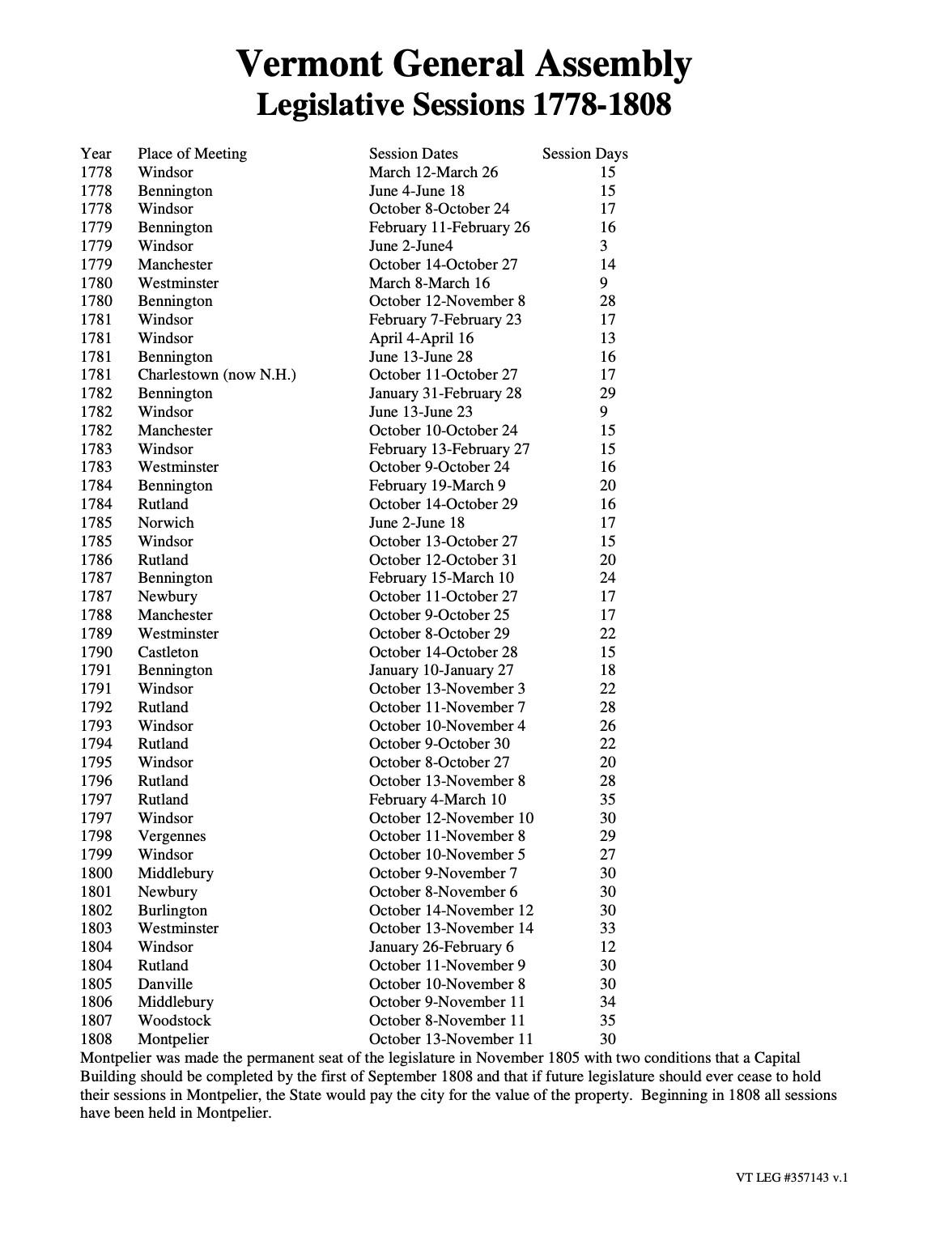
Charlestown, NH, was part of Vermont briefly between 1781 and 1783, before Vermont became the 14th state on March 4, 1791. The town seceded from New Hampshire during the "Vermont Controversy" due to dissatisfaction with the New Hampshire government. Vermont had claimed towns in New Hampshire and New York during ongoing disputes with its neighbors. Vermont gave up its claims under pressure from George Washington, who threatened Vermont statehood. Vermont subsequently was "the only state admitted without conditions of any kind."
To support vital journalism, access our archives and get unique features like our award-winning profiles, Book of Lists & Business-to-Business Directory, subscribe HERE!
 Vermont Business Magazine