

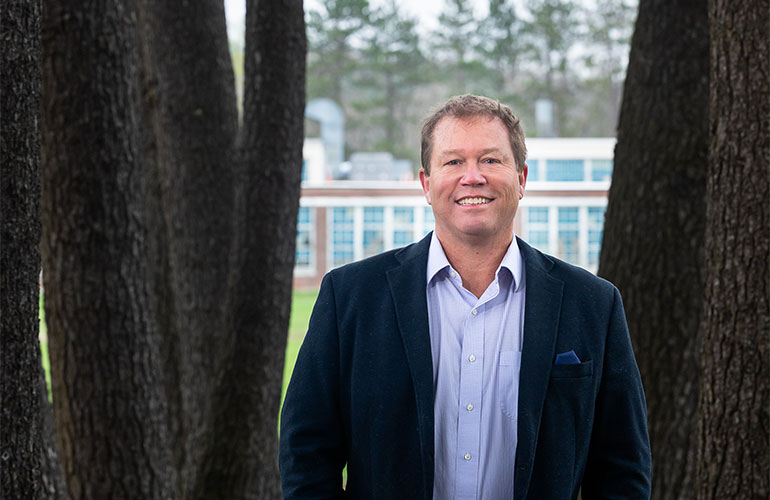
Adam Grinold Executive Director Brattleboro Development Credit Corporation. Photo: Kelly Fletcher
by Timothy McQuiston, Vermont Business Magazine
Windham County is hustling. When the Entergy Vermont Yankee nuclear plant in Vernon closed at the end of 2014, much was lost. The plant employed about 600 highly paid workers. While the plant is located on the Vermont side of the Connecticut River, the workers resided about evenly in Vermont, New Hampshire and Massachusetts.
A facility that large impacts the tax base, housing, infrastructure, retail, and more, on top of the labor. The closing was politically contentious. Many agreed that the 42-year-old plant, which was showing its age, needed to be shuttered. Many others worried about the economic impact of such an action.
At the end of the day, the corporate owner, Entergy, closed the plant based not on politics, environmental impact or local sentiment, but based on the fact that plant was losing money. They made a business decision. Hardly anybody wanted to admit that, regardless of the reality. But close it did, in any case.
The most positive result of the plant’s closing was that it created a sense of urgency on the part of local public and private development and on the part of the state.
The closing of Vermont Yankee also resulted in the establishment of the Windham County Economic Development Program. WCEDP provides funding and financial services to stimulate job creation, business expansion, and economic infrastructure in the county. Originally funded by a settlement with Entergy following the plant’s closure, it focuses on private sector growth through loans and grants administered by the Agency of Commerce and Community Development (ACCD).
Like the other three southern Vermont counties, Windham has a legacy of manufacturing and tourism. Hydro power along the Connecticut and Deerfield rivers powered mills and generated electricity.
Even before Interstate 91 swiftly connected southern New England and New York to the region starting nearly 70 years ago, visitors were making their way up to Vermont via the railroad and Route 5. They found cooler summers and even cooler ski areas relatively nearby.
The interstates brought more tourists, mountain development and Act 250, which intended to quell the unregulated growth. It worked. The irony now is that with housing shortage and housing costs at a premium, there is an effort in the Legislature to reduce the regulatory impact of Act 250 on rural areas while also opening up downtowns for more concentrated growth.
A dozen years after Yankee closed, the focus of economic activity has coalesced around housing development, in a sort of if-you-build-it-they-will-come philosophy, while enhancing the region’s historic strengths in manufacturing and tourism.
BDCC
At the center of this momentum is the Brattleboro Development Credit Corporation (BDCC), which continues to translate the region’s Comprehensive Economic Development Strategy (CEDS) into tangible progress across infrastructure, workforce, business development, and community resilience.
BDCC Executive Director Adam Grinold has led the state’s largest regional development organization since, notably, 2014. He provided VermontBiz with a detailed outline of economic development efforts in Windham County and regional efforts involving Bennington County.
“We are seeing a significant shift where localized partnerships are taking the lead,” Grinold said. “In Wilmington, the collaboration between Wilmington Works, the Chamber, and municipal development provides a robust model for local support. Dover too has similar strong partnerships and outcomes.
“Similarly, Brattleboro is benefiting from the longstanding partnership between the municipality and BDCC, which is now bolstered by a revived Downtown Brattleboro Alliance and the energy of the nascent Next Generation Brattleboro group. Rockingham has seen a remarkable revival through investments in historic landmarks and projects like the Island, the train station, and industrial park expansion.
“Putney is riding strong momentum with the Discover Putney initiative and a focus on downtown designation and housing, including a keen interest in the future of the Paper Mill. Londonderry also continues its steady recovery from the 2023 flooding by focusing on essential infrastructure like municipal wastewater systems. All of these efforts suggest that while the external environment is indeed bumpy, the region is responding with a high degree of local awareness and strategic planning.
BDCC positions itself not simply as a service provider but as a regional convener.
As he said, “We are strongest when we act regionally,” a theme that threads through nearly every initiative underway. The organization’s work spans all corners of Windham County—from Rockingham and Putney to Wilmington, Whitingham, and Brattleboro—where communities are modernizing wastewater systems, preparing new housing, and strengthening industrial infrastructure.
A Regional Roadmap in Motion
The CEDS remains the backbone of Southern Vermont’s longterm strategy, built through broad community participation and designed as an “assetbased roadmap for longterm economic resilience and growth.”
In 2026, BDCC and its affiliate SeVEDS (Southeastern Vermont Economic Development Strategies) will merge their Regional Priority Projects and Vital Projects lists into a unified Southern Vermont Economic Development Zone CEDS project slate. Both the Bennington and Windham regions will rank their top ten projects under the NBRC program, creating a more coordinated pipeline for federal and state investment.
BDCC also continues to expand regional coordination through monthly partner meetings, the Municipal Leaders Network, and the annual Southern Vermont Economy Summit, returning May 12 at Mount Snow in Dover.
A recent BDCChosted event in Brattleboro drew more than 100 attendees and featured state leaders including Treasurer Mike Pieciak and Housing Commissioner Alex Farrell, underscoring the region’s growing engagement with statewide policy shifts such as Act 181 (with its changes to Act 250, now under heavy scrutiny. With the elimination of the “Road Rule” and Tier 3 more rural development could become available) and the new CHIP housing tool.
The Community and Housing Infrastructure Program (CHIP) is a statewide tax increment financing tool designed to help Vermont communities unlock housing opportunities by investing in critical public infrastructure.
With CHIP, $2 billion can be invested between now and 2035, one of the largest investments in municipal infrastructure in Vermont history.
The state program allows for municipalities to invest in infrastructure to allow more streamlined and timely private development in downtown areas. Before this year, only certain municipalities, mainly in Chittenden County, had been allowed by the Legislature to use TIFs.
CHIP enables municipalities to finance essential infrastructure (like water, sewer, roads, and stormwater systems) that supports new housing development. It allows towns and cities to: Access long-term financing without raising local property taxes; Capture a portion of new property tax revenues from future development; and Invest in public improvements that directly support the creation of homes.
Industrial Development
BDCC’s long history of managing “sophisticated capital stacks and federal resources” remains a defining strength. Recent industrial projects highlight how the organization deploys state tools—including Vermont Economic Development Authority (VEDA) Sub3 loans, Rural Industry Development Program (RIDP) grants, and Brownfields Reuse and Environmental Liability Limitation Program (BRELLA, a Vermont Department of Environmental Conservation program) —to retain and expand local employers.
In Wilmington, BDCC helped WheelPad acquire a 3.41acre brownfield site using $240,000 in RIDP capital and a VEDA loan, enabling the company to bring manufacturing inhouse and create new year round jobs. Wilmington supported the project with tax stabilization and direct investment.
They now have 19 employees and can call on contract manufacturers in other parts of the country to deliver their homes on wheels to all “lower 48” states.
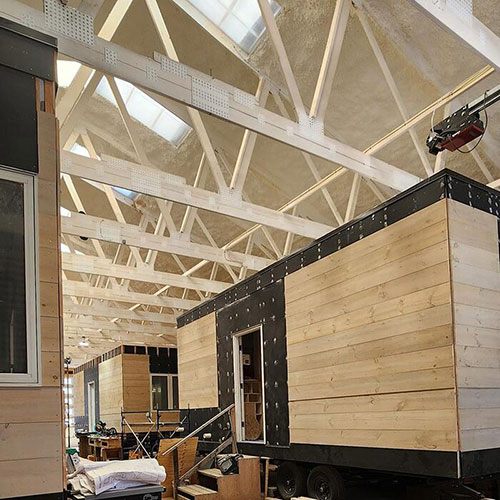
Photo: New WheelPad Manufacturing facility in Wilmington. Courtesy photo.
Their SuitePAD product is a 200-square-foot modular home attachment designed to create a private, fully accessible bedroom and bathroom (not a kitchen) for sudden injury, recovery, or aging in place. They can be delivered in within three months, said Vice President RJ Adler.
With the new financing, Adler said they can create inventory to shorten the delivery time. He said potential customers often “need it now” especially if they’re coming off a medical event and need the mobility assistance very soon.
Adler said their goal is to deliver 19 units this year. They cost $133,000 delivered ($3,250 to lease) and require a local installer for an additional fee. The units typically are situated next to an existing home and, in most cases, tap into the existing utilities.
Adler said WheelPad will not be the only solution to the region’s or the state’s housing needs, but is part of it.
In May they also unveiled their StudioPAD (with kitchenette), a prototype of its first ADU (Accessory Dwelling Unit), modular accessible home ($165,000, $4,000 to lease).
“Via the 802 Homes initiative and the Land Access and Opportunity Board the state is putting together workshops for small scale developers,” said Adler, who participated in the one in Middlebury in April.
However, given the long-lead time for a subdivision housing development or an apartment building, which could take 10 years given the permitting, financing and construction, “WheelPad stands alone a little bit because people need it right away,” he said.
WheelPad was founded by longtime area businessperson Julie Lineberger, especially through her work with LineSync Architecture, a green and sustainable firm in southern Vermont.
Fulflex
In Brattleboro, BDCC intervened to prevent Fulflex, a major rubber thread manufacturer, from relocating out of state. BDCC offered to purchase the company’s 100,000squarefoot facility to manage capital improvements and brownfield cleanup—an example of the organization’s willingness to take on direct ownership to stabilize regional employers.
Fulflex is one of those legacy Brattleboro businesses. Now part of Garware, Fulflex elastics are leaders in the hygiene market catering to elastication of a range of products: baby diapers, training pants, feminine hygiene, adult incontinence segment, kids swim pants and more.
“Currently we employ about 80 people with about 10 new openings coming in three to four months, as we work to expand our business,” said Donald Venice, Vice President of Operations for Garware Fulflex USA Inc.
“Our high at one time was 140 people but cost of running a business in Vermont made us uncompetitive against Asian competition so were forced to reshape our business.
“Adam and the BDCC are great partners of ours, as they recently purchased the property our business sits on, from our previous owners, and we lease the building. This move allowed us to commit to staying in Brattleboro and not relocating the business. Vermont overall is not business friendly, and this is getting a lot of recent attention in the Brattleboro area as manufacturers are closing. The BDCC is working hard to change this.
“From an economic standpoint we face many challenges, as the world’s global situation changes almost daily. We are a global business, so not only do we need to react to changes in the USA, but also to changes around the world. Energy costs will bring some short term pain, as not only the energy required to keep our machines running, but also the cost of shipping for both imports and exports is rising. It affects all parts of our business decision making process and the instability creates many concerns on how to react. The key, truly, is to remain as flexible as we possibly can as we trust energy costs will subside shortly.
“From housing and labor, you need housing to bring labor in. Affordable housing is needed in the area. Affordable daycare is also needed. We, also being on the Connecticut River, suffer to bring in employees from New Hampshire due to Vermont’s high income tax.
“Legislators need to understand that today they need a manufacturing base in the area, and we are one of the few manufacturers left. 40 years ago the area was swarmed with manufacturing companies. Until someone outside of the BDCC cares about this, the area will continue to suffer, storefronts will be boarded up, and restaurants will close.”
TriPark: A Landmark Resilience Project
One of the region’s most significant recent achievements is the $7 million TriPark InfillRelocation Project, which is moving 19 households out of floodprone areas into new Zero Energy Ready Homes. BDCC Holdings II serves as the primary developer, coordinating funding from the Flood Resilient Communities Fund, CDBG, and other sources.
The project reflects BDCC’s decadeslong experience in complex development. BDCC has a history of “directly owning and managing multimilliondollar business expansion projects” and partnering with towns on major water and wastewater upgrades.
To ensure the relocation comes at no cost to residents, BDCC and the Windham & Windsor Housing Trust structured a financing model built on forgivable loans and deferred mortgages.
Leadership, Workforce, and Career Pathways
Jen Stromsten, BDCC Director of Programs, noted that the Vermont Department of Labor data shows that, “We continue to climb out of our labor force trough: As of 2024, we had 24,654 people in the labor force which is looking a lot like pre-COVID numbers. Unemployment is at 2.4%, slightly looser than the 2.1% it was in 2023. But it's still a really tight labor market.”
According to the US Census Bureau (July 2025), the population of Windham County is 45,204, down 1.5% from 2020.
The average annual wage in Vermont is $61,880, according to the US Bureau of Labor Statistics, and $58,396 in Windham County, ranking it eighth highest of the 14 counties. The US average wage is $75,868. Vermont ranks 32nd overall.
Chris Campany, Executive Director, Windham Regional Commission, pointed out the demographic implications of a diminishing and aging population, something the entire state is dealing with, as consternation grows in the Legislature and governor’s office.
“We have and will have more closed small rural schools. It’s my opinion that some of these may serve as assets to further support our outdoor recreation economy.
“I’d like to see VOREC (the state’s Vermont Outdoor Recreation Economic Collaborative) put resources into exploring their use as hostels, overnight indoor “camping” facilities, etc,” he said. “All have bathrooms. Most have kitchens. Inexpensive bunks could be built where folk can roll out their sleeping bags. This could accommodate more scout, volunteer trail crew, bike/water sports/fishing/etc. groups, university orientation groups, etc. who would then patronize local businesses.
“This wouldn’t have to be a permanent reuse of school properties, but could be an interim use that could generate some revenue and keep those buildings active (unused buildings decay quickly).
“Top of mind, in our region would be Readsboro (Long Trail, Catamount Trail, and ATV trail access), Windham (gateway access to new 3,500 acre Conte National Wildlife Refuge holding on Glebe Mountain), Jamaica (gateway to Jamaica State Park, West River Trail, and activities throughout the West River watershed generally), and Athens and Brookline (Windmill Hill, Bull Run, Putney Mountain trail networks Turner Hill WMA).”
BDCC’s leadership programming continues to expand. The Windham Leadership Series and CEO Roundtable, launched in 2025, provide regional leaders with datadriven insights and crosssector dialogue on workforce, housing, and economic pressures. The CEO Roundtable now represents firms employing more than 6,000 workers.
Workforce development remains a core BDCC function. The Pipelines and Pathways Program (P3) now operates in every Windham County public high school, embedding staff to codevelop curriculum, career exploration events, mentorship, and financial literacy programming. Spring 2026 includes career fairs, apprenticeship events, and a slate of classroombased readiness programs.
Adult workforce initiatives include construction fundamentals training with HatchSpace, digital literacy courses with Technology4Tomorrow, and careerfocused ESL programs in partnership with Vermont Adult Learning and SIT (School for International Training). BDCC is also helping bring 17 UVMsupported interns to local nonprofits this summer.
Entrepreneurship, Ownership, and Capital Access
BDCC’s business services continue to support both new ventures and legacy firms. Through BDCC Next, the organization is assisting 36 businesses with succession planning, with six transitions completed—including Putney Winery and Temple Chiropractic—and a pipeline is expected to exceed 50 by the end of 2026. BDCC also supported the region’s first 100% employeeowned ESOP/coop hybrid at Green River Data Analysis.
LaunchPad cohorts continue to train 18–30 entrepreneurs at a time, while BDCC’s advising and capitalaccess work helps businesses navigate financing challenges, including SBA, USDA, KIVA, and WCEDP tools.
BizConnect, a traveling business support program, held 14 events across five communities in 2025 and continues to expand into underserved areas.
Rockingham, Putney, Wilmington, Whitingham, Brattleboro
Rockingham (encompassing the villages of Bellows Falls and Saxtons River) is advancing major infrastructure projects, including a $1 million Amtrak platform reconstruction, hazardous material remediation at Union Station, and a $750,000 restoration of the 1787 Rockingham Meeting House. The completed Bellows Falls Garage redevelopment now provides 27 affordable housing units with rooftop solar.
Putney is navigating the transition of the Soundview Paper Mill while advancing housing and community planning under strong municipal leadership.
Wilmington and Whitingham, in the Deerfield Valley, continue to modernize wastewater systems, supported by regional collaboration.
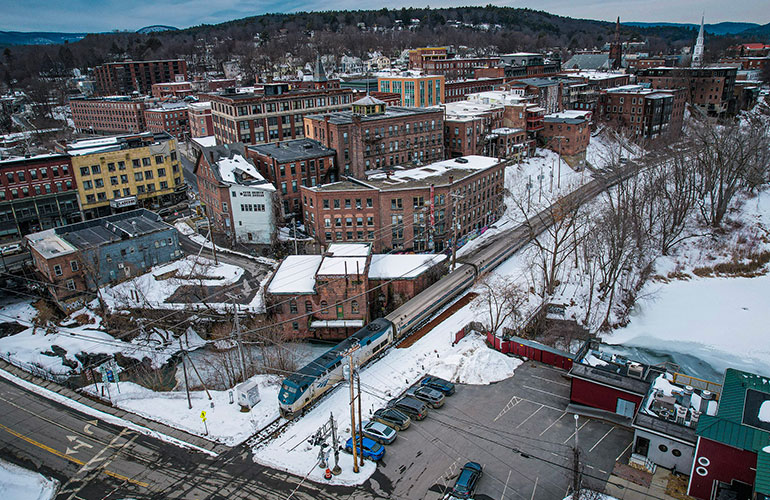
Photo: Amtrak. Courtesy photo.
Rockingham (Bellows Falls and Saxtons River)
“In Rockingham we see years of planning and partnerships creating voter support and buy in for growth and local investment.,” Grinold said.
The Town of Rockingham is currently managing several major infrastructure and preservation projects scheduled for key milestones in 2026. These initiatives range from transportation upgrades at Bellows Falls Union Station to critical restoration work on the historic Rockingham Meeting House.
Transportation & Infrastructure
- Bellows Falls Amtrak Station: A $1,000,000 grant from the Federal Railroad Administration was finalized in April 2026 for the reconstruction of the station platform. The project will bring the platform up to ADA and Amtrak standards to improve accessibility for intercity rail service.
- Bellows Falls Union Station:The Town purchased the 1923 station building on March 25, 2025. Remediation of hazardous materials (asbestos, lead, and vapor intrusion) is underway, with a subsequent phase planned to renovate mechanical, electrical, and plumbing systems to accommodate a full-service restaurant.
- Bridge 24-3 (I-91): Rehabilitation of this state-owned corrugated metal plate pipe bridge is scheduled for Summer/Fall 2026. Contract bidding is expected in Spring 2026 followed by a contract award in Summer 2026.
Historic Preservation & Community
- Rockingham Meeting House:A major preservation project is set to kick off construction in the spring of 2026. The project is supported by a $750,000 grant from the National Park Service and includes restoration and conservation of the 1787 building, which is the most intact 18th-century public building in the state.
- Rockingham Historic Murals:Fundraisers were conducted throughout late 2025 to support the restoration of two historic murals with deep local roots.
Island & Downtown Development
- Bellows Falls Garage Redevelopment:This completed brownfield project transformed the former garage site into the Bellows Falls Garage, providing 27 affordable housing units in downtown Bellows Falls. The new structure is energy-efficient, featuring a 30 kW solar photovoltaic array on the rooftop.
- Island Area Conservation: Recent investments from the Vermont Housing and Conservation Board (VHCB) include $187,500 to conserve 130 acres of natural area adjacent to existing conserved lands, protecting wetlands and tributaries that feed into the Saxtons River.
Municipal & Public Safety
- Municipal Investments: While specific fire house expansion details for 2026 were not as prominently featured in recent local updates as the rail and historic projects, the Town continues to prioritize "Vital Projects" aimed at remediating dilapidating structures and improving public space infrastructure.
Putney
While no project yet exists in Putney, BDCC has been actively engaged with current and past owners of Soundview Paper Mill (often known by its former name of Putney Paper) throughout their announced closure and change in ownership. BDCC’s expertise in industrial brownfield remediation and industrial development stands ready to serve the owners and community.
Putney is a great example of regional partners doing great things. Discover Putney has renewed energy and focus in support of leveraging their assets. Municipal leadership is consistent and earns high regards with focus and execution under town manager Karen Astley. Recent planning efforts have brought resources and support for continued planning. Housing construction is underway with strong community support and planning for additional housing.
Wilmington
“I am the Economic Development Consultant for the Town of Wilmington. And very concerned about our economy here in Wilmington. We should be seeing increases due to the increased cost of dining, lodging, and retail items,” said Gretchen Havreluk. “When I have conversations with local businesses most say they are doing great...record year, however it is not showing in the state data.”
She acknowledge that there could be a lag in reporting of tax data.
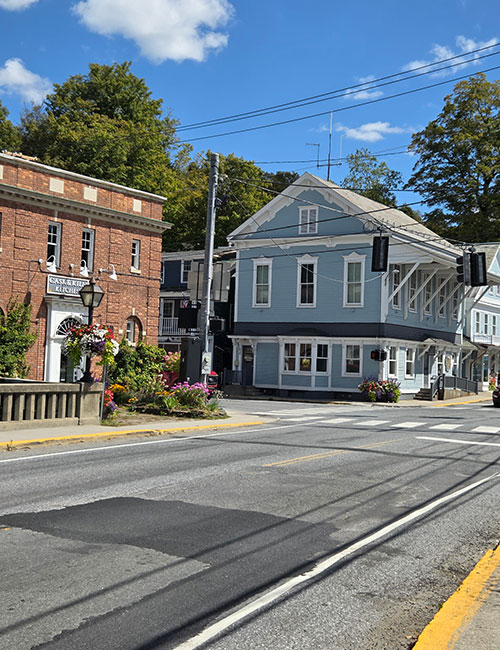
Photo: Wilmington Town office. Courtesy photo.
“We really have not had many closed businesses within the last few years,” she said. “I am sure you noticed our vacant buildings downtown, but these have all been vacant since either Irene in 2011 or the pandemic.”
“As far as labor goes, Mount Snow, owned by Vail Resorts, and the Hermitage Club both hire J1's or H-1B's and these hires always want to make as much money as possible so they get a second job in the restaurants. Having a housing crisis does not help the employment issue. Our average cost of a 1 bedroom apartment is $1,300 per month. Starting pay at Mount Snow is $20 per hour, however small businesses cannot afford to pay employees this much, for example dishwashing. Our industry is mostly hospitality with a few manufacturers in town: The Vermont Bowl Company, WheelPad, and HH Properties, LLC (Timber Frame).
Brattleboro
Planning department has positioned the community for maximum benefit from recent state changes under Act 181 and CHIP.
Winston Prouty housing projects is ready to bring needed housing to the region and is seeking final investments and philanthropic support to close the capital stack.
In March, Treasurer Michael Pieciak stood with local leaders in Brattleboro to announce a $4 million funding commitment from the 10% in VT program to support Phase 1 of The Village at Winston Prouty.
The $9.5 million project will build 28 new units of workforce housing on the Winston Prouty campus. The treasurer’s investment is the most significant tranche of funding committed to date.
Units will target 80 to 120% of area median income, supporting more affordable local housing options, a stronger hiring pipeline for Brattleboro employers, and economic growth for generations to come. Residents will have direct access to child and family services from The Winston Prouty Center and enjoy close proximity to trails and natural green space.
Brattleboro currently has one of the lowest housing vacancy rates in the country (2.7%), driving up costs for renters and homeowners alike. The aging and dilapidated housing stock also burdens residents with high utility costs.
Pieciak, who grew up in Brattleboro, said the new development will “strengthen the local economy and help attract and retain young people and families.”
“Brattleboro is full of local businesses, non-profits, and service providers who care deeply about the community, but they can’t grow and succeed unless working people can afford to live here,” he said.
Meanwhile, the Brattleboro Amtrak station is getting a major upgrade. Along with other amenities including a 36-seat waiting area and a covered platform, the $10 million project will include the first elevated passenger platform in the state.
According to Amtrak for FY 2024, Brattleboro is the second busiest station in the state on the Vermonter line and third overall (Burlington, 26,477, Ethan Allen Express; Essex Junction, 17,453; Brattleboro, 16,682).
Town Manager John Potter said: “Brattleboro is primed for growth. After over three years of key investments in public safety, infrastructure improvements, and planning and permitting adjustments, the town is prepared for and actively encouraging private investment.
“I have seen alignment around a smart economic strategy emerge over the past six months with the development of the NextGen Brattleboro initiative. There is a renewed energy, urgency, and focus coming from civic leaders and key institutional players to organize and promote shared goals and new opportunities for growth and development in Brattleboro. People are identifying with the concept of "802 by 2032," a rallying cry for attracting and retaining a critical mass of younger workers and families in our area over the next five years.
“At the moment, Brattleboro is leveraging its physical assets and generational investments. Amtrak's construction of a new, fully accessible, at-grade train station opening in June offers a significant new asset to build from. As the first stop on the rail line in Vermont, we are actively working to capitalize on that by building out and improving the downtown waterfront district as a key gateway into the state.
“Brattleboro has seen more housing permits pulled in the past year than any time since the 1980s. This is significant progress resulting from a state-leading effort to modernize our zoning and make it a welcoming community for new construction. The Town is fully embracing the new CHIP legislation that the State has offered towns like ours to better invest in filling the gaps that otherwise have developers pausing. Housing is a key driver and together with BDCC's work on jobs and workforce, the town is poised to allow new residents and businesses discover us and take advantage of the arts, culture, recreation, and third spaces that abound in Brattleboro.”
Brattleboro also is partnering with BDCC on a $50,000 ICLEIsupported cleanenergy initiative tied to more than $51 million in identified renewableenergy opportunities.
“When communities row in the same direction,” Grinold said, “the result is greater capacity, greater impact, and a stronger foundation for prosperity.”
Brooks House
There is also a new owner for the Brooks House, the centerpiece of downtown Brattleboro.
A fire gutted the historic building, formerly a hotel, in April 2011. A few months later Tropical Storm Irene slammed the downtown area, causing significant flooding. The block-long Brooks House in the middle of Main Street was boarded up and surrounded by tarps and scaffolding.
Bob Stevens of Stevens & Associates, Craig Miskovich of Downs Rachlin Martin, and Ben Taggard, Pete Richards and Drew Richards of The Richards Group joined together (as Mesabi Inc) to buy it for $2.3 million, restore and renovate the downtown treasure.
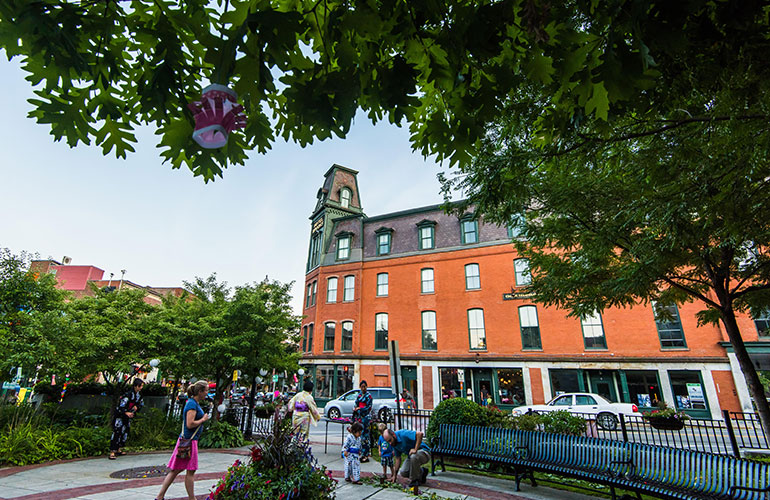
Photo: Hotel Brooks and Brattleboro park. Photo Courtesy: Stevens Group
While, as the group admitted it did not make economic sense, the five decided that saving Brooks House was critical to the future of Brattleboro. (The value of the building after the renovation was $8 million. The cost of the renovation was approximately $24 million).
The investors saw a way forward by making use of Federal and State tax credits and a host of other financing sources. They turned to community members to become shareholders. The State of Vermont supported the fit up with State College space. Vermont Rural Ventures and The Massachusetts Housing Investment Corp helped the Brooks House Development Team access New Market Tax Credits — federal tax credits available for projects in certain eligible population centers across the United States.
In 2013, New Hampshire’s Mascoma Bank agreed to become a lender to the project, along with Brattleboro Savings & Loan. The group closed on the deal in July 2013. The Brooks House held a grand re-opening in October 2014 led by Governor Peter Shumlin.
In January 2026, Mesabi Inc sold the Brooks House to Harry May LLC (principal David Shlansky) for $8.5 million.
John Potter said the new owner “told me that he expects only incremental changes and mostly continuing as is including keeping the management team. He recognized and appreciated the Town’s recent investments in downtown public safety as a prerequisite for a successful enterprise.”
Chris Campany said, “I’m deferring to the Brattleboro people on that but I will say the fact it was bought, and that properties continue to sell and be invested in, is good news.
“We’re also seeing this in smaller communities. The refurbishment and renewed operation of the Newfane Inn, the resumed operation of the Four Columns Inn, the new life you can see at the Newfane Store, the sale and continued operation of The Fat Crow are all huge for that village. A new restaurant has opened in Jamaica - River and Rye. New restaurants have also opened in Weston. Just to name a few. Jacksonville in the southwest corner of the region has seen investment in their existing stores. My hope is that we will begin to see investment in Readsboro, which really needs it. It’s a fantastic little village with lots of promise.”
According to the Brattleboro Reformer, Shansky is a Florida resident who also has a place in Ferrisburgh, Vermont.
The Brooks House is now comprised of 23 apartment units, six retail spaces, three office spaces, with Vermont Technical College, Community College of Vermont, the law offices of Downs Rachlin Martin, Brilliance, Tulip Café, Tavernier Chocolates and Midnight's as tenants.
Brattleboro Memorial Hospital
BDCC is actively supporting the hospital through a variety of avenues. BDCC stands ready to launch an awareness program highlighting the hospital’s importance to our region.
“We understand that a hospital is vital to a community’s health, vibrance, and longevity,” Adam Grinold said. “While no community is defined solely by its hospital, one that loses such an institution is often defined by that loss. As the hospital management and staff conclude their labor negotiations, BDCC looks forward to initiating an awareness campaign supporting the value of quality local care, ‘Because a Thriving Economy Starts with a healthy community’.”
BMH, like nearly every other hospitals in Vermont, is facing financial problems. Those issues resulted in the former CEO and CFO stepping down last year. While it goes through the process of finding a permanent leader, BMH is now run by Co-CEOs Elizabeth McLarney, MD, and Tony Blofson, MD.
The 61-bed hospital with about 600 employees has suffered annual losses since 2021 and is facing a projected $14.5 million operating loss for the 2026 fiscal year, or about10% of its budget.
In April, the nurse’s union reached an agreement to avert a strike, but support staff is also threatening a strike unless they get a new deal.
Gina Pattinson sent this statement from BMH:
"After several challenging years, 2025 became a pivotal moment for Brattleboro Memorial Hospital—bringing long-standing financial pressures into sharper public focus and creating the urgency needed for meaningful change. While leadership transitions, budget setbacks, and rising deficits drew increased attention from regulators and the community, they also set the stage for a more transparent and proactive path forward. In 2026, there are clear signs of progress: the hospital has better defined its financial trajectory and begun laying the groundwork for long-term recovery.
"The financial strain had been building over time, but last year clarified both the scale of the challenge and the need for decisive action. A projected $14.5 million operating loss and recurring deficits prompted leadership to align around solutions. While the situation required difficult conversations—including the possibility of cost reductions and revenue enhancements—it also catalyzed a stronger focus on financial discipline and accountability.
"Encouragingly, early 2026 marked a shift toward renewal. New leadership and financial expertise have been brought in, with a clear mandate to strengthen internal systems and improve transparency. Efforts to rebuild the hospital’s budgeting process and evaluate services and expenses are already underway, helping ensure that operations are aligned with financial realities. These steps represent meaningful momentum toward a more stable and sustainable future.
"Challenges remain, but they are now being addressed with greater clarity and structure. While the deficit has not yet been eliminated and full recovery will take time, the hospital has successfully moved from reactive crisis management to a more strategic, long-term approach. Broader pressures—such as reliance on Medicare and Medicaid, rising labor and supply costs, and changes in federal reimbursement policies—continue to affect performance, but these are being actively incorporated into planning efforts.
"Brattleboro Memorial Hospital’s importance extends far beyond its financial statements. As a major employer with approximately 600 staff members, it plays a vital role in the regional economy. Its presence supports household income, local spending, and economic stability across southeastern Vermont. At the same time, it provides essential healthcare services to roughly 55,000 residents, making it a cornerstone of both community well-being and regional infrastructure. The hospital’s ongoing progress is therefore not only a financial story, but a community one.
"A strong hospital also strengthens the broader ecosystem—supporting local clinicians, attracting residents and businesses, and reinforcing confidence in the region’s future. As Brattleboro Memorial Hospital continues its recovery, these positive ripple effects are expected to grow, helping sustain both economic vitality and access to care.
"Importantly, the hospital’s experience reflects wider challenges facing rural healthcare providers across Vermont and the United States. Demographic trends, reimbursement stagnation, and rising costs are systemic issues that require both local innovation and broader policy solutions. Brattleboro’s efforts position it as part of a larger conversation about how to sustain rural healthcare—and potentially as a model for thoughtful adaptation.
"Looking ahead, the hospital is focused on steady, disciplined progress. Continued attention to cost management, operational improvements, and strategic partnerships will be key, along with ongoing collaboration with regulators. While the recovery journey is still unfolding, the hospital is now building toward long-term resilience.
"For southeastern Vermont, the outlook is increasingly hopeful. Brattleboro Memorial Hospital remains a vital anchor—supporting jobs, ensuring access to care, and contributing to the region’s quality of life. Its recovery is in motion, guided by stronger leadership, clearer systems, and a shared commitment to sustainability. The path forward will take time, but the direction is positive and the foundation for a stronger future is taking shape.
New Chamber Leader
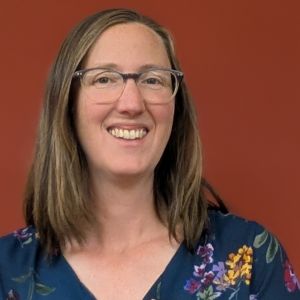
The Brattleboro Regional Chamber of Commerce announced on May 13 the hiring of Rachel Shields Ebersole as its new Executive Director.
Shields Ebersole brings more than a decade of experience in community building, communications, program management, and regional economic development. Most recently, she served as GROW SoVermont Program Manager & Community Projects Specialist at BDCC, where she developed and led initiatives focused on newcomer engagement, regional connection, events, and communications across southern Vermont.
Her background spans membership organizations, coworking, publishing, arts nonprofits, and community engagement initiatives across several states. Earlier in her career, Shields Ebersole managed an organic farm’s CSA membership program in western Colorado, helped operate a large coworking space in Portland, Oregon, supported an arts and culture coalition in Milwaukee, and worked in book publishing and editorial project management in central Vermont.
“Rachel brings exactly the combination of relationship-building, organizational leadership, and regional knowledge that the Chamber needs in this moment,” said Board President Jonas Murray. “She understands the importance of supporting local businesses while also helping people feel connected to the broader community. We’re excited for the energy, thoughtfulness, and collaboration she brings to this role as the Chamber continues strengthening its role as a trusted regional guide and connector across southern Vermont.”
The Chamber has undergone significant transition over the past year following the death of longtime Executive Director Greg Lesch, whose leadership helped guide the organization through the challenges of the pandemic and into a period of strategic renewal. The Board also expressed deep appreciation to former Executive Director Kate O’Connor, who returned to serve as Interim Executive Director during the transition period.
“We’re incredibly grateful to Kate for stepping back in to provide steady leadership and continuity during an important moment for the Chamber,” Murray said. “Her commitment to this organization and this region has been invaluable.”
As Executive Director, Shields Ebersole will lead the Chamber’s ongoing work to strengthen member visibility, expand regional partnerships, support local businesses, and continue developing the Chamber’s role as a trusted source of information, advocacy, and connection for the region.
She told VermontBiz: "We're really excited to lean into our regional identity. Coming from regional community and network building programs at BDCC, I'm looking forward to continuing to have that regionwide focus. As I step into the role, I'm planning on doing a lot of listening — learning what members, nonmembers, potential members value about the chamber, where they are getting support now, and where they could use more."
Brattleboro Next Gen
The Brattleboro Next Gen Advisory Group is engaging in a community-driven process to enhance the regional hub, specifically aiming at five areas of focus 1) careers/livelihoods, 2) housing/infrastructure, 3) community, 4) arts/outdoors, and 5) coordination/promotion.
Boosted by initial plans to create a community investment fund for catalyst projects, the effort began on November 6, 2025, with a dialogue at Retreat Farm North Barn, launching a series of workshops and public forums driven by concerned citizens to develop an actionable plan for community improvements on a path to 2030.
BDCC is encouraged by the growing momentum among Brattleboro’s community leaders as they deepen their understanding of intentional economic development. Grinold said it is a pleasure to see such an increase in awareness and a genuine readiness to align local resources with broader strategic goals. By creating the necessary conditions for sustainable economic growth today, Brattleboro is positioning itself to be a more resilient and vibrant hub for the entire region
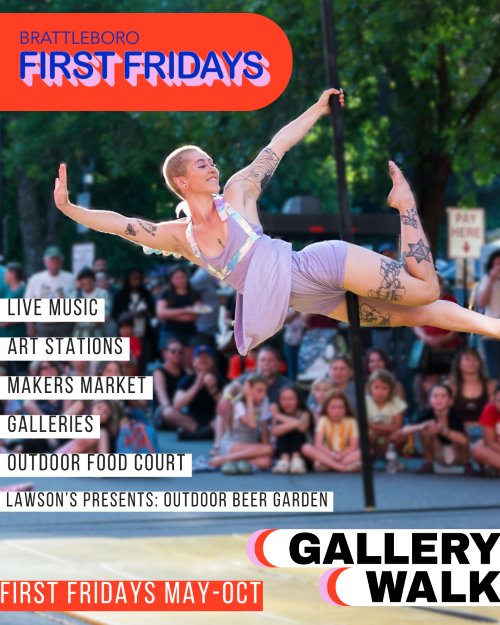
Creative Economy
The "Collaborative Cultural Plan for Southeast Vermont" is a long-term strategic framework initiated by a coalition including the towns of Brattleboro, Wilmington, and Rockingham, alongside the Windham Regional Commission,” said Kate Trzaskos, Executive Director of the Downtown Brattleboro Alliance.
“The report highlights what we know to be true, that this area has an outsized cultural footprint. Vermont’s creative sector—which includes businesses, nonprofits, and individual artists —is a powerful driver of our state’s economy. In 2023 alone, arts and culture represented more than $1.2 billion in economic activity.
“Brattleboro’s downtown is a living example of what this looks like. It’s not only a destination for visitors—it’s a proving ground for the future of Vermont’s creative sector. This year we've welcomed three new makerspaces to our downtown. Folks are able to experience Brattleboro's creativity with their own hands, learn skills, and feel a greater sense of community. We also launched three new festivals!
“Brattleboro has benefited from greater collaboration with Vermont Tourism, specifically highlighting the Brattleboro Festival of Miniatures during December 2025. These celebrations and events not only entertain—they educate, nurture civic pride, stimulate the local economy, and spotlight Vermont’s unique creativity. Data from 2022 tells us what we already feel on the ground: nearly 25% of cultural event attendees are nonlocal visitors, and 80% say the event was their primary reason for visiting. And once here, they spend—$52 per person beyond ticket costs, boosting local restaurants, shops, and lodging.
“In Brattleboro, our visitation data from 2023 shows nearly 100,000 visitors booking 1,800 nights with an estimated spending potential of $35 million.
“I share all of this because arts and culture are crucial ingredients to a thriving community and economy- especially one that wants to retain and attract young families and workforce. I echo John's sentiment that Brattleboro is primed for growth.”
To support vital journalism, access our archives and get unique features like our award-winning profiles, Book of Lists & Business-to-Business Directory, subscribe HERE!
 Vermont Business Magazine