


A Weekly State House Recap By Maggie Lenz and Gwynn Zakov (on behalf of Atlas Government Affairs and Garnet Government Relations
Battle Lines Drawn
Two weeks ago, we wrote about how the Senate Committee on Natural Resources and Energy threaded a difficult needle with S.325, producing a unanimous committee vote on a bill that extends deadlines for Act 181's most contentious provisions while preserving the law's fundamental framework. Since then, the bill has moved through the full Senate, and the political dynamics have sharpened considerably.
The week began with a "Repeal Act 181" rally on the State House lawn last Tuesday, where rural Vermonters, landowners, and farmers gathered to make their frustrations heard in person. The rally was the latest expression of an organizing effort that has been building for months through a vibrant Facebook group, op-eds, and public backlash. Bringing that energy physically to the State House steps, right as the Senate was preparing to take up the bill, underscored just how personal this issue has become for people in rural communities across the state.
Inside the building, S.325 moved to the Senate floor, where Republicans made their play. They pushed an amendment to repeal Tier 3 outright, one of the two provisions that have drawn the most sustained opposition from rural communities. The amendment failed along party lines. There was no middle ground, no crossover, no threading the needle this time. The vote laid bare what has been increasingly obvious that the two parties have fundamentally different views of what should happen with Act 181.
S.325 is a substantial piece of legislation, and while the "road rule" and Tier 3 timelines have dominated the public debate, the bill does a lot more than push back deadlines.
Nearly every major Act 181 implementation date gets extended. The Tier 3 rulemaking deadline moves from February 2026 to June 2028. The "road rule" effective date pushes to January 1, 2030. Temporary housing exemptions covering ADUs, commercial-to-residential conversions, and the various unit-cap exemptions in designated growth areas are all extended to January 1, 2030. Those housing exemptions have broad support because they've been producing results, and nobody wants to pull the rug out from under projects that are actually getting built.
Beyond the deadlines, the bill clarifies how development transitions from Act 250 to municipal jurisdiction in Tier 1A areas, allowing municipal panels to absorb prior Act 250 permit conditions while dropping those that are outdated or already addressed. Tier 1A municipalities must also identify and plan for significant natural communities and rare, threatened, and endangered species, or exclude those areas from the Tier 1A boundary. The LURB also gets explicit authority to limit which of the ten Act 250 criteria apply to "road rule" and Tier 3 development, a meaningful concession to concerns about regulatory overreach.
The regional planning process gets significantly reworked with streamlined amendment procedures, a new minor amendment pathway for future land use map changes under 10 acres, and extensions for regional and municipal plans expiring in 2026. Village centers are clarified as not requiring public water, wastewater, zoning, or subdivision bylaws, with the stated intent that most Vermont towns should have at least one village center supporting additional housing. The DHCD must report by January 2027 on reducing negative impacts of discretionary review of housing, including whether to create a Vermont Model Code with clear and objective standards.
Importantly, the bill explicitly states that it does not alter Act 181's underlying policy goals. That language is doing real work. It signals that the legislature views this as an implementation correction, not a policy reversal.
Democrats see a law that needs more time. Their position is that the tiered system, the environmental protections, and the mapping process are worth preserving, and that the problems people are experiencing stem from an implementation timeline that moved too fast, not from the law itself. Extending deadlines, in their view, gives the LURB room to get the rulemaking right, gives municipalities time to understand what's coming, and gives the public process a chance to catch up to the policy.
Republicans see something different. They see provisions that disproportionately burden rural Vermont, particularly the “road rule” that subjects development at the end of long driveways to Act 250 review, and Tier 3 that layers new restrictions on ecologically sensitive land that happens to be where rural Vermonters live and work. From their perspective, pushing deadlines out to 2028 or 2030 doesn't fix the problem, it just delays it. The provisions are still on the books. The uncertainty remains. And rural landowners are still left wondering what their property rights will look like when those deadlines arrive.
S.325 is now in the House, and the question is whether anything changes. The honest answer is probably not much, that is, unless rural Democrats break with their caucus.
That's the dynamic to watch. There are Democratic members from rural districts who have heard from the same constituents, read the same frustrated Facebook posts, and fielded the same phone calls from landowners and farmers who want the “road rule” and Tier 3 gone, not delayed. Some of those members have expressed sympathy with those concerns. But sympathy and a floor vote are two different things. Going against Democratic leadership on a high-profile land use bill during session would be a significant move, and legislative caucuses exert real gravitational pull.
Barring that kind of break, the most likely outcome is that the House passes a version of S.325 that looks a lot like what the Senate sent over, with deadline extensions, implementation adjustments, maybe some tweaks around the edges, but no repeal of the “road rule” or Tier 3. The fundamental framework of Act 181 stays intact.
And that sets up an interesting dynamic heading into the election cycle. If the bill lands as expected, rural communities that have been organizing, testifying, rallying on the State House lawn, and pushing hard for repeal will have a clear verdict - the legislature heard them and chose to extend timelines rather than roll back the provisions they find most objectionable. For rural Democratic legislators, that's a gamble. They'll head home to districts where the frustration is real, the organizing energy is still building, and the question voters will be asking is straightforward. They will ask, “Did you fight to fix this, or did you go along with your caucus?”
Republicans will certainly frame it that way. Act 181 and its impact on rural Vermont has all the ingredients of a potent campaign issue since it's tangible, it's personal, and it connects to deeply held feelings about property rights, local control, and whether Montpelier understands life outside Chittenden County and more urban areas. Whether that energy translates into actual electoral consequences remains to be seen, but the political raw material is there.
For now, the action is in the House. But unless something unexpected breaks loose in the caucus dynamics, the bigger story may be what happens after the session ends and the campaign season begins.
Curiosities: a weekly peek at the odd and intriguing happenings under the Golden Dome
Bracketology
The buzz around the State House March Madness bracket, a tradition that has been around for years, is impossible to miss. People talk about it between meetings, check standings, react to games in real time, even slip in snarky comments on the House floor. That was enough to make us curious about the place it seems to occupy in the State House psyche, so we spent the weekend talking to the people who play, run, and follow it to understand what it is and why it has endured.
At a basic level, the State House bracket is a typical five dollar NCAA pool, with the money going to a different charity every year. In practice though, it functions as an emotional pressure release valve, a shared distraction that helps people who work in and around Vermont state government push through the most grueling stretch of the legislative session. Legislators, lobbyists, legislative attorneys, cabinet level officials, agency staff, reporters, and former State House regulars are all following the same thing at the same time.
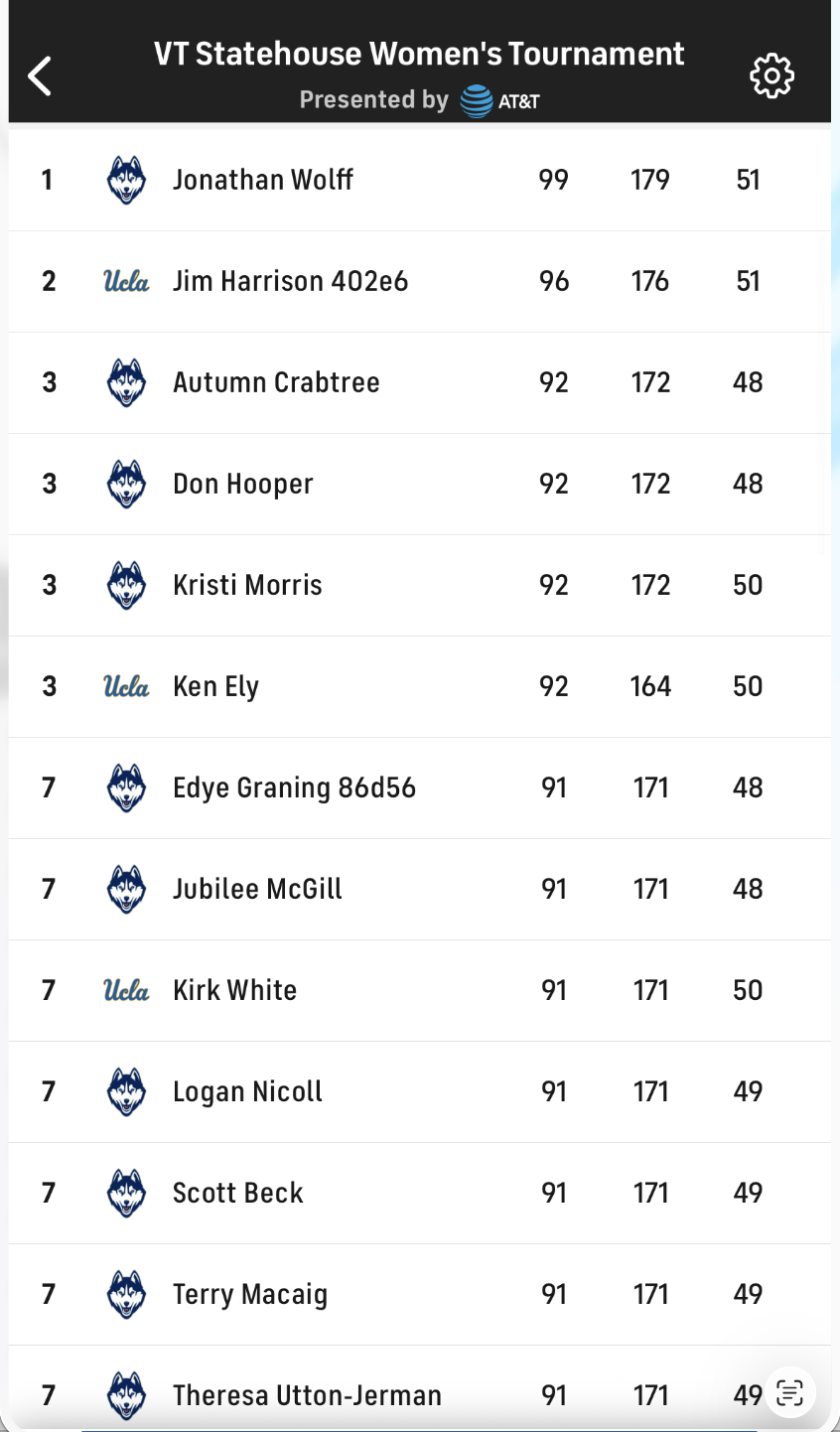
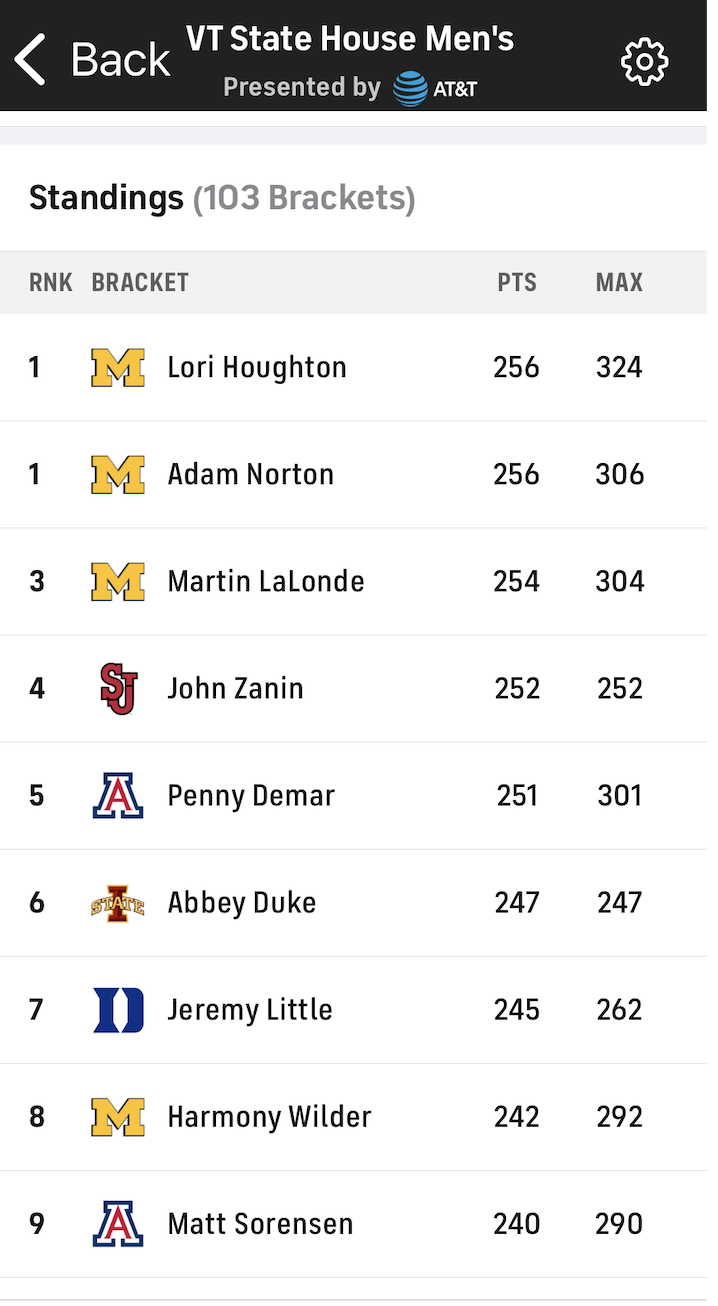
That collective attention plays out in real time. The Elite Eight game between Duke and UConn tipped off on Sunday eve at 5:05 p.m., and by the final seconds, the standings had already shifted. Adam Norton, a Strategic Analyst with the Vermont State Employees’ Association, held first place on the men’s bracket on Sunday. By Monday morning, as we finalized this piece, that had changed. House Majority Leader Rep. Lori Houghton (D-Essex) had moved into the lead. She was enjoying it. “I think the whole neighborhood heard me cheering for UConn,” she said. She added that she was “the only one with a perfect Final Four.”
Jonathan Wolff, a lobbyist at Primmer Piper Eggleston & Cramer PC, held onto first place on the women’s side. On the men’s side, he summed it up quickly. “My men’s bracket is totally busted.” He added, “I have to cheer for my old college teammate Tim Fudd’s daughter, Azzi Fudd, who is pure buckets.” The next day, after results came in, he followed up with, “Go Lori! I think I’m still in first place on the women’s side.”
Megan Sullivan, Vice President of Government Affairs at the Vermont Chamber of Commerce, described the contrast between her work and the game. “At the State House, I take a thoughtful, informed approach to my advocacy grounded in real world impact. My March Madness bracket is entirely vibes based,” she said. “That explains why I’m 74 out of 103 in the men’s and 43 out of 50 in the women’s. Three years in, I’ve improved from last place overall to still firmly in the bottom half.” She added that former Representative Jim Harrison told her after year one not to quit her day job. “Based on these results, that advice continues to hold.”
The timing of the bracket is part of what makes it work. Conor Kennedy, Chief of Staff to the Speaker of the House, said, “The March Madness tournament comes at a time when the session is firing on all cylinders. There are long days and it can be really stressful, but the tournament is a nice distraction and something that can unite people outside of tough policy debates.” It is worth noting that he is also the one who entered the pool under the name “House Rules Senate Drools,” a detail many had suspected but few had confirmed.
Attorney General Charity Clark put it succinctly. “Girl, I’m getting SMOKED. That’s my quote,” she said. She then added, “It’s just a silly thing that brings us together regardless of political party, geographic area, or station. And maybe that makes it not so silly.”
Senator Tom Chittenden (D-Chittenden Southeast) offered a more understated update. “Not sure how I’m doing this year,” he said when pressed for an answer, “but I’ve got UVM Catamounts winning it all next year.”
In nearly every conversation, former Representative Jim Harrison came up. People described him as a kind of godfather of the State House bracket, not just for running it but for shaping how it feels and functions.
Benjamin Novogroski, who until this year served as an attorney in the Vermont Legislature and now works as Associate Director of Legislative and Government Relations at Blue Cross Blue Shield of Vermont, described it as “a total who’s who of Vermont politics past and present.” He listed lobbyists, staffers, committee assistants, reporters, agency staff, legislators, and people who have moved on but still participate. “Even when you’re a State House emeritus, you can still participate,” he said. He also called it “a great equalizer of sorts,” where “people of all stripes find a common interest to be part of something adjacent to politics.”
He also pointed to Harrison’s role in shaping that dynamic. “He always sent around witty updates leading up to and throughout the tournament,” Novogroski said. Harrison would call out past champions and losers and come up with nicknames for whoever was leading.
Harrison, who resigned his seat earlier this year, described his role in practical terms. He moved the pool onto a CBS app so it would update automatically and said he “promoted the hell out of it,” emailing staff, members, lobbyists, and pulling in administration officials. After each day of games, he would send updates focused on “who’s in first and who’s in last.” When something shifted, it warranted a “breaking news alert.” He also gave people nicknames, including calling Vermont Public reporter Lola Duffort “Lucky Lola” after she climbed the rankings. “The motivation behind it is just to have fun,” said Harrison. “There’s too much serious stuff going on, and at the end of the day, we have to get along as people.”
Those dynamics carried into everyday interactions. At one point, Senate Appropriations was ahead of House Appropriations in the standings. During a budget exchange, the Chair of Senate Appropriations, Senator Andrew Perchlik (D/P-Washington), opened by asking, “So how is the House Appropriations team basketball pool this year?” Harrison’s response to moments like that was simple. “Brag when you can.”
The bracket has also evolved. Representative Ashley Bartley (R-Fairfax), who took over managing the bracket when Harrison left the legislature, pushed to create the women’s bracket. “The men’s bracket always has more participants,” she said. “I’m working on fixing this.” She also described what the game reflects about the State House. “We do serious work, but we know how to be silly and have fun.” She noted that people from all branches of government participate, that multiple bracket commissioners help decide the charity tied to a portion of the entry money, and that “we all bond over wins and losses.”
Former Lieutenant Governor David Zuckerman, a co-creator of the State House bracket, traced its origins back to the mid 2000s, when he was in the House. He described a legislature where people spent more time together across roles and parties, with bowling nights, dances, and other shared spaces. “We weren’t just partisans in the building. We were humans from the state of Vermont,” he said. In his view, the bracket became one more way people connected, giving them “something else to talk about” and a way to not always be in opposition. He was one of many who pointed to the shift at the State House in recent years away from informal socializing and the void it has left.
Finally, we asked one of the biggest basketball fans we know in the building for his take. Rep. Conor Casey (D-Montpelier) declined to sugarcoat it. “No, it’s too depressing,” he said. “Mine is a sad story where I only filled out the bracket five minutes prior. It’s actually really painful to see these fair weather fans destroying me. And I was a former D3 college player who briefly sat the bench for the Emerson College Lavender Lions.”
The State House bracket is five dollars and a set of picks. It is also a reminder that the work behind policy and politics is, at the end of the day, human. Beyond offering a break from the grind, it reflects how much better this work goes when people with differing views see each other as people. Government runs, in part, on those relationships, on people knowing each other and interacting with each other beyond the day-to-day grind.
To support vital journalism, access our archives and get unique features like our award-winning profiles, Book of Lists & Business-to-Business Directory, subscribe HERE!
 Vermont Business Magazine