


Chris Caldwell, new CEO of Community National Bank, which is celebrating its 175-year anniversary and their approval for listing on Nasdaq. Photo: StoryWorkz/Paul Richardson.
How Vermont’s financial institutions are navigating housing scarcity, rate uncertainty, commercial demand, and a fiercely competitive landscape
This article was first published in the March 2026 print version of VermontBiz. Since it went to print, the war in Iran began, oil and gas prices spiked, employment numbers from February sagged, mortgage rates edged up, 2025 GDP was just barely positive, inflation remained above Fed targets with upward momentum and the stock markets have struggled (however, they are off to a strong week today as oil prices have softened). The Federal Reserve Governors will meet this week and will decide on whether to raise or lower interest rates. Before the recent events, economists had been expected to keep them unchanged for now. Signs of inflation could lead them to raise rates, or a weakening economy could lead them to cut rates or they could hold and take a wait-and-see approach, which appears to be what they will do.
by Timothy McQuiston, Vermont Business Magazine
Vermont’s financial sector enters 2026 navigating one of the most complex operating environments in recent memory. While the state’s financial institutions remain fundamentally strong — well capitalized, competitive, and deeply rooted in their communities — they are also confronting a convergence of pressures that shape nearly every lending decision, strategic plan and customer conversation.
Housing scarcity continues to dominate the economic landscape, influencing both residential and commercial activity. Interest rate uncertainty, inflationary aftershocks, and workforce shortages add further strain, creating a market where stability and constraint coexist.
Yet despite these challenges, Vermont’s banks and credit unions are not retreating. They are expanding, reinvesting, modernizing systems, and sharpening their competitive edge.
Commercial lending remains steady and intentional, driven by businesses focused on efficiency, durability, and long-term resilience. Mortgage activity is stabilizing, though affordability remains a barrier. Credit unions are stepping up with down payment assistance, energy efficiency financing, and member focused programs designed to ease cost pressures.
Community banks continue to lean into local decision making and relationship driven service, while regional and national institutions leverage scale to deliver treasury modernization, fraud prevention tools, and broader advisory capabilities.
NBT Bank’s Vermont Regional President Dan Werme describes the institution as “a strong, growing and stable financial institution,” noting that NBT now offers “full service banking products…across the state.” The bank opened a new South Burlington office in 2025 and plans further expansion.

Photo: Dan Werme, Vermont Regional President, NBT Bank. Courtesy photo.
Werme said the housing market remains constrained by homeowners locked into ultra low pandemic era mortgage rates.
“Meaningful rate declines would help motivate downsizing and free up homes for younger families,” he said. New construction has slowed, though “several large apartment projects coming online in 2026 should help ease, but not fully resolve, rental market pressure.”
On competition, Werme said NBT differentiates itself through service and expertise, pointing to repeated recognition on the Forbes World’s Best Bank list and Coalition Greenwich Awards.
TD Bank, meanwhile, remains the state’s top SBA lender by loan count, with 45 SBA loans in 2025 worth a total of $3 million. Northern New England Commercial Market President Donald Baker said Vermont’s relationship driven culture continues to be a competitive advantage.

Photo: Donald Baker, Northern New England Commercial Market President TD Bank. Courtesy photo.
“We’re seeing healthy engagement with our clients and prospects,” Baker said. “Businesses are starting to reinvest in infrastructure and return to more normal replacement cycles.” He adds that even modest Fed rate cuts would “renew confidence” and get delayed projects moving.
The next Federal Open Market Committee (FOMC) meeting is scheduled for March 17-18, 2026. Following the January 2026 meeting where rates were held steady, this meeting will be closely watched for potential adjustments to interest rates, with market consensus currently favoring a hold as inflation hovers stubbornly above the 2% target while the overall economy has stabilized.
Housing remains a universal concern.
“Building in Vermont is expensive and increasingly prohibitive,” Baker said, adding that housing supply is now central to nearly every commercial conversation.
TD also sees rising demand for treasury modernization.
“As businesses become more digital and interconnected, those tools are no longer ‘nice to have’ — they’re essential,” Baker said.
Community National Bank CEO Christopher Caldwell said CNB’s growth stems from a deliberate shift toward commercial banking.

Photo: Christopher Caldwell, CEO, Community National Bank. Courtesy photo.
“We built an infrastructure to help us grow our capacity and abilities to provide robust commercial offerings,” he said, while maintaining 12 retail branches. Community National Bank boasted the highest dollar amount of SBA lending in 2025 with $9.6 million financed on 26 loans.
Caldwell expects rate cuts would help businesses through lower credit line costs, though long-term rates may not fall as quickly. He describes Vermont’s economy as “strong and resilient,” but emphasizes that affordable housing will require “public private partnerships.”
CNB’s competitive strategy centers on discipline.
“When we see a ‘shiny object’… we must ask ourselves if it is truly something that we chase,” Caldwell said. “We know what we do extremely well and that is what we try to do better each day.”
EastRise COO Robert Miller said Vermont’s housing shortage remains severe, with median home prices up 67% since 2019.

Photo: Rob Miller, COO, EastRise Credit Union. Courtesy photo.
“Inventory remains low, with the state needing 24,000–36,000 more homes by 2029,” he said.
EastRise is seeing strong demand for home equity borrowing as Vermonters renovate aging housing stock or create space for multigenerational living. As a national leader in green lending, the credit union is financing heat pumps, weatherization, and solar projects.
Miller also points to rising auto costs and a surge in EV adoption — up 41% in one year.
M&T Bank’s Vermont Regional President Heidi Stumpff highlighted the bank’s dual mission of lending and community support.

Photo: Heidi Stumpff, Vermont Regional President, M&T Bank. Courtesy photo.
“We reinvest… through lending and philanthropic giving,” she said, citing $1.7 million in grants and 5,000 employee volunteer hours last year.
Stumpff said Vermont’s biggest challenge is housing supply, not interest rates. Still, she remains optimistic: “The state has strong communities, committed employers and a quality of life that continues to attract people.”
Commercial credit quality remains strong, with low delinquencies and a “healthy commercial pipeline.”
Vermont Federal Credit Union Chief Growth Officer Tim Daniska reports modest improvements in 2025, with more starter homes available and mortgage rates dipping below 6%. Still, affordability remains difficult.
“We do our best to make home buying accessible,” he said, citing down payment assistance and partnerships like the 16 home Morristown project with Downstreet Housing.
Union Bank CEO David Silverman echoes the inventory crisis. “Interest rates… are not what is holding the housing and mortgage activity back,” he said. “It is the lack of inventory and the cost of existing and new housing.”

Photo: David Silverman, CEO, Union Bank. Courtesy photo.
Northfield Savings Bank President Joseph Bator said NSB’s strength lies in its identity as “Builders, Makers and Doers,” emphasizing long-term relationships and local decision making.
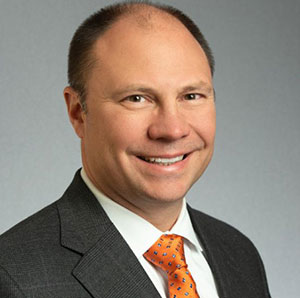
Photo: Joseph Bator, President, Northfield Savings Bank. Courtesy photo.
The Business Bank COO Victoria Bronner said the bank’s rebrand (formerly known as the Bank of Burlington) reflects its growth trajectory. Commercial clients, she notes, need “a banking partner that can be responsive and provide services at a low cost and with ease.”

Photo: Victoria Bronner, COO, The Business Bank. Courtesy photo.
Bronner’s bank is not the only one looking at expanding and rebranding.
Beacon Financial Corporation (NYSE: BBT) announced in February the successful combination of four financial institutions under one new brand, Beacon Bank, one of the 100 largest banks in the United States. This includes Berkshire Bank, with branches in southern Vermont.
Beacon Financial Corporation is led by Paul A. Perrault, Chief Executive Officer. Perrault was the CEO of Chittenden Corp, based in Burlington, until it was acquired by People's United in 2008. M&T Bank Corporation then acquired and rebranded People's in 2021.
"Launching Beacon Bank represents a significant achievement for our organization and a critical step forward in our long-term strategy," Perrault said.
And Community Bancorp, the parent company of Community National Bank, has announced that it has received approval to list its common stock on the Nasdaq Capital Market. The company began trading its shares on the Nasdaq Capital Market effective February 2, 2026. The common stock will trade on the Nasdaq Capital Market under its current ticker symbol “CMTV.”
“We are pleased to have received approval for listing on Nasdaq,” said Chris Caldwell. “This move represents a significant milestone in our 175-year history. We believe that uplisting to a nationally recognized trading platform may enhance our visibility, potentially broaden our access to a wider base of investors, and support the continued execution of our long-term business strategy.”
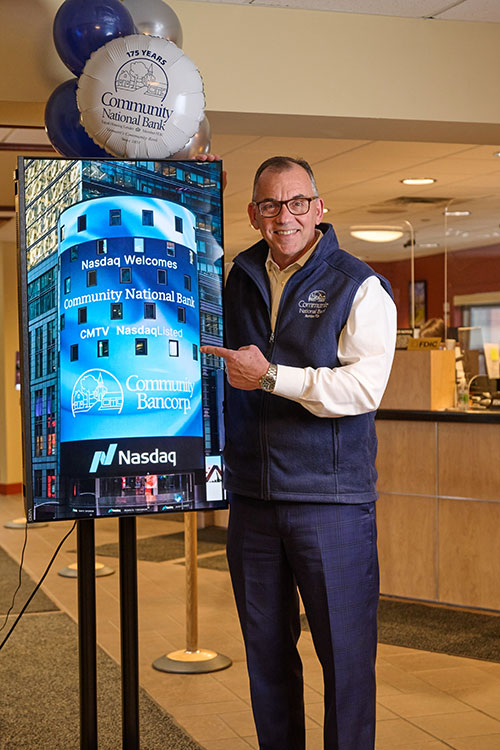
Photo: Chris Caldwell, CEO of Communtiy National Bank celebrating the bank's 175-year anniversary and their approval for lising on Nasdaq. Photo: StoryWorkz/Paul Richardson.
A Body in Motion
If there is one theme that unites Vermont’s banking leaders, it is the intensity of competition. The state’s financial landscape is crowded with national banks, regional institutions, community banks, and credit unions — all vying for deposits, loans, and relationships in a small but economically diverse market.
Vermont Federal Credit Union: A Slightly Looser Market
Chief Growth Officer Tim Daniska reports modest improvement in 2025. Many members who were prequalified in 2023–24 “were finally able to go under contract to buy in 2025.”
Still, affordability remains a barrier. Mortgage rates dipped below 6% at the end of 2025, but Daniska expects them to remain in the high 5% to low 6% range even if the Fed cuts rates.
M&T Bank: Community Investment as a Business Strategy
M&T Bank’s Vermont Regional President Heidi Stumpff emphasizes the bank’s dual mission: financial performance and community support.
“Vermont offers strong opportunities with an economy built on local businesses and close knit communities,” she said. M&T ranked #2 in SBA lending in 2025 and holds a majority market share.
But Stumpff highlights the bank’s philanthropic footprint as well: “Last year M&T provided more than $1.7 million in charitable grants and sponsorships… and our employees contributed nearly 5,000 volunteer hours.”
Commercial clients, she said, are resilient. “Line usage remains low… commercial delinquencies remain low… and we continue to see a healthy commercial pipeline.”
Community Bank NA: Diversification Is Essential
Community Bank’s New England Regional President Matthew Plasse oversees a $17 billion institution with 30 Vermont branches. He recently was promoted to the position.

Photo: Matthew Plasse, New England Regional President, Community Bank. Courtesy photo.
What drew him to the bank? “The strength of the foundation… a $17 billion institution that operates with the mind set of a true community bank.”
Plasse said diversification is essential. Through its parent company, Community Financial System Inc., the bank offers wealth management, insurance, and retirement services. “Banking has become more competitive… you have to offer more than a single product.”
On housing, Plasse sees normalization rather than decline. “Demand has not gone away… buyers are simply more disciplined.”
On rates, he sees stability ahead. “Borrowing costs are higher… but they are also stabilizing.”
And on commercial lending, he sees resilience. “Industrial real estate remains tight… multifamily demand remains strong… and businesses are adapting in thoughtful ways.”
EastRise Credit Union: The Affordability Crisis in Numbers
Rob Miller paints a stark picture of Vermont’s housing market: “Median single family home prices hit $379,000 last year, up 67% since 2019, while incomes rose only 42%.”
The state needs 24,000–36,000 new homes by 2029 to stabilize prices. “This chronic shortage continues to push prices and rents upward and constrains workforce growth,” Miller said.
EastRise is responding with down payment assistance, counseling, and partnerships with housing agencies. But Miller stresses that credit unions can’t solve the problem alone: “That’s why we support the important work being done by Let’s Build Homes… Their coalition should make more homes possible.”
Union Bank: Inventory, Not Rates, Is the Real Constraint
Union Bank CEO David Silverman is blunt: “Interest rates, loan programs and down payments are not what is holding the housing and mortgage activity back in Vermont. It is the lack of inventory and the cost of existing and new housing.”
Silverman notes that Vermont homeowners have the highest equity levels in the country, and that short-term rate cuts will help home equity borrowers. But long-term mortgage rates, tied to the 10 year Treasury, “are not projected to decrease in step with short-term rates.”
He cites the 2025 Statewide Housing Needs Assessment: Vermont needs 24,000–36,000 new homes by 2029, and construction costs have risen 50% in five years.
If the mortgage market is constrained, the commercial market is active, disciplined, and increasingly focused on long-term resilience.
Union Bank appoints Jeff Weidley as President and CEO
NBT Bank: Strategic Expansion in a Tight Market
NBT Bank’s Dan Werme describes an institution that sees opportunity even in a constrained environment. “NBT Bank is definitely a strong, growing and stable financial institution,” he said. The bank offers “full service banking products including retail, small business, commercial and wealth — not only in Chittenden County, but across the state.”
In 2025, NBT opened a new South Burlington office, and Werme said the bank is “looking to strategically expand our footprint in Vermont with additional locations that complement our existing presence.”
Competition, he argues, is good for consumers — and NBT is prepared for it. “Our experienced team helps set NBT apart,” he said, pointing to the bank’s repeated recognition on the Forbes World’s Best Bank list and multiple Coalition Greenwich Awards. “We deliver a holistic approach… with a full suite of financial solutions combined with exceptional service.”
TD Bank: Consistency as a Competitive Advantage
TD Bank remains one of Vermont’s most active lenders, particularly in the small business space.
Donald Baker said Vermont’s relationship driven culture continues to be a competitive advantage for TD. “Vermont remains a relationship driven market, and that continues to be a real opportunity for TD,” he said. “We’re seeing a market today that feels steadier than it did a year ago.”
TD’s national strength, Baker argues, allows it to remain steady locally. “When the broader bank is doing well, it gives us the capacity to keep showing up for customers here… even when the national environment is uneven.”
Community National Bank: A Small Town Bank with Big Market Reach
Community National Bank, headquartered in Derby, has become one of Vermont’s most influential commercial lenders. Chris Caldwell said this is the result of a deliberate strategic shift.
“We made a strategic decision to become a commercial focused bank for Vermont’s businesses,” he explains. CNB built the infrastructure and talent to support that shift, while still maintaining 12 retail branches. “It is not strictly a commercial only focus,” he notes, but the bank’s commercial capabilities have become a defining strength.
Caldwell said CNB’s strategy is disciplined: “We analyze opportunities to determine if they fit within our strategic plan… We know that we cannot be all things to everyone.”
Yet the bank’s optimism is unmistakable. “We are bullish on our state and what it means to be a Vermonter,” Caldwell said. “We love being part of this cycle of helping make our state a better place for all.”
Northfield Savings Bank: Local Roots, Local Decisions
Northfield Savings Bank (NSB) President Joseph Bator said the bank’s strength lies in its emphasizing long-term relationships and local decision making.
“We are big enough to be able to meet everyone’s needs while being small enough to provide the local personalized service that Vermonters appreciate,” Bator said. NSB supports consumers, municipalities, non profits, and commercial businesses across the region.
The Business Bank: A Rebrand with Purpose
The Business Bank has rebranded to reflect its identity as a commercial focused institution. Victoria Bronner said the rebrand “better reflect[s] who we are today and… support[s] our long-term growth and geographic expansion.”
Bronner said commercial clients need speed, responsiveness, and simplicity. “Commercial customers have different needs than the retail customer.”
Her clients span manufacturing, construction, trades, professional services, hospitality, and retail — “established companies with experienced management teams that need capital for growth.”
Across institutions, the message is consistent: housing scarcity is the single most influential force in Vermont’s economy.
NBT Bank: A Market Bottle Necked by Low Rates
Werme points to a structural issue: “Many homeowners are locked into ultra low mortgage rates, creating a bottleneck in housing turnover.” Even if rates fall, he said, the impact will be uneven.
“Meaningful rate declines would help motivate downsizing and free up homes for younger families.”
But new construction remains slow. “Higher rates have also slowed new construction,” Werme notes, though he expects large apartment projects coming online in 2026 to “help ease, but not fully resolve, rental market pressure.”
TD Bank: Housing Comes Up in Every Commercial Conversation
Baker said that even on the commercial side, housing is unavoidable. “Housing comes up in almost every conversation, even if we’re not directly involved on the residential side.”
The reason is simple: “Businesses can’t expand, or even maintain staffing levels, without places for people to live.”
Lower rates may help, but Baker stresses that “housing affordability and supply are fundamentally structural challenges that go well beyond interest rates alone.”
Community National Bank: Built for Commercial Growth
Caldwell said CNB’s commercial focus is deliberate and long-term. “We built an infrastructure to help us grow our capacity and abilities to provide robust commercial offerings.”
The bank’s disciplined approach means saying no as often as yes. “When we see a ‘shiny object’… we must ask ourselves if it is truly something that we chase or if we determine that it isn’t what we do best.”
Northfield Savings Bank: A Stable, Growing Commercial Market
NSB’s Joseph Bator sees opportunity. “Commercial banking in Vermont is performing within a growing and stable market,” he said. The bank’s size, he said, allows it to serve a wide range of clients while maintaining local decision making.
The Business Bank: High Touch Service for Growth Focused Firms
Bronner said The Business Bank’s clients are “primarily small to mid-sized businesses across a wide range of industries… established companies with experienced management teams that need capital for growth.”
She emphasizes responsiveness: “Commercial customers have choices… and we have created a simple model to attract the business owner who wants to focus on managing their business without having to worry about their banking relationships.”
EastRise Credit Union: Housing, Energy, and Consumer Costs
Miller said EastRise is seeing strong demand for home equity borrowing as Vermonters renovate aging housing stock or create space for multigenerational living. As a national leader in green lending, the credit union is financing heat pumps, weatherization, and solar projects.
He also points to rising auto costs and a surge in EV adoption — “Vermont has added nearly 18,000 EVs, up 41% in a single year.”
Meanwhile, EastRise CEO John Dwyer, who guided the state’s largest credit union through its merger with Vermont State Employees Credit Union and the rebranding to EastRise, will retire in June 2026 after 38 years.

Photo: John Dwyer, CEO, EastRise Credit Union. Courtesy photo.
Miller calls him “a key figure in Vermont’s business landscape,” and Board Chair Art Woolf praises his “authentic leadership” and “purpose driven” approach.
The merger was approved in 2022 and the rebrand for the $3 billion institution was announced in 2024.
Commercial Lending Trends 2026
Matthew Plasse said: “I see tremendous opportunity here. The relationships are deep, the communities are strong and our brand is well respected. My focus is on building on that momentum and ensuring we continue to deliver the right solutions for businesses and families across the region.”
Commercial lending across Vermont in 2026 is neither booming nor retracting. Instead, bankers describe a market that is steady, selective, and increasingly strategic, shaped by higher borrowing costs, workforce constraints, and the ripple effects of the state’s housing shortage.
Across institutions, several clear trends emerge.
After a cautious 2025, companies are beginning to move forward again.
TD’s Don Baker notes a visible uptick in capital expenditures and equipment financing, a reversal from the prior year when many firms replaced equipment only when absolutely necessary.
But the tone is measured. Baker describes the shift as “cautious optimism” rather than exuberance.
Across the state, banks say commercial clients are focusing on long-term resilience, not rapid expansion.
“Clients are investing with intention,” Baker said. “They’re focused on efficiency, durability, and long-term viability rather than rapid expansion.”
This mind set is influencing:
- Equipment purchases
- Owner occupied real estate
- Infrastructure upgrades
- Energy efficiency investments
It’s a market where businesses want to grow — but only in ways that strengthen their balance sheets.
Even lenders who don’t originate residential mortgages say housing is now central to commercial credit decisions.
Construction and development clients tell TD that building in Vermont is expensive and increasingly prohibitive, and businesses across sectors say they cannot expand without places for employees to live.
Community National Bank’s Caldwell echoes the concern, calling housing “a challenge that will require public private partnerships to make things work for all Vermonters.”
As fraud risks rise and digital operations expand, Vermont businesses are upgrading their financial infrastructure.
“Clients are increasingly focused on upgrading their treasury management systems,” Baker said, citing demand for:
- Embedded banking
- Automated end-to-end payments
- Real time cash flow visibility
- Stronger fraud prevention tools
A wave of founder led businesses is preparing for transition, creating new demand for financing and advisory services.
“Many Vermont businesses are owned by founders who are thinking seriously about what comes next,” Baker said. He calls succession planning one of the fastest growing areas of commercial activity.
Banks are structuring:
- Ownership transfer financing
- ESOP related lending
- Buy sell arrangements
- Advisory partnerships
This trend is expected to accelerate as Vermont’s business owner demographics continue to age.
Commercial Credit Quality Remains Strong
Despite inflation and workforce pressures, lenders report healthy portfolios.
“Commercial delinquencies remain low and credit quality is strong,” said Heidi Stumpff, Vermont Regional President at M&T Bank. She adds that line of credit usage remains low, suggesting that many companies are generating sufficient cash flow to fund operations without tapping credit lines.
M&T continues to see “a healthy commercial pipeline of new opportunities.”
Community National Bank, Northfield Savings Bank, and The Business Bank all report steady commercial demand — and say their size is an advantage.
The Business Bank’s Bronner said commercial clients want responsiveness above all:
Across institutions, the message is consistent: Vermont’s commercial lending environment is stable, disciplined, and preparing for long-term growth.
Baker sums it up: “Alongside continued investment in equipment, energy efficiency, and balance sheet strength, these trends point to a market that’s stabilizing and deliberately preparing for the next phase of growth.”
SBA Vermont Lenders (ranked FY 2025)
|
Lender Name (State) |
Approval Count |
Approval Amount |
Average Loan Size |
|---|---|---|---|
|
Community National Bank (VT) |
26 |
$9,578,000 |
$368,385 |
|
Beacon Bank and Trust (MA) |
4 |
$6,111,000 |
$1,527,750 |
|
Newtek Bank, National Association (FL) |
3 |
$5,450,000 |
$1,816,667 |
|
First Bank of the Lake (MO) |
2 |
$4,560,000 |
$2,280,000 |
|
Bank Five Nine (WI) |
1 |
$3,523,000 |
$3,523,000 |
|
National Cooperative Bank, National Association (OH) |
1 |
$3,134,000 |
$3,134,000 |
|
Citizens Bank, National Association (RI) |
2 |
$3,000,000 |
$1,500,000 |
|
TD Bank, National Association (DE) |
45 |
$2,966,700 |
$65,927 |
|
Manufacturers and Traders Trust Company (NY) |
38 |
$2,808,000 |
$73,895 |
|
Northfield Savings Bank (VT) |
2 |
$2,640,000 |
$1,320,000 |
|
Northeast Bank (ME) |
16 |
$2,152,000 |
$134,500 |
|
United Midwest Savings Bank, National Association (OH) |
1 |
$1,958,000 |
$1,958,000 |
|
The Huntington National Bank (OH) |
4 |
$1,943,000 |
$485,750 |
|
First Financial Bank (OH) |
1 |
$1,380,000 |
$1,380,000 |
|
KeyBank National Association (OH) |
9 |
$1,352,900 |
$150,322 |
|
Vermont 504 Corporation (VT) |
6 |
$1,205,000 |
$200,833 |
|
Mission Valley Bank (CA) |
1 |
$1,102,500 |
$1,102,500 |
|
Heritage Family FCU (VT) |
10 |
$784,500 |
$78,450 |
|
BayFirst National Bank (FL) |
6 |
$629,000 |
$104,833 |
|
Live Oak Banking Company (NC) |
3 |
$600,000 |
$200,000 |
|
Citizens Bank (TN) |
1 |
$442,600 |
$442,600 |
|
Celtic Bank Corporation (UT) |
3 |
$396,200 |
$132,067 |
|
Vermont Community Loan Fund, Inc. (VT) |
3 |
$375,000 |
$125,000 |
|
Bar Harbor Bank & Trust (ME) |
4 |
$347,700 |
$86,925 |
|
City National Bank of Florida (FL) |
1 |
$325,000 |
$325,000 |
|
NBT Bank, National Association (NY) |
1 |
$316,000 |
$316,000 |
|
North Country FCU (VT) |
4 |
$239,500 |
$59,875 |
|
OptimumBank (FL) |
1 |
$217,500 |
$217,500 |
|
SmartBiz Bank National Association (IL) |
1 |
$150,000 |
$150,000 |
|
Passumpsic Savings Bank (VT) |
2 |
$112,400 |
$56,200 |
|
Mascoma Bank (NH) |
1 |
$100,000 |
$100,000 |
|
Union Bank (VT) |
1 |
$75,000 |
$75,000 |
|
Peoples Trust Company of St. Albans (VT) |
2 |
$55,400 |
$27,700 |
|
Community Bank, National Association (NY) |
1 |
$50,000 |
$50,000 |
|
EastRise Federal Credit Union (VT) |
1 |
$50,000 |
$50,000 |
|
Vermont Federal Credit Union (VT) |
1 |
$7,000 |
$7,000 |
To support vital journalism, access our archives and get unique features like our award-winning profiles, Book of Lists & Business-to-Business Directory, subscribe HERE!
