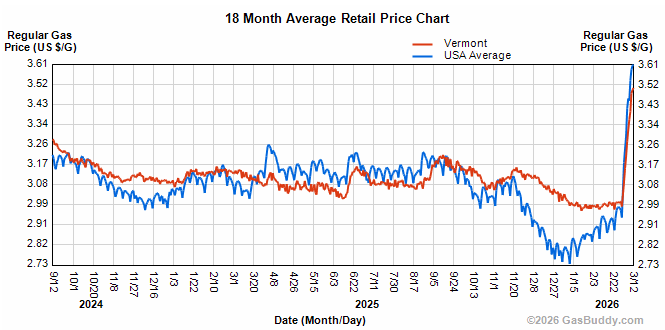
by Timothy McQuiston, Vermont Business Magazine Average gasoline prices in Vermont are $3.50 per gallon, up 34 cents per gallon from last week, up 51 cents/g from last month and up 36 cents/g from a year ago, according to AAA, as the war in Iran has created chaos and uncertainty, drone strikes on shipping and pushed Brent crude over $100 a barrel.
Prices are lowest in Bennington ($3.42/g) and Windham ($3.43/g) counties and highest in Essex ($3.56/g), Lamoille ($3.57/g), and Franklin ($3.57/g), according to AAA.
The lowest price in the state this week was $2.88/g while the highest was $3.89/g, a difference of $1.01/g. The historic peak was $5.05/g at the end of the post-COVID inflation in June 2022.
The national average price of gasoline has risen 34 cents per gallon in the last week, averaging $3.59/g today. The national average is up 65 cents per gallon from a month ago and stands 51 cents per gallon higher than a year ago, according to AAA.
The national average price of diesel has increased 85.9 cents compared to a week ago and stands at $4.599 per gallon.
Historical gasoline prices in Burlington and the national average going back five years:
March 9, 2025: $3.21/g (U.S. Average: $3.03/g)
March 9, 2024: $3.25/g (U.S. Average: $3.40/g)
March 9, 2023: $3.44/g (U.S. Average: $3.45/g)
March 9, 2022: $4.35/g (U.S. Average: $4.32/g)
March 9, 2021: $2.72/g (U.S. Average: $2.81/g)
Neighboring areas and their current gas prices:
Albany- $3.36/g, up 35.8 cents per gallon from last week's $3.00/g.
New Hampshire- $3.33/g, up 49.4 cents per gallon from last week's $2.84/g.
“In just a week, consumers have seen gasoline prices surge at one of the fastest rates in years after oil prices spiked following U.S. strikes on Iran and the effective closure of the Strait of Hormuz,” said Patrick De Haan, head of petroleum analysis at GasBuddy. “With additional attacks across the Middle East over the weekend pushing oil above $100 per barrel for the first time in years, fuel markets are now rapidly recalibrating to the risk of prolonged disruption to global supply flows. As a result, gasoline prices in many states could climb another 20 to 50 cents per gallon this week, with price-cycling markets potentially seeing increases as early as today. Diesel may rise even more sharply, with increases of 35 to 75 cents per gallon possible as global distillate markets react. While the situation remains highly fluid, consumers are already beginning to feel the impact as energy markets adjust to this sudden escalation.”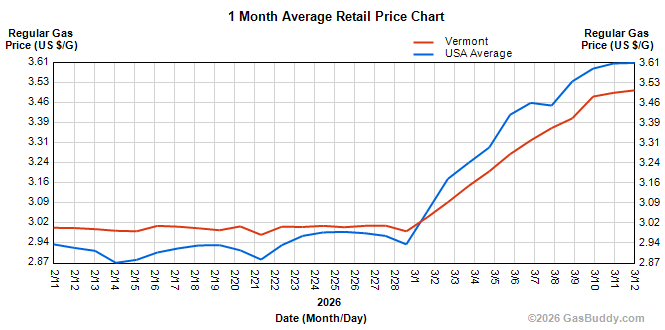
Since the end of February and the start of war in Iran, fossil fuel prices in Vermont have been increasing dramatically. EAN recently analyzed how gasoline price increases are affecting Vermonters and our state economy. The full analysis is available on EAN’s website.
Key points – consumer level:
-
At $3.06/ gallon (the Feb. 27th, pre-war price), the average cost of gasoline per Vermonter was $120 a month.
-
At the March 11th price of $3.54/gallon, that cost has risen to about $140 a month, or roughly a $20 increase in monthly gasoline costs per Vermonter.
-
Every additional 50 cents a gallon increases average fuel costs for each Vermonter by about $20 a month or $240 per year.
-
If gasoline prices were to rise and remain a dollar per gallon higher (ex. $4/gallon rather than $3/gallon), that would translate to about a $40/month or $475/ year cost increase for the average Vermonter.
Key points – statewide economy:
Before the Iran War began on Feb. 28, statewide average gasoline prices in Vermont were $3.06 a gallon, and had been right around that price for most of February. Since then, gas prices have risen rapidly. Over the week of March 4-11, gas prices in Vermont rose every single day, but averaged $3.41 over the full week.
In just the past week, Vermonters paid an additional $2 million in gasoline costs, due to the increase in gas prices. If gas prices had held steady at their pre-war price of $3.06/gallon then nearly $17 million would have been spent on gasoline in Vermont in the last week. Instead, gasoline averaged $3.41/gallon over the last week, increasing weekly spending on gasoline in the state to nearly $19 million.
A helpful shorthand is that every extra 50 cents per gallon for gasoline creates about $2.8 million in increased costs to Vermont per week, or about $12 million in increased costs to Vermont per month.
Over a full year, gasoline at $3.50/ gallon instead of $3.00/gallon would translate to an increase in annual statewide gasoline costs to Vermont of about $143 million dollars. $4.00/gallon gasoline rather than $3.00/gallon would increase annual statewide gasoline costs by about $287 million.
Unfortunately, the costs to Vermont of continued fossil fuel dependence and exposure to fossil fuel price volatility are not new. About 80% of total average household energy costs in Vermont come from the use of fossil fuels for transportation and heating, creating a large energy cost burden for household budgets.


Over the years, EAN’s research has identified four key features of fossil fuels. They are expensive; price-volatile; drain money out of the Vermont economy; and are heavily polluting. More information and analysis on energy affordability is available in EAN’s 2025 Annual Progress Report for Vermont.


Energy Action Network is both a network and an organization. As a non-profit organization, EAN conducts climate and energy data tracking, research, and analysis on behalf of all Vermonters while also convening and facilitating collaborative meetings among its diverse network of members. The Network’s mission is to achieve Vermont’s climate and energy commitments in ways that create a more just, thriving, and sustainable future.
GasBuddy®, a PDI Technologies company, is North America’s trusted fuel savings platform, helping consumers fuel up for less for over 25 years. With over 100 million app downloads, GasBuddy delivers real-time prices at 150,000+ stations and tangible savings through Pay with GasBuddy+™. It is the most authoritative source of station-level fuel pricing data, updating averages 288 times daily from the broadest mix of inputs— spotter reports, direct station integrations, and transactional data.
SOURCE 3.9.2026. GasBuddy. 3.11.2026. Montpelier, VT – Energy Action Network. 3.12.2026. AAA
To support vital journalism, access our archives and get unique features like our award-winning profiles, Book of Lists & Business-to-Business Directory, subscribe HERE!