

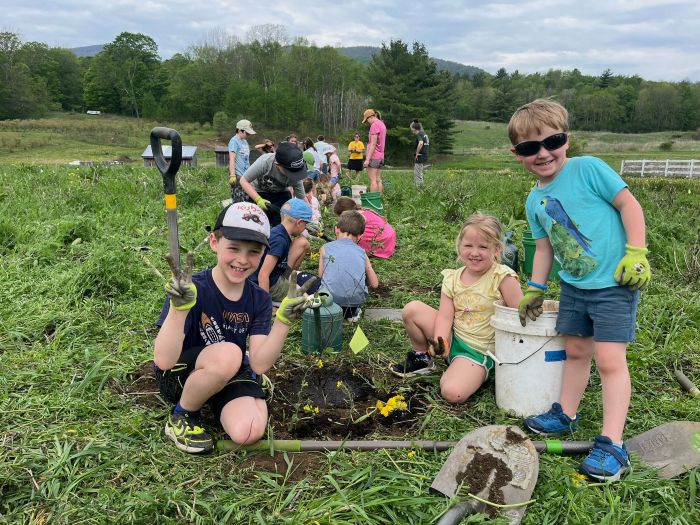
Students from Tinmouth Elementary School planting new honeyberry plants at Smokey House Center
Vermont Business Magazine Smokey House Center, a 5,000-acre forest and farming research nonprofit in Danby, Vermont was awarded a Farm to School Provider Grant through the Vermont Agency of Agriculture, Food, and Markets, which has funded the installation of a new Berry Alley Cropping system on its main campus this spring and early summer. The project has brought more than 300 students from over 14 schools to the land to help plant a diversified perennial food system—and marks the third addition to Smokey House Center’s growing community U-pick operations.
Agroforestry is the intentional integration of trees, shrubs, and crops or livestock into a single agricultural system. By combining these elements, agroforestry practices improve soil health, support biodiversity, sequester carbon, and create more resilient and productive landscapes in the face of climate change compared to conventional monoculture farming.
Alley cropping is a form of agroforestry where rows of trees or perennial shrubs are planted in parallel strips with crop-producing alleys running between them. This structure creates a diverse, layered system that supports pollinators, reduces erosion, improves water infiltration, and produces food over the long term.
At Smokey House Center, the new Berry Alley Cropping system will feature rows of honeyberries and elderberries as the primary perennial shrub plantings. In partnership with neighboring farm, Yoder Farm, strawberries will be planted in the alleys between rows—creating a diverse, multi-species system that produces fruit across multiple seasons.
This spring, school groups through Smokey House Center’s Saplings-to-Stewards youth program have been visiting to not just learn about agroforestry but actually help build this new system. Students have been participating in planting, site preparation, and hands-on learning about ecosystems, biodiversity, agroforestry, and growing food that is resilient in the face of climate change. Students have even had a chance to taste honeyberries, many tasting this fruit for the first time.
Students have responded positively to the experience. “We loved our time there so much. I haven't seen the 8th graders so engaged in a trip all year.” said Lauren Harvey, 8th grade teacher at Poultney High School.
The project is coordinated by Smokey House Center staff Walker Cammack, who is the Program Director, and Lauren Kelly, who is the Education Coordinator. Lauren and Walker spent the beginning of year designing the new system and preparing the field trips to Smokey House as an immersive experience for students. This winter they surveyed the public on potential varieties and overwhelmingly the public voted that they would love to see honeyberries and elderberries grown at Smokey House.
Honeyberries are blue, about the size and shape of a grape and taste similar to a raspberry and blueberry combined. They are eaten fresh and often used in jams, jellies, juices, and baked desserts. Elderberries produce small clusters of dark purple berries and are processed before being consumed into syrups, juices, jams, and wines. Both berries are high in vitamin c and antioxidants.
“Students (and teachers!) worked hard, and had tons of fun in the field digging holes and planting berries in this new system. As an added bonus, kids got to taste fresh, frozen honeyberries and other products made from honeyberries and elderberries. It was awesome to see their bravery as they tried new things, and watch their faces light up with delight because the berries were delicious!” said Lauren Kelly, Smokey House Center’s Education Coordinator.
The Berry Alley Cropping system is the latest addition to Smokey House Center’s expanding community U-Pick operations. The organization’s Blueberry U-Pick—a nearly 50 year old patch of 500 bushes—has long drawn community members to the main campus each summer. Last year, Smokey House Center planted nearly 300 fruit and nut trees as part of a new Community U-Pick Orchard, featuring a diverse mix of species including hazelnut, serviceberry, persimmon, mulberry, pear, peach, and plum. These trees should be ready for picking in 2-5 years.
The Berry Alley Cropping system is the third U-Pick addition to the campus, and will expand the season for fresh, locally grown fruit available to community members. Honeyberries, elderberries, and strawberries are expected to be ready for public picking within just a few years.
Together, these systems support broader community food access goals. In addition to U-Pick, fruit grown at Smokey House Center is donated to regional food programs including the Kids’ Summer Lunch Program, the Vermont Farmers Food Center’s Food as Medicine Pharmacy Program, and local community food cupboards.
Community members wanting to learn more about the u-pick opportunities are encouraged to check out Smokey House Centers website, www.smokeyhouse.org, for picking times and updates. Blueberries are usually ready for picking the second week of July.
6.4.2026. Smokey House Center, Danby
To support vital journalism, access our archives and get unique features like our award-winning profiles, Book of Lists & Business-to-Business Directory, subscribe HERE!
 Vermont Business Magazine