

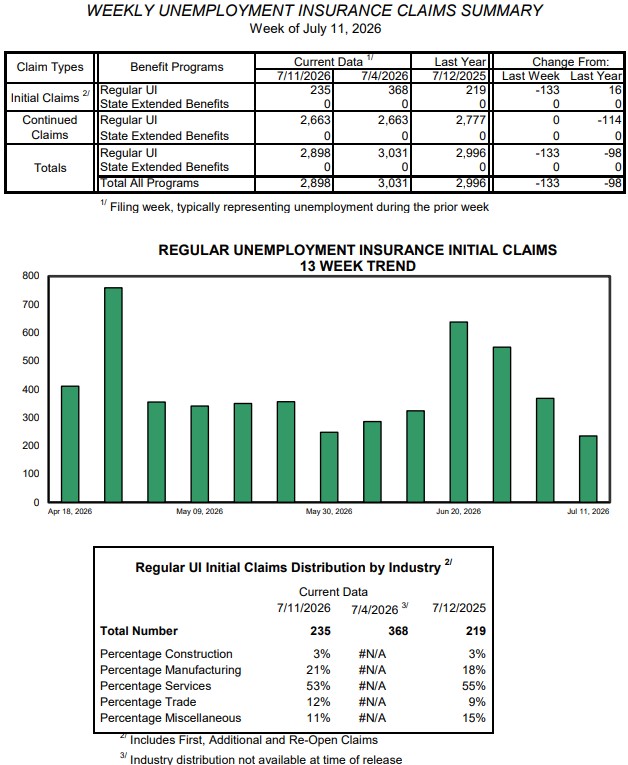
by Timothy McQuiston, Vermont Business Magazine Vermont initial weekly unemployment claims fell again for the third straight week and remain at a low summer level. For the week ending July 11, 2026, the Vermont Department of Labor reported that there were 236 new claims, down 133 from the previous week and up 16 from last year at this time. Claims had spiked at the end of June. Summer hiring typically drives claims down. Meanwhile, total claims this week were 2,898, down 133 from the week before and down 98 from last year at this time. Initial claims, which tend to be lowest in the summer, were 186 in September 2025.
Nationally, stocks fell again for a rough week as the war in Iran has created economic uncertainty, along with inflation concerns, possible Fed rate hikes, corporate AI battles and chipmaker shares falling. An increase in interest rates is usually in response to an overly revved economy or increased inflation. This would be weighed against a slumping economy, which could send rates lower. Inflation has been increasing over the last year.
The Dow was down about 0.55% Friday, the S&P was down 0.93% and the volatile Nasdaq was off 1.30% by mid-afternoon.
US GDP saw a solid, but lower than expected, increase of 2% for the first quarter. The latest U.S. inflation rate — measured by the Consumer Price Index (CPI) — is 4.2% year-over-year for the 12 months ending May 2026, according to the U.S. Labor Department. This is up from 3.8% in the prior month and marks a notable rise from the 2.7% recorded in December 2025.
In Vermont for the weekly labor UI claims report, manufacturing accounted for 21% of the total. Manufacturing overall has become a smaller part of the Vermont economy over the last 25 years and that trend appears to be continuing. The Service industry, which typically accounts for the most claims, last week reported 53% from the previous week. Construction was 3%.
In the week ending July 11, the advance figure for seasonally adjusted initial claims nationally was 208,000, a decrease of 8,000 from the previous week's revised level. The previous week's level was revised up by 1,000 from 215,000 to 216,000. The 4-week moving average was 214,250, a decrease of 4,750 from the previous week's revised average. The previous week's average was revised up by 250 from 218,750 to 219,000.
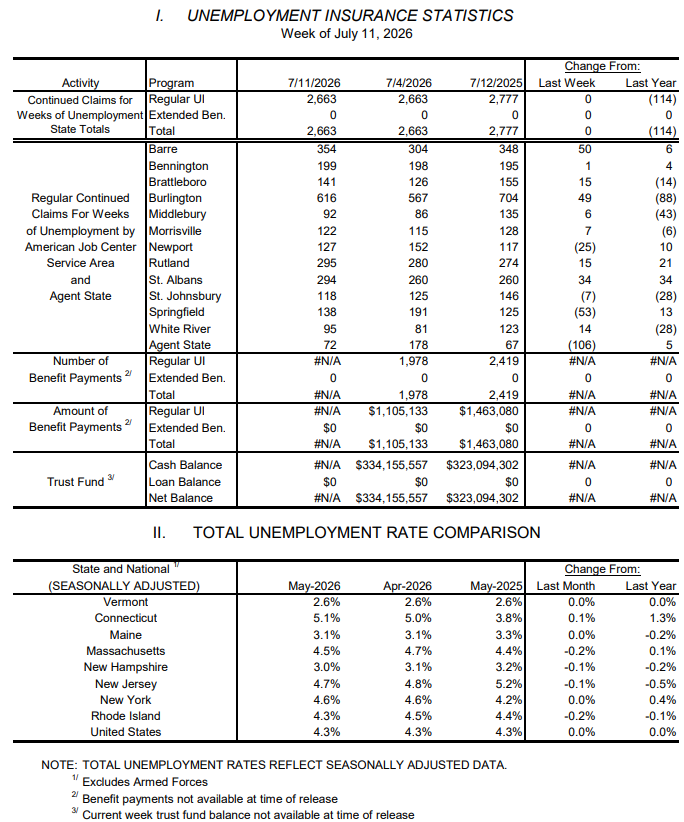
The Vermont Unemployment Trust Fund is well capitalized. As of the most recent data, there was $334.2 million in the Trust Fund, up over $10 million from the previous week (as claims are paid out on one side, employers are contributing to the fund on the other). The pre-pandemic Trust Fund balance on March 1, 2020, was $506.2 million.
Vermont’s unemployment rate holds at 2.6 percent in May
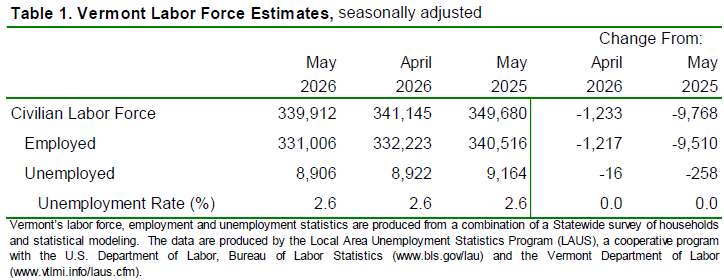
The Vermont Department of Labor has released the seasonally adjusted statewide unemployment rate for May of 2.6%. This reflects no change from the prior month’s revised estimate. However, the Labor Force fell steeply again and has now lost almost 10,000 workers from a year ago. The civilian labor force participation rate was 62.5% in May, a decrease of two-tenths of one percentage point from the prior month’s revised estimate.
The comparable United States rate in May was 4.3%, no change from the revised April estimate. Vermont has the fourth lowest rate in the nation. The Labor Force is the denominator in the equation to determine the UI rate. South Dakota continues to have the lowest at 2.1%, while California has the highest at 5.3%.
“Though unemployment remains low, the big story continues to be the shrinking labor force,” said Kendal Smith, Commissioner of the Vermont Department of Labor. “But this also means there has never been a better time to start a career here. To the high school and college graduates, we need your talent, innovation, and energy in every corner of our economy and communities. Vermont offers something increasingly rare: a chance to make an impact from day one, work closely with mentors, and to see the results of your efforts firsthand. With many experienced workers nearing retirement, opportunities for advancement and leadership will continue to expand across the state. If you need help figuring out what’s next, writing a resume, identifying training opportunities, and more, the Vermont Department of Labor Regional Job Centers are here to help. To find a local office near you, visit https://labor.vermont.gov/workforce-development to be connected with a specialist, or view jobs now on https://www.vermontjoblink.com/.”
The seasonally adjusted Vermont data for May show the Vermont civilian labor force decreased by 1,233 from the prior month’s revised estimate (see Table 1). The number of employed persons decreased by 1,217 and the number of unemployed persons decreased by 16. The changes to the labor force and number of employed persons were statistically significant in the seasonally adjusted series.
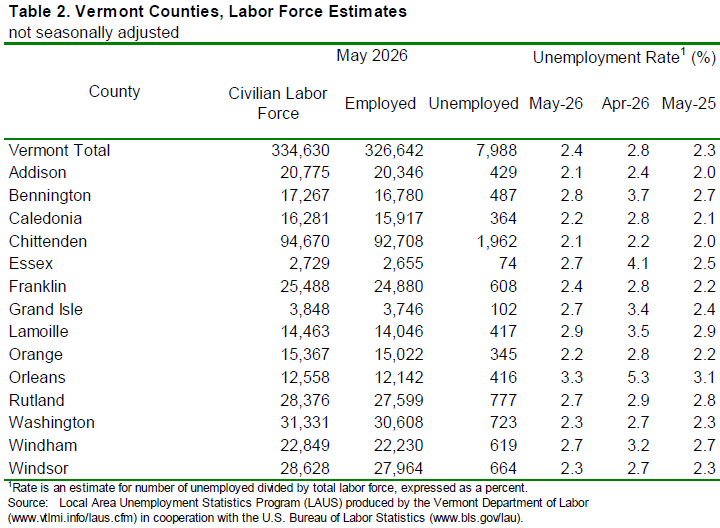
The May unemployment rates for Vermont’s 14 counties ranged from 2.1 percent in Addison and Chittenden Counties to 3.3 percent in Orleans County (note: county unemployment rates are not seasonally-adjusted – see Table 2). For comparison, the May unadjusted unemployment rate for Vermont was 2.4 percent, a decrease of four-tenths of one percentage point from the revised unadjusted April level and an increase of one-tenth of one percentage point from a year ago.
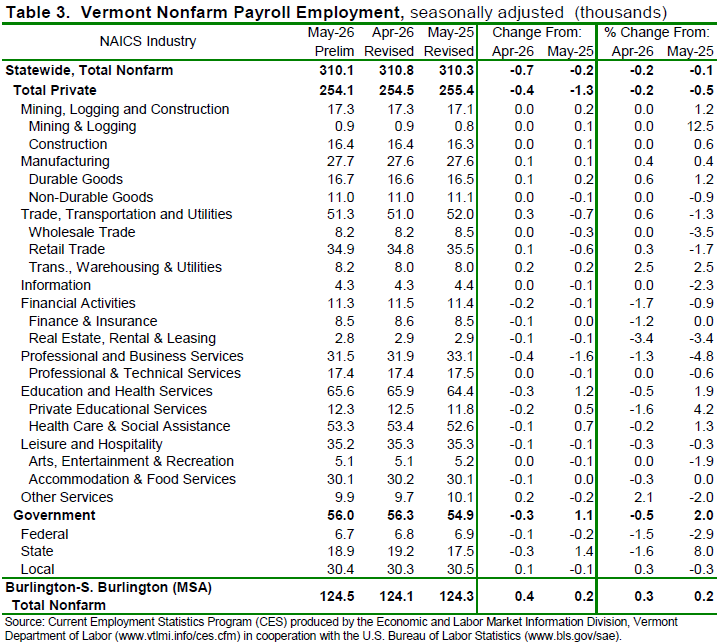
Seasonally-Adjusted (Table 3)
The seasonally adjusted data for May reported a decrease of 700 jobs from the revised April data. There was an increase of 500 jobs between the preliminary and the revised April estimates due to the inclusion of more data. The seasonally adjusted over-the-month changes in May varied at the industry level. The industries with a notable increase were: Transportation, Warehousing, & Utilities (+200 jobs or +2.5%) and Other Services (+200 jobs or +2.1%). The industries with a notable decrease were: State Government (-300 jobs or -1.6%) and Private Educational Services (-200 jobs or -1.6%).
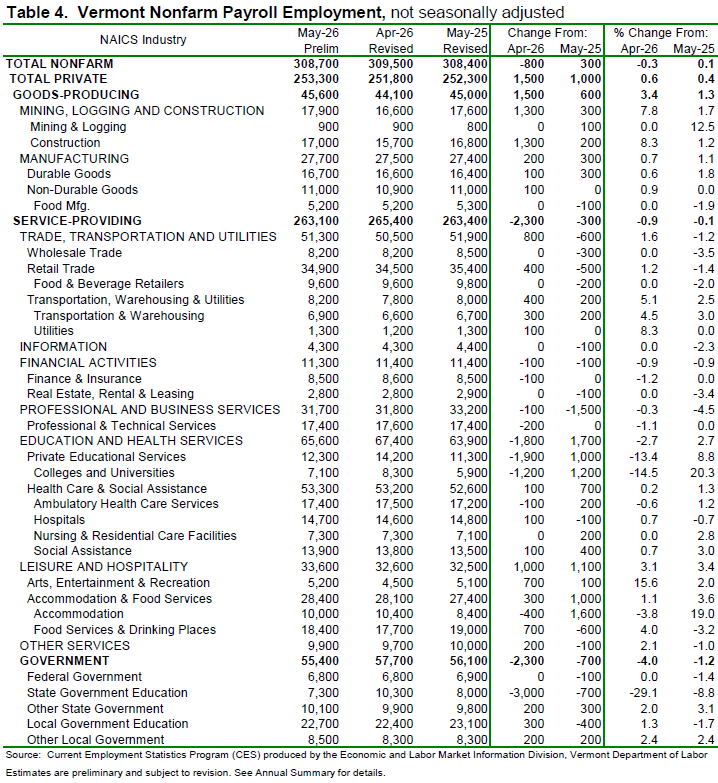
Not-Seasonally-Adjusted (Table 4)
The preliminary ‘not-seasonally-adjusted’ jobs estimates for May showed a decrease of 800 jobs when compared to the revised April numbers. As with the seasonally adjusted data, this over-the-month change is from the revised April numbers which experienced an increase of 500 jobs from the preliminary estimates. The broader economic picture can be seen by focusing on the over-the-year changes in this data series. As detailed in the preliminary not-seasonally-adjusted May data, Total Private industries increased by 1,000 jobs (+0.4%) over the year and Government (including public education) employment decreased by 700 jobs (-1.2%) in the past year.
*** BLS note on CES series drops in 2026: https://www.bls.gov/sae/notices/2026/notice-of-publication-changes-with-the-release-of-May-2026-data.htm ***
The Unemployment and Jobs Report for June is scheduled to be released on Tuesday, July 21, 2026, at 10:00 a.m.
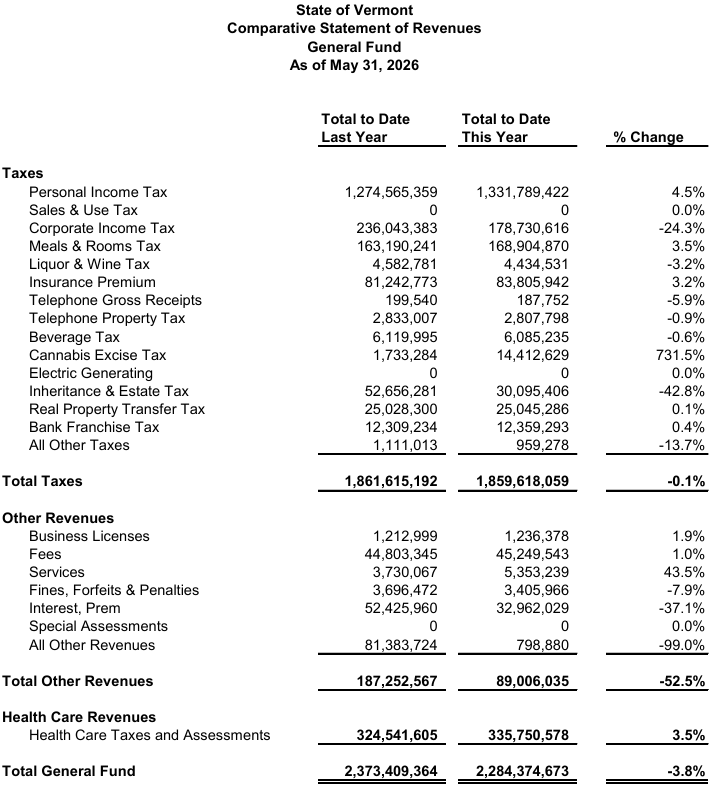
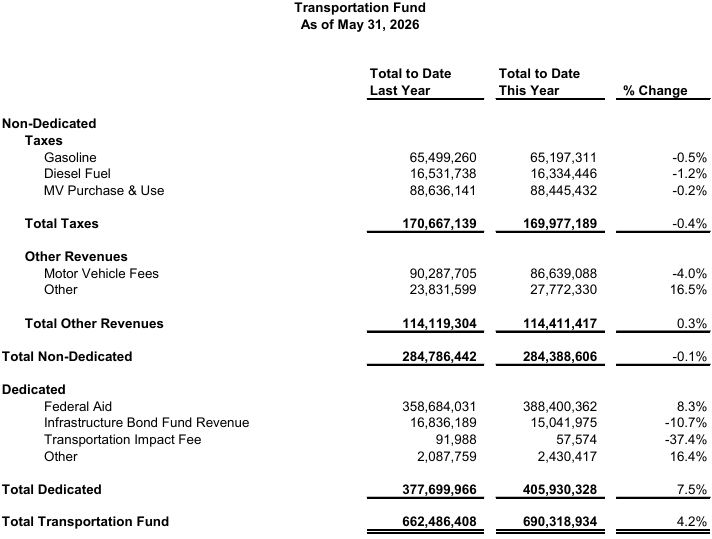
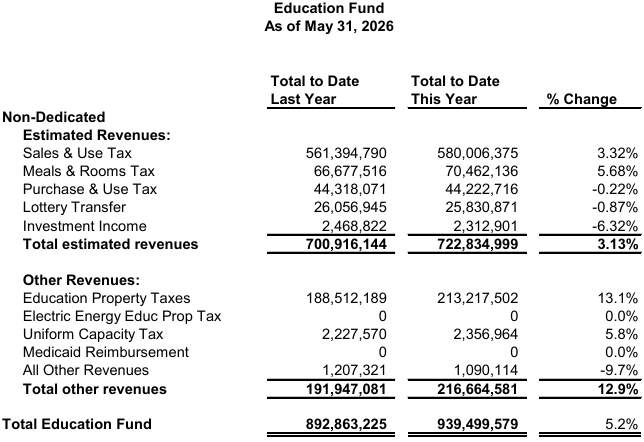
State GF revenues slipped slightly in May, Personal Income stays strong
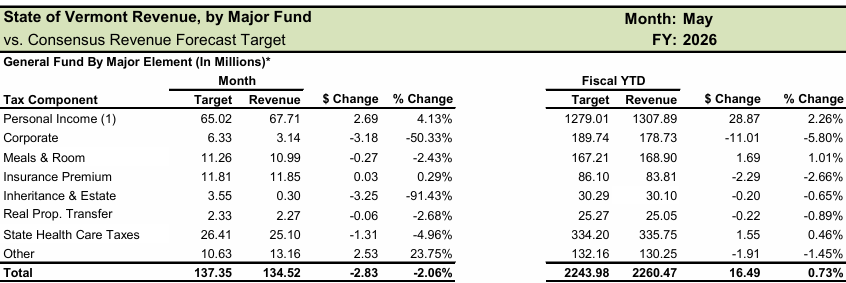
Secretary of Administration Sarah Clark has released Vermont’s revenue results for May 2026. The General and Transportation Funds missed their monthly consensus targets while the Education Fund exceeded its monthly target.
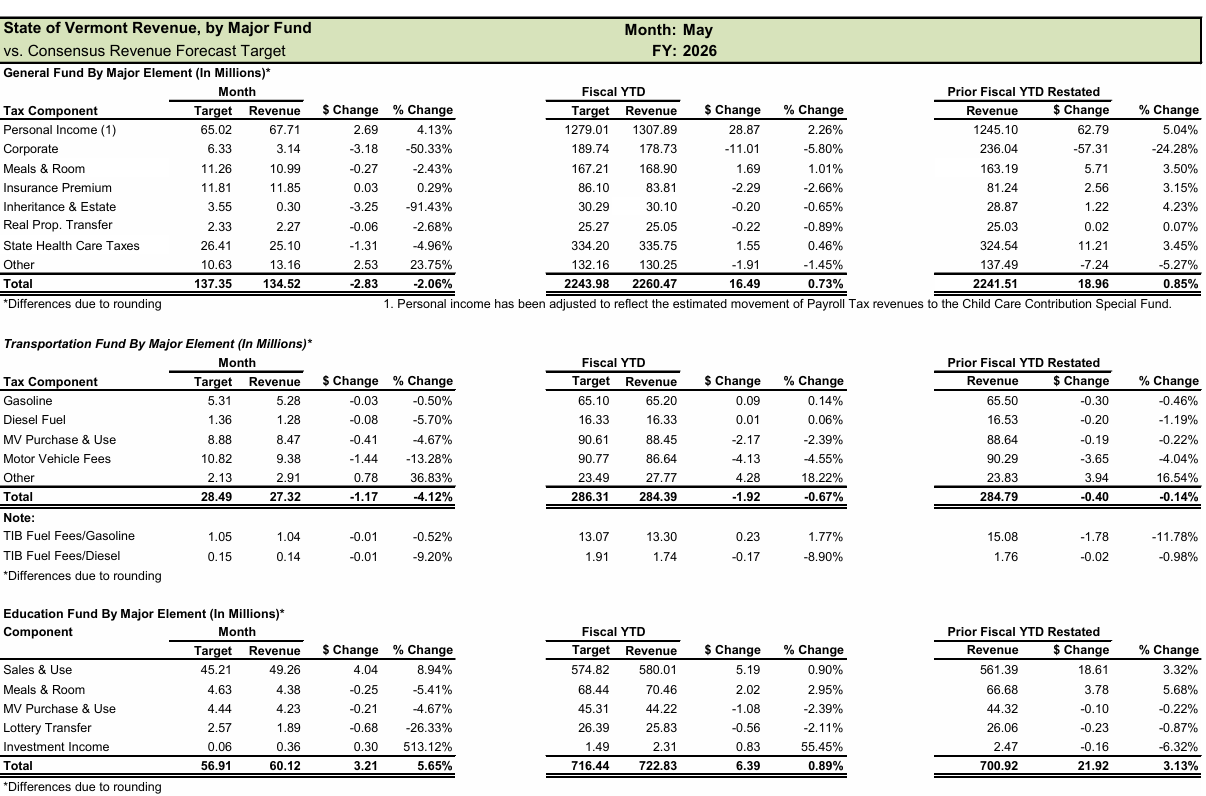
The State’s General Fund, Transportation Fund, and Education Fund receipts totaled a combined $222.0 million, narrowly missing the $222.7 million monthly consensus target by $0.8 million, or 0.4%.
Total General Fund revenues were $134.5 million, which is -$2.9 million, or 2.1%, below the $137.4 million monthly consensus cash flow target. This monthly shortfall was driven primarily by the continued underperformance of the Corporate Tax (-$3.2M, or 50.3%, below target) and the Estate Tax (-$3.3M, or 91.43%, below target).
These declines were partially offset by another strong month of Personal Income Tax collections, which came in $2.7 million, or 4.1%, above target. Personal Income receipts now show a cumulative overperformance of $28.9 million and continue to be the principal driver maintaining the General Fund $16.5 million, or 0.7%, above its cumulative consensus target.
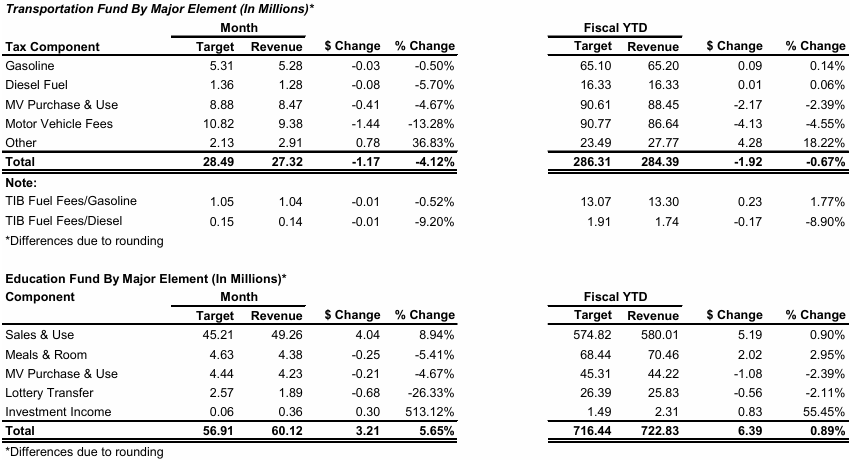
Revenues in the Transportation Fund totaled $27.3 million for May, missing the $28.5 million monthly consensus target by -$1.2 million, or 4.1%. All four major components finished marginally below their individual targets, contributing to the overall monthly underperformance. On a cumulative basis, Transportation Fund receipts are slightly below expectations at -$1.9M, or -0.7%, relative to the cumulative consensus target.
Monthly Education Fund revenues of $60.1 million were $3.2 million, or 5.7%, above the May cash flow target of $56.9 million. This overperformance was largely driven by the Sales & Use Tax, which exceeded its target by $4 million, or 8.9%. Cumulatively, Education Fund receipts remain positive at $6.4 million, or 0.9%, above cumulative consensus target.
According to Secretary Clark: “While some key sources of receipts underperformed this month, revenues continue to hold up well with the three major funds tracking within +/-1% of their cumulative consensus forecast.”
To support vital journalism, access our archives and get unique features like our award-winning profiles, Book of Lists & Business-to-Business Directory, subscribe HERE!
 Vermont Business Magazine