A Weekly State House Recap By Maggie Lenz and Gwynn Zakov (on behalf of Atlas Government Affairs
and Garnet Government Relations
)
Trying to Make a Dollar out of Fifteen Cents
Last Tuesday, the Governor delivered his annual budget address to a joint session of the House and Senate, proposing a $9.4 billion FY27 budget. The numbers were sobering. Federal pandemic funds are gone. The state’s revenue forecast has been slightly downgraded by $8 million. And Vermont faces roughly $139 million in additional costs simply to maintain current state operations.
Education sits squarely at the center of this moment. The Governor proposed a $105 million one time buy down to ease property tax pressure, but was explicit that temporary relief does not address long term cost growth. He again expressed support for a proposal from Senate President Pro Tempore Phil Baruth (D/P – Chittenden Central) to place multi-year caps on school district spending growth. Education spending will shape decisions across the state budget, affecting transportation, housing, healthcare, and workforce policy.
That interconnectedness is already visible in the transportation budget. The governor highlighted a $33 million structural deficit in the transportation fund and proposed addressing it in part by reducing transfers from the education fund. As federal infrastructure dollars taper off and long term revenue sources remain constrained, transportation funding is increasingly competing with education and other core priorities.
In recent years, common practice has been to treat the prior year’s budget as a starting point and focus on managing increases or decreases around that baseline. This year is different. The Appropriations Committees are not assuming last year’s spending as a given. Instead, they are breaking agency budgets down to the ground floor, closely examining what is actually being funded, why those programs exist, and what outcomes they produce. This reflects a shared recognition that the fiscal conditions that allowed incremental adjustments no longer hold.
The result is a shift away from incremental budgeting and toward a more fundamental examination of what the state pays for and why. There is an acute need to understand what the state is paying for, what it is getting in return, and which systems may no longer be sustainable in their current form. Education finance will remain at the center of those debates, but the implications extend far beyond schools.
Curiosities: a weekly peek at the odd and intriguing happenings under the Golden Dome
Changing Lanes
Housing is not just a housing issue. It is also a workforce issue, an economic issue, a healthcare issue, and a question of municipal capacity. Healthcare, in turn, is not just a healthcare issue. It is a workforce issue and a major driver of costs across employers, school districts, and state government. Permitting and land use shape not only our natural landscape, but whether housing gets built, homelessness decreases, businesses expand, and critical projects survive long enough to reach the finish line. Increasingly, Vermont’s biggest challenges do not live neatly inside a single policy category, within a legislature structured around distinct policy areas.
That disconnect is a large part of the genesis of a new caucus now taking shape under the Golden Dome: the Caucus for Vermont’s Economy. The caucus, mainly composed of House Members but open to all legislators, is forming around a shared frustration among lawmakers that the structure of the legislature itself is getting in the way of solving the problems Vermonters are actually bringing to them.
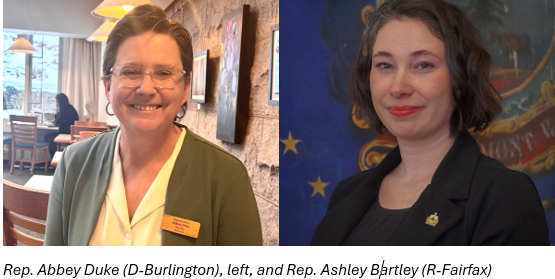
The issue, as co-chairs Rep. Abbey Duke (D-Burlington) and Rep. Ashley Bartley (R-Fairfax) describe it, comes down in large part to “jurisdiction.” Vermont’s committee-driven system divides housing, energy, economic development, transportation, healthcare, permitting, and education into distinct lanes that do not always reflect how those challenges show up in real life. Partisan politics create yet another lane, further complicating collaboration.
Every state has its own style, and Vermont’s legislature is notably committee-centered in how policy actually gets made. Committees are where most substantive decisions happen, and they are where lawmakers spend the vast majority of their time. In the House, members each serve on a single committee and workday after day, hour upon hour with the same small group of colleagues, typically around eleven members, focused on the same subject area. In the Senate, members serve on two committees, usually with five to six members each, one in the morning and one in the afternoon, which can create slightly more overlap in expertise though that overlap remains limited.
Over time, committees tend to form close working relationships, even across party lines, functioning like small teams or tight-knit families that meet constantly, work through disagreements, and even socialize together outside the committee room. That intensity builds trust within committees, but it can also mean that collaboration thins beyond those walls, making it harder to address problems that cut across multiple policy areas. The Caucus for Vermont’s Economy formed informally out of conversations among legislators who felt there was no outlet for talking about economic challenges in a cross-committee and nonpartisan way.
Bartley described the problem in explicit terms. “We all operate within committees of jurisdiction,” she said. Bills can be worked within a committee’s scope, but “the conversation often stops once some aspect of an issue falls outside that jurisdiction.” That, she said, is not how problems show up for Vermonters. “You don’t solve problems by working inside a box. You have to take the top off and talk to other people.” Vermonters do not experience their lives in tidy boxes, and they do not care whether their lawmaker sits on Education, Housing, or any other committee. They care whether someone can help move the problem in front of them toward a solution.
Duke described the same limitation when talking about how the caucus came together. “The structure of the legislature is very siloed by committees,” she said. “And the reality is that we have a lot of very large problems that cannot be solved that way, in silos.”
The other goal they have identified is political. From the start, the caucus was designed to operate without an ideological frame. “We have been very intentional about making this nonpartisan,” Duke said, explaining that the focus is on practical solutions rather than partisan positioning. Both Duke and Bartley consistently use the term “nonpartisan,” rather than “bipartisan,” when describing the caucus.
Duke and Bartley are focused on reforming the process as much as advancing policy. For years, the legislature has tended to talk about “Vermonters” and “businesses” as if they are separate constituencies, a framing that does not reflect the reality that many Vermonters own, operate, or work in local businesses. Part of what makes the Caucus for Vermont’s Economy notable is its implicit recognition that better policy outcomes will require better relationships between the legislature and the business community, starting with a willingness to listen more carefully and treat business owners as part of the fabric of Vermont’s communities rather than as a distinct or opposing interest.
That outlook is closely tied to the caucus’s emphasis on “customer service”, a theme both Duke and Bartley return to often, shaped by their professional backgrounds. Bartley, who comes from a human resources background, describes customer service as listening carefully to how people experience systems in practice and then asking what is realistic given the capacity of the government to deliver. Duke, who spent decades building and running a small business, frames it in operational terms: businesses are not asking for weaker rules, but for clarity, workability, predictability, and processes they can understand and plan around. Together, those perspectives reflect a shared view that better policy depends on understanding how systems actually function for the people navigating them.
As the caucus takes shape, its members are beginning to translate ideas into structure and next steps. The group has launched a public website as a way to make participation visible, share materials, and allow interested legislators and stakeholders to follow its work. Duke described that infrastructure as essential to the caucus’s goal of having influence. “We want people to have some skin in the game,” she said. “The whole point of it is to have influence.”
Looking ahead, caucus members have discussed a range of next steps, including listening sessions with businesses, presentations on permitting and regulatory reform, and the possibility of advancing a caucus-backed bill in a future session. Duke stressed that the caucus is intentionally keeping its agenda open at this stage. “Let’s see what bubbles up,” she said, emphasizing that the group wants its priorities to emerge from the conversations it is convening. At the same time, members have discussed identifying bills already introduced that align with the caucus’s goals and could be supported as the work evolves.
Bartley echoed that focus on process over immediate outcomes, framing the caucus as a place to broaden conversations and build relationships before locking in policy. The aim, both co-chairs stressed, is to ensure that whatever comes next is informed by how systems actually function and by the people who have to navigate them.
The Caucus for Vermont’s Economy is still in its early stages, but its direction is coming into focus. In a legislature where committees of “jurisdiction” shape nearly every conversation, the caucus represents an effort to create space for work that does not fit neatly inside those boundaries and to rethink how lawmakers listen, collaborate, and ultimately govern.
To support vital journalism, access our archives and get unique features like our award-winning profiles, Book of Lists & Business-to-Business Directory, subscribe HERE!