by Timothy McQuiston, Vermont Business Magazine Vermont initial weekly unemployment claims increased last week following the usual volatile labor activity at the end of holiday season. For the week ending January 10, 2026, the Vermont Department of Labor reported that there were 600 new claims, up 69 from the previous week and down 15 from last year at this time. New claims are at typical seasonal levels but ongoing claims are high. Total claims were 4,815, up 504 from the week before and are up 211 from last year at this time. Claims, which tend to be lowest in the summer, were 181 at the end of September 2024 and 186 last September.
Claims tend to rise and fall around the holidays with temporary work hires and layoffs.
The Montpelier-based Public Assets Institute released its analysis of the labor market this week, which found that the number of Vermonters working has fallen below pre-pandemic levels as of late 2025.
The Vermont DOL is reminding employers that beginning January 1, 2026, Vermont’s minimum wage will increase from $14.01 to $14.42 per hour - an increase of $0.41.
In Vermont for the weekly labor UI claims report, manufacturing accounted for 16% of the total, down 5 points from the previous week. Manufacturing overall has become a smaller part of the Vermont economy over the last 25 years and that trend appears to be continuing. The Service industry, which typically accounts for the most claims, last week reported 34% from the previous week, up 4 points. Construction was 30%, up 7 points.
Service hiring is strong during the holidays then slumps, while cold weather slows down construction.
Reuters reported Thursday that economists expect the Fed will keep its benchmark overnight interest rate in the 3.50%-3.75% range at its January 27-28 meeting; however, reductions in borrowing costs are anticipated this year to safeguard the labor market. They also reported that data this week showed inflation pressures were stable in December, but consumers faced higher food prices and rents. Meanwhile, hiring in the US in 2025 was the lowest in five years, or since beginning of the COVID-19 pandemic.
In the week ending January 10, the advance figure for seasonally adjusted initial claims was 198,000, a decrease of 9,000 from the previous week's revised level. The previous week's level was revised down by 1,000 from 208,000 to 207,000. The 4-week moving average was 205,000, a decrease of 6,500 from the previous week's revised average. This is the lowest level for this average since January 20, 2024 when it was 203,250. The previous week's average was revised down by 250 from 211,750 to 211,500.
Wall Street lost ground this week, as the S&P 500 fell slightly to close at 6,940 after it peaked earlier this week at 6,986. The Nasdaq and Dow also slumped. The DJIA finished the week at 49,359 after a 52-week high of 49,633 and Nasdaq closed at 23,515 after peaking a 24,019.
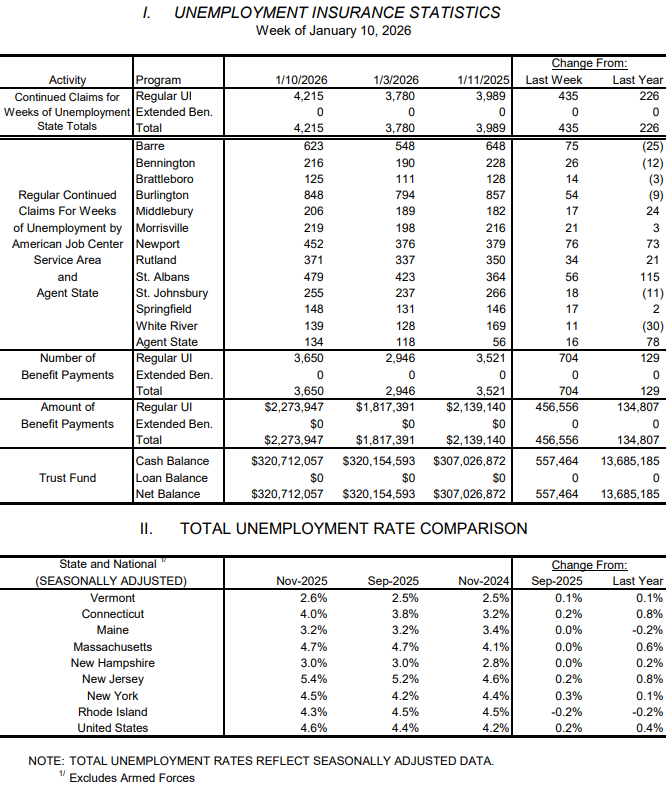
The Vermont Unemployment Trust Fund is well capitalized. As of the most recent data, there was $320.1 million in the Trust Fund, up slightly from the previous week (as claims are paid out on one side, employers are contributing to the fund on the other). The pre-pandemic Trust Fund balance on March 1, 2020, was $506.2 million.
Vermont’s unemployment rate up one-tenth to 2.6 percent in November
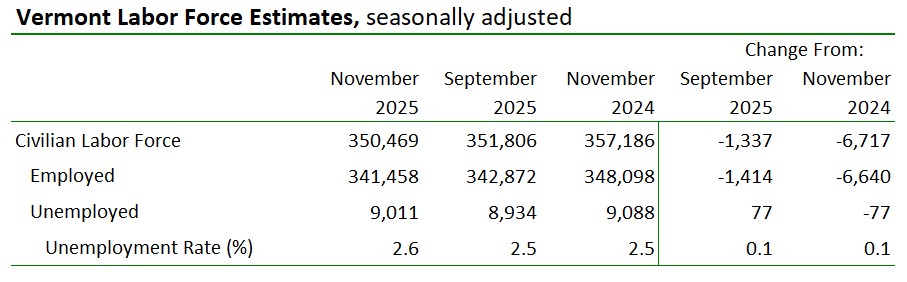
by Timothy McQuiston, Vermont Business Magazine Today, the Vermont Department of Labor released data on the Vermont economy for the time period covering November 2025. According to household data, the seasonally adjusted statewide unemployment rate for November was 2.6 percent. This reflects an increase of one-tenth of one percentage point from September’s revised estimate. The civilian labor force participation rate was 64.2 percent in November, a decrease of two-tenths of one percentage point from September’s revised estimate.
All three major indices showed weakness.
The seasonally adjusted Vermont data for November show the Vermont civilian labor force decreased by 1,337 from September’s revised estimate (see Table 1). The number of employed persons decreased by 1,414 and the number of unemployed persons increased by 77 over the same time period. The change to the number of employed persons was statistically significant in the seasonally adjusted series.
Vermont is tied for the third lowest unemployment rate with North Dakota. South Dakota is lowest (2.1%), Hawaii is second (2.2%) and California is highest (5.5%).
The U.S. unemployment rate was 4.4% in December 2025, a slight decrease from the revised 4.5% in November 2025.
*** Note: The monthly data programs are still being impacted by the federal shutdown that occurred last fall. The jobs data, as provided by Vermont businesses, was able to produce estimates for October and November - both of which are contained in this release. For topics like the number of employed Vermonters, unemployed Vermonters and ultimately, the unemployment rate, there was no monthly data collection completed for October so estimates cannot be produced. For household concepts, like the unemployment rate, this release includes updated September data, preliminary November data but again, no estimates for October. Regular data processing has resumed and is on track for the December data release scheduled for January 27, 2026. ***
“The numbers tell a story beyond statistics—they represent Vermonters looking for work and local businesses trying to hire. Helping people connect with jobs close to home is key to keeping Vermont’s communities strong and our economy moving forward,” said Kendal Smith, Vermont Department of Labor Commissioner. “Over the next few weeks, the Department will be sharing information about upcoming job fairs, hiring events, and other employment opportunities. For the latest news and resources, please visit https://labor.vermont.gov/ .”
General Fund tax revenues lag again in November
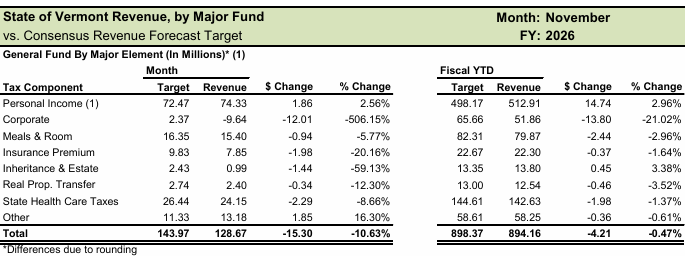
by Timothy McQuiston, Vermont Business Magazine The vital personal income tax bounced back from a rare below-target month and remains the strongest of the major indices this fiscal year. However, it was not enough to support an overall disappointing report, which shows total tax revenues in all three major funds below expectations year-to-date. Secretary of Administration Sarah Clark today released Vermont’s revenue results for November 2025. Transportation Fund receipts were slightly above consensus revenue expectations on a monthly basis, while General Fund and Education Fund receipts lagged.
The state’s General Fund, Transportation Fund, and Education Fund receipts were a combined $214.4 million, representing collections -$17.2 million, or 7.4%, below the $231.6 million monthly target in the consensus forecast adopted by the Emergency Board at its July 2025 meeting.
Corporate Income Taxes are well below targets for the month and the year-to-date, offsetting GF gains in the PI. GF revenues are also below the prior year to date. For Transportation, Motor Vehicles sales had a strong month. Meanwhile, Education was drawn down by missed targets in Sales & Use and Meals & Rooms in particular. Lottery sales are also well behind targets.
Clark said collections may have been impacted by the timing of the Thanksgiving holiday, which resulted in November being a ‘short month’ for revenue collection purposes. Some November revenues may spill over into December.
Total General Fund revenues for November were $128.7 million, -$15.3 million or 10.6% below the $144.0 million monthly cash flow target, driven by lagging collections in the Corporate Income Tax.
1.9.2026. Vermont DOL. https://www.vtlmi.info/
To support vital journalism, access our archives and get unique features like our award-winning profiles, Book of Lists & Business-to-Business Directory, subscribe HERE!