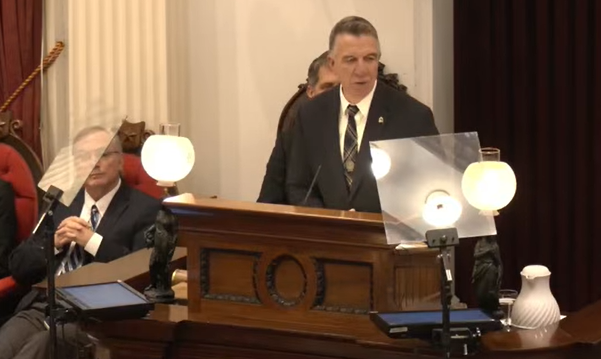
by Timothy McQuiston, Vermont Business Magazine In this State of the State address on Wednesday, Governor Phil Scott focused on education transformation. Act 73, passed last year with the support Democratic leadership, remains a work in progress. A task force commissioned to propose school realignment plans concluded late last year by only offering recommendations. Then in December the state announced that school property taxes are estimated to go up by double digits (11.9% FY27), nearly as much as they did in FY25 (13.8%).
For FY26, the legislature used $118 million to pay down property taxes to nearly wipe out a tax increase (1% increase). Scott has proposed again using such a "band-aid" ($75 million) to hold down taxes this year. However, there is considerable pushback for that plan as surplus funds are lower now and the economy is softening.
Here are some reactions to the governor's speech and his education proposals.
Joint Statement by Republican Legislative Leaders
A very clear message was delivered Wednesday by Governor Scott in his annual State of the State Address: Vermont can be a national model of government that solves problems and helps people, if we follow through on education reform. The Governor spoke of education reform not being an option; it is essential: to affordability, housing, workforce growth, and Vermont’s future.
With education spending rising from $1.6 billion to $2.5 billion in just over a decade, driving double-digit property tax increases, even as schools are still cutting programs and opportunities for students, Vermont cannot afford to kick the can down the road any longer.
Now is the time. Today is the day that we should begin to follow through on the proposals put forth in ACT73. We owe it to our students; we owe it to our communities; and, we owe it to Vermonters.
House and Senate Republicans support Governor Scott in his efforts to reform education, and we will roll up our sleeves and get to work. Let’s begin now.
Representative Pattie McCoy. Senator Scott Beck
The Vermont Progressive Party Calls for Act 73 to be Repealed
Governor Phil Scott, during his State of the State address, demanded that Vermont legislators stay the course with Act 73 – an act that would end local control of public education, force school redistricting and closures, and use the foundation formula to fund school districts, while providing no property tax relief.
Act 73 is fundamentally flawed and working Vermonters need property tax relief. But, our state needs to fix the funding mechanism to alleviate the property tax crisis – that is what Vermonters have called for – and not take an ax to our education system. We can’t stand by and watch the exponential increases in health insurance premiums be the driver of ballooning educational expenses while cutting key components of the educational delivery. This methodology will only further erode a system that has been cutting programs, and asking our educators to do more with less resources. We need to bolster our public support of our system to have a thriving public education system in Vermont. Slashing programs and services is not the answer, nor are proposals to close rural schools – which preserve the rural communities that are the essence of Vermont life.
The Vermont Progressive Party demands that state legislators take up the evidence-based recommendations of the School Redistricting Task Force, including consolidated regional services, strategic voluntary mergers, regional public high schools, the voluntary closure of small schools, as well as moving towards an income-based system of education funding that can provide real tax relief for working Vermonters.
Governor Phil Scott: we demand that Vermont fix education funding and leave our schools alone.
The Vermont Chamber of Commerce Statement
“At a time of rising costs and uncertain federal support, Vermont cannot afford delay or dilution of reform. Governor Scott’s address underscores the need for the Administration, Legislature, and partners across the state to work together to follow through on education transformation in ways that improve outcomes, restore affordability, and prevent education costs from continuing to crowd out other critical investments that support economic stability and growth.”
Amy Spear, President of the Vermont Chamber of Commerce.
NFIB Vermont Statement
The National Federation of Independent Business (NFIB), the nation's leading small business advocacy association, released the following statement today regarding Governor Phil Scott's annual State of the State Address:
"Vermont small businesses commend Governor Scott’s urgent call for property tax relief," said John Reynolds, state director for NFIB in Vermont. "State lawmakers would be wise to follow Governor Scott’s lead on buying down sky high property tax bills with surplus funds, securing long-term tax relief for small businesses, and reducing – not growing – regulatory barriers to starting and growing a business in Vermont."
Governor Scott has called for lawmakers to use surplus funds to buy down the 12% increase in the statewide education property tax projected by the Vermont Department of Taxes in the December 1 letter.
"Main Street is struggling under the weight of high business taxes, high property taxes, chronic worker shortages, and a legislative fixation on bureaucratic red tape," added Reynolds. "The last thing small business owners need is for their taxes to double under proposals that claim to fix the property tax burden, or for lawmakers to pile on new regulations and lawsuits like what is proposed in the so-called Workplace Temperature Regulation proposal. We urge lawmakers to give Vermont small businesses a break."
Vermont small businesses are facing a massive tax increase under H.177, a proposal to eliminate homestead property taxes by shifting the burden onto small businesses and workers. This bill would effectively double the state’s income tax rates while forcing small businesses, farms, and other non-homestead property owners to keep paying property taxes.
Small businesses that are pass-through entities pay taxes at individual rates and would be hardest hit. According to U.S. Census Data, 92% of all businesses in Vermont are pass-through entities with fewer than 20 employees. Meanwhile, the bill does not change the corporate tax rate.
Lawmakers have also proposed a wide range of new mandates and regulations, including a complex set of workplace temperature regulations (S.153, H.348) that would impact thousands of workplaces across the state. That proposal would subject small businesses to duplicative micromanagement by Montpelier and ruinous litigation for ambiguous violations.
To support vital journalism, access our archives and get unique features like our award-winning profiles, Book of Lists & Business-to-Business Directory, subscribe HERE!