A Weekly State House Recap By Maggie Lenz and Gwynn Zakov (on behalf of Atlas Government Affairs
and Garnet Government Relations
Hope, Hard Calls, and Heartbreak
Each year during the legislative session, House policy committees have the opportunity to weigh in on the state budget through what's known as the "budget letter" process. Committees submit written recommendations to the House Committee on Appropriations, outlining their funding priorities for agencies, departments, programs, and organizations. It's a process that sounds straightforward on paper, but plays out with considerable variation, and considerable heartbreak, in practice.
The process begins with guidance from the Appropriations Committee itself, and this year Chair Robin Scheu's memo to policy committees laid out clear expectations. She expected committees to come prepared, understand the problems before jumping to solutions, test assumptions, and focus testimony time on the information her committee actually needs to make decisions. The memo emphasized that resources are finite and tradeoffs matter, and it's a message that lands differently from committee to committee.
As of this week, roughly half of the policy committees have already submitted their budget letters, and by next week the remaining committees will have finalized and submitted theirs. What's already coming in illustrates the wide range of approaches committees take.
And here's where the process gets a little wonky. Some committees take the guidance to heart, doing the difficult work of winnowing down requests and prioritizing ruthlessly. They weigh competing needs, make tough calls, and send Appropriations a focused letter that reflects genuine deliberation and prioritization. Other committees take a different approach entirely, loading up their budget letters with almost every request that comes before them, reasoning that the Appropriations Committee will sort it out and make the cuts.
Both approaches have consequences. The kitchen-sink strategy may feel politically safer for committee members who don't want to say no to investments they truly believe are in the best interests of Vermonters, but it shifts the burden onto Appropriations, and can dilute the weight of a committee's true priorities. Meanwhile, the committees that do the hard work of prioritizing sometimes feel penalized, with their restraint looking like a lack of support for very worthy investments that may need more vocal cheerleaders and advocacy.
Perhaps the most painful consequence falls on the advocates, organizations, and agencies who see their requests included in a committee's budget letter and understandably feel optimistic. Inclusion in a letter, however, is far from a guarantee. Appropriations holds the final pen on the House budget, and in a tight fiscal year, many of those recommendations simply won't survive. The results can be genuine heartbreak from those who believed they had cleared a critical hurdle, only to find their funding cut from the final product.
And even then, the process is far from over. The budget must still pass a vote of the full House before crossing over to the Senate, where it faces an entirely new round of scrutiny, revision, and prioritization. What emerges at the end of that gauntlet can look very different from what any single committee envisioned in its letter. And that's to say nothing of the final Committee of Conference negotiations in May, last-minute cuts and additions during the last 24 hours of a session, and the Governor's final decision whether to sign or veto a budget. Right now we’re at about Step 2 of a 10-step process with the FY27 state budget. It’s a true marathon, not a sprint.
It's an imperfect, exhausting, and sobering process, full of difficult tradeoffs and heartbreak. But it remains one of the most important ways Vermont's citizen legislature attempts to match limited resources with limitless need.
The More You Know
(by Maggie Lenz)
The Senate Education Committee room was full last Thursday as students and community leaders urged lawmakers to adopt a statewide Holocaust education requirement. Vermont remains the only state in New England without one, and for 90 minutes the committee heard testimony from Jewish Vermonters describing antisemitism in K–12 schools across the state.
Seats filled quickly, walls lined with observers including protesters, and an overflow room was opened. The atmosphere was tense and emotional as students waited with prepared remarks in hand and lawmakers settled in. During opening introductions, Sen. Kesha Ram Hinsdale (D–Chittenden Southeast) noted that she is currently the only member of the Vermont Senate who identifies as Jewish.
Students described a fifth grade project in which a classmate presented Adolf Hitler as “successful,” and the presentation continued without interruption. They described swastikas drawn repeatedly in bathrooms. Pennies thrown on a school bus with the words “pick them up, stupid Jew.” Nazi salutes in hallways. AI-generated images of Hitler circulating among classmates online.
One student recounted a swastika made of feces on a bathroom wall that administrators declined to label antisemitic. Another described a classmate walking through school with a swastika drawn on his forehead and a Hitler-style mustache while wearing a yarmulke. A different student filed a federal civil rights complaint before substantial administrative action followed..
A consistent theme ran throughout the afternoon. Several students said they had received little structured education about the Holocaust or about antisemitism before high school. They connected that gap directly to what they were experiencing. Symbols and rhetoric carried enormous historical weight, yet classmates often lacked the context to understand it.
Jewish community and faith leaders reinforced the legislative request, describing uneven Holocaust coverage across districts and called for consistent statewide standards supported by educator training. The Anti-Defamation League presented research linking Holocaust education to stronger historical understanding and greater willingness among students to challenge biased information. Forty-one states have enacted Holocaust education requirements or oversight measures. In New England, every state except Vermont has adopted such a policy.
The committee remained notably attentive throughout the hearing. Members listened closely, asked focused questions, and engaged directly with the students’ experiences. At the conclusion, Chair Seth Bongartz (D-Bennington) remarked that the testimony had been more impactful than he expected, noting that the afternoon carried greater weight than originally anticipated. The Jewish Vermonters who testified are asking the State to step in and provide the historical foundation that helps prevent the horrendous experiences they described from continuing. And now the legislative question sits with the committee.
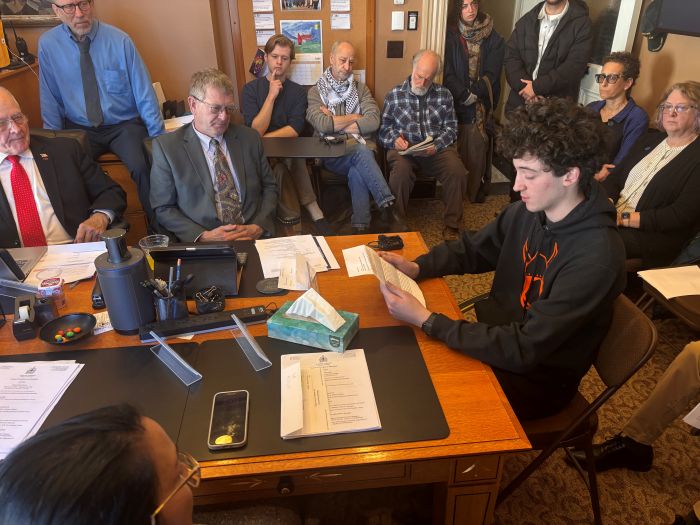
A recent Vermont high school graduate testifies before the Senate Education Committee about his experiences with antisemitism in Vermont’s K–12 schools, as onlookers fill the room.
To support vital journalism, access our archives and get unique features like our award-winning profiles, Book of Lists & Business-to-Business Directory, subscribe HERE!