
A Weekly State House Recap By Maggie Lenz and Gwynn Zakov (on behalf of Atlas Government Affairs
and Garnet Government Relations
The Great Squeeze
By now we're all aware of the financial constraints the governor and legislature are facing as they finalize the FY26 budget adjustment act and dive deeper into the FY27 state budget. What's happening at the national, state, and local levels all has an impact on the state budget. For legislators, decisions made to address fiscal issues often depend on what district they're from, what political party they belong to, and even where their personal experience and knowledge base leads them. The governor has been clear in his administration's approach, which is fiscal constraint at all costs, and all agency and department heads know their marching orders. And don't forget, he also promised to veto a budget and not allow legislators to go home this year until he gets a new consolidated district map that's tied to forward momentum towards robust education reform.
The state has a massive property tax problem, federal funding is drying up, transportation funds are struggling, and there are so many competing interests vying for limited state funds—all the while the legislature needs to ensure they have enough money to meet federal match obligations to maximize available federal funding. And legislators are not only trying to make sense of it all but also make the best short- and long-term decisions on behalf of Vermonters. It's an overwhelming, unenviable task.
The most immediate pressure point is property taxes. Over the past five years property taxes have risen over 40%, and everyone, no matter what district or party they come from, sees this as the most pressing issue for Vermonters. Governor Phil Scott has proposed using $105 million in one-time surplus funds to buy down the projected 12% average property tax increase, which would cut the hike roughly in half.
His January budget address outlined a $9.4 billion spending plan that includes this significant transfer from the General Fund to the Education Fund. Legislative leaders are hesitant to commit these funds so early in the session, however. This property tax crisis has been brewing for years. Last year the legislature bought down the property tax with $118 million in General and Transportation Funds as a one-time fix, which unfortunately creates immense fiscal pressure on the FY27 budget.
In terms of the Transportation Fund, that was the fund years ago that was "robbed" to plug other holes in the state budget when it was flush with money. Those days are long gone. The Transportation Fund faces a $33.4 million structural deficit in FY27, threatening the state's ability to match federal infrastructure dollars. The fund was downgraded by approximately $9 million for FY26, forcing the Agency of Transportation to make difficult cuts including $2.2 million in position management savings, delays to construction projects, and reductions in maintenance.
Gasoline tax revenues have been steadily declining as vehicles become more fuel efficient and drivers adopt electric vehicles. Consensus revenue forecasts project sluggish annual growth in out years, far below inflation levels. And as with nearly everything else, costs for labor and infrastructure have surged. Now the FY27 deficit is threatening the state's ability to draw down an estimated $163 million in federal funding.
Legislators are also having mixed emotions about the governor's proposal to redirect $10 million annually in purchase and use tax revenue from the Education Fund to the Transportation Fund over five years. And to add insult to injury, the percentage of state highway miles in very poor condition is set to rise from 6% today to 48% by 2035 if current funding levels are maintained.
Over the past few weeks, legislators have been exploring new revenue sources, and it feels a bit like the early stages of the dating process. They're trying to get to know these potential matches and getting a feel for how they get along. It's impossible to guess how serious they are in exploring the options, but it's certainly worth noting who they're dating.
A bill in the Senate, S.238, proposes a 2% surcharge on lodging, on top of the existing rooms tax, to raise funds for a new fund to assist non-profit housing developers. It would also redirect the existing short-term rental surcharge to this new fund. It also proposes a 1-cent per ounce excise tax on sugar-sweetened beverages to raise revenues for the Education Fund. Another bill, S.286, proposes a 2% surcharge on meals and rooms taxes to fund the School Construction Aid Special Fund.
This bundle of taxes impacts lodging occupancies, restaurant meals, and alcoholic beverage sales. And let us not forget the legislature continues to look at non-homestead tax classifications proposed under last year's Act 73 to create a separate tax on second homes and short-term rentals. Yes, this last one isn't technically a new tax, but it's certainly an opportunity to increase revenues by restructuring current taxes.
The only "bright spot" in terms of revenue growth is the estate tax, and the state collected $55.2 million in revenues in FY25. Legislators are trying to determine whether this is a signal of the beginning of the "great wealth transfer" as baby boomers pass on their assets to younger generations. Under current law, when estate tax revenue exceeds 125% of the July forecast, the excess is automatically deposited into Vermont's Higher Education Endowment Trust Fund. In FY25, approximately $26.4 million was transferred to this fund, nearly doubling its balance. Lawmakers are questioning whether this allocation remains appropriate given competing budget pressures.
Are you overwhelmed yet? Well, you're not the only one.
As the legislative session progresses, we're definitely going to get more clarity on where the legislature is heading, but it's going to be a painful process. Democrats who hold majorities in both chambers are trying to create a responsible budget, implement new policies, and keep the state on firm financial footing as they put together a budget the governor will sign.
The $150 million buydown proposal could become a bargaining chip in broader budget negotiations, particularly as legislators weigh how aggressively to pursue education reform, whether to advance new property classifications, and how to balance property tax relief against other state priorities like healthcare and housing. The coming months will test whether the governor and legislature can move beyond temporary buydowns and patchwork solutions to address the fundamental questions of how Vermont funds education, maintains infrastructure, and balances the competing demands on limited state resources.
Public Good
Vermont has long moved public education dollars from the public school system to private schools through tuitioning in certain districts. In school districts that do not operate public schools for certain grades, taxpayers fund tuition for resident students to attend another school. Sometimes that school is a neighboring public school. Sometimes it is an approved independent school, Vermont’s statutory term for private schools. Over time, this arrangement has become routine, even as the system around it has grown more strained and more complex.
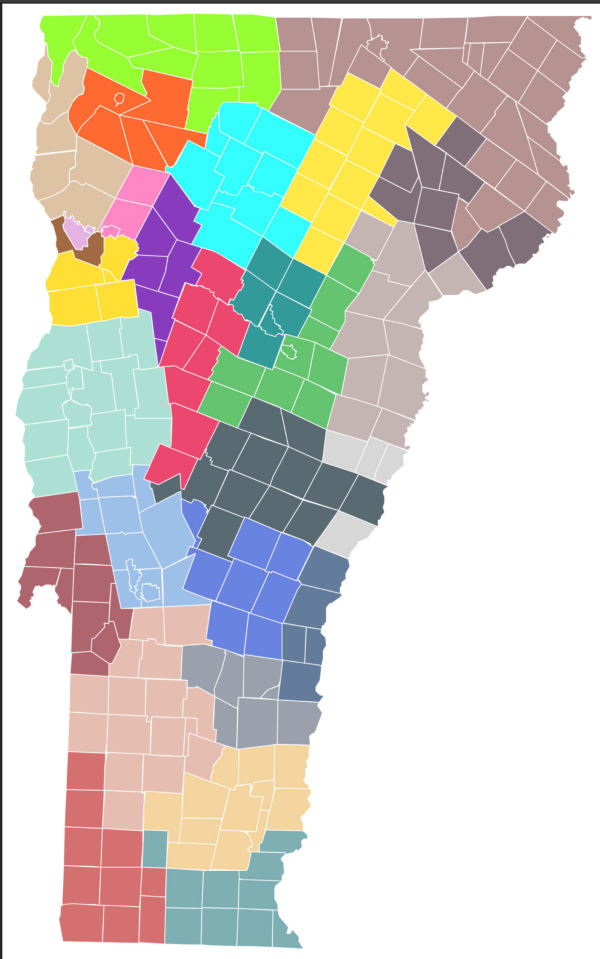
Last week, the House took a step toward addressing that reality directly. On Thursday, House Education Chair Peter Conlon (D-Cornwall) introduced a package of proposals tied to Act 73. The most visible element was a draft consolidation map that would reduce Vermont’s 119 school districts to 27 supervisory districts. The map immediately raised questions about geography and travel times. But it was only one piece of a broader effort to confront how the system functions in practice.
Conlon also rolled out a proposal that would change how tuitioning districts operate. Under current practice, families in non-operating districts may select a school, be it public or private, and the district pays tuition with few formal conditions attached. The proposal would replace that approach with written contracts between districts and receiving schools and would make clear that the district holds designation authority and sets the terms under which public funds are used.
Under the proposal, approved independent schools designated to receive public tuition would be required to enroll students sent by the district who require special education services, provide attendance and academic progress reports at intervals approved by the Agency of Education, administer state-mandated assessments, and share those results publicly in the same manner as public schools.
Designated schools would also be required to comply with nondiscrimination law, refrain from using selective admissions practices for publicly funded students, operate without application, academic, or materials fees for those students, notify sending districts prior to suspensions or expulsions, and attest annually that public funds are not used to subsidize private-pay students.
A separate House bill, H.813, recently introduced but not yet taken up, addresses the same set of accountability questions through a broader statutory framework. Like Conlon’s designation proposal, it focuses on the conditions that attach when public dollars flow to independent schools. Where the designation proposal embeds those requirements within district-level contracts tied to student assignment, H.813 applies many of the same standards directly in statute to all approved independent schools receiving public funding.
The bill would extend Vermont’s Education Quality Standards to approved independent schools that receive public funding, along with open enrollment requirements, prohibitions on selective admissions and extra fees, public records and open meeting obligations, student discipline protections, special education staffing requirements, labor protections, and expanded financial transparency and oversight.
A related issue is now pressing the Legislature from another direction. Vermont is being asked to decide whether it will allow a new federal education funding mechanism to operate inside the state. Under the “Big Beautiful Bill,” Congress created a scholarship tax credit that allows federal tax dollars to support K–12 education expenses, including private school tuition through scholarship-granting organizations. Donors receive a dollar-for-dollar federal tax credit for their contributions, and the organizations distribute funds on behalf of students.
The federal program does not automatically apply in every state. It only operates if a state submits a list of approved scholarship organizations to the U.S. Treasury. Submitting that list activates the program locally and determines which organizations may receive tax-advantaged donations and distribute scholarship funds within the state.
Vermont has not yet submitted a list, and two bills now frame how that decision would be made. In the Senate, S.161 would codify in state law that the governor holds sole authority to submit the list, with limits tied to serving economically disadvantaged students and schools already eligible to receive public tuition. In the House, H.770 would instead place that authority with the Legislature. While the bills differ on who holds the pen, both are grappling with the same issue already embedded in Vermont’s tuitioning system: under what conditions public dollars may flow to private institutions.
That question matters more now than ever before as public schools across Vermont face declining enrollment and rising special education costs. Funding structures shape staffing, programming, and long-term planning in immediate and local ways, and tuitioning decisions run through all of it. Tuitioning has long sent public money outside the public school system. The proposals now on the table start from that reality and ask what public funding should require in return.
To support vital journalism, access our archives and get unique features like our award-winning profiles, Book of Lists & Business-to-Business Directory, subscribe HERE!