


A Weekly State House Recap By Maggie Lenz and Gwynn Zakov (on behalf of Atlas Government Affairs
and Garnet Government Relations
Mandatory Choice
On Thursday and Friday, the House debated and ultimately passed H.955, the major education reform bill, on a largely party-line vote, with all Republicans and several Democrats and Progressives voting in opposition. The vote reflects both the urgency around education reform and the lack of consensus on how to get there.
Under the House proposal, lawmakers moved away from the earlier concept of forced mergers after Vermonters flooded the Legislature with resistance to a top-down consolidation approach. In its place, the bill establishes a structured, statewide process intended to move districts toward consolidation without requiring it outright.
Districts are grouped into regional service areas and required to participate in formal merger studies. Those studies are funded by the state, supported by facilitators, and mandatory for all districts, while the decision to merge is not. Districts will ultimately vote on consolidation, which means the Legislature is requiring the analysis and the process while leaving the final decision at the local level. This shift defines the House approach, which is to create the conditions for consolidation by building shared infrastructure, requiring districts to evaluate their options, and putting real proposals in front of voters, while stopping short of mandating outcomes.
The bill also begins to take on school construction, which has been one of the biggest unresolved cost drivers in the system. It establishes a State Aid for School Construction framework and signals a shift toward more direct state involvement in capital projects, including the potential use of state bonding and debt service support.
The intent language is clear that Vermont’s current model, where construction costs flow through the Education Fund and drive property taxes, is not sustainable, especially given the scale of need identified across aging facilities. The bill prioritizes projects that align with future governance structures and consolidation, meaning construction funding is being tied directly to how districts organize themselves.
It also introduces the concept of state support for existing, or “legacy,” school construction debt, recognizing that current obligations are a major barrier for districts considering change. Much of this is still to be built out through rulemaking and future appropriations, but it sets the direction toward a system where the state plays a larger role in funding and shaping school infrastructure, rather than leaving those decisions and costs primarily at the local level.
The bill moves Vermont closer to a foundation formula while pushing the start date out to 2030. A foundation formula is a funding model where the state sets a base amount per student and then adjusts that amount using weights or other factors to account for differences in student need and cost, distributing funding through a more standardized and predictable structure across districts. Because the House plan would not trigger the formula as written under Act 73, which tied implementation to new district lines, it effectively decouples that trigger and instead sets a path forward based on a series of conditions that must be met. There is growing concern, however, that implementing the formula on current district lines could create significant funding disruptions, which is part of why the timeline has been extended and additional safeguards are being built in.
For now, the funding system does not change. The current structure remains in place while the state prepares for a transition to a model where a base amount per student is set and funding flows through that structure. The earliest possible start is July 2030, and even that only occurs if several conditions are satisfied.
Those conditions are central to how the bill functions. Districts must complete the merger study process and have the opportunity to vote. A finalized foundation formula must be delivered to the Legislature. The Joint Fiscal Office must produce a comparison showing what districts receive now versus what they would receive under the new system. Lawmakers must also resolve major components of the formula, including weights, special education funding, transportation, and regional cost differences. Until those pieces are in place, the new system does not go live.
The bill also closes a long-standing gap in tuitioning, but on that same delayed timeline. It prohibits schools receiving public tuition from charging families additional tuition or fees above what the district pays. That establishes a clear rule that public tuition is meant to cover the full cost. Under H.955, that change does not take effect until the foundation formula is implemented, which means 2030 at the earliest if all conditions are met. An amendment offered on the floor would have made that change effective earlier, but it was withdrawn, so the policy is set while the timing is pushed out.
The amendments debated on the House floor highlight where the system is still unsettled. One of the most significant would have required all approved independent schools receiving public tuition to meet Education Quality Standards. The amendment would have set a single baseline so that any school receiving public dollars would meet the same standards as public schools. It did not pass, although more than thirty members supported it and several who voted no said they agreed with the concept but wanted more testimony or committee review before adopting it.
This leaves a clear gap in equity. Public schools operate under defined standards that govern curriculum, staffing, and student supports. When public dollars go to other settings, those expectations are not always aligned in the same way. The amendment would have closed that gap, and its failure leaves the issue open and clearly identified for future action.
Another area of tension is the excess spending threshold. Lawmakers proposed suspending the penalty for fiscal years 2028 and 2029, recognizing that districts will still be operating under the current system while preparing for a different one. That proposal failed, leaving the penalty in place during the transition period.
At the same time, a separate bill, S.220, is moving through the Legislature with the explicit goal of controlling costs until the foundation formula is in place. It lowers the excess spending threshold from 118 percent to 112 percent of the statewide average, tightening the cap on district spending, while also excluding certain costs such as older voter-approved bond payments and allowing exceptions in limited circumstances. That bill originated in the Senate as part of a broader effort to contain spending in the near term. Taken together, the constraint is not only staying in place but is likely to become tighter while districts are still operating under the current system.
Another related and unresolved issue did not receive full attention on the House floor but has been raised in committee around how the funding formula treats districts that do not operate schools. At a recent House Committee on Ways and Means meeting, Professor Tammy Kolbe, who led the original pupil weighting study, explained that the weights used to account for student need were designed to reflect the actual cost of operating schools and were not intended to apply to districts that simply pay tuition. When a district pays a flat tuition rate that does not vary based on student need, there is no cost difference to adjust. She stated directly that there is no conceptual or empirical basis for applying weights in those situations.
The current system does apply them, and the bill continues to rely on that structure in the near term. Sending districts are required to report student-level data, and the formula treats those students as if their costs are generated within the district, even when the district is paying a fixed tuition rate. That creates a mismatch between how funding is calculated and how costs actually occur.
When those weighted calculations interact with the excess spending threshold, districts can appear to exceed limits based on the formula rather than actual spending decisions. If the threshold is lowered under S.220, that dynamic becomes more pronounced.
All of this is unfolding alongside a major divide between the House, the Senate, and the Governor on the central question of consolidation. The House has taken a voluntary approach built around studies and local votes. The Senate is working on a more aggressive plan that would move toward required mergers to ensure scale is achieved. The Governor has been clear that he believes consolidation is necessary and has indicated he will veto a bill that does not get there.
That leaves a difficult path forward. The House approach, the Senate direction, and the Governor’s position are not aligned, and it is not yet clear where those three will converge.
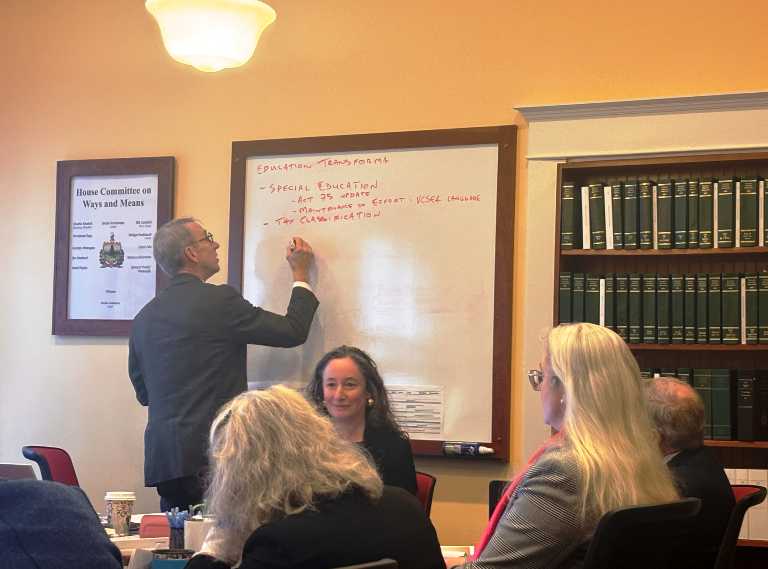
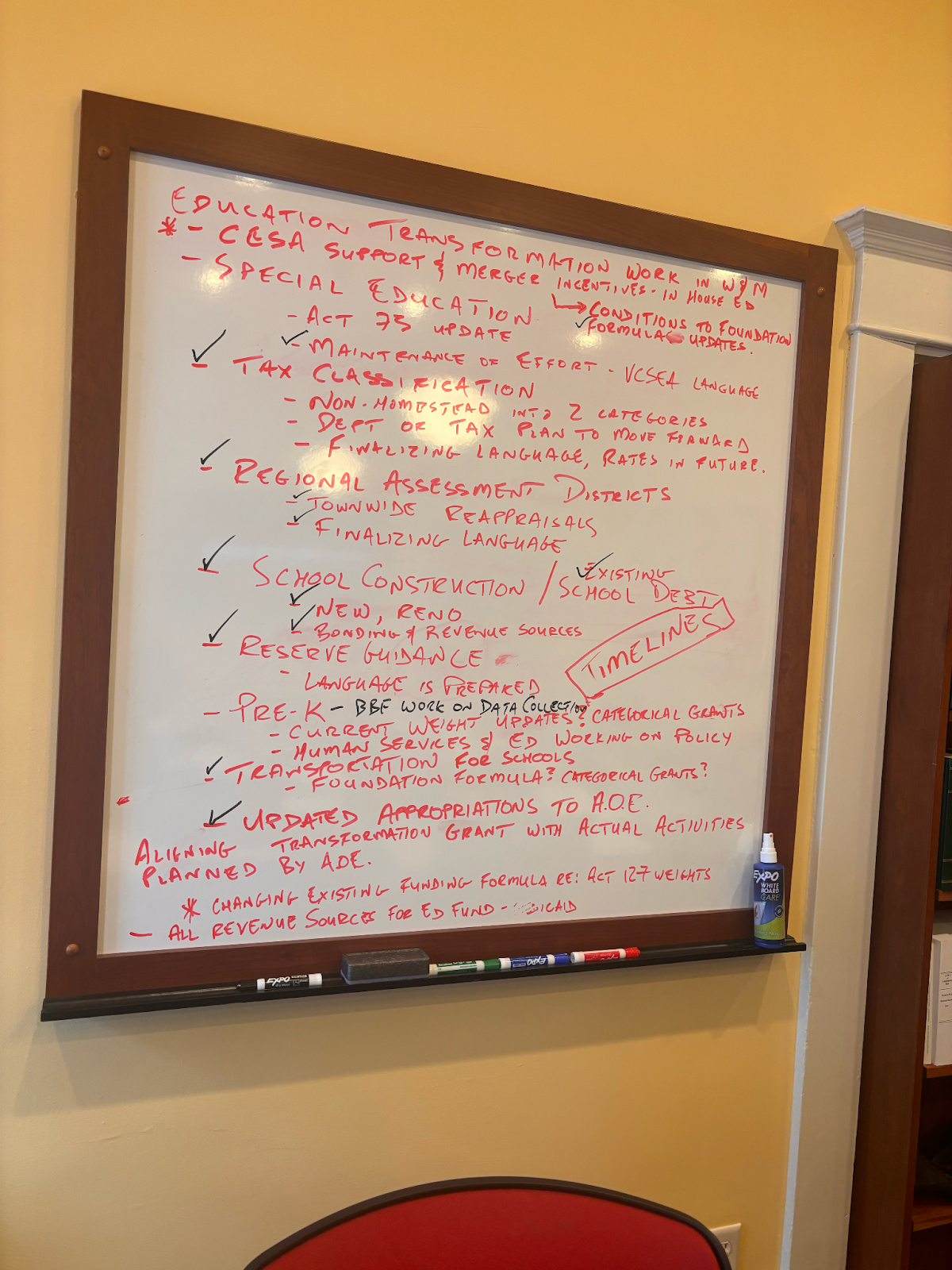
Whiteboard outlining key decision points in the education reform bill, drafted by the House Ways and Means Committee Ranking Member Charlie Kimbell (D-Woodstock), reflecting the complexity of choices facing lawmakers as H.955 moved through the House.
Erosion
Last week we explained how the ground around Act 181 had shifted, with grassroots pressure reaching a volume legislators hadn't seen in years and a tri-partisan Rural Caucus letter calling for full repeal of the "Road Rule" and Tier 3. A House floor amendment to repeal was possible but not the most likely outcome. The committee process was going to determine a lot.
Early this past week, the committee process delivered its answer, and the speed of the alignment is the story. On Tuesday, House Committee on Environment Chair Amy Sheldon signaled she was open to repealing both the "Road Rule" and Tier 3. That was a notable reversal. Chair Sheldon helped draft the original Act 181 and had consistently said she was not interested in rolling it back. The next day House Speaker Jill Krowinski issued a public statement backing the repeals and committing to a "robust public engagement process” with Vermonters moving forward. Senate leadership indicated shortly after that the Senate is prepared to do the same when the bill returns to their chamber.
After the repeal announcement, Agency of Natural Resources (ANR) Policy and Planning Director Billy Coster testified that the implications of the Act 181 process extend well beyond S.325. For months, the conversation around Tier 3 and the "Road Rule" had become a contest between conservation and rural livelihoods. Environmental groups argued the provisions were necessary to protect forest fragmentation and habitat connectors. Rural landowners, housing advocates, and municipal leaders argued they would pile costly permitting onto working lands and make the housing shortage worse. Both sides had real points, but neither was going to convince the other.
Coster reframed the question. Tier 3 implementation, he told the committee, was damaging other conservation programs that depend on landowner trust. He named them directly: the Vermont Conservation Plan being developed under Act 59 to conserve 30% of Vermont by 2030 and 50% by 2050, the Current Use program, and recreational trail access agreements. A small but growing number of landowners had already revoked public trail access in protest. ANR's decades-long catalog of threatened and endangered species was at risk because landowners watched Vermont Conservation Design data get pulled into Tier 3 maps in ways the Department of Fish and Wildlife had promised for years would never happen. That reframing changed the political logic. Repealing Tier 3 was not a capitulation to opponents of conservation. It was the pro-conservation move, because Vermont's conservation record over the last forty years has been built on voluntary landowner participation, and Tier 3 was undermining the foundation the system rests on.
His testimony matters most for what it signals about the next round of conservation policy. Vermont is in the middle of developing its Vermont Conservation Plan under Act 59, with a statutory mandate to meet ambitious conservation goals, and every credible path to hitting them runs through private landowners. Roughly 80 percent (about 3.6 million acres) of Vermont's forested land is privately owned. Getting to 30x30 requires Current Use enrollment, conservation easements, farm and forest viability investments, and a steady pipeline of landowners willing to say yes. Tier 3 was damaging that pipeline before it took effect. Landowners nowhere near a mapped habitat connector heard about Tier 3 and drew their own conclusions about what Act 59 might do next. This was the first time the agency responsible for implementing 30x30 said in a committee hearing that this was happening. It raises a harder question the legislature will eventually have to confront: whether the statutory architecture of Act 59 itself, with its mapped reserve areas and acreage targets, generates enough landowner anxiety to undermine the participation it needs to succeed.
The conservation-trust problem does not end with Act 181 and potentially Act 59. Act 121 of 2024, the Flood Safety Act, expanded Vermont's authority over development in mapped river corridors and flood hazard areas. Beginning January 1, 2028, ANR will require permits for development in mapped river corridors on streams with watersheds of two square miles or greater. The policy case is strong, as flood damage has cost Vermont over a billion dollars in recent years, but implementation will affect thousands of privately owned parcels in state-mapped corridors, shaping what their properties are worth, what owners can build, how they can rebuild, and even if they can build at all.
If Tier 3 is a cautionary tale about what happens when landowners are left out of the conversation, Act 121 is the next test of whether the state has learned from it. It requires community education and outreach, provides for municipal delegation of river corridor regulation, and is effective January 2028. The maps can still be refined with landowner input rather than released and defended. Property value and rebuilding impact analyses can still be done before the lines harden. But the Act 181 experience also exposed a timeline problem, and Act 121 has the same one. Twenty months is not much runway for ANR to do the internal technical work of mapping, rule drafting, and program design while also conducting the sustained landowner outreach that builds trust rather than erodes it. One of those tracks tends to get compressed, and if Act 181 is any guide, it is the outreach. Whether the Coster lesson is applied to Act 121, and whether ANR has the time and resources to apply it properly, will be one of the most consequential questions of the next biennium for working-lands landowners across Vermont.
Back on S.325, the most likely path forward is an amended bill that repeals Tier 3 and the "Road Rule," renames "tiers" as "delegated areas," pushes regional plan expirations further out to protect tax credit eligibility, and rejects the Senate's 50-unit village-center housing expansion. The housing exemptions survive. The Tier 1 framework survives. The critical natural resources concept survives as a placeholder for future work. This is not a repeal of Act 181. It is a repeal of two specific provisions, leaving the core framework intact. The Tier 2 report, now past its February deadline, takes on significantly more importance as the vehicle for addressing fragmentation of working lands, primary agricultural soils, and on-farm accessory businesses. The committee is already signaling that the Tier 2 study needs a wider scope, a longer timeline, and a rewritten charge that asks LURB to look at voluntary and incentive tools, not just regulatory ones.
For decades, Vermont's conservation policy has succeeded because it has been built on voluntary landowner partnership. When a regulatory provision gets layered on that foundation without meaningful landowner involvement, it erodes the trust every other conservation program depends on. The damage shows up quietly, in Current Use numbers that plateau, easements that go unsigned, trail access that is not renewed, and 30x30 acreage targets that aren’t met, long before it shows up in a committee room.
The Tier 3 repeal is the opening chapter. The Vermont Conservation Plan under Act 59 is coming. The 30x30 deadline is four years away. Act 121's river corridor rules will land on thousands of parcels whose owners have not yet been part of the conversation. The next time Vermont proposes a statewide land use or conservation framework, the question of whether the landowners it depends on were in the room when it was drafted will be asked first, not last. That is the lesson of this week. Whether the state applies it is the question of the next decade.
To support vital journalism, access our archives and get unique features like our award-winning profiles, Book of Lists & Business-to-Business Directory, subscribe HERE!
 Vermont Business