

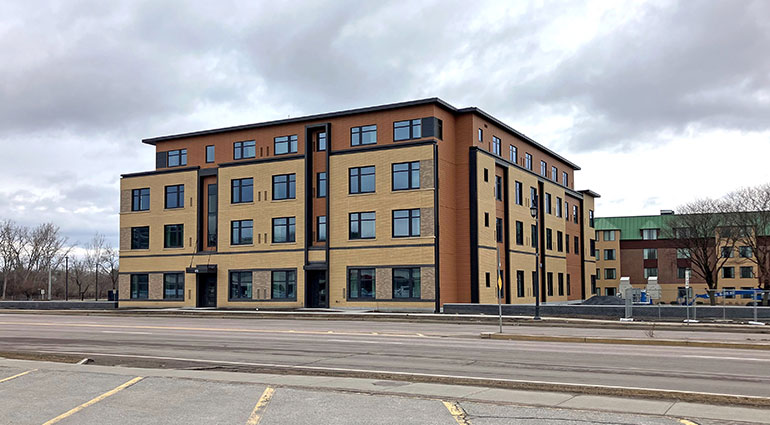
PC has nearly completed the DoubleTree by Hilton hotel expansion in South Burlington. Photo courtesy PC Construction
by Timothy McQuiston, Vermont Business Magazine
Vermont’s construction and development industry enters the 2026 construction season at a paradoxical moment: The challenges are immense, the constraints are real and yet the work keeps coming. As Richard Wobby, Executive Vice President of AGC/VT, puts it plainly, Vermont is navigating “a period of significant pressure but also meaningful opportunity.”
The national picture is familiar by now — high interest rates, rising material costs, and persistent labor shortages — but Vermont’s experience is shaped by a combination of federal investment, local resilience, and a housing crisis so acute that even the most challenging projects continue to move forward.
Across the state, contractors, lenders, developers, and policy makers describe a market defined by tension: between need and feasibility, between ambition and regulation, between the urgency to build and the realities that slow construction down. Yet the through line is unmistakable: Vermont is building. Not fast enough, not cheaply enough, and not without friction — but building nonetheless.
This is the story of a sector under strain, and the people trying to keep Vermont’s communities, economy, and housing stock moving forward.
Wobby ticked off the trends:
What’s Hot
- Infrastructure & public works projects: boosted by federal dollars.
- Climate resilience construction: now baked into nearly every local and state project.
- Healthcare, education & clean energy facilities: steady or growing demand.
- Adaptive reuse of commercial buildings.
- Digital tools, prefabrication & modular methods: rising rapidly across Vermont job sites.
What’s Not
- Office construction: still oversupplied and weak.
- Large speculative commercial projects: often unable to pencil under current interest rates.
Key Pressures: Housing Costs, Labor, Interest Rates
Interest Rates
Developers tell Wobby that current financing conditions make many projects “financially unworkable.” In some cases, “The cost to finance new buildings now exceeds what the finished building is worth in the local market.”
Mortgage rates, which had briefly fallen below 6%, are back on the rise in the 6.2% to 6.5% range. Rates have increased recently, according to Freddi Mac, influenced by rising 10-year Treasury yields and inflation expectations.
In addition, commercial lending rates will likely not go down any time soon as the Federal Reserve governors did not lower interest rates in March, as a weakening economy was seen as being offset by an upward push in inflation.
Labor
Workforce availability remains the single largest constraint across all sectors. High demand roles include carpenters, electricians, plumbers, equipment operators, masons, and site supervisors. Collaboration among contractors — once rare — is now common as firms pool resources to meet demand.
Construction Costs
High material and labor costs continue to push prices upward, making affordability a challenge even when projects do move forward.
Permitting
Time lines remain slow, unpredictable, and difficult for developers to navigate — a theme echoed across every interview in this report.
And yet, despite all of this, housing remains one of Vermont’s most active construction sectors. Developers continue to pursue multifamily and workforce housing projects, though many are being resized or reprioritized. The downsizing of Burlington Square (formerly CityPlace) from 420 to 350 units is a prime example of adjusting to financial realities.
The need is simply too great for the market to stall entirely. Rehabs, energy efficiency upgrades, and smaller scale multifamily developments continue to move forward, even as larger market rate projects struggle to “pencil.”
Richard Wobby summed up his thoughts by saying: Vermont builders remain “busy, adaptive, and optimistic about the long-term trajectory of construction and development across the state.”
“Current trends in the industry indicate that projects with approved internal budgets and funding are moving forward into construction,” said Matt Cooke, President / CEO, PC Construction. “Projects that rely on a pro forma, primarily in the multifamily housing and hospitality markets, are struggling to “pencil,” leading to construction starts that are significantly slower or non-existent.”
PC has nearly completed the DoubleTree by Hilton hotel expansion in South Burlington and the manufacturing addition for Weidmann Technologies in St. Johnsbury. They are also building the Perry Center for Native American Art at the Shelburne Museum and the addition and renovation at Porters Point School in Colchester, as well as a new middle and high school in Woodstock.
Matthew Wheaton, Executive VP at DEW, said: “Despite national volatility, Vermont’s construction market remains relatively resilient. Architects — often a leading indicator for future construction activity — continue to stay busy. That said, we are seeing some softening in market rate housing driven by construction costs and interest rates. New market rate housing starts have slowed and are largely concentrated in higher rent areas of Chittenden County.”
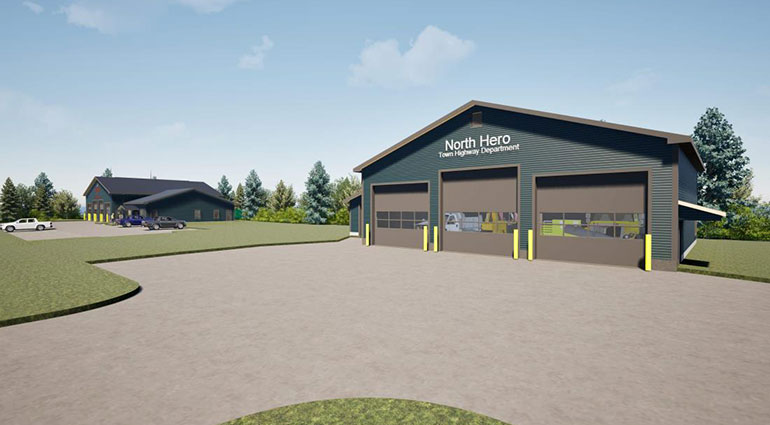
Rendering of the Town of North Hero's Fire Department & Public Works Garage. Photo courtesy DEW Construction
But the barriers are equally formidable:
“Construction costs remain the biggest hurdle for ground-up development, “said Erik Hoekstra of Redstone. “Construction inflation has far outpaced CPI, and that reality effectively halted most of our development activity at Redstone after 2019.
“Interest rates are affecting the investment market in a different way. They’ve created a wide bid-ask gap between buyers and sellers. Sellers remain anchored to values set during the low-rate environment, while buyers are adjusting to higher borrowing costs and are less willing to accept the compressed cap rates of the last cycle. Concerns about tariffs, a softening labor market, net out-migration from Vermont, and broader economic uncertainty have further slowed investment sales.
“Looking ahead, we expect new development and construction to remain limited. Public-sector funding that supported recent infrastructure projects has largely dried up, with the federal government pulling back and state and local governments facing taxpayer pressure after steep property tax increases. On the private side, high construction costs, elevated interest rates, and economic uncertainty are keeping many developers cautious. At Redstone, we have no ground-up projects in the pipeline and do not expect that to change significantly in the near term.”
John Illick, CEO, ReArch, said: “The labor market remains one of the most significant challenges. The number of young people entering the skilled trades still does not keep pace with industry demand. This is the reality across the industry and impacts all trades.
“ReArch Construction, in partnership with PC Construction, the ABC NH/VT Chapter, and many other contractors and subcontractors, continues to work closely with the Vermont Construction Academy (VCA) to prepare the next generation of tradesmen and women for successful careers in construction.
“At the same time, the industry recognizes that workforce training alone will not solve the long-term labor challenge. Vermont must also address its demographic constraints and continue working to attract and retain more working-age residents. Expanding the population and workforce will be essential to sustaining construction activity and supporting the broader economic health of the state.
“Beyond labor, material tariffs and broader economic uncertainty continue to add volatility to construction pricing, and these factors still influence project planning in 2026-27. Fluctuating material costs can make it difficult for owners to lock in budgets in the early stages of a project, sometimes delaying decision-making or pushing projects back as owners wait for greater stability.”
"It's the infrastructure, stupid," said Ted Brady, Executive Director of the Vermont League of Cities & Towns, while paraphrasing a famous political line. “I fundamentally believe the number one reason we aren't building more housing throughout Vermont is because we don't have the sewer, water, road, and telecommunications infrastructure in place to facilitate the growth. This puts the burden on developers to finance those things into the cost of housing development, reducing the viability of project after project. I hope the new Community Housing Investment Program will begin to tackle this issue one town at a time. VLCT has already fielded dozens of inquiries from towns eager to use the program - so I'm hopeful we'll start putting a dent in this issue in the coming years.”
Development, then, is uneven across the state, with in organizations like VLCT and Let’s Build Homes, which updates to Act 181 and Act 250 are attempting to rectify.
Let’s Build Homes is a non-partisan coalition dedicated to addressing Vermont’s housing shortage. Through advocacy, policy reform, and community engagement, the coalition works to remove barriers to home construction and ensure that, “Vermont remains a place where everyone can live, work, and thrive.”
Bob Davis, Senior VP/Senior Commercial Banking Officer at Brattleboro Savings & Loan, said: “We are not seeing many new housing or apartment projects in the area. The few we have seen usually have some form of State/Federal subsidy and more complex capital stock, or a skilled individual able to complete some of the work to save on costs. We have, however, seen many projects where people are buying and renovating older apartment stock, or converting unused space in commercial building into apartments.”
Heavy Construction: The Backbone Holding Steady
If there is one segment of Vermont’s construction economy that remains reliably strong, it is heavy civil and infrastructure work. Wobby notes that Vermont’s heavy contractors are “still operating from a strong backlog,” buoyed by federal investments through the IIJA, IRA, and CHIPS Act. These dollars are flowing into:
- Road and bridge upgrades
- Water and wastewater systems
- Broadband expansion
- Climate resilience infrastructure
Nearly every municipal capital plan now includes a climate adaptation component — a shift that has effectively baked resilience work into the state’s long-term construction pipeline.
There are challenges, of course. VTrans funding constraints remain a concern, though Wobby says indications suggest these pressures “may become manageable over the next 18 months.” But compared to the volatility in private development, heavy construction remains the sector’s stabilizing force — the work that keeps crews employed, equipment moving, and firms confident enough to plan ahead.
Housing: The Need That Won’t Quit
If heavy construction is the backbone, housing is the pressure point — the place where every force shaping Vermont’s economy converges. Demand is “extremely high,” Wobby says, especially for workforce housing, multifamily projects, and energy efficient renovations.
Brad Worthen of Pomerleau Real Estate in Burlington said: “Multifamily (aka apartment buildings) has stood the test of time due to significant demand for housing. However, even with record low vacancy rates, apartment availability has slowly improved over the past 12-24 months. Many landlords report sitting on empty apartments for several months before signing up new tenants. And it’s not surprising to see incentives offering a month or two rent free.”
Matthew Wheaton said: “The most notable trend is a continued slowdown in new market rate housing development, particularly outside of the strongest rental markets. Developers are taking a more measured approach as they navigate financing challenges and shifting demand.”
And, “Affordable housing remains one of the most active sectors, supported by ongoing demand and public private investment.”
“Housing costs, availability, interest rates, and labor constraints are all influencing how — and when — projects move forward. Higher borrowing costs and construction pricing are prompting developers to be more selective, often extending predevelopment time lines and prioritizing projects with stronger funding structures or public support. Labor availability continues to affect scheduling and sequencing, reinforcing the need for early planning and realistic delivery strategies.
“Despite these pressures, housing demand remains significant. DEW is currently constructing five residential projects across Vermont, New Hampshire, Maine, and Massachusetts that total 600+ units, with five additional projects scheduled to begin in the coming year. Our active work includes both affordable housing developments and market‑rate residential projects.”
“The apartment market is going through an adjustment,” Erik Hoekstra said. “Several years of record supply have pushed vacancies above long-term averages and slowed rent growth while operating expenses continue to rise for property owners. Pandemic-era demand from remote workers has faded as many returned to major metro offices. While most of the new supply is at the high end, the impact is filtering through the broader market and easing pressure on mid and lower-tier apartments.”
Matt Cooke at PC said: “Despite the high-cost rental markets in Vermont, market-rate housing (i.e. multifamily) still isn’t getting to a successful construction start. Conversations with developers have identified a number of barriers in the overall development pro forma – from mid-to-high land acquisition cost, high construction cost (driven by many factors), high interest rates, and high property taxes to increasing operating expenses and form-based codes that limit first floor usage to non-primary revenue uses and that require more premium features than typical. The Community Housing and Infrastructure Program (CHIP) or Tax Increment Financing are both good first steps in supporting this development but, alone, they are not enough.”
Meanwhile, John Illick said, “Housing is still the ‘hot’ market.”
ReArch’s projects include: Revitalizing the former YMCA site, preserving its historic façade and adding a six-story addition with 79 modern apartments and underground parking; the new Marsh House in Waterbury will offer 26 permanently affordable apartments, including units for individuals with disabilities and those facing homelessness; and the mixed-income housing development at the Alice Holway housing project in Putney, with 25 units across two buildings, including units for formerly homeless residents and fully accessible apartments.
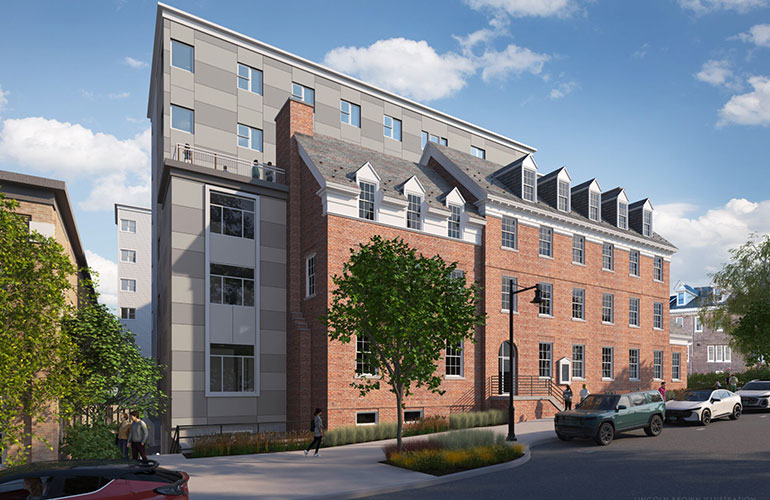
Rendering of the revitalized former YMCA site. Photo courtesy ReArch Construction
Mia DeAngelis, SVP, Senior Mortgage and Consumer Lending Officer at the Brattleboro S&L noted the price of land is a barrier.
“We are seeing an increase in purchase activity during the first quarter, particularly in the single-family market. However, many of these homes are still priced above what most first-time buyers can afford. Properties that do fall within a typical first-time home buyer budget often require significant repairs or updates, which can make it difficult because you have to bring the cost of repairs beyond what buyers can afford.
“Another trend we’re noticing is existing homeowners seeking financing to add accessory dwelling units (ADUs) to their properties. Many are looking to create extra income, either through long-term leases or short-term rentals through Airbnb.
“We do offer financing for construction loans, but new construction is rarely an affordable option for most first-time home buyers. Construction costs are high, and when buyers also need to purchase land, it is not a doable option. Land prices have also increased. Another challenge we see frequently is that the cost does not equal value, the differences between construction cost and appraised value. In some cases, the cost to build a home exceeds what the property will appraise once it’s completed, which can make financing more complicated unless you have the excess cash to put down.”
Still, progress is being made on what experts say is the need for 30,000 to 40,000 more units in Vermont by 2030.
Ted Brady said: “In the past five years, the state, cities and towns have made historic investments in affordable housing, reduced the regulatory grip on housing construction, and created the single largest housing infrastructure investment program in the state's history.
“Reports from around Vermont are that these actions have resulted in new and renewed interest from housing developers from Bennington to Newport. These actions include nearly a billion dollars in federal and state pandemic investments in the construction of workforce housing, modernizing zoning regulations to require dense developments anywhere there is water and sewer available, exempting our downtowns and village centers from Act 250, and setting housing targets for every community.
“It's too soon to tell if these actions will really move the dial on the creation of affordable housing, and municipalities and the state aren't done creating and changing policies that could further spur housing development. In the legislature, S. 325 is moving - a bill that aims to fine tune the housing incentives of the past few years by extending Act 250 interim exemptions and delaying new Act 250 triggers that may slow housing growth.
“On the House side, H. 775 creates new housing finance initiatives, new housing pilot programs, and dedicates more state funding to housing development. And S. 328 in the Senate also focuses on housing investments and state and municipal regulatory relief. All three bills appear to be moving.”
TD Bank's Commercial Market President, Don Baker, and Head of Community Development Lending, Andrew Warren, weighed in from the financing side:
Vermont's housing affordability challenge is the result of long‑building structural pressures, not a single factor.
“There isn’t one simple cause behind Vermont’s housing affordability challenge. It’s the result of years of underbuilding combined with economic and policy factors that have compounded over time. The impact of that undersupply is well documented, including in the Vermont Housing Finance Agency’s Housing Needs Assessment.”
Many new housing projects no longer financially “pencil out” under today’s cost environment.
“Housing development in Vermont is uniquely challenging because projects often require long state and local approval timelines. Many of the projects we see coming online today were planned years ago, when construction and financing costs were much lower. As developers look ahead, a growing number of potential projects simply don’t pencil out anymore because the equity required is too high to generate a reasonable return.”
Elevated construction costs and interest rate uncertainty continue to constrain new development.
“Construction costs remain elevated from the pandemic era, and labor costs have stayed high due to sustained demand. At the same time, shifts in global and national conditions have created ongoing interest rate uncertainty, which adds another layer of cost and risk. Together, those factors make it harder to bring new housing projects forward.”
Rising operating costs have reset rents across Vermont’s existing housing stock.
“On the existing housing side, Vermont saw historically low vacancy rates during the pandemic, which pushed rents sharply higher, especially on new leases. Since then, property taxes have risen more than 20%, insurance premiums have nearly doubled, and interest rates have increased significantly. Those higher carrying costs have effectively set a new floor for rents, impacting both new and existing tenants.”
Business Assistance
Both the Vermont Economic Development Authority and the SBA Vermont office provide assistance with financing and expertise.
Joan Goldstein, who served many years as the State of Vermont Economic Development commissioner, took over as VEDA’s CEO just over a year ago.
“We are eager to see S328 make it to the finish line with VEDA’s expanded lending powers to multi-unit housing, Goldstein said. “This is THE public policy challenge for Vermont and as an economic development organization we feel we need to play a role in its solution.”
“Whether it’s renovations to The Granary in Jeffersonville or a big expansion project at Weidmann Electrical Technology in St. Johnsbury, VEDA is there to support projects that fuel employment and development.
In FY25, 48% of VEDA-supported projects were for construction, renovation, and leaseholder improvements.
“VEDA works in commercial and industrial real estate by lending to a variety of projects including those that help acquire and develop space for retail, manufacturing, office space, and hotels and inns,” she said.
“VEDA investments lead to countless construction and development projects. We support agriculture investments like building new barns and farm worker housing. We support downtown development, renewable energy projects, land acquisition, business expansions, and development of industrial parks. With our Disaster Recovery Loan Fund, we also support building back better for Vermont businesses that suffer damage during a declared disaster.”
Adam P. Locklin, SBA Vermont District Director, said: “The 7a and 504 loan programs provide several products/opportunities for small business owners to work with Certified Development Companies and/or lenders on real estate acquisition, construction, and/or development projects.
“504 loans, for example, are typically utilized in larger real estate purchases (done in conjunction with a CDC and private lender).
“The 7a loan program has multiple products that assist lenders in making loans by guaranteeing portions of the loans made. Offering these loan guarantees allows lenders to reduce risk, expand their borrowing base, offer longer terms than they typically might (to improve cash flow) and offer competitive rates. Term loans can be used to acquire land, expand facilities, and make leasehold improvements, amongst other eligible uses. There are multiple line-of-credit options, including project-based lines of credit that support residential home building in opportunity zones and working capital lines of credit that cover a wide-array or working cap needs.”
Locklin took over the Vermont position earlier this year and their new office is in Williston.
Major Projects Include
CSWD breaks ground on new $38 million recycling facility
The Chittenden County Solid Waste District is constructing a new state-of-the-art Materials Recovery Facility (MRF) to sort and prepare blue-bin recyclables for market. This modern facility will replace the existing MRF, built in 1993, which has exceeded its capacity and operational lifespan. The new MRF will be significantly more efficient and effective, offering extensive environmental benefits and ensuring affordable, in-state processing of recyclables for Vermonters for years to come.
The project is estimated to cost $38 million, funded through CSWD reserves, grants, and a $22 million bond approved by Chittenden County voters.
Initially, the facility was to be sited on a parcel owned by CSWD on Redmond Road in Williston. However, during the permitting process in June 2024, the site was deemed too wet for development and the project was put on hold to find an alternative location. CSWD has since acquired a more suitable 38-acre parcel further down Redmond Road, close to the existing transfer station, which will serve as the new location for the MRF.
Despite a cyber fraud case that cost CSWD $3 million, the recycling facility construction will not be affected and the project remains on-time for January 2027 and on-budget.
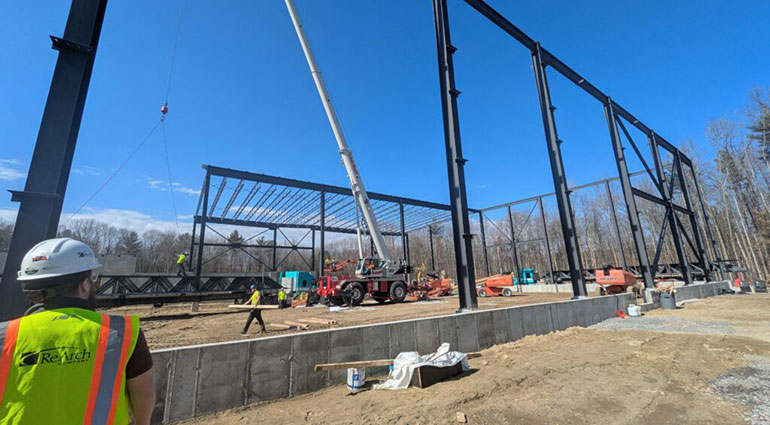
Construction site at the Chittenden County Solid Waste District new state-of-the-art Materials Recovery Facility. Photo courtesy ReArch Construction
House approves another $30 million for the 10% in VT program
The Vermont House unanimously approved H.775 on March 19, a major housing bill that would free up an additional $30 million for local investment in housing and economic development through Treasurer Michael Pieciak’s 10% in VT program. The bill must also be approved by the Senate and signed by Governor Scott to become law.
The 10% in VT program authorizes the Treasurer’s Office to invest 10% of the State’s average daily cash balance into projects that grow Vermont’s economy and the State’s tax base. H.775 would expand the program’s lending capacity by 2.5%.
Treasurer Pieciak has invested over $130 million into new housing development through the 10% in VT program — supporting over 1,700 homes including affordable, market-rate, workforce, and senior housing. The funding, issued through low-interest loans, offsets high interest rates that would otherwise make projects difficult, if not impossible, to finance.
The Treasurer's Office recently announced several major new investments through the program, including the Ride Your Bike project in Burlington, The Rutland Downtown Hotel Project, The Village at Winston Prouty in Brattleboro, and a new $2.5 million partnership with the Bank of Bennington.
“There is almost no issue in Vermont that can be solved without building more housing,” said Treasurer Pieciak. “This is a prudent expansion of the 10% in VT program that will allow our office to make more critical investments in housing across Vermont — making it cheaper to build homes, helping more projects break ground, and moving the needle on our significant housing shortage.”
“Building Up Bennington County” program, a new $2.5 million partnership to jump-start new housing development across Bennington County. The program will offer low-cost loans to home builders in the region, helping a pipeline of local housing projects break ground. Bennington County is expected to need over 1,000 new housing units over the next six years.
Phase 1 of The Village at Winston Prouty. The $9.5 million project will build 28 new units of workforce housing on the Winston Prouty campus. The treasurer’s investment is the most significant tranche of funding committed to date. Units will target 80 to 120% of area median income, supporting more affordable local housing options, a stronger hiring pipeline for Brattleboro employers, and economic growth for generations to come. Residents will have direct access to child and family services from The Winston Prouty Center and enjoy close proximity to trails and natural green space.
$8 million from the 10% in VT program to support the development of the Rutland downtown hotel. The new funding is a major step toward financing the project — transforming the Center Street block, strengthening local tourism, and sparking a new chapter of the Marble City’s revitalization. The hotel will replace the long-vacant brownfield “pit” on the corner of Wales Street and Center Street with a seven-story, mixed-use building accommodating 100 guest rooms, 30 permanent jobs, and 26 new apartments — boosting downtown foot traffic and welcoming new customers for local businesses. The added lodging space will also soften demand for short-term rentals, expanding local housing options for workers and families. Rutland’s downtown has been without a hotel since the Berwick Hotel, which previously occupied the space, burned down in 1973. The project is expected to add millions in new revenue to the local tax base over time.
Burlington Square Nears Finish Line
Construction on the $300 million Burlington Square, formally known as CityPlace, may see completion as soon as next year. Begun in 2022, the long-envisioned downtown development is on track for a late 2027, early 2028 completion date.
The previous mall was demolished in 2018 and the site left vacant for four years and became known as the “Pit.” The new development boasts over 300 apartments, two hotels, restaurants and upwards of 80 affordable housing units in the north tower. At 11 stories (approximately 140 feet) the south tower is the tallest building in Vermont.
2026 Barn Preservation Grants
The Vermont Division for Historic Preservation (VDHP) and the Vermont Advisory Council on Historic Preservation have announced the 2026 Barn Preservation Grant awardees. This year, the program will award $365,350 in matching grants to fund 20 preservation projects across nine Vermont counties. These grants will leverage over $1 million in restoration and rehabilitation efforts. VDHP received 29 applications this year requesting a total of $522,700 in funding.
Historic Preservation Undertakes Transformative Work at Five Locations
The Vermont Division for Historic Preservation (VDHP) has announced that significant historic preservation and restoration projects are underway at five state-owned historic sites. These critical infrastructure improvements are designed to stabilize and protect Vermont’s cultural landmarks, ensuring these special places are preserved and accessible for future generations.
They are: President Calvin Coolidge State Historic Site – Plymouth Notch; Senator Justin S. Morrill State Historic Site – Strafford; Old Constitution House State Historic Site – Windsor; Theron Boyd State Historic Site – Quechee; and Bennington Battle Monument State Historic Site – Bennington.
Okemo’s 70th Anniversary with Environmental Stewardship
The SouthFace Village development spans 23,200 square feet across 14 residences, utilizing Bensonwood’s Open-Built high-performance walls. The slope side community offers ski-in/ski-out access along with shared amenities including an indoor/outdoor pool and fire pit, blending durability and comfort in this mountain living environment.
The development addresses the challenges of strict land management requirements, high-density planning, limited site access, and complex mountain topography. These conditions are particularly imperative to solve in Vermont, a state known for its pristine views, progressive environmental laws, and stringent building codes.
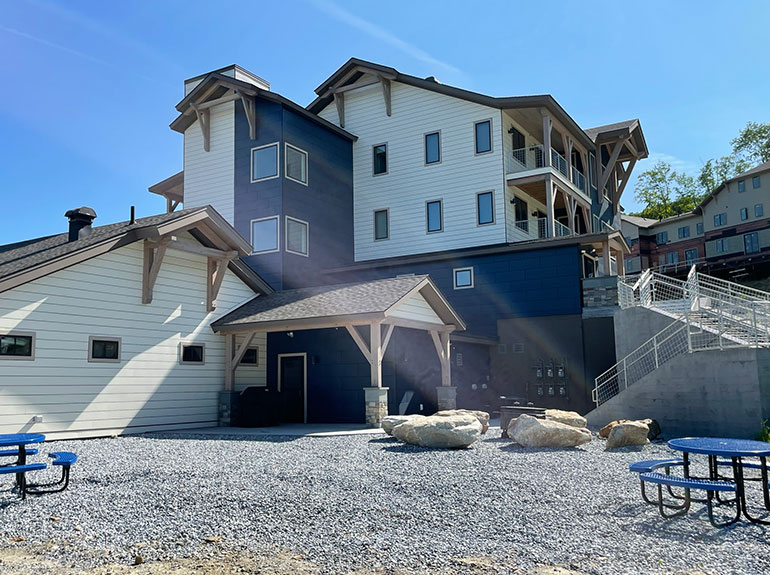
Bensonwood’s high performance building technologies at Okemo's SouthFace Village. Courtesy photo
To support vital journalism, access our archives and get unique features like our award-winning profiles, Book of Lists & Business-to-Business Directory, subscribe HERE!
 Vermont B