


A Weekly State House Recap By Maggie Lenz and Gwynn Zakov (on behalf of Atlas Government Affairs
and Garnet Government Relations
Tipping Point
Two weeks ago, we wrote about how the Senate passed S.325, a bill that extends deadlines for Act 181's most contentious provisions while preserving the law's fundamental framework. We described the political dynamics as sharpening, with rural communities organizing on the State House lawn and Senate Republicans trying unsuccessfully to repeal Tier 3 on the floor. The most likely outcome looked like a House version of S.325 that closely mirrored the Senate's, with deadline extensions and implementation tweaks but no repeal of the Road Rule or Tier 3.
Well, the ground has shifted, and it has shifted in one direction.
We often hear Vermonters say the State House feels distant, that decisions get made by people they feel disconnected from, in rooms they're not in. The story unfolding around Act 181 is a powerful counterexample. The grassroots pushback has reached legislators in a way that is genuinely unprecedented, particularly for a land use law. And the most striking thing is that it isn't being run by an advocacy group or nonprofit. It is a movement of ordinary Vermonters. Farmers, landowners, small business owners, retirees, and working families who share concerns about their ability to live in rural communities and have the same opportunities as Vermonters in cities, downtowns, and villages. They organized, showed up, and legislators are listening.
That energy has worked its way into hallway conversations, leadership offices, and constituent calls in a volume that legislators haven’t seen in years. What started outside the building is now driving the conversation inside it.
Nowhere has that been more visible than in the House Committee on Environment. This week the committee took testimony from a broad cross-section of voices including Regional Planning Commissions (RPCs), environmental, housing and municipal advocates, business groups, conservation districts, a former Act 250 District Coordinator, and notably, farmers and rural Vermonters who had never before been invited to participate in these Act 250 revamp discussions. When Act 181 passed in 2024, the stakeholder process was largely confined to organizational representatives, planners, and policy professionals. The everyday farmer working a hill farm, the rural landowner trying to build a house for an aging parent, the family on a back road, those voices were not at the table under the Golden Dome. This time, they were, and what they brought was lived experience that no policy briefing can replicate.
What emerged from testimony, as much as anything substantive about maps or jurisdictional triggers, was a critique of process. Witness after witness described an Act 181 implementation that had moved forward without meaningfully engaging the people most affected. Maps were drawn before the predicate stakeholder questions had been answered. Public hearings were held after key decisions had already been framed. Rural landowners learned about the implications for their own property by finding their parcels on a state website rather than through any direct outreach. The frustration was not primarily about ecology or regulation, it was about being shut out of a conversation that directly affects people's homes, farms, and futures. Trust, multiple witnesses said in their own words, has been broken.
That framing explains why many are calling for repeal rather than delay. For people who feel they were not part of building Act 181, pushing implementation deadlines out a few years does not solve the problem. It just postpones it. The only way to rebuild trust, in their view, is to start from a clean slate with the people most impacted at the table from day one, not as commenters reacting to a draft, but as co-designers from the beginning.
The challenge is that a full repeal of Act 181 is not a good idea overall. Vermont's cities, downtowns, and village centers genuinely benefit from the housing exemptions and the Tier 1 framework Act 181 created. Those provisions are working. They have made it easier to build housing where housing already belongs, and they enjoy broad support across the political spectrum. Throwing out the entire law to fix the parts that aren't working would do real damage to communities that have spent years planning for the growth Act 181 is helping accommodate.
The testimony reflected that tension. Vermont Natural Resources Council (VNRC) resisted calls for repeal of the Road Rule and Tier 3, arguing the provisions are necessary for protecting forest fragmentation and critical natural resources. Audubon Vermont struck a more conciliatory note, conceding the implementation timeline was rushed and the Land Use Review Board (LURB)'s draft maps created confusion, but defended the underlying framework. On the other side, the committee heard strong calls for full repeal from a coalition that crossed traditional political lines including equity advocates, farmers, rural citizens, Vermont League of Cities and Towns (VLCT), the Vermont Chamber of Commerce, housing organizations, and the Vermont Association of Conservation Districts.
The clearest signal that the political math is moving came this week, when the Rural Caucus sent legislative leadership a letter asking for full repeal of the Road Rule and Tier 3. Initially, the caucus had asked for delays. But given what they've learned this session about how Act 181 is being implemented, and the sheer volume of constituent contact pushing for repeal, the caucus concluded that a stronger position was necessary. The tri-partisan letter carries 57 signatures: 2 Independents, 19 Democrats, and 36 Republicans. Additional legislators outside the Rural Caucus have also expressed support. Nineteen Democrats signing onto a repeal letter is exactly the kind of break from caucus discipline we flagged two weeks ago as the dynamic to watch.
The committee will likely take the bill back up again soon, and the procedural situation is unusually consequential. Because Act 181 remains current law, S.325 must pass for any of its delays to take effect. If the committee doesn't move the bill forward for fear of a floor amendment to repeal Tier 3 and the Road Rule, the bill will die in committee, and components passed in 2024 will take effect as written, including the Road Rule on July 1, 2026.
Two weeks ago, the most likely outcome was a House version of S.325 that mirrored the Senate's. Today, that outcome is still possible, but no longer the only realistic possibility. A repeal amendment on the House floor, once unthinkable, is now within the realm of possibility.
Whatever happens next, there is a lesson worth holding onto. Vermonters who had never testified in a committee room, never written to a legislator, never thought of themselves as activists, decided this was an issue that mattered enough to show up for. They organized around kitchen tables, Facebook groups, and shared their thoughts on Substack, rather than around an institution. And they have meaningfully shifted the trajectory of a major piece of legislation in the middle of session. That doesn't happen often. When it does, it's worth paying attention to.
Curiosities: a weekly peek at the odd and intriguing happenings under the Golden Dome
Sniff Test
Last month, members of the House Institutions and Corrections Committee, the committee responsible for the State’s Capital Budget which pays for prisons and state buildings, began to smell something unusual. What started as a faint odor slowly escalated into a full-blown, olfactory paranoia that took hold of the room.
“It smelled like a corpse was under the desk when we came in,” Rep. Conor Casey, (D-Montpelier) recalled, describing how the situation quickly went from mildly unpleasant to completely consuming.
Days of side-eyes followed as members tried to identify which of their colleagues might be responsible for the rancid, sulfuric smell, all while carefully avoiding any direct acknowledgment in case there was a legitimate health issue at play. The tension built as members attempted to proceed with committee work, quietly scanning the room, shifting in their seats, and trying not to gag.
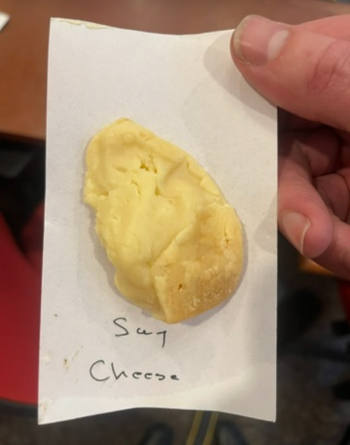
After being driven near insane by the persistent odor, the breakthrough came almost by accident. Casey opened a drawer in his desk that he did not know existed and discovered the source: a blob of soft cheese placed on a piece of paper that read “say cheese.”
That should have been the end of it, but it was not. The smell lingered. The next day, another stash was discovered, this time in a desk belonging to Rep. Gina Galfetti (R-Barre Town) also on a piece of paper which had the word “cheese!” written on it.
The response quickly escalated from confusion to investigation. Casey described how they began narrowing down suspects by identifying the type of cheese and cross-referencing it with higher-end State House receptions where it may have originated, tracing the paper used in the notes back to the third-floor copier, and comparing handwriting samples in an attempt to match the culprit.
“We’ve narrowed it down to a list of five suspects,” he said, only half joking, before adding, “a prank is a prank, but I will find this person.”
The pranks that people play on each other in the State House are not unlike something out of The Office, and in recent years, many of them involve Rep. Casey, either as the culprit but also sometimes as the victim.
There was the time in the prior biennium when Casey never emptied his mailbox, sparking a friendly war known to this day as “The Page Wars” with the eighth grade State House pages tasked with delivering mail to lawmaker’s boxes. When his box became overstuffed, they would empty the contents onto his desk, and he would respond by shoving the entire pile back in. The back-and-forth escalated, eventually culminating in Casey calling a page over across the House Floor to pick up for hand delivery a manila envelope addressed to the Speaker’s Chief of Staff, Conor Kennedy. The envelope appeared routine but turned out to be packed with a heavy weight.
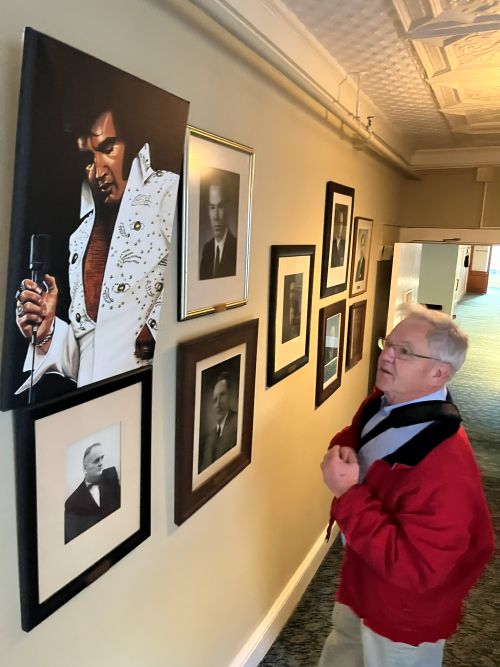
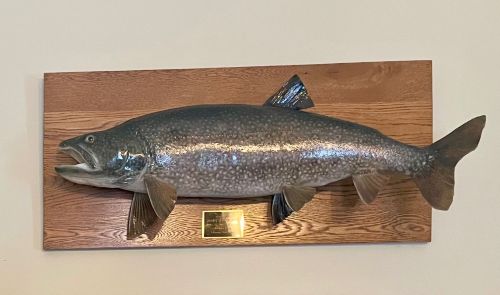
At one point several years ago, Casey returned to the State House after hours and mounted a Big Mouth Billy Bass onto a men’s bathroom wall. The same evening, and perhaps more daring given the State Curator’s reputation for strict oversight of artwork, he placed a portrait of Elvis Presley among a hallway of serious historical political portraits. He spent much of the session afterward attempting to convince the Speaker’s office to return the confiscated fish.
Casey has also been on the receiving end of these efforts. Last session, one of the authors of this column slipped into his committee room and installed a small brass placard on the heating vent behind his desk reading “Representative Conor Casey Memorial Vent,” followed by a phrase in Latin: “Silentium loquitur” which is Latin for “silence speaks.” The plaque remains in place to this day.
There was a moment that came close to crossing from prank into something more serious, when on April Fool’s Day a couple of years ago Casey convinced his committee chair that the Senate had made derogatory comments about their work on their signature budget bill. He ultimately pulled the plug before it spilled into the very real negotiations.
This past April Fool’s Day, while Casey was relatively quiet, others carried the torch. One of these authors opened her phone to find a message from fellow lobbyist Nick Charyk of DRM declaring that a House Education meeting was “getting spicy,” accompanied by a video clip. About ten seconds into what appeared to be a routine discussion, the screen abruptly shifted to Rick Astley singing “Never Gonna Give You Up,” the classic Rickroll.
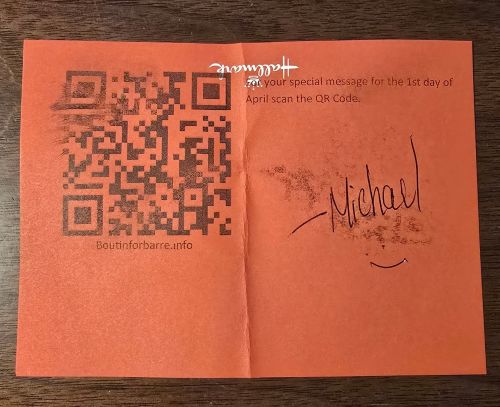
Charyk, for his part, was inspired after watching Rep. Chris Morrow (D-Weston) fall victim to a Rickroll earlier that day, opened from a link sent by Rep. Michael Boutin (R-Barre City). Boutin described his approach to pranks as a way to shift the tone of the building, noting that after feeling discouraged last session, he decided to focus on “trying to bring smiles to the state house.”
There is also prank lore that circulates. One piece of such lore that to be clear has not been verified but that we heard in various fragments across conversations. The story goes that years ago, when Peter Shumlin was governor, then–Lt. Gov. Phil Scott drove into the State House lot and parked in the governor’s designated spot. When questioned by passersby, he explained that it was actually Pro Tem John Campbell’s car and that he would be calling security on it, after having parked it there himself. No one we spoke with could recall the story exactly, only a vague sense that something like it had happened.
The case of the clandestine cheese has yet to be solved, though Casey remains confident he is closing in. For now, the suspect list remains active, the evidence continues to be reviewed, and the memory of the smell lingers just enough to keep the story alive. As Rep. Galfetti put it, “I am bolstered by the fact that it was a bipartisan cheesing which just shows we are all working together.”
To support vital journalism, access our archives and get unique features like our award-winning profiles, Book of Lists & Business-to-Business Directory, subscribe HERE!
 Vermont Business Magazine