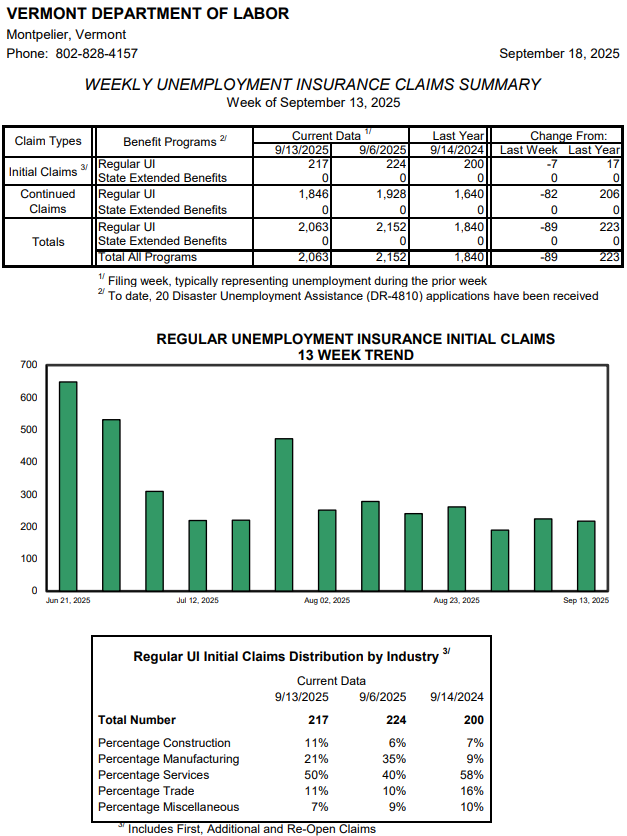
by Timothy McQuiston, Vermont Business Magazine Vermont weekly unemployment claims for the week ending September 13, 2025, fell slightly and remains close to the lowest level of 2025, achieved the week of August 30. New claims were 217 last week, down 7 claims from the week before and up 17 from last year at this time. Claims, which tend to be lowest in the summer, were 181 at the end of September 2024.
In Vermont for the weekly report, manufacturing accounted for 21% of the total, down 14 points from the previous week. Manufacturing overall has become a smaller part of the Vermont economy over the last 25 years and that trend appears to be continuing. The Service industry, which typically accounts for the most claims, last week reported 50% from the previous week, up 10 points. Construction was 11%, up 5 points.
For the week, Vermont total unemployment insurance claims were 2,063 (down 89 for the week and up 223 from this time last year).
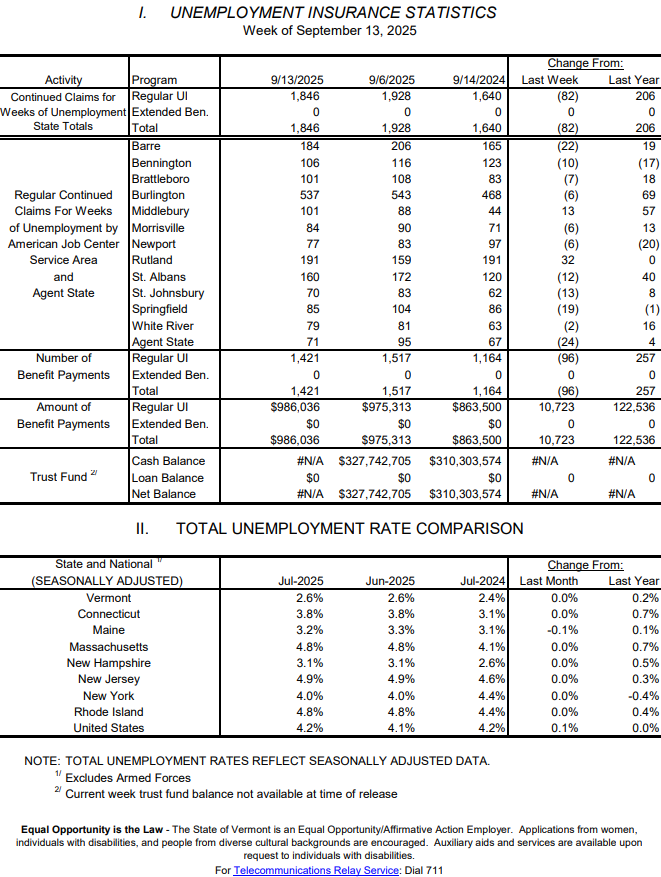
The Vermont Unemployment Trust Fund is well capitalized. As of the most recent data, there was $327.7 million in the Trust Fund (as claims are paid out on one side, employers are contributing to the fund on the other). The pre-pandemic Trust Fund balance on March 1, 2020, was $506.2 million.
In the week ending September 13, the US DOL reported that the advance figure for seasonally adjusted initial claims was 231,000, a decrease of 33,000 from the previous week's revised level. The previous week's level was revised up by 1,000 from 263,000 to 264,000. The 4-week moving average was 240,000, a decrease of 750 from the previous week's revised average. The previous week's average was revised up by 250 from 240,500 to 240,750.
Unemployment claims were lighter than anticipated and far lower than last week's surge, but hiring also remains soft.
Meanwhile, the US August Labor Report from the US DOL indicated that employment is waning. This comes after a poor July report and another revised lowering of the June numbers. See National Employment Trends below.
Markets
Meanwhile, the stock market had a positive week as the Fed did, indeed, cut interest rates by a modest 25 basis points, as expected. It appears the Fed's concern over a rise in inflation is out-weighed by a weakening economy. The markets anticipate that the Fed will respond to the overall economic news with an interest rate cut, perhaps more than the previously anticipated 25 basis points. The inflation report from from last week showed an increase of 2.9%, higher than the Fed's goal of 2%.
Powell hinted in a speech August 22 that overall economic conditions allow the Fed to "proceed carefully" with fiscal policy as downside risks mount.
The US unemployment rate for August was up one-tenth to 4.3%. The Vermont labor situation also weakened, despite the rate drop, but incomes have also stagnated.
The Federal Open Market Committee met Sept. 16-17 and indicated that this could be the first of three cuts before year's end, with another one next year.
The Fed raised rates starting in 2022 in order to stifle spiking inflation, but at a time when federal stimulus funds and a general economic recovery was also occurring. Now, they must decide on whether to risk more inflation by cutting rates at a time of a weakening economy, which could lead to stagflation. They appear to be siding on shoring up the economy and employment over inflation.
Wall Street has lobbied for a rate cut as it should stimulate economic activity and lower costs for businesses and consumers. It also makes stocks a more appealing investment vehicle if interest rates are low for other types of investments tied to high interest rates, like certificates of deposit (CDs) and money markets. As those rates fall, the "wall of cash" might come washing back to equities, or not.
Lower interest rates should also lower mortgage rates. These rates are not directly tied to the Fed rates and have come down more slowly than expected. There is also hope that if interest rates fall rents may also fall as overhead cost pressure declines on landlords and housing development and competition increases. Mortgage rates already have fallen.
The S&P, Dow and NASDAQ all reached historic peaks this week.
As of the close of trading Friday, the S&P was at 6,664.36; the Dow was at 46,315.27 and the NASDAQ was at 22,631.476.
Meanwhile, the average 30-year fixed mortgage rate fell to 6.39%, after it peaked at 7.08% in May, as refinancing surged.
National Employment Trends August 2025
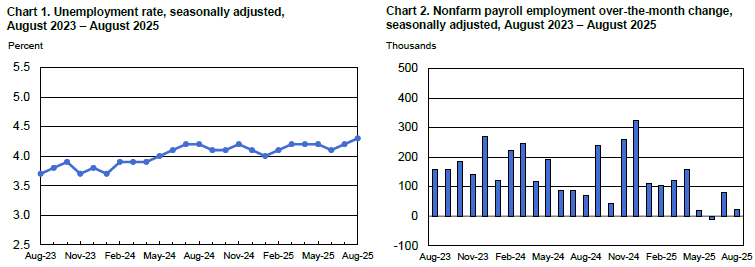
- Nonfarm Payrolls: Increased by just 22,000 jobs in August, continuing a trend of minimal growth since April.
- Unemployment Rate: Rose slightly to 4.3% (its highest level since 2021), up from 4.2% in July.
- Long-Term Unemployment: Held steady at 1.9 million, now accounting for 25.7% of all unemployed individuals.
- Labor Force Participation: Remained unchanged at 62.3%, continuing a gradual decline over the past year.
- Employment-Population Ratio: Also unchanged at 59.6%.
Sector Highlights
Gains:
- Health Care: Added 31,000 jobs, below the 12-month average of 42,000.
- Growth seen in ambulatory services, nursing/residential care, and hospitals.
- Social Assistance: Up by 16,000 jobs, mainly in individual and family services.
Losses:
- Federal Government: Down 15,000 jobs in August; 97,000 lost since January.
- Mining, Quarrying, Oil & Gas: Declined by 6,000 jobs.
- Wholesale Trade: Dropped 12,000 jobs; down 32,000 since May.
- Manufacturing: Fell by 12,000 jobs, with transportation equipment hit hardest due to strike activity.
Wages and Hours
- Average Hourly Earnings: Rose by $0.10 to $36.53 (+3.7% year-over-year).
- Average Weekly Hours: Held steady at 34.2 hours.
- Manufacturing Overtime: Unchanged at 2.9 hours.
Revisions to Previous Months
- June: Revised down from +14,000 to -13,000.
- July: Revised up from +73,000 to +79,000.
- Net Effect: Employment for June and July combined is 21,000 lower than previously reported.
Demographic Breakdown
- Unemployment Rates by Group:
- Adult Men: 4.1%
- Adult Women: 3.8%
- Teenagers: 13.9%
- Whites: 3.7%
- Blacks: 7.5%
- Asians: 3.6%
- Hispanics: 5.3%
- New Entrants: Fell by 199,000 to 786,000.
- Discouraged Workers: Steady at 514,000.
Alternative Measures of Labor Underutilization
- U-6 (Broadest Measure): Rose to 8.1%, includes unemployed, marginally attached workers, and those working part-time for economic reasons.
Upcoming Releases
- September Employment Report: Scheduled for release on October 3, 2025.
- Preliminary Benchmark Revision: To be published September 9, 2025, aligning survey data with unemployment insurance records.
To support vital journalism, access our archives and get unique features like our award-winning profiles, Book of Lists & Business-to-Business Directory, subscribe HERE!