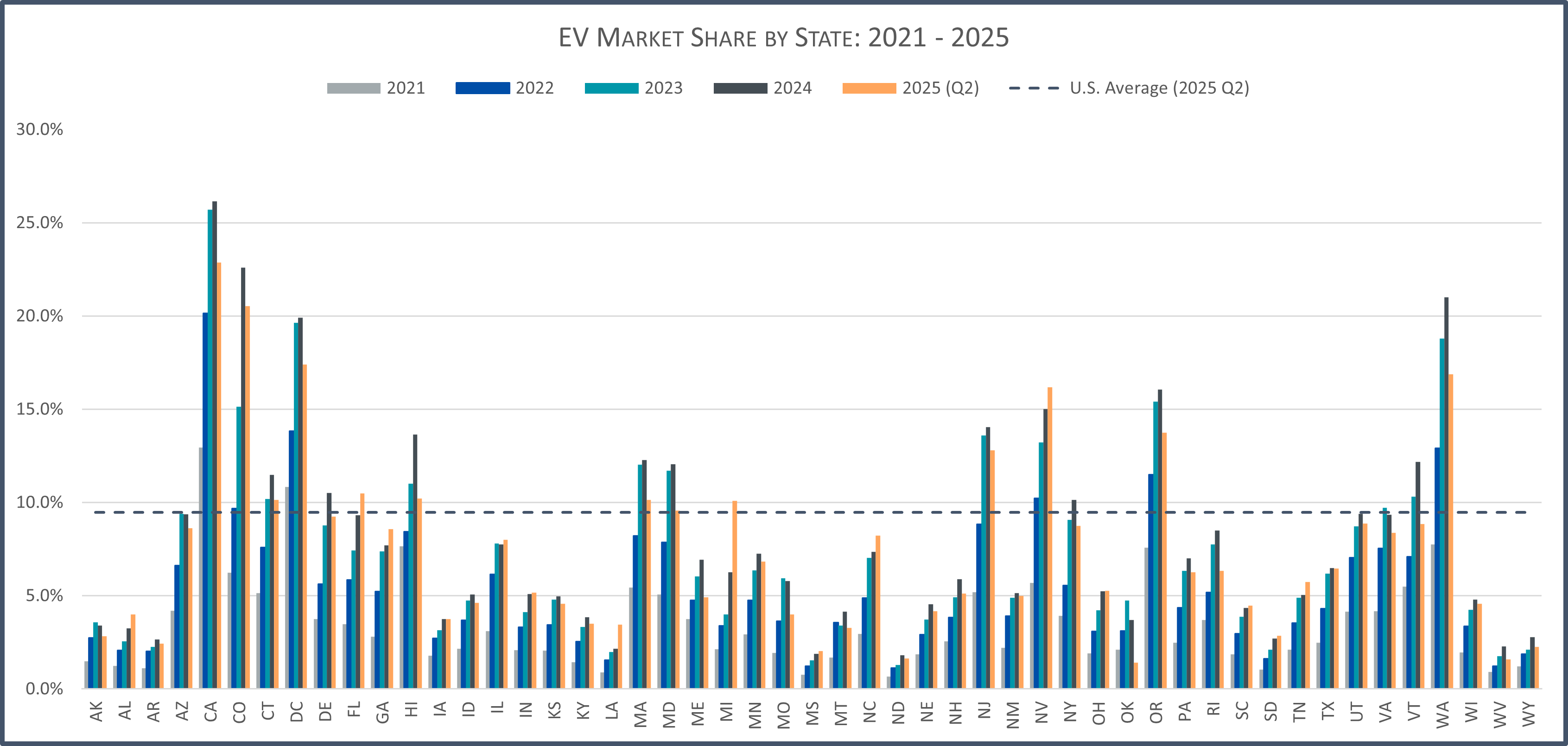
Vermont Business Magazine While Vermont ranks No. 16 in electric vehicle sales in market share by state, the state has slipped just below the US average in the 2025 second quarter. In Vermont EVs are 8.85% of new light-duty vehicle sales. The US average is 9.5%, as states like California, Colorado and Washington dominate the market. Vermont ranks No. 15 in ratio of EVs to public chargers. Alliance for Automotive Innovation released its exclusive state-by-state analysis of the U.S. electric vehicle market for Q2 2025. The Get Connected Electric Vehicle Report summarizes EV sales, purchasing trends and charging infrastructure across the country.
EV sales
Nationally: EVs represented 9.5 percent of new light-duty vehicle sales in Q2 2025 – down from 9.6 percent in Q1 2025 and down from 10 percent in Q2 2024.
- 155 electric car, utility vehicle, pickup truck and van models available for sale in the U.S. in Q2 2025.
Vermont: EVs represented 8.85 percent of new light-duty vehicle sales in Q2 2025 – down from 10.85 percent in Q1 2025 and down from 11.93 in Q2 2024.
- 844 EVs sold in Vermont in Q2 2025.
- Vermont ranks No. 16 in EV market share.
- EV market share was 0.60 percentage points below the national average of 9.5 percent.
Public EV charging
Nationally: At the end of Q2 2025, there were 6.5 million EVs on the road and a total of 217,929 publicly available charging outlets – a ratio of 30 EVs for every public port.
- This includes 57,599 DC Fast chargers – which can charge battery electric vehicles in as little as 20 minutes – with 3,783 added in Q2 2025.
Vermont: At the end of Q2 2025, there were 18,183 EVs on the road and 1,235 publicly available charging outlets – a ratio of 15 EVs for every public port.
- This includes 246 DC Fast chargers – with 6 added in Q2 2025.
- Vermont ranks No. 15 in the ratio of EVs to public chargers.
According to Drive Electric Vermont, between 2019 and 2024, the State of Vermont’s EV incentive programs helped Vermonters save thousands on the purchase or lease of new or used electric vehicles. Last fall, funding for these programs was fully expended, with over $11 million in incentives distributed to drivers across the state. No additional funds were appropriated during the 2025 legislative session, so state-funded EV incentives will not return this year. Shoppers are encouraged to explore EV incentives programs offered by their electric utilities. The federal EV incentives expired on September 30.
Alliance for Automotive Innovation’s Get Connected Electric Vehicle Report is released quarterly and is the most comprehensive state-level analysis of the U.S. EV market.
Sign up to receive Get Connected EV reports.
About Alliance for Automotive Innovation
From the manufacturers producing most vehicles sold in the U.S. to autonomous vehicle innovators to equipment suppliers, battery producers and semiconductor makers – Alliance for Automotive Innovation represents the full auto industry, a sector supporting 11 million American jobs and more than 5 percent of the economy. Active in Washington, D.C. and all 50 states, the association is committed to a cleaner, safer and smarter personal transportation future.
10.16.2025. WASHINGTON, DC – www.autosinnovate.org
To support vital journalism, access our archives and get unique features like our award-winning profiles, Book of Lists & Business-to-Business Directory, subscribe HERE!