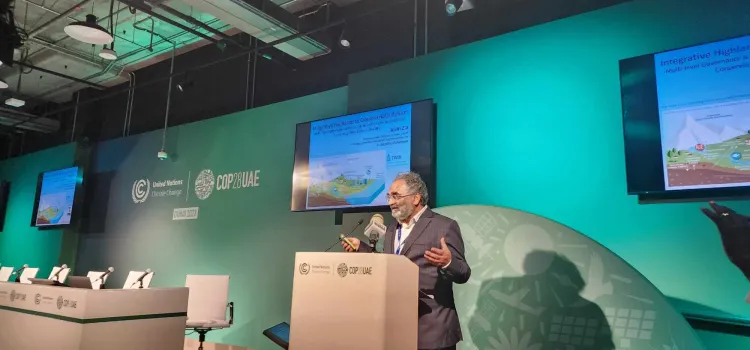
Dr. Asim Zia giving keynote at a sidepanel during COP29
Asim Zia will lead global AI panel in Brazil, while Jon Erickson speaks on regional climate solutions
Vermont Business Magazine Two University of Vermont (UVM) sustainability researchers—Asim Zia and Jon Erickson—will join the United Nations Climate Change Conference (COP30) in Belém, Brazil. Several scientists from across UVM will also attend virtually from the Green Mountain State with “observer status.”
Asim Zia, of UVM’s College of Agriculture and Life Sciences, is organizing a high-profile panel focused on the intersection of artificial intelligence and climate. Jon Erickson of UVM’s Rubenstein School of Environment and Natural Resources will speak about ecological economics, with a focus on regional climate solutions. Both are fellows of UVM’s Gund Institute for Environment.
Zia will outline how AI-enabled technologies—such as early warning systems, precision agriculture, and climate diplomacy tools—can support global and local efforts to build climate resilience. The event brings together international experts and government officials.
Zia’s panel is an official UNFCCC side event and part of the UN’s Green Digital Action initiative. The event, “Leveraging AI-Augmented Digital Technologies for Climate Security, Adaptation and Mitigation,” is on Saturday, November 15, from 18:30 to 20:00 (BRT) (Side Event Room 5). It will be livestreamed on the UNFCCC YouTube channel.
Zia, who has led over $70M in research projects, directs UVM’s Institute for Environmental Diplomacy and Security and co-directs the Social Ecological Gaming and Simulation Lab. The AI event is co-organized by UVM in partnership with the United Nations Environment Programme, Cornell University, Environmental Peacebuilding, and official COP delegations, including Pakistan and Armenia.
At COP, Erickson will explore state and regional climate leadership, including ways to create and strengthen climate-resilient regional economies. He notes that Vermont is part of the US Climate Alliance—a group of 24 states representing 55% of US population and 60% of US economy. Collectively, these states have reduced GHG emissions by 24% below 2005 levels while increasing collective GDP by 34%, he adds. Erickson is tracking areas of progress—and lack thereof—since the landmark Paris Agreement ten years ago.
“This is a proud moment for Vermont,” said Zia. “UVM is not only contributing cutting-edge research but is also leading a global conversation on how AI innovation can accelerate climate action and improve our resilience.”
Dr. Zia will open the session with an overview of how AI-enabled technologies—such as early warning systems, precision agriculture, and climate diplomacy tools—can support global and local efforts to build climate resilience. The event brings together a diverse group of international experts and government officials, including:
- Dr. Musadik Masood Malik, Federal Minister for Climate Change, Pakistan (Keynote)
- Sally Golestan, Chief Digital Officer, UNEP (Keynote)
- Dr. Allison M. Chatchyan, Cornell University, AI-LEAF Institute & Armenian Delegation
- Dr. Yiqi Luo, Liberty Hyde Bailey Professor, Cornell University
- Dr. Maaz Gardezi, Virginia Tech, expert in Responsible AI and Precision Agriculture
- Ms. Aisha Humera Moriani, Federal Secretary, Ministry for Climate Change, Pakistan
- Ms. Nona Budoyan, Ministry of Environment, Armenia

Zia’s research spans computational policy analysis, governance networks, social ecological systems, sustainable development, food, energy and water systems. This week the impact of his career was acknowledged when he was selected for induction in the National Academy of Public Administration. His leadership at COP30 reflects Vermont and UVM’s growing role in shaping international climate policy.
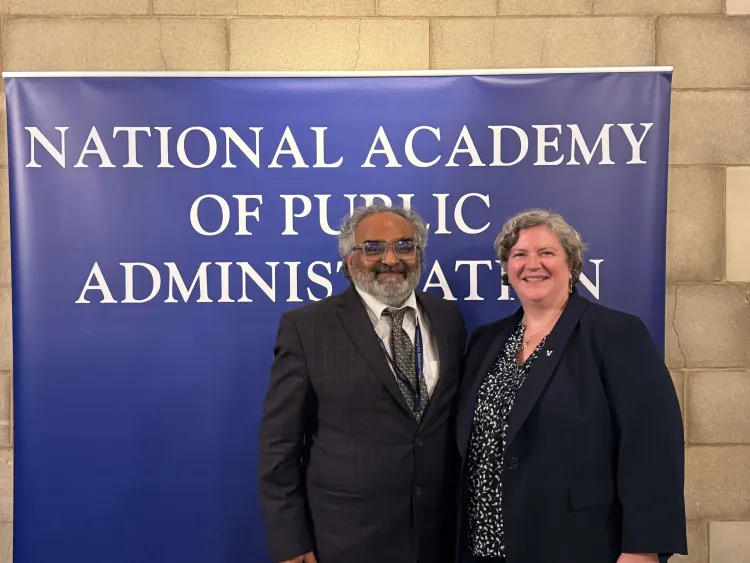
Dr. Zia with CALS dean Linda Prokopy at the NAPA Fellow Induction Ceremony in Washington, DC in November 2025.
About UVM: For People and Planet
Founded in 1791, UVM is the leading public university where discovery, creativity, community, and action coalesce to secure a thriving future for people and planet. Recognized among the nation’s top R1 research institutions, Vermont’s land-grant university attracts $260 million annually for groundbreaking research and enrolls approximately 14,000 students from 50 states and 75 countries. At UVM, students, faculty, and staff work together in pursuit of a healthier, greener future.
11.12.205. uvm.edu.
To support vital journalism, access our archives and get unique features like our award-winning profiles, Book of Lists & Business-to-Business Directory, subscribe HERE!