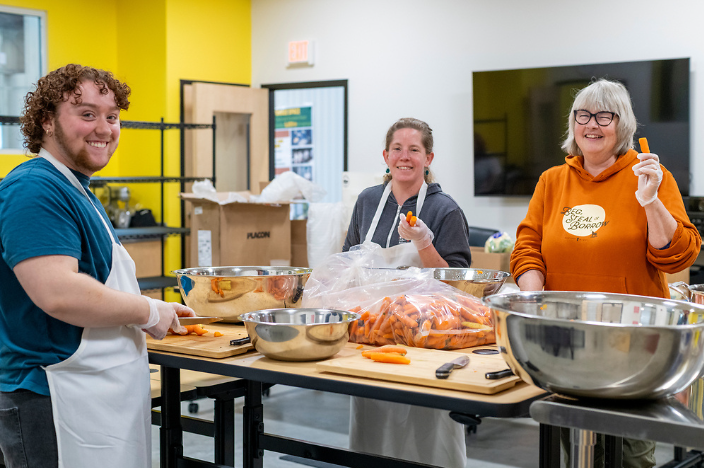
Community members from local businesses and nonprofits gather in the Community Room at the Center for an Agricultural Economy's Food Hub to cook soup to help fill the gap in the loss of SNAP benefits. Left to Right: Calder Camardello, Front Seat Coffee; Martha Machia, Salvation Farms; Bethany Dunbar, Center for an Agricultural Economy. | Photo by Kelly Bogel Stokes.
Vermont Business Magazine On Friday afternoon October 31, Buffalo Mountain Market’s general manager, Emily Hershberger, reached out to a group of community leaders to see how they could work together to help fill the need for food left by the freeze of SNAP benefits. Hardwick Area Food Pantry (HAFP) Director, Stella James, said that fresh soups and stews in to-go containers ready for families and individuals would be the most helpful offering. From there a team quickly mobilized: by Saturday, the team at the Center for an Agricultural Economy (CAE), had secured donations of local meat from Snug Valley Farm and Saw Mill Brook Farm; on Monday, there was a plan and CAE’s Human Advocacy Director, Kate O’Neil, took point on coordinating logistics; and on Wednesday, a team of volunteers and staff members from those convening organizations and businesses were working in the Community Room at the Food Hub in Hardwick, making gallons of soup.
In a true “stone soup” style, where everyone brings an ingredient they have to make a huge soup, local businesses and nonprofits stepped up sharing what they had available. Front Seat Coffee owner, Tobin Porter, donated food, supplies, and equipment. CAE’s Community Program Manager, Bethany Dunbar, can’t over-emphasize the generosity: “I went over to Front Seat and had to make three trips back to the car to get all the stuff that Tobin donated or lent us.” Pete’s Greens donated carrots and vegetables; Salvation Farms came up with gleaned vegetables and extras from their freezer. Almost everything for the project - from ingredients to containers - was donated.
The Hardwick area has a decades-long history of community organizing, which has gotten stronger in recent years through intentional collaborations. “In my mind whether it’s this or something in the future, the more we work on these networks, the more we have them during challenging times” says Emily. Examples of neighbors coming together in solidarity to support each other include programs like Everyone Eats; a resurgence of the Hardwick community meals during the pandemic; the formation of the mutual aid group, Hardwick Neighbor to Neighbor; and community support through the floods of 2023 and 2024.
Buffalo Mountain Market Cafe Manager, Jessie Ziegler, took the lead on planning the soups. She started with the donations they had and worked backwards to figure out what they would make. Jessie laid out all of the donations on the table and sorted them into soups. “That was the planning phase,” Jessie said, “and it is how I work at the co-op as well.” Bethany added, “We are so lucky to have Jessie because she said ‘we are going to do this and this and this’ and it’s perfect.“ Buffalo Mountain Market has a long history of feeding the community beyond operating a grocery store. Bethany mused, “It's so great that the co-op was leading the charge because 30 years ago Robin Cappuccino, at the co-op, would make soup from whatever was around for free for the community. He was instrumental in the early days of the community meal, which still happens at the United Church in Hardwick.”
The Community Room at the Center For an Agricultural Economy’s new Food Hub, finished this June, was created with activities like this in mind. The multipurpose room was designed with a robust home kitchen in order to host CAE’s and the HAFP’s Grow Your Own Classes, meals, and more. The idea was for it to be a flexible space to support the community, and as Bethany puts it, “This is exactly what we hoped this room would be used for.” Salvation Farms’ Vermont Commodity Manager, Martha Machia, jumped at the opportunity to cook in the new facility: “I get to work in that kitchen? I was so excited…[especially by the] brand new knives and cutting boards.“ Jessie agreed, and added her appreciation, “Thank you to all the people who have built this kind of infrastructure for the community.”
On November 5, the first day of soup making, a team of six people made 50 quarts of beef stew and 40 quarts of squash soup. 60 quarts of lentil soup were started, and chili, carrot soup, and hamburger soup were made later in the week. CAE’s Meryl Friets, Farm Connex Logistic Manager, and CAE’s Farm Connex team are storing the soups in the Food Hub walk-in coolers and providing logistics support. By the end of the day on Thursday, the team had made, packaged and labelled 354 quarts of soup.
Hill Farmstead Brewery also jumped in with a contribution that supports this round of soup making and another in the future. On Thursday and Friday November 6 and 7, soup was distributed through the Hardwick Area Food Pantries, and the team is working to have them available at other pantries throughout the area. The team will keep making soup as long as there are ingredients. Stay tuned for more details as it all comes together. The group doesn’t know exactly what kind of help they need yet, but they will need help! If you want to donate food, time, or money, email [email protected] to coordinate.
To support vital journalism, access our archives and get unique features like our award-winning profiles, Book of Lists & Business-to-Business Directory, subscribe HERE!