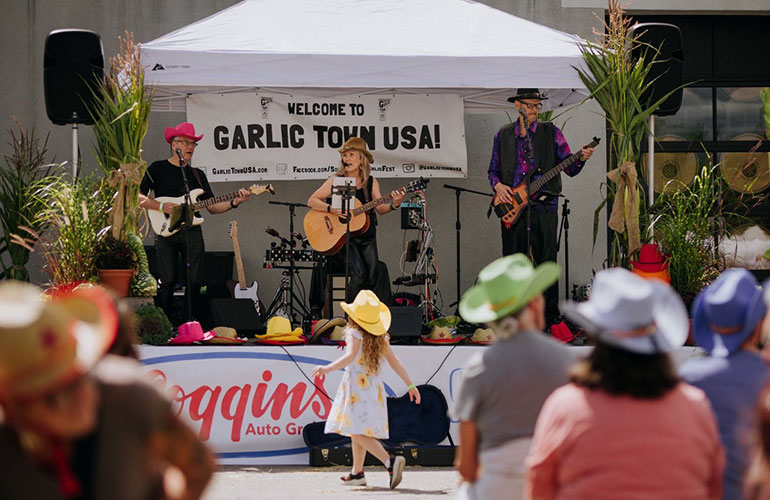
Photo: More than 6,500 people gathered in downtown Bennington over the Labor Day weekend for Garlic Town USA’s 30th anniversary celebration. The event featured live music, more than 100 curated vendors, chef demonstrations and more. SWVT Chamber photo.
by Timothy McQuiston, Vermont Business Magazine
In September, the Southwestern Vermont Chamber released its ”State of the Commerce” economic survey, revealing a blend of realism and resilience among over 100 businesses and organizations across various sectors and communities.
Matt Harrington, the chamber’s executive director, emphasized the value of this feedback as a critical tool for data-driven decisions, enabling the organization to focus its energy on supporting the business community through current economic challenges and changes.
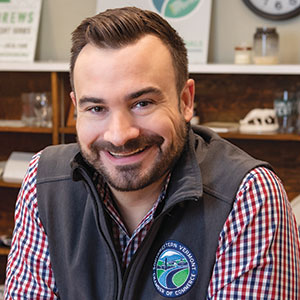
Photo: Matt Harrington, Executive Director of the Southwestern Vermont Chamber. Baldwin Photography.
Bennington County is unique in Vermont for its two distinct economic regions: the North Shire, centered around tourism in Manchester, and the larger South Shire, which represents a more traditional economy in Bennington. The South Shire’s economy is anchored by institutions like Southwestern Vermont Medical Center and Bennington College, alongside manufacturing companies such as NSK Steering Systems America. In contrast, the North Shire is known for its country inns, The Equinox and Orvis, as well as manufacturers like Mack Molding in Arlington and the diversified lumber company r.k. Miles.
But business often is just business.
Woodworker JK Adams was acquired last month by John Boos & Co, which does similar work from its headquarters in Illinois. Boos & Co. will retain the JK Adams’ headquarters and staff in Dorset, Vermont, where the company has operated since 1944. The two companies will continue to operate independently, while expanding Boos & Co.’s U.S. footprint, along with maintaining its headquarters in Effingham, Illinois, where it has been located since 1887.
”As a family-owned business, we have been searching for someone who shares our interest in U.S.-made, quality wood products, as well as a track record of supporting U.S. manufacturers to guide JK Adams into the next generation,” said company owner Malcolm Cooper Jr. ”John Boos & Co. has an appreciation of Vermont and is committed to growth in South Dorset.”
Business is a moving target, and change is expected.
At Bennington College, President Laura Walker is stepping down at the end of this year. At Southwestern Vermont Medical Center, regulators are requiring the regional hospital to tighten its already tight belt. At the same time, the hospital has gone through a successful fundraising campaign to open a new cancer center.
Meanwhile, the former Bennington High School is being converted to a mixed-use residential and commercial development under a public-private initiative projected to cost approximately $54 million. The Benn Hi redevelopment, as it is currently known, will increase the supply and quality of housing by creating 17 perpetually affordable housing units and 22 additional market-rate units; improve the quality of life by investing in a public facility that houses the town’s senior center; and include a recreation center with wellness programs and a child care center. The plan includes 27,000 square feet of municipal and community space, 70,000 square feet of residential space and 3,000 square feet of office space.
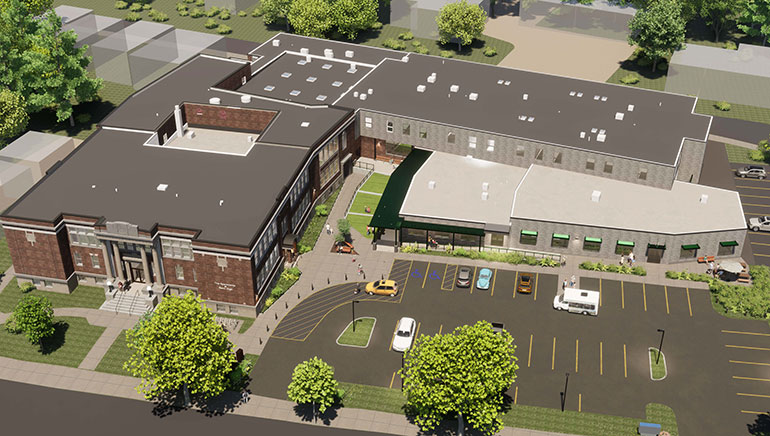
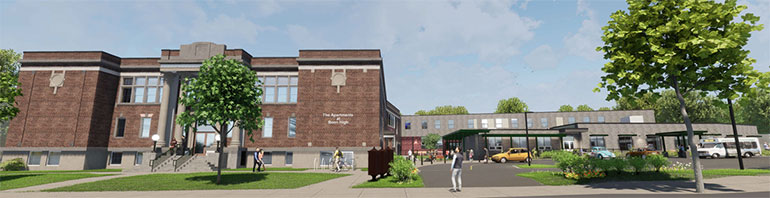
Photos: Rendering of the Bennington High School redevelopment. Courtesy photos.
In Manchester Center, DEW Construction Corp. is nearing completion of the town’s first brewery, Lost Marble Brewing Co. The 9,725-square-foot facility, designed by BMA Architects & Planners, will house a state-of-the-art 10-barrel brewing system, an open-concept commercial kitchen with a pizza oven and a mezzanine-level meeting room.
The chamber’s survey seeks to identify the ebbs and flows of these changes as well as strengths and weaknesses in the local economy.
Survey respondents cited these top challenges:
- Rising costs: mentioned by 24% of respondents.
- Recruiting and retaining workers: 19%
- Marketing and gaining customers: 17%
- Employee costs (health care, benefits, insurance): 11%
- Financial limitations: 10%
- Tariffs: 3%
”What strikes me most about this year’s survey,” Harrington said, ”is the mix of realism and resilience. Yes, rising costs and staffing remain front and center, but optimism about our region and state is still strong — nearly nine in 10 say Vermont is a good place to do business. That tells me there’s confidence in our long-term potential. At the Chamber, we take seriously the call for better destination marketing, stronger connectivity and access to capital and training. These are the levers that can unlock growth, attract new talent and ensure that even in uncertain times, southwestern Vermont remains a place where businesses and communities thrive.”
Other concerns revealed by the survey included start-up growing pains, housing for staff, competition, Act 250 and local permitting, supply chain, technology, climate change and lack of vendors/suppliers. No respondents selected jobs for spouses, globalization, remote work, cybersecurity or rent/space costs as their top challenge.
Looking ahead 12–18 months, respondents identified managing economic uncertainty such as inflation or recession (24%) as the greatest anticipated challenge. Staffing (16%), growing customer or donor bases (11%), and fatigue/burnout alongside financial stability (8% each) followed closely.
When asked to grade their organization’s health (A=excellent, F=closure imminent), 64% of respondents reported a grade of B (successful) to A (excellent), a decrease from 70% last year. The remaining 33% reported B-minus (temporarily successful) to D (not doing well), an increase of 3% from the previous year. Three percent gave themselves a D-minus (fear of closure), with no respondents indicating imminent closure (F).
A significant portion, 40%, of businesses reported improved financial performance compared to a year ago, while 32% saw a decline and 27% remained stable. Over a five-year span (since 2020), more than half (53%) of organizations felt they were performing better, with 22% reporting a decline and 18% remaining consistent. Eight percent were not established five years ago.
A strong 90% of respondents believe southwestern Vermont is a good place to operate a business. This is a 3% increase from last year but slightly down from 94% in 2023. For Vermont as a whole, 89% of respondents found it a good place to do business, a significant 19% rise compared to the previous year.
In the next three years, a majority of respondents remain optimistic about southwestern Vermont (75% anticipate improvement, down 2 points from last year) and Vermont overall (69% expect improvement, with 31% expecting a decline).
However, there’s a rising trend in business closures or retirements, with 12% planning to do so within 1–3 years, a 5% increase from 2024.
Two significant needs emerged: 39% of businesses in southwestern Vermont are seeking more marketing assistance, a concern that stands out compared to other regions, possibly indicating a slowdown after recent growth. Furthermore, 27% highlighted the ongoing need for improved cell service, a widely acknowledged issue throughout Vermont.
Bennington County Regional Commission
Jonathan Cooper, community and economic development program manager at the Bennington County Regional Commission, echoed respondents’ optimistic outlook for the near future.
”The county is in a period of significant project development, with investments meeting evolving needs for residential, community, cultural, commercial, and civic space, Cooper said. ”2026 is shaping up to be a banner year as projects currently underway reach completion. For many of us in the community and economic development space, the first phase of the Putnam Block redevelopment (downtown Bennington) seemed about as complex as a project could get in Vermont. But a number of ongoing projects are engaging with significant complexity in logistics, in funding and in partnerships.
”It’s a relief to say that Bennington County is not just home to complex projects,” he added, ”it is home to people who can solve the problems that complex projects bring.”
Cooper noted a vibrant period of civic and cultural development in southwestern Vermont, impacting several communities.
Dorset, for instance, is managing a ”good problem” stemming from a substantial land gift on Raptor Lane, which is prompting plans for new town offices and housing alongside public engagement. Shaftsbury has successfully used ARPA funds to build a municipal office and breathe new life into Cole Hall. Pownal is focused on securing federal funding for a new fire station.
In Manchester, cultural expansion is evident with a $14 million gallery addition at the Southern Vermont Arts Center and the anticipated launch of Lost Marble Brewing Co., in addition to ongoing efforts to redevelop key properties.”
In Old Bennington, two historic acquisitions — the Walloomsac Inn and a former seminary — are being redeveloped by a firm with ties to Bennington College.
Bennington itself is undergoing major transformations, including the Bradford Mill housing conversion, the second phase of the Putnam Block project and the previously mentioned Bennington High School redevelopment, known as Benn Hi.
Plans are also underway to turn the former Southern Vermont College into a luxury hospitality destination and redevelop the Energizer facility into housing and community space. A new skatepark opened downtown, reflecting strong public engagement. Despite economic challenges, local businesses remain optimistic.
The year also marked the passing of Bennington Town Manager Stuart Hurd, Cooper noted, who held that post for 30 years and served the community for 50.
Town of Dorset
Dorset Town Manager Rob Gaiotti articulated a common sentiment that Vermont officials do not adequately address Bennington County’s economic indicators, which are below state averages, in the same way they do for other regions of the state.
”Like much of rural Vermont, you can’t get very far into a discussion about the local economy without talking about housing,” he said.
Supporting this, Bennington County’s August 2025 unemployment rate (3.0%) is higher than the state average (2.6%).
”Our region’s economy is driven in large part by tourism and real estate (and the service industry that goes along with real estate),” he said. ”In northern Bennington County, we are fortunate to have access to great local elementary schools as well as independent schools like Burr & Burton and Long Trail School for 9-12.”
Gaiotti highlighted the dramatic shift in the housing market post-COVID.
”Prior to COVID and the large-scale changes to rural real estate, tourism and our schools sold most of the homes,” he said. ”After COVID, the housing inventory on the market has dropped by 60% to 75%, at the same time values have increased significantly.”
In response to these challenges, Dorset is proactively tackling housing shortages with initiatives for workforce and senior housing. The town is developing land near the Town Forest to create a blend of market-rate and affordable units for working families and downsizing seniors, offering access to outdoor trails.
Dorset intends to utilize market forces and the CHIP program to facilitate development, which will benefit major employers like Orvis and local schools. Complementing these efforts, a new marketing website promotes community life, and local businesses and cultural institutions — such as the Dorset Theatre Festival and Southern Vermont Horse Show — continue to flourish, solidifying Dorset’s position as a dynamic and economically active community.”
Town of Bennington
Bennington has had several recent successes that show the town is on a positive trajectory, said Shannon Barsotti, director of community development for the town of Bennington.
”There has been tremendous public and private investment in the redevelopment of Bennington High School and construction is in progress on 39 new housing units, community recreation space and a child care center in the building. The town recently completed a new skatepark and the expansion of our bike/pedestrian pathway system is underway with a connection from downtown Bennington to North Bennington.
”We also have historic properties such as the Holden-Leonard Mill, Bradford Mill, the Walloomsac Inn, the Energizer facility and the Everett Estate (former Southern Vermont College) that have been purchased or are under contract and are being redeveloped. National and regional chain stores such as Marshalls, Harbor Freight, Chipotle, Starbucks, Burger King, and Hoffman Car Wash have all recently opened new stores in Bennington.
”Local businesses and developers still face challenges with an uncertain economy, a burdensome regulatory environment and a shortage of workers and worker housing, and there are challenges ahead in the health care sector.
”We have had strong leadership under Tom Dee at Southern Vermont Medical Center and the merger with Dartmouth Health, beautiful new additions to the hospital and many awards for patient care are examples of how Bennington is fortunate to have such an exemplary health care system in our community.
”The town, and my work in particular, is focused on smart growth and new housing developments centered around our historic downtown, as well as outdoor recreation improvements. We want to promote Bennington as a great place to live and do business, as well as a wonderful place to visit. The planned resort at the Everett Estate will be a huge boost to tourism in Bennington, and the upcoming American 250th events in 2026 and the Battle of Bennington 250th in 2027 will also be reasons to visit and celebrate Bennington.”
Southwestern Vermont Medical Center
Thanks to its partnership with and membership in Dartmouth Health, Southwestern Vermont Medical Center continued to expand its scope of services in 2025 and treat more complex patients.
”Overall, our goal is to reduce the need for Vermonters to travel out of state to facilities in New York, Massachusetts and New Hampshire, where health care is more expensive than at SVMC,” said SVMC President and CEO Tom Dee. ”This, in turn, lowers the cost of care for all Vermonters. We will continue to pursue critical expansions in 2026, in areas like primary care, surgery services, oncology, mental health, cardiology and vascular care.”
Projects include the $21 million Hoyt-Hunter Center for Oncology Care and renovations for an approximate $10 million, 7,000-square-foot in-patient mental health unit to serve up to 12 teen patients.
”SVMC, like hospitals across the country, is challenged by a multitude of factors,” Dee said. ”We have been proactively preparing to meet these challenges and those which are unique to our region and state. At the state level, we have been working diligently to do our part to address the rising health care costs that impact individuals and businesses in Vermont.
”Our patients remain at the forefront of all our decisions. SVMC has served this community for more than 100 years, and we are committed to keeping it strong through the next century of caring.”
The Vermont regulatory Green Mountain Care Board in September cut SVMC’s net patient revenue request by 1.5% to $214.7 million. The Bennington hospital fared better than most, as the state hospital system overall was cut by $94.6 million, or 2.5%.
Mack Molding Co., Arlington
This has been a pivotal year for Mack Molding, marked by the first full year of leadership under Mack North President Josh Pang, said Larry Hovish, the company’s director of marketing and communications. The business pipeline remains strong, with growing interest from both existing customers and new prospects seeking U.S. manufacturing partners.
”To support this momentum, Mack made more than $3 million in new equipment investments over the past year, including the largest press purchase by volume in more than 25 years,” Hovish said. ”In Vermont, Cavendish installed 1100-ton and 500-ton hybrid Milacron presses, while East Arlington added a 500-ton press and replaced older models with 950-ton and 1500-ton units.”
These additions expand capacity and automation, improving efficiency, precision and energy use while strengthening Mack’s ability to deliver large, complex parts for medical, industrial and transportation customers.
”We are also growing our team, with opportunities across manufacturing, engineering, and professional roles,” he said. ”Just as important as adding new talent is continuing to invest in the people who are already here. Mack is expanding training in leadership, technical skills, and advanced manufacturing, while also fostering a culture that values collaboration, community and employee well-being.
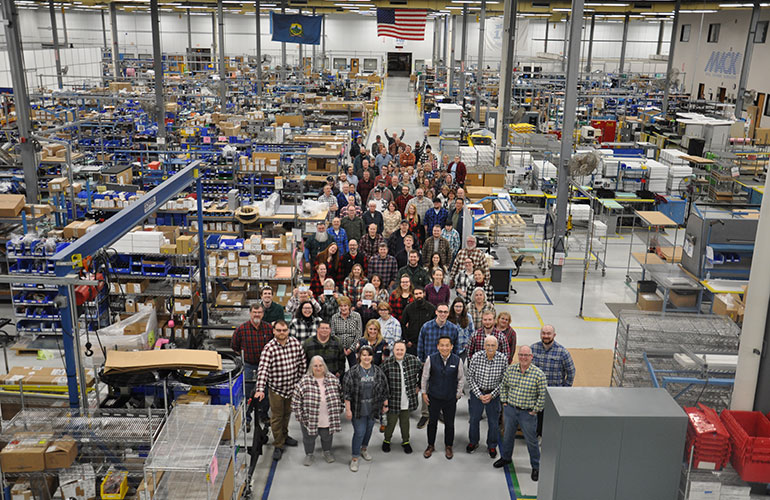
Photo: Mack Molding team members at the company’s headquarters in Arlington take part in Flannel Friday, one of several engagement activities held across the company’s three Vermont facilities. Courtesy photo.
Like many manufacturers, Mack is watching the evolving tariff landscape closely, Hovish noted.
”While tariffs are putting pressure on raw material and component costs, the company’s vertically integrated operations and strong domestic sourcing position us well to manage those impacts,” he said. ”Given the size, complexity and proximity requirements of the products we make, Mack has long been a natural choice for companies looking to manufacture stateside — a trend we see accelerating.”
Looking ahead, Mack expects continued growth in 2026 as it leverages it people, facilities and new technology to meet customer demand.
”With increased capacity and an engaged team, we are ready to turn today’s challenges into tomorrow’s opportunities for Vermont manufacturing,” Hovish said.
Mack is the ninth largest firm in Vermont, according to VermontBiz, with revenues of $601 million and 600 employees.
Bennington College
One of the anchors of the local economy is Bennington College. Like the hospital, the college is facing a tightening budget that required a reduction in staff of 15 positions, out of about 300 and a budget of $50 million.
Laura Walker, who formerly was CEO of New York Public Radio WNYC, has been president of the college since 2020. She is stepping down at the end of this fall semester and an interim president will be appointed until a permanent president is hired.
”First, I want to say how much of our historic and current successes owe to our location,” she said. ”Vermont is defined by its rural economies, and we’re lucky to benefit from state and local leadership who really understand and support the role of the small college here. The state’s beauty, safety, and culture is what draws students to Bennington; the vibrant small communities are what keep them here.”
”And that’s really our first and most important success: Bennington College is attracting great students. We graduated our largest graduating class ever in 2025. We broke our record for early admissions applications in 2025, and we have the lowest acceptance rate in years: 37%. Our incoming class, the class of 2029, is strong and diverse. Students hail from 32 states and 25 countries. Twenty-two percent are domestic students of color, and 29% are Pell-eligible students.
”We continue to hit high marks academically: We have the No. 3 theater program in the country, according to The Princeton Review, and we are ranked No. #11 for Best Classroom Experience nationwide. In fact, Bennington College breaks the top 10 in the nation for several Princeton Review lists, including Most Beautiful Campus (#3), Most Politically Active Students (#3) and most LGBTQ-Friendly (#5).
”Meanwhile, we continue to expand key offerings. The students who transferred from University of the Arts in Philadelphia had a great first year. And we have launched new graduate programs in clinical mental health counsel. Just recently, we launched an MFA in screenwriting.
”Of course, this year hasn’t been without challenges, most of which are the same financial issues other colleges are seeing. The rising costs of health insurance, food, fuel and other needs, and broad, national economic uncertainty required us to make targeted layoffs over the summer. That was a very unfortunate last resort to achieve a sustainable budget. Now, we are continually looking for ways to save that do not affect the academic or student experience.”
To support vital journalism, access our archives and get unique features like our award-winning profiles, Book of Lists & Business-to-Business Directory, subscribe HERE!