
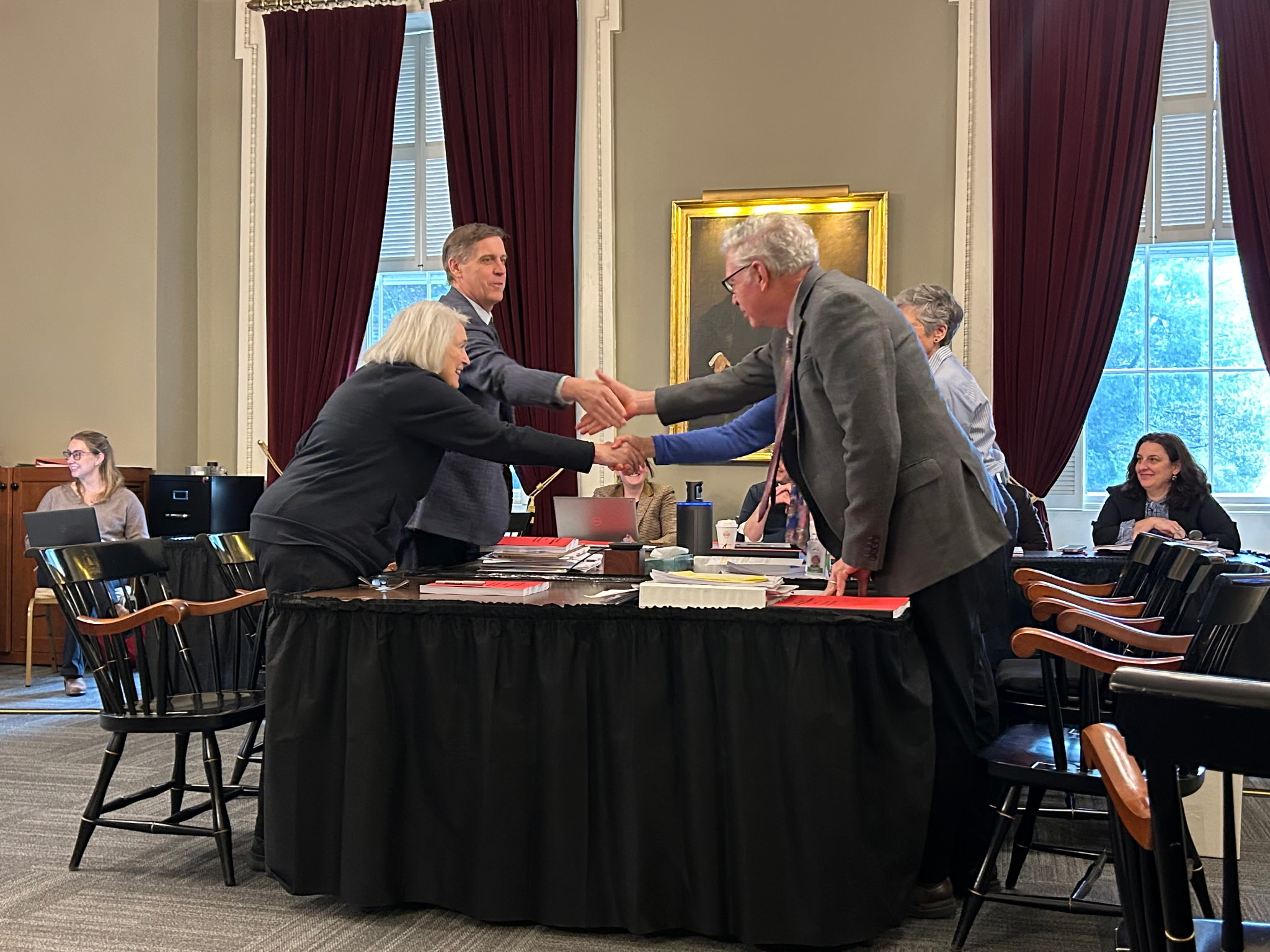
Chair of the Senate Appropriations Committee, Andrew Perchlik, dressed as Father Winter.
A Weekly State House Recap
by Maggie Lenz and Nick Charyk on behalf of Atlas Government Affairs
“Dear Andy”
The FY26 budget, known as the Big Bill, is usually the final domino to fall before adjournment. Passing the budget signals the end of negotiations, funds the state, and sends weary lawmakers home. On Friday afternoon, budget conferees finalized and signed off on a nearly nine billion dollar spending package, which now heads to the House and Senate floors for final debate and votes early next week. After that, it goes to the Governor.
This year, the Big Bill is doing more than usual. Earlier this session, a standoff between the Legislature and the Governor over the midyear Budget Adjustment Act, which normally serves to tweak the current year’s spending, resulted in two vetoes. Rather than continue the stalemate, lawmakers folded those adjustments into the FY26 budget itself. That means there's real urgency around these items that should have been approved many months ago.
The budget includes significant amounts for urgent programs, including funding to extend the motel voucher program and expand shelter capacity, maintain expanded child care subsidies, and address toxic PCBs in school buildings. It also allocates funding for bridge assistance to the state college system, clean water infrastructure projects, and sets aside contingency reserves to soften the blow if Congress cuts back on key funding. This is a serious budget, shaped by the disappearance of federal pandemic aid and a growing sense of financial uncertainty in Trump’s America.
That uncertainty must have made this a particularly challenging year to chair the Appropriations Committees. And it just so happened to be Senator Andrew Perchlik’s (D/P-Washington) first year in the role. He stepped into the position following the retirement of longtime chair Senator Jane Kitchel whose “Dear Jane” letters, (memos submitted to the powerful appropriations chairwoman by state agencies and legislative committees asking for money) became a budget season institution. The “Dear Andy” term has not caught on yet, but folks are working on it. He has time.
By all accounts, Senator Perchlik has done a remarkable job steering the committee through a tough year. Between the loss of one-time money, a doom and gloom federal forecast, and pressure to respond to real on-the-ground needs, this was not an easy time to step into leadership. But he kept the process moving, kept it grounded, and delivered a package that prepares Vermont for the road ahead.
Still, the budget’s passage will not mark the end of session this time around. The Legislature will remain in session while the House and Senate (and the Administration) try to hammer out a deal on education reform, the most complex and consequential policy debate in recent memory. It is a recipe for a major structural shift, with big implications for school funding, tax rates, and communities across the state. And it is likely the main obstacle standing between lawmakers and their summer plans. So yes, the Big Bill has begun its descent. But until the education bill lands, we ask that you please remain seated.
Paying the Price
For years, Vermont has been one of the few states to tax military pensions, treating retirement benefits income from military service the same as any other paycheck. That policy has survived over a dozen attempts at revision, even as almost every other state exempts some or all military retirement benefits. But this week, in a notable shift, the Vermont House brought the measure to the floor for a vote. In a 142–2 decision, lawmakers approved an exemption for military retirement pay.
Support for the change has been strong. A standalone House version of the bill, H.43, drew an impressive 72 cosponsors from across the political spectrum, coming just shy of a majority with the sponsors alone. Despite this, uncertainty remained until this week about whether House leadership would allow the measure to come to the floor for a vote.
About 4,000 veterans in Vermont could benefit directly from the tax break. Lt. Governor John Rodgers, a longtime advocate for the exemption, laid it out plainly in an op-ed in The Caledonian Record: “Taxing veterans is just wrong,” he wrote. “They’ve given so much for us, and asking them to give more through income taxes on their military retirement pay is an insult.” He also pointed out the real-world effect of that policy, saying, “I can’t count how many veterans I know who have chosen to leave Vermont for states that treat them with the respect they deserve.”
The proposal now heads to the Senate, where things get more complicated. The pension language was added to S.51, a bill originally titled An act relating to the Vermont unpaid caregiver tax credit. The House completely rewrote it to include the pension exemption, refundable credits, and a package of other tax changes. This means the Senate must vote on the bill again before it can proceed to the governor’s desk. They can either approve the changes outright or send the bill to a conference committee where members from both chambers will hash out their differences.
Sen. Ann Cummings (D-Washington), who chairs the Senate Finance Committee, has long questioned whether military pensions should be the only retirement income fully exempted from Vermont taxes. Speaking to Vermont Public, she said she’s open to the House’s approach but would not support it unless the final version includes a benefit for unpaid caregivers, which was the bill’s original focus. “If it doesn’t, I can’t support it,” she said. “We have to recognize all kinds of service, not just the ones that come with uniforms.”
Financially, the military pension piece is a smaller part of the picture. According to the Joint Fiscal Office, it represents only $2.5 million of the total $13.5 million cost of S.51. The Veterans Credit contributes an additional $1.4 million to that cost. The remainder of the funding supports various other measures that expand existing tax credits and exemptions. These include increasing the Vermont Child Tax Credit to cover children aged six and under, raising the Earned Income Tax Credit for childless claimants from 38 percent to 100 percent of the federal amount, and raising income thresholds for Social Security.
The bill represents a convergence of interests from a broad coalition, including members from both chambers. Newly elected Sen. Joe Major (D-Windsor), a military veteran, is helping to lead the push publicly for the exemption, including co-authoring an op-ed alongside Rep. Lisa Hango (R-Berkshire) and Rep. Laura Sibilia (I-Dover). “This is not a partisan issue. It’s about doing right by our veterans and their families,” they wrote. “Let’s honor their service with action, not just words. Our veterans have done their part. Now it’s time for us to do ours.”
After years of discussion, the issue is now moving closer to becoming law, no longer stalled in committee. This is a significant step forward for a policy with widespread support that has often found itself bogged down in Vermont's political machinations.
Curiosities: a weekly peek at the odd and intriguing happenings under the Golden Dome
Spring Fever
Every year toward the end of April, the same question echoes through the State House like a toddler in the back seat: Are we there yet? “There”, of course, means adjournment. And like any road trip worth its salt, the answer is usually: “Almost”. Which, in State House time, can mean anywhere from three hours to two months. There is no law or statute that requires the Legislature to finish by a certain day. Adjournment is determined by a resolution passed by both chambers. They cannot even take a long weekend without agreeing to the terms, as their fates are tied together through adjournment. Leadership often targets mid-May, but it is far more aspirational than it is scientific.
Each day the legislature stays in session costs Vermont taxpayers money. With 180 members, staff, and building operations, the daily cost of staying in session can exceed $50,000. Leadership is keenly aware of these costs and the associated optics. The price tag remains a major consideration for adjournment date.
And then there is the heat. The State House has no air conditioning. Or if it does, it is a well kept secret. By May, the building bakes. The tiny committee rooms trap warm air as they are packed with humans. It’s like the most stressful spa you could ever imagine. Lawmakers are allowed to remove their coats eventually, but it doesn’t do much. Everyone looks damp and upset. Paper sticks to forearms. There is a specific kind of despair that comes from trying to pass amendments and play politics while everyone is sweating through their suits and staring longingly out the cafeteria windows into the beckoning sunshine and green lushness of Hubbard Park.
Sometimes, the biggest roadblock between the Legislature and adjournment is the Governor. In 2018, lawmakers adjourned in May after a bruising standoff with Governor Scott over teacher health care. One week later, he called them back for a special session. What followed was weeks of budget ping-pong and veto threats, with everyone stuck in Montpelier long after their Montpelier leases were up. The final budget did not pass until the end of June.
Other times, it’s the House and Senate standing in each other's way. In 2019, the House and Senate collided over how and when to adjourn. The two chambers had spent months trying to deliver on Democratic priorities: a $15 minimum wage (Senate) and a statewide paid family and medical leave program (House). Negotiations broke down in the final days.
On the morning of what was supposed to be the last day of that infamous 2019 session, Speaker Mitzi Johnson sent Senate President Pro Tem Tim Ashe a letter declaring an impasse and giving him until noon to accept one of five compromises. Noon came and went. And Speaker Johnson, in a remarkable show of strength, demonstrated to the Senate that she wasn’t bluffing. The House gaveled out that afternoon without the Senate, passing the remaining bills on their calendar. They hugged each other goodbye in the well, and carried boxes of papers and tote bags out of the building and into their cars. From the Senate chamber, Senators watched out the windows, dumbfounded as the House packed it up and went home for the year. It was the first and only time in modern Vermont history that the House and Senate formally adjourned on separate days.
Other notable sessions and exits from Vermont’s legislative past:
- In April 1861, just days after the attack on Fort Sumter, Vermont’s Legislature convened in a special emergency session. In less than 48 hours, lawmakers authorized over $1 million dollars in war funding, twice what the governor had requested, and approved the rapid mobilization of troops. The session lasted only four days before adjourning, making it one of the most focused and efficient legislative turnarounds in state history.
- Four years later, in March 1865, the Legislature held another brief session. They convened on March 9 for the sole purpose of ratifying the Thirteenth Amendment to abolish slavery. The vote was unanimous, and they adjourned the same evening. The next day, Governor J. Gregory Smith sent a telegram to President Lincoln reporting Vermont’s action. It remains one of the clearest examples of a one-day session with a singular purpose and swift adjournment.
- After the 1869 session, lawmakers began meeting only once every two years. The 1870 Legislature adjourned knowing no regular session would happen the following year. This schedule lasted almost a century.
- In 1967, biennial sessions came to an end. After that year's adjournment, the Legislature reconvened in 1968, beginning Vermont's era of annual sessions. Adjournment would never again mean two years off.
- In 1994, a bruising second-year session dragged all the way to mid-June, which at the time was the longest continuous regular session in Vermont history. Budget fights and policy gridlock meant adjournment came only after lawmakers were utterly exhausted.
- In 2009, for the first time ever, the Legislature returned to override a budget veto. Governor Jim Douglas had rejected the FY2010 budget, and lawmakers reconvened in June to override him. It was the first budget veto in Vermont history. Adjournment is now viewed cautiously, more of an intermission than a final bow.
- In 2020, the session never really ended. COVID hit over the March Town Meeting Week break. The building shut down. Lawmakers passed an emergency budget, met remotely for months, and finally adjourned in late September. It was the longest session Vermont has ever had.
Even when the Legislature adjourns, it rarely says goodbye for long. Since the 1990s, the adjournment resolution has included a built-in return date for veto overrides. This year, it is set for June 16/17. It can be canceled, but in recent years, it rarely is. In 2023, they overrode six vetoes in a single day. Of course this biennium the veto sessions will not look like the last ones. Democrats still hold a majority, but it’s no longer a “supermajority” meaning that they cannot override the Governor’s veto without the help of republican colleagues.
So, are we there yet? Almost. Maybe. Ask again next week.

Rep. Jay Hooper, (D-Brookfield) at Positive Pie in Montpelier, ready to be done during the June 2023 Veto Override Session
To support vital journalism, access our archives and get unique features like our award-winning profiles, Book of Lists & Business-to-Business Directory, subscribe HERE!